Tag: grief

  • The Notes Between the Lines

    The Notes Between the Lines

    One Year Later: Malcolm-Jamal Warner, Miles Long, and the Art of Seeing a Person

    There is something strange about anniversaries.

    They do not ask permission before arriving.

    A year ago, Malcolm-Jamal Warner left this world.

    Like so many people, I first knew him as Theo, not as a character, exactly, but as someone who quietly occupied a corner of my life. Week after week, he reminded us that growing up was awkward, that mistakes did not have to define us, and that being a young Black man could include gentleness, humor, uncertainty, and love.

    He became familiar.

    And familiarity has a way of convincing us we know someone.

    I have thought about that a great deal over this past year.

    When he died, I did what many of us do now. I searched.

    Not because I wanted headlines. I wanted something closer to the man than the memories television had given me.

    That search led me somewhere I never expected.

    Apple Music.

    I typed his name.

    That is where I found Miles Long.

    At first I wondered if it could really be him. Then I pressed play.

    What I discovered wasn’t simply another creative pursuit from an actor I admired.

    It was another language.

    The music carried the warmth of the records that raised many of us. Soul. Jazz. Hip-hop. Spoken word. Music that wasn’t trying to chase trends because it understood something more important.

    Truth never goes out of style.

    The grooves were patient.

    The bass never hurried.

    The lyrics trusted you enough to meet them halfway.

    They sounded like conversations that begin after midnight, when people finally stop pretending they’re fine.

    Listening to those songs felt less like discovering a new artist than discovering a room in a house I thought I already knew.

    And that realization stayed with me.

    How many people have I admired while never truly seeing them?

    How many lives have I reduced to the role they played in my own story?

    We often say we should give people their flowers while they’re here.

    But flowers are not enough if we never walk through the garden.

    Malcolm-Jamal Warner was never just the young man who helped redefine television. He was a poet. A musician. A thinker. A man still asking questions about love, identity, fatherhood, justice, and becoming.

    His work was larger than the spotlight.

    Maybe that is the lesson I have carried this past year.

    Most of us are more than the thing the world applauds us for.

    The teacher paints.

    The mechanic writes poetry.

    The grandmother who makes the best cornbread also carries stories no one has bothered to ask about.

    The quiet man in the corner may have spent decades composing songs no one in the room has ever heard.

    We spend our lives introducing ourselves through occupations.

    But our souls rarely fit inside a job title.

    A year later, I still return to Miles Long.

    Not because grief demands it.

    Because gratitude does.

    Those songs remind me to slow down.

    To look again.

    Rest well, Malcolm.

    Thank you for reminding us that the most beautiful parts of a person are often the ones waiting just beyond what everyone already knows.

    Kyle J. Hayes

    kylehayesblog.com

    Please like, comment, and share

    Resources for Hard Times

    If you’re looking for practical help, food support, or community resources, you can visit the Salt, Ink & Soul Resources Page.
    👉 Resources for Hard Times

  • The Death of the Family Reunion

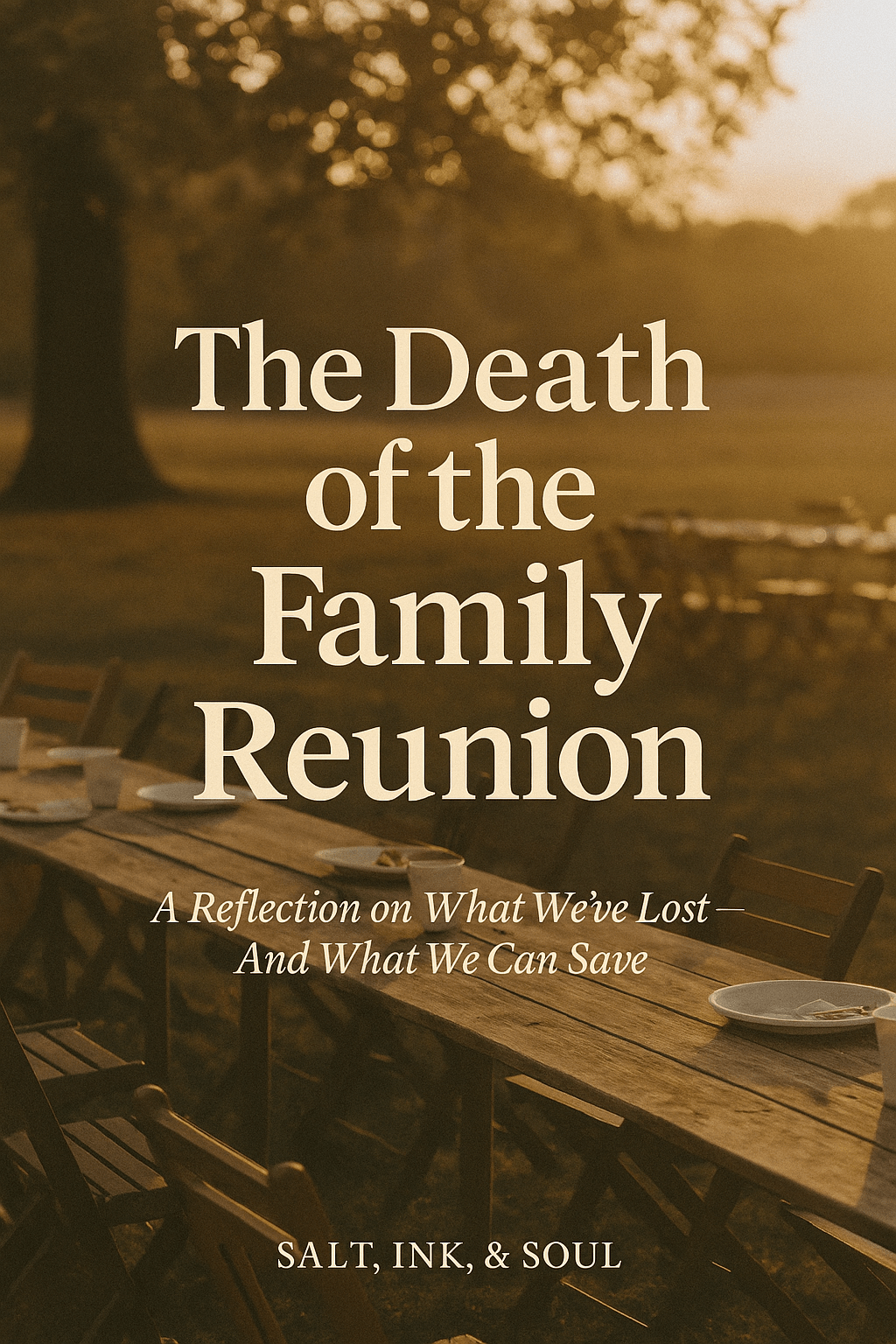
    The Death of the Family Reunion

       There was a time when the family reunion was a sovereign nation. It was its own country—borderless, sprawling, stitched together by folding chairs and potato salad, the language of inside jokes and side-eyes, the music of Stevie Wonder & Michael Jackson playing under the shade of Pine trees. A time when cousins you hadn’t seen in three summers ran up to you like the years hadn’t passed at all. When your great-aunt sat in the middle of the picnic like a tribal elder, commanding respect simply by being.

    But those days are dying.

    Today, we still have the cookout, but it’s smaller—more intimate. Just mama and them, maybe a stray cousin or two, whoever was close enough to text the night before. The sprawling tree has been pruned down to a sapling. Third and fourth cousins have become strangers. The great-aunts and uncles who used to hold court, the ones who could make feuding relatives hug just long enough for the picture—they are passing on. And no one has stepped up to replace them.

    The family reunion wasn’t just a party. It was a performance of survival. It was where the family came to bear witness to itself. You’ve got to see the uncles who hadn’t spoken in years sitting at the same table, grunting through peace for a few hours because Big Mama asked them to. You saw your cousins—those living testaments to the places your blood had wandered—The Quad-Cities, St. Louis, Albuquerque—all gathered in one place. You saw what your people had endured. The reunion was a history lesson with Kool-Aid and pound cake.

    And then there were the secrets. Every family has them—the ones you whisper about in the kitchen when you think the kids aren’t listening. The reunion was where those secrets were kept, not because they were shameful, but because they were binding. The elders held them like scrolls, as if they were holy texts. They knew which stories to tell and which to carry to their graves, and somehow that discipline kept the family whole.

    Now, the elders are gone. The scrolls are scattered. The secrets have slipped into the wind, sometimes aired out in group chats, other times left to die in silence. And without the keepers of the covenant, we are drifting.

    We live in an era of curated distance. We say “family” but mean it like a password, not a promise. The younger ones, the ones raised on social media and soft boundaries, have little appetite for gathering with people who once judged them, who might still hold the memory of their worst mistakes. The old guard could make you come anyway—make you show up, make you sit in the heat, make you pass the potato salad to the cousin you swore you’d never speak to again. They could force you to remember that family is not optional.

    And yet, here we are—choosing.

    There is grief in this. Grief not just for the elders who are gone, but for the version of ourselves that was possible when we stood together. Grief for the messy, complicated love that once kept us tethered.

    But there may also be a call. We may have to decide whether the reunion dies with them or is reborn through us. It’s our turn to be the ones who hold the secrets, who call the roll, who get the feuding cousins to show up just long enough to remember that they still share a name.

    The family reunion is not gone. It is waiting—like a pot on the back burner, simmering slow, hoping someone remembers to stir it.

    The question is whether we will.

    By Kyle J. Hayes

    kylehayesblog.com

    Please like, comment, and share

    Thinking of Family Reunions makes me wonder, what’s your favorite dish to eat or to bring? Please leave a comment.