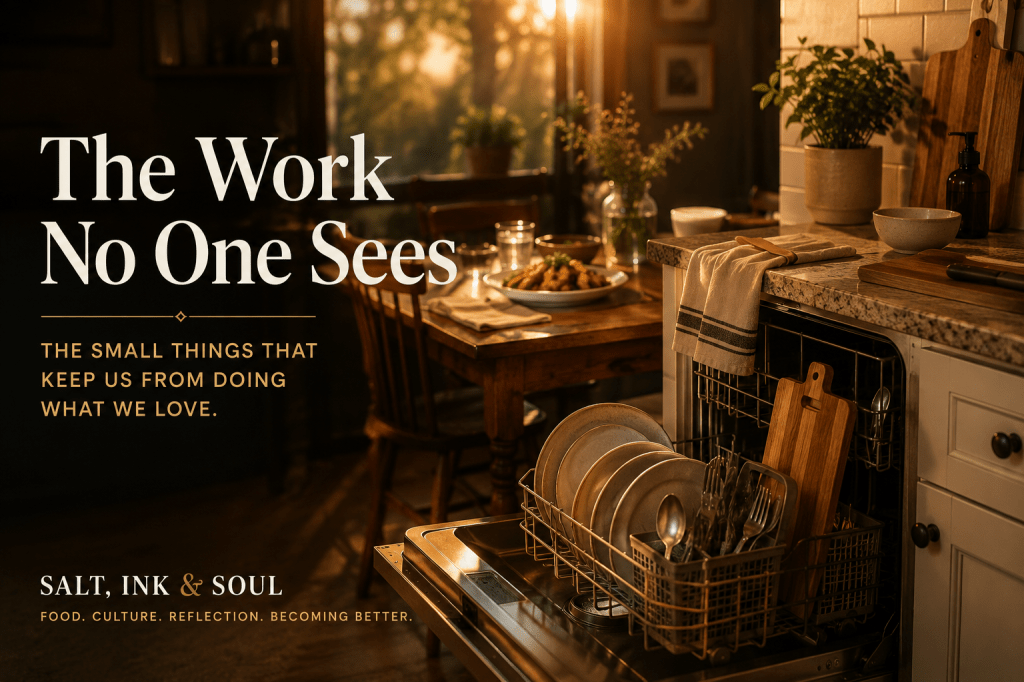
Tag: habits

  • The Work No One Sees

    The Work No One Sees

    The Dishes Almost Kept Me From Learning to Cook.

    I write a lot about learning the metric system.

    It probably seems like an odd thing to get excited about, but switching from cups and teaspoons to weighing ingredients changed the way I cook. Recipes became more consistent. Bread rose the way it was supposed to. Sauces tasted the way I imagined they would. The more I cooked, the more I realized that precision wasn’t taking the joy out of cooking.

    It was giving me confidence.

    I started cooking because I love food.

    Good food.

    Not expensive food.

    Just food made with care.

    For a long time, I thought learning to cook would be the hardest part.

    I was wrong.

    Believe it or not, what almost kept me from cooking wasn’t the recipes.

    It was the dishes.

    The pots and pans.

    The cutting boards.

    The greasy stove.

    The food splattered across the counter.

    The crumbs on the floor.

    All the little reminders that every good meal leaves something behind.

    I can’t tell you how many times I’ve made a meal that turned out exactly the way I hoped. I’d taste as I cooked, adjusting a little salt here, another pinch of pepper there, until everything felt right.

    Then I’d sit down and realize something.

    I wasn’t hungry anymore.

    I’d spent so much time smelling the food and tasting the food that by the time dinner was finished, I was exhausted.

    The kitchen looked like a disaster.

    And now I had another job waiting for me.

    That’s when I realized something.

    Cooking isn’t just about cooking.

    It’s about planning.

    These days I rarely cook for just one meal.

    If I’m already chopping vegetables, washing dishes, heating the oven, and dirtying a sink full of bowls, I might as well make enough for a few days. I try to keep a few meal-prepped meals in the refrigerator or freezer for the evenings when I don’t feel like cooking at all.

    That one change made cooking easier.

    But another lesson changed everything.

    I learned something embarrassingly simple.

    The dishwasher has to be empty before I start cooking.

    Otherwise, everything backs up.

    Dirty dishes stay in the sink because there’s nowhere for them to go.

    Bowls pile up.

    Utensils pile up.

    Before long, one small task I skipped yesterday becomes today’s biggest obstacle.

    It was such a simple lesson.

    But I don’t think it’s only about dishwashers.

    How often do we avoid doing something we love because of one small part we don’t enjoy?

    Maybe it isn’t cooking.

    Maybe it’s writing.

    The writing isn’t the hard part.

    Editing is.

    Maybe it’s exercising.

    The workout isn’t the hard part.

    Putting on your shoes is.

    Sometimes the thing standing between us and the life we want isn’t the dream.

    It’s the cleanup.

    And then there’s another lesson every cook eventually learns.

    The food doesn’t always turn out the way you imagined.

    Sometimes you follow the recipe exactly, and something still feels off.

    Sometimes you try a new ingredient, and it simply doesn’t work.

    Sometimes dinner is just… okay.

    And that’s okay.

    Not every meal has to become your signature dish.

    Not every attempt has to be perfect.

    Every meal teaches you something.

    Every mistake teaches you something.

    The next one is usually a little better.

    I think writing works the same way.

    Most people only see the finished essay.

    They don’t see the sentences that were deleted.

    The paragraphs rewritten five times.

    The moments you stare at the screen wondering why the words won’t come.

    They don’t see the work before the work.

    The same is true of cooking.

    People see the meal.

    They don’t see the planning.

    They don’t see the grocery list.

    They don’t see the dishes.

    They don’t see the quiet work that made any of it possible.

    I’ve come to believe that’s true of almost everything worthwhile.

    The parts people applaud are usually the parts everyone can see.

    The parts that change us are usually the ones no one ever notices.

    Maybe that’s why we should give ourselves a little more grace.

    The work no one sees is still work.

    Sometimes it’s the dishes.

    Sometimes it’s the planning.

    Sometimes it’s simply emptying yesterday’s dishwasher so today’s work has somewhere to begin.

    And more often than not…

    It’s the work that matters most.

    Kyle J. Hayes

    kylehayesblog.com

    Please like, comment, and share

    Resources for Hard Times

    If you’re looking for practical help, food support, or community resources, you can visit the Salt, Ink & Soul Resources Page.
    👉 Resources for Hard Times

  • What Are We Rehearsing?

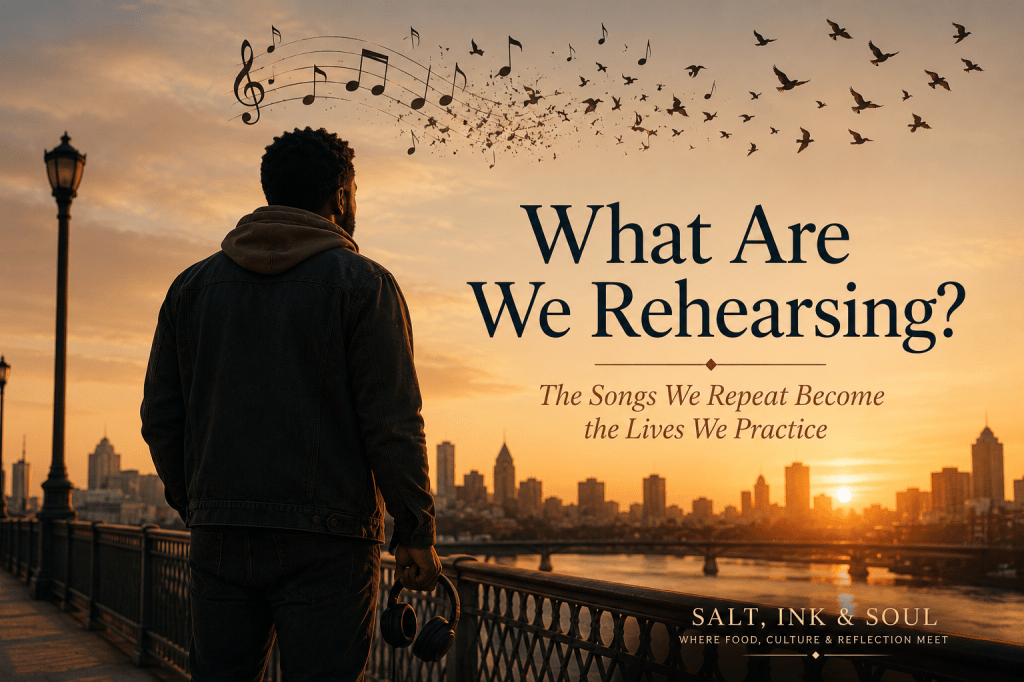
    What Are We Rehearsing?

    Sometimes another person’s question stays with you longer than their answer.

    This week, I found myself thinking about a conversation sparked by singer India Arie. She wondered aloud what it means when the songs we celebrate become the stories we live by. She was not asking for censorship. She was not asking anyone to stop making music. She was asking whether what we repeatedly consume eventually begins to shape us.

    That question has followed me around.

    Maybe I’m seeing too much.

    Or maybe I’m finally paying attention.

    I have been thinking about repetition.

    Not just in music, but in every part of life.

    A basketball player takes thousands of jump shots until the movement becomes instinct.

    A pianist practices scales until the fingers no longer ask permission from the mind.

    A grandmother makes cornbread so many times that measuring cups become unnecessary.

    We call it practice.

    We call it discipline.

    We call it muscle memory.

    We already understand that repetition changes the body.

    So why do we become uncomfortable when someone asks whether repetition might also shape the heart?

    Long before neuroscience gave us language like neural pathways and habit formation, people understood that words carried power. Communities repeated prayers because they believed repetition strengthened faith. Parents repeated lessons because they hoped they would become character. Freedom songs were sung over and over because they reminded weary people that they were more than the conditions surrounding them.

    Some people called those rituals sacred.

    Others believed repeated words could become something darker.

    They believed that speaking certain things over and over invited them into your life.

    Whether we call it ritual, conditioning, or simply human psychology, perhaps they were all reaching toward the same truth.

    What we practice eventually begins to feel natural.

    That thought has stayed with me as I watch our culture.

    Not just Black culture.

    All culture.

    We live in an age where algorithms have become our DJs.

    They decide what rises.

    They decide what repeats.

    They decide what millions of people hear before breakfast.

    I am not interested in arguing that music alone determines the future of a community.

    It doesn’t.

    No song can explain generations of segregation, economic inequality, underfunded schools, broken public policy, or the many burdens that Foundational Black Americans have carried across centuries. To pretend otherwise would ignore history.

    But I also refuse to believe music is powerless.

    If songs had no influence, companies would not spend millions of dollars making sure certain ones reach our ears.

    Advertising exists because repetition works.

    Political campaigns exist because repetition works.

    Religious liturgy exists because repetition works.

    Education itself depends on repetition.

    Why would we imagine music is somehow exempt?

    This is not about blaming any one artist.

    Every generation has created music that unsettled the one before it.

    Hip-hop, like jazz before it, has given voice to neighborhoods that were often ignored. It has documented struggle, celebrated creativity, challenged power, and preserved stories that might otherwise have disappeared.

    Some of the greatest poetry I have ever heard arrived wrapped in a beat.

    That deserves respect.

    But every art form also contains choices.

    Some songs call us toward dignity.

    Others celebrate revenge.

    Some remind us that love requires sacrifice.

    Others convince us that commitment is weakness.

    Some tell young people they are worth more than what the world has offered them.

    Others invite them to build an identity around excess, exploitation, or self-destruction.

    Those differences matter.

    What troubles me even more is not that those songs exist.

    Art has always reflected both light and shadow.

    What troubles me is what gets amplified.

    There are artists creating music about healing.

    About fatherhood.

    About faith.

    About perseverance.

    About accountability.

    About joy that does not require someone else’s humiliation.

    They exist.

    Yet they rarely seem to receive the same machinery behind them.

    That should make us curious.

    Not angry.

    Curious.

    Why do stories that flatter our impulses often travel farther than stories that challenge us to grow?

    Why does outrage outperform wisdom?

    Why is self-control so difficult to market while excess is endlessly profitable?

    Those are questions worth asking.

    Especially for those of us who are descendants of people who once sang their way through unimaginable suffering.

    Our ancestors understood something about repetition.

    They sang hope until hope became endurance.

    They repeated Scripture until it became courage.

    They gathered around kitchen tables and church pews, telling the same family stories until children understood they belonged to something larger than themselves.

    Those songs did not erase injustice.

    But they strengthened people enough to survive it.

    I wonder what songs we are teaching ourselves now.

    Not because I believe every lyric becomes destiny.

    But because I know that what surrounds us eventually begins to sound like home.

    And what sounds like home eventually becomes normal.

    The most dangerous ideas are rarely the loudest.

    They become dangerous because they stop sounding unusual.

    They become ordinary.

    That is how repetition works.

    It does not always convince.

    Sometimes it simply familiarizes.

    And familiarity is powerful.

    I think about food often.

    Anyone who has spent time reading Salt, Ink & Soul knows that.

    A single meal will not make you healthy.

    Neither will a single meal make you sick.

    But years of eating eventually shape the body you live in.

    Perhaps the soul works the same way.

    Perhaps one song changes very little.

    But thousands of repetitions…

    Thousands of rehearsals…

    Thousands of small invitations toward the same vision of success, love, relationships, wealth, and identity…

    Perhaps those leave fingerprints we cannot always see.

    This is not a call to fear music.

    It is not a call to silence artists.

    It is certainly not a call to stop creating.

    It is a call to become more intentional listeners.

    To ask ourselves a simple question before we press play.

    What am I rehearsing?

    Because every day we are practicing something.

    Compassion or contempt.

    Discipline or indulgence.

    Hope or cynicism.

    Dignity or degradation.

    None of us escapes rehearsal.

    The only choice we have is deciding what kind of life we want to become fluent in.

    Maybe I’m seeing too much.

    Or maybe I have simply reached an age where I understand that nothing enters the soul without leaving something behind.

    If that is true, then perhaps one of the quietest acts of freedom is choosing carefully what we allow to echo there.

    Kyle J. Hayes

    kylehayesblog.com

    Please like, comment, and share

    Resources for Hard Times

    If you’re looking for practical help, food support, or community resources, you can visit the Salt, Ink & Soul Resources Page.

    👉 Resources for Hard Times