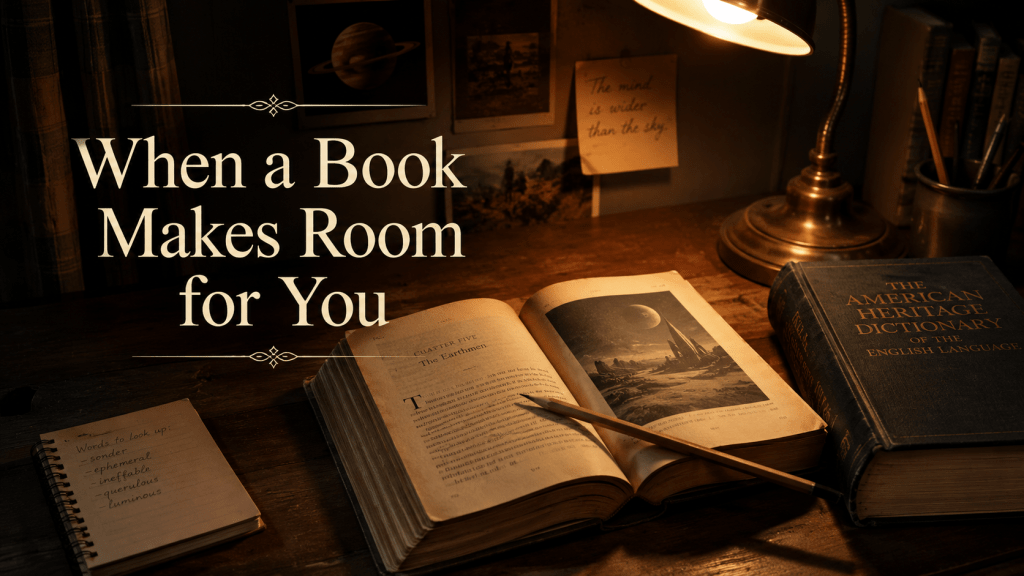
I had written before about Pawn of Prophecy being the first grown-up book I truly remember finishing.
I called it grown-up because, to the boy I was then, grown-up meant weight. It meant no pictures waiting kindly on the page to tell me where to look. It meant more than two hundred pages. It meant holding a book in my hands and realizing that the story was not going to bend down to meet me. I would have to rise toward it.
That book pulled me into fantasy.
It showed me that reading could be more than an assignment, more than an obligation, more than something adults told children was good for them in the same dry voice they used for vegetables and bedtime. It showed me that a book could be a door. That worlds were waiting behind paper. That some maps were printed in ink, and some were built in the mind.
But years later, another book did something different.
It did not pull me in gently.
It made me work.
The author was Isaac Asimov.
The book was Foundation.
I had read his work before. I had read I, Robot. I knew, at least a little, the clean machinery of his imagination. I knew he could take a question and dress it in steel, logic, and circuitry until it became something larger than a question. But Foundation was different.
Foundation did not feel like a story at first.
It felt like being dropped into a room where every adult was already deep in conversation.
Empire. Decay. Mathematics. Religion. Trade. Politics. Psychology. Civilization. Collapse.
These were not the words of childhood.
Not really.
They were the words of men in quiet rooms deciding the shape of history. Words spoken over maps. Words carried inside institutions. Words sharpened by people who understood that power does not always arrive with a raised fist. Sometimes power arrives as a theory. Sometimes as a doctrine. Sometimes as a prediction. Sometimes, as a sentence, it is so cold and precise that it seems to have no human being behind it at all.
I remember reading it and feeling the pressure.
The book gave me a headache.
Not in the way a bad book gives you a headache. Not from boredom. Not from confusion alone. It was the headache of being stretched too thin. The ache that comes when the mind is trying to grow faster than comfort allows. The ache of climbing stairs two at a time because something above you is calling, and pride will not let you turn around.
So I kept a dictionary nearby.
That detail matters to me now.
A dictionary beside a child reading science fiction is a small altar to hunger.
It says: I do not understand yet, but I want to.
It says: I will not let this word turn me away.
It says: there is something in here worth reaching for.
I would come across a word I did not know, and the sentence would stop. The whole machinery of the book would halt in front of me. I could have skipped over it. Children do that. Adults do it too. We learn to walk around what we do not understand and pretend the gap did not matter.
But I wanted to understand what I had gotten myself into.
That is the phrase that stays with me.
What had I gotten myself into?
Not just a book.
A different kind of thinking.
With fantasy, I had entered a world of quests, prophecies, chosen people, ancient evils, and hidden destinies. That world had its own difficulty, its own language, its own inheritance. But Foundation asked something else of me. It did not ask me to believe in magic. It asked me to consider history as a force. It asked me to imagine that civilizations could be studied the way storms are studied. That human beings, in great masses, might move with patterns they could not see from inside their own lives.
That is a heavy thing for a child to hold.
Because children already live inside systems they cannot name.
Family systems. School systems. Neighborhood systems. Money systems. Race systems. Silence systems. The strange laws of who gets listened to and who gets dismissed. Who is allowed to be brilliant and who is merely told to behave? Who gets called gifted? Who gets called difficult? Who is encouraged to dream, and who is warned early about the cost of dreaming too loudly.
A child may not know the vocabulary.
But he knows the feeling.
Maybe that was why Foundation troubled me so much.
The words were difficult, yes. But beneath the words was something I recognized before I could explain it. The book understood that people are not only people. They are also citizens, believers, workers, rulers, servants, merchants, cowards, visionaries, tools, threats, memories, and ghosts inside the body of history.
It understood that a person could be swallowed by a time.
And maybe some part of me already feared that.
Maybe some part of me knew that being lost was not always a matter of direction. Sometimes you are lost because the world around you has already decided where you belong, and you have not yet learned the language to argue back.
So I learned words.
Not all at once.
Slowly.
One page at a time.
I looked them up. I went back to the sentence. I read it again. Sometimes I understood. Sometimes I only understood enough to keep going. But enough is not nothing. Enough is how many of us survive the beginning of anything.
And then, something changed.
The book got easier.
Or maybe I did.
That is one of the quiet miracles of reading. You enter a book as one person and, if the book does its work and you do yours, you leave as someone slightly altered. Not healed. Not completed. But changed in some small interior way.
At first, the world of Foundation felt like a locked room.
Then the words began to open.
The unfamiliar became familiar. The machinery of empire began to hum in a language I could follow. The names no longer felt distant. The ideas no longer stood over me. I started to move inside the book instead of standing outside it, knocking.
And once I could understand the words, I began to feel something I did not expect.
I felt welcomed.
That sounds strange, maybe.
A book about the fall of a Galactic Empire is not warm in the usual sense. It is not a grandmother’s kitchen. It is not a pot on the stove with steam rising and somebody telling you to sit down before your plate gets cold. It is not soft light, clean linen, or a hand on the shoulder.
And yet I felt welcomed.
Not because the book made itself easy.
Because it allowed me in after I did the work.
There is a particular dignity in that.
Some doors open because somebody loves you enough to unlock them.
Some doors open because you learn how the lock works.
Both matter.
I think about that boy with the dictionary now, and I feel tenderness for him. I see him sitting there, probably more stubborn than confident, refusing to let the book defeat him. I see him reaching for meaning. I see him being humbled and strengthened at the same time.
He did not know then that he was doing more than reading.
He was training.
Training his patience.
Training his attention.
Training his ability to sit with difficulty without mistaking difficulty for rejection.
That is not a small lesson.
Too many people are taught that if something is hard, it must not be for them. They meet a closed door and assume the house was never meant to hold them. They meet a word they do not know and hear the old voices rise up: this is not your place, this is not your level, this is not your world.
But sometimes difficulty is not a warning.
Sometimes it is an invitation with teeth.
Sometimes the book is not saying ‘ leave.‘
Sometimes it says, “Come closer.“
Bring your dictionary.
Bring your confusion.
Bring your headache.
Bring the part of you that is tired of standing outside rooms where meaning is being made.
Come closer anyway.
I have spent much of my life trying to understand that difference. The difference between a thing that excludes you and a thing that challenges you. The difference between a gate built to keep you out and a mountain that asks whether you are willing to climb.
As a child, I did not have those words.
I only had the book.
I only had the dictionary.
I only had the ache behind my eyes and the strange hunger that kept me turning pages.
But I know now that something important happened there.
A boy who had once learned that fantasy could be fun began to learn that reading could also be demanding, serious, even disciplinary. Not punishment. Discipline. The kind that teaches you to stay. The kind that asks you to become worthy of your own curiosity.
And that, maybe, is one of the hidden gifts of difficult books.
They do not simply give us stories.
They give us evidence.
Evidence that we can grow.
Evidence that confusion is not the end.
Evidence that language, no matter how intimidating, can be approached. Studied. Broken open. Claimed.
There is power in learning a word.
There is power in refusing to be embarrassed by not knowing.
There is power in saying, quietly, even as a child: I am going to understand this.
That kind of hunger becomes part of you.
It follows you into adulthood.
It follows you into the books you later write, the essays you later shape, the memories you later return to with older hands and a more wounded heart. It follows you into all the rooms where you still sometimes feel like you do not belong. It reminds you that belonging is not always given at the beginning.
Sometimes, belonging is built.
Page by page.
Word by word.
Looked up.
Read again.
Carried forward.
I think that is why Foundation stayed with me. Not only because of its ideas, though the ideas were enormous. Not only because of its scope, though the scope was vast. It stayed with me because it made me participate in my own becoming.
It did not entertain me passively.
It required me.
And there is a strange love in being required by something worthy.
A book that is too easy may comfort you. There is nothing wrong with that. We need those books too. We need the ones that meet us when we are tired, when the world has scraped too much from us, when we need to be held instead of tested.
But some books arrive like a teacher who does not raise his voice.
They place the work in front of you.
They trust that you can do it.
They do not flatter you.
They do not simplify themselves to spare you discomfort.
They wait.
And if you stay long enough, they open.
That was Foundation for me.
A headache.
A dictionary.
A locked room.
A world.
And then, eventually, a welcome.
I did not know then how much of my life would be shaped by that pattern. How many times I would stand before something difficult and wonder whether it was beyond me. How many times I would have to decide whether to walk away or reach for the dictionary, whatever form the dictionary took.
A book.
A memory.
A conversation.
A silence.
A wound.
A history.
A self I did not yet understand.
Maybe all of us carry dictionaries of one kind or another.
Tools for translating the parts of life that first arrive unreadable.
We use them to understand grief. Love. Race. Family. Masculinity. Faith. Failure. Hunger. Loneliness. Hope. We use them to name what once only hurt. We use them to walk back into the sentence of our lives and read it again with more mercy.
That boy reading Foundation did not know he was practicing for all that.
He just wanted to understand the book.
But maybe that is how becoming often begins.
Not with a grand declaration.
Not with destiny.
Not with anyone telling you who you are.
Just a child, alone with a difficult page.
Please like, comment, and share
Resources for Hard Times
If you’re looking for practical help, food support, or community resources, you can visit the Salt, Ink & Soul Resources Page.
 Salt,Ink, & Soul