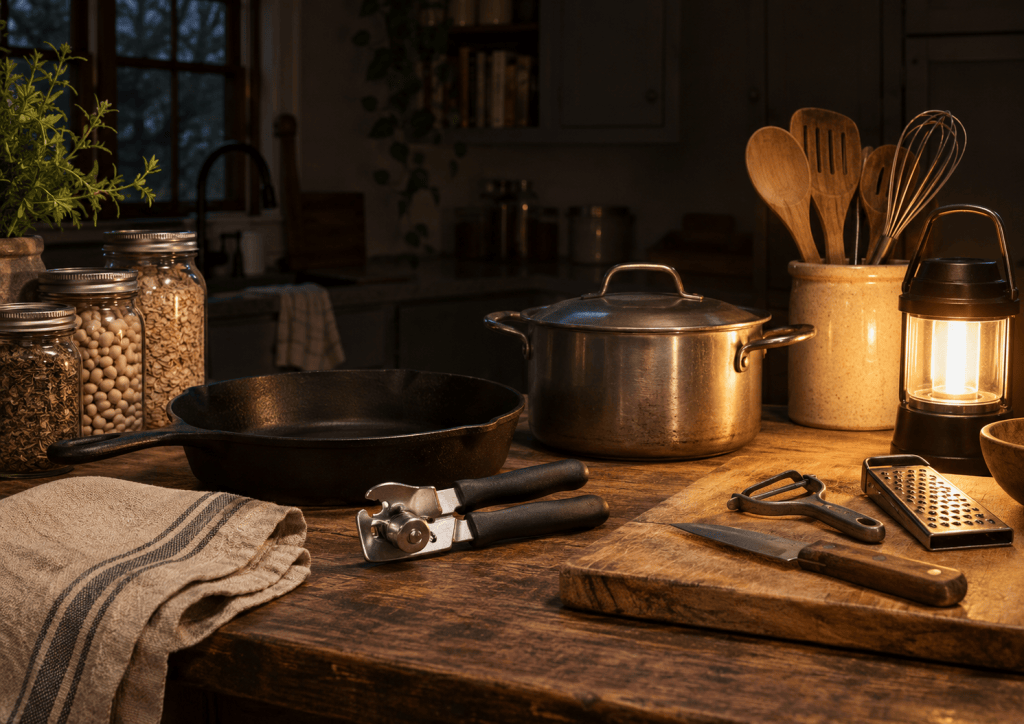
Because being prepared doesn’t mean you believe everything you hear.
Lately, I’ve noticed many people talking about the possibility of a widespread blackout.
Some speak about it as though it’s inevitable. Others seem convinced something is coming, though exactly what that is remains unclear.
Personally, I’m not buying into the speculation.
I’ve lived long enough to know that rumors have a way of growing legs, especially when fear gives them somewhere to run. These days, between social media, television, and the endless stream of people predicting the next catastrophe, it’s hard to separate genuine concern from someone simply looking for attention.
But here’s something else I’ve learned over the years.
You don’t have to believe something is going to happen to be prepared in case it does.
That’s not fear. That’s common sense.
I’ve always believed that a well-stocked kitchen is about more than having something good to eat. It’s about taking care of yourself, making the most of what you have, and knowing how to get things done without depending on every modern convenience.
We have become accustomed to pressing buttons.
Coffee makers, electric can openers, microwaves, air fryers, rice cookers, and a seemingly endless collection of appliances promising to make our lives easier.
And they do.
Until the electricity goes out.
Suddenly, that expensive appliance sitting on the counter becomes little more than a decoration.
Now, I’m not suggesting we all abandon modern technology and return to cooking over an open fire. I happen to enjoy my appliances, and I have no intention of giving them up.
But I do believe every kitchen should have a few dependable tools that don’t require a plug, a battery, or an internet connection to do their job.
Some of these things our grandparents kept around without giving them a second thought.
Not because they were preparing for the end of the world.
Because they understood the value of being prepared for an ordinary bad day.
And sometimes, that’s all a blackout really is.
The Kitchen Essentials I Believe Everyone Should Have
I’m deliberately leaving Food and water off this list. Those deserve their own conversation. Right now, I’m talking about the tools, utensils, and basic equipment that can help you manage your kitchen when the power isn’t available.
1. A Good Manual Can Opener
Not one of those flimsy things that bends after three uses. A sturdy, reliable, hand-operated can opener.
Electric can openers are convenient, but when there’s no electricity, they’re about as useful as an unplugged television.
If you don’t already own a manual one, buy one. Better yet, keep a spare.
2. A Cast-Iron Skillet
If you’ve followed my cooking for any length of time, you know I appreciate cookware that can do more than one job.
A good cast-iron skillet is one of those things.
It can fry, sear, sauté, and last for years with proper care. It works on many different cooking surfaces, including suitable outdoor cooking equipment.
Something is reassuring about a piece of cookware that may very well outlive the person who bought it.
Our grandparents understood that.
3. A Sturdy Pot With a Lid
You don’t need an entire collection of expensive cookware.
One good, medium-sized pot with a properly fitting lid can accomplish quite a bit.
Heating, simmering, boiling, and preparing simple meals become much easier with dependable cookware.
For those of us who enjoy one-pot cooking, this is already familiar territory.
4. A Sharp Kitchen Knife and Cutting Board
A dependable chef’s knife, a smaller utility knife, and a solid cutting board.
That’s enough to handle most basic kitchen preparation.
You don’t need a knife block holding seventeen different blades, half of which you’ve never used.
You need something sharp, comfortable, and reliable.
And while you’re at it, learn how to maintain the edge. A dull knife can be more dangerous than a sharp one.
5. A Manual Food Preparation Set
This is where a few inexpensive utensils become surprisingly valuable.
- A vegetable peeler
- A box grater
- A sturdy whisk
- A potato masher
- A mixing spoon
- A spatula
- Kitchen tongs
- A colander or strainer
- Measuring cups and spoons
None of these require electricity. They simply require a little effort.
Remember when making mashed potatoes involved actually mashing potatoes?
Some of us still do.
6. A Manual Coffee Maker
Now, this one may not qualify as a necessity for everybody.
But for those of us who appreciate a good cup of coffee, waking up without electricity shouldn’t automatically mean going without it.
A French press or a simple pour-over coffee maker can do the job, as long as you have a safe way to heat water.
There’s something comforting about holding a warm cup of coffee when the rest of the world seems a little uncertain.
And personally, I would prefer to face whatever inconvenience comes my way after I’ve had my coffee.
7. A Safe, Alternative Cooking Method
This one requires a little thought.
An outdoor propane camp stove or camping grill can be useful when electricity isn’t available, provided you have the appropriate fuel and know how to operate the equipment safely.
But let me be absolutely clear.
Never use a charcoal grill, camping stove, propane burner, or generator inside your home, garage, or another enclosed space.
Carbon monoxide poisoning is real, and it can be deadly. These devices belong outdoors, well away from doors, windows, and vents.
And if you live in an apartment or somewhere outdoor cooking isn’t permitted, don’t take unnecessary risks trying to improvise.
Sometimes being prepared means knowing when not to cook.
8. Battery-Powered or Rechargeable Lighting
Trying to prepare anything in a completely dark kitchen is asking for trouble.
A good LED lantern can illuminate a countertop, while a headlamp allows you to work with both hands free.
I would keep a flashlight as well, along with spare batteries or a charged backup power source.
And although candles may look wonderful in photographs, an open flame near towels, paper products, and cooking supplies is not my idea of smart Preparation.
9. A Cooler and Appliance Thermometers
One thing people often overlook during an outage is tracking temperatures.
A refrigerator thermometer and a freezer thermometer can help determine whether your appliances are maintaining safe temperatures.
An insulated cooler may also come in handy if an outage lasts longer than expected.
Just remember that a cooler doesn’t create cold temperatures on its own. It needs an appropriate cold source.
And resist the temptation to keep opening the refrigerator just to see how everything is doing.
Every time you open that door, you’re letting the cold air escape.
10. Basic Cleaning and Sanitation Supplies
A kitchen doesn’t stop needing to be clean because the lights go out.
I’d keep the following readily available:
- Dish soap and a sturdy scrub brush
- Clean dish towels
- Paper towels
- Household disinfectant
- Heavy-duty garbage bags
- Disposable gloves
- A small supply of disposable plates and utensils
If water service is interrupted along with the electricity, keeping the kitchen sanitary becomes even more important.
And while I prefer washing and reusing my dishes, there are circumstances when minimizing cleanup makes practical sense.
11. Matches and a Utility Lighter
A dependable lighter and waterproof matches can help you safely ignite approved outdoor cooking equipment.
Keep them dry, secure, and out of reach of children.
They aren’t an invitation to improvise an indoor fire or manually light a gas appliance against the manufacturer’s safety instructions.
There’s a difference between being resourceful and being reckless.
12. Basic Kitchen Safety Equipment
A small, accessible fire extinguisher rated for kitchen fires is worth having.
So are functioning smoke alarms and carbon monoxide detectors with battery backup.
I’d also keep a basic first-aid kit somewhere easy to reach.
We spend so much time thinking about what might happen outside our homes that we sometimes forget about the accidents that can happen inside them.
Especially when we’re trying to do familiar things under unfamiliar circumstances.
A Few Other Things Worth Keeping Around
There are a handful of additional items I’d recommend, even if they aren’t strictly kitchen utensils.
A battery-powered or hand-crank radio can provide information when internet service is unavailable. A charged power bank can keep your phone working longer. A printed list of important numbers is useful when you can’t simply search for them.
And don’t overlook an ordinary kitchen clock that runs on batteries.
Sometimes knowing how much time has passed matters more than we realize.
Preparation Doesn’t Have to Become Panic
Here’s where I think we sometimes lose our way.
People hear something unsettling, and before long, they’re spending money they don’t have on equipment they may never need.
Entire shopping carts filled with emergency supplies.
Expensive gadgets.
Elaborate survival kits.
All because somebody on the internet declared that something terrible was about to happen.
I don’t believe that’s necessary.
Most of what I’ve listed can be purchased inexpensively, and chances are you already own a good portion of it.
You don’t have to buy everything at once.
Start with what you have. Figure out what’s missing. Add a little at a time.
More importantly, learn how to use what you own before you actually need it.
A manual can opener isn’t much help if you’ve never figured out how to use it. Neither is a camping stove still sitting unopened in its original box.
And a shelf full of emergency equipment doesn’t make anyone prepared if they haven’t taken the time to understand its limitations.
What Our Grandparents Already Knew
When I think about preparedness, I don’t necessarily picture somebody standing in a basement surrounded by expensive survival equipment.
I think about the kitchens I remember growing up.
The drawers filled with ordinary utensils.
The pots that had been used so many times the handles had begun to show their age.
The cast-iron skillets.
The handwritten recipes.
The women and men who seemed capable of making something out of practically nothing.
They didn’t have a machine for every task.
And they certainly didn’t need an app to tell them how to cook dinner.
They understood their tools because they used them.
They knew the difference between what was convenient and what was necessary.
Somewhere along the way, I think we’ve allowed those two things to become confused.
Convenience is wonderful.
But there’s a certain dignity in knowing how to do things for yourself.
In being able to prepare a simple meal without depending on half a dozen electrical appliances.
In understanding that sometimes the most useful thing in your kitchen isn’t the newest thing you bought, but the oldest thing you remembered to keep.
When the Lights Come Back On
Do I believe some mysterious nationwide blackout is just around the corner?
No. I haven’t seen convincing evidence that such an event is imminent, and I have no intention of organizing my life around internet predictions.
But power outages happen.
Storms happen.
Equipment fails.
Sometimes a perfectly ordinary afternoon becomes considerably less ordinary through no fault of our own.
And when that happens, I’d rather open a drawer and find what I need than discover that everything I own requires an electrical outlet.
This isn’t about preparing for the end of the world.
It’s about being able to take care of yourself when the world, for a little while, doesn’t work quite the way you expected.
Buy what you need. Keep what works. Learn a few basic skills.
And don’t let somebody else’s fear convince you to spend money unnecessarily.
Because if the lights never go out, you’ll still have a well-equipped kitchen.
And if they do?
At least you’ll know where the can opener is.
Salt, Ink & Soul
If something here speaks to you, please like, comment, and share.
Support Salt, Ink & Soul
The stories, recipes, and reflections continue beyond the page. Visit the Salt, Ink & Soul Store to explore merchandise inspired by Food. Memory. Meaning.
👉 Visit the Salt, Ink & Soul Store
Resources for Hard Times
For practical help, food support, or community resources, visit the Salt, Ink & Soul Resources Page.

