Tag: Life Lessons

  • What Do You Love Now That You Hated When You Were Younger?

    What Do You Love Now That You Hated When You Were Younger?

    Myself.

    That answer took me a long time to arrive at.

    I would not say I hated myself when I was younger. Hate is too strong a word. But I spent a great deal of my youth wishing I were someone else.

    Even at a young age, I knew I was different.

    Sports were fine, but I was never as good as my older brother. Music was enjoyable, but I could not play an instrument or sing like my other siblings. Everywhere I looked, someone seemed to have a gift that was easier to see than mine.

    My gift was quieter.

    I was smart. I liked books.

    That may not sound like much now, but when you are young, fitting in can feel more important than understanding who you are. I spent years measuring myself against other people and coming up short because I was using the wrong ruler.

    I wanted to be an athlete. The musician. The person everyone noticed when they walked into a room.

    Instead, I was the kid who disappeared into a book.

    What I did not understand then was that the things that made me different were also the things that would shape my life. The hours spent reading taught me how to think. They taught me curiosity. They taught me empathy. They taught me how to sit with an idea long enough to understand it.

    Most importantly, they taught me how to find my own voice.

    Age has a way of settling old arguments. The things we once viewed as flaws often turn out to be foundations.

    Today, I no longer wish I were someone else.

    I am grateful for the quiet kid who loved books. Grateful for the young man who kept reading even when it was not popular. Grateful for the person who eventually learned that fitting in is overrated and that becoming yourself is the greater achievement.

    What do I love now that I disliked when I was younger?

    The answer is simple.

    I love being me.

    Kyle J. Hayes

    kylehayesblog.com

    Please like, comment, and share

    Resources for Hard Times

    If you’re looking for practical help, food support, or community resources, you can visit the Salt, Ink & Soul Resources Page.


    👉 Resources for Hard Times

  • To All the Men Called Dad

    To All the Men Called Dad

    To all the men who answer to Pop, Pops, Dad, Daddy, Father, or even “The Old Man.”

    Happy Father’s Day.

    Most of us do not ask for recognition. We do not keep score. We simply do what needs to be done.

    We wake up early. Stay up late. Carry worries we rarely speak aloud. We fix things, provide what we can, protect who we love, and keep moving even when we are tired.

    Much of what fathers do goes unnoticed because, when it is done well, it looks ordinary. The lights stay on. The bills get paid. The advice is there when needed. The steady hand remains available even when no one thinks to thank it.

    That is the nature of fatherhood. Much of the work happens quietly.

    But we know.

    We know the sacrifices made, the opportunities passed by, the extra hours worked, the fears swallowed, and the promises kept.

    So today, take the day.

    Take a breath.

    Sit in your favorite chair. Enjoy your coffee a little longer. Watch the game. Fire up the grill. Take a nap. Spend time with the people you love.

    The work will be there tomorrow.

    Today, give yourself a moment to appreciate the man in the mirror.

    You have earned it.

    Happy Father’s Day

    Kyle J. Hayes

    kylehayesblog.com

    Please like, comment, and share

    Resources for Hard Times

    If you’re looking for practical help, food support, or community resources, you can visit the Salt, Ink & Soul Resources Page.
    👉 Resources for Hard Times

  • Who Are You Most Inspired By?

    Who Are You Most Inspired By?

    The person who inspires me most is Fred Rogers.

    Not because he was famous.

    Not because generations of children grew up watching him.

    And not because he seemed to have all the answers.

    He inspires me because he knew exactly who he was and never seemed interested in becoming someone else.

    In a world that often rewards loud voices, he spoke softly.

    In a world that celebrates outrage, he chose kindness.

    In a culture that often mistakes cynicism for wisdom, he believed people were worth caring about.

    What strikes me most is that he did what he truly loved. He found a way to use his gifts in the service of others and then spent decades doing exactly that. He did not seem to chase trends, popularity, or approval. He held fast to his convictions, whether the crowd agreed or not.

    That kind of consistency is rare.

    Many of us spend years trying to figure out who we are. Others know who they are but are afraid to live it. The pressure to fit in, to be accepted, or to be successful on someone else’s terms can be overwhelming.

    Yet he seemed content to walk a different path.

    A path built on the belief that every person has value.

    As I’ve gotten older, I’ve come to admire that more than talent, wealth, or fame. The people who leave the deepest mark on the world are often the ones who make others feel seen. They remind us that kindness is not weakness, that compassion requires courage, and that treating people with dignity is a worthy life’s work.

    When I think about the kind of person I hope to become, I don’t think about being the smartest person in the room or the most successful.

    I think about being useful.

    I think about leaving people better than I found them.

    That is why he inspires me.

    Not because he changed the world through power.

    But because he changed it through service, one person at a time.

    Kyle J. Hayes

    kylehayesblog.com

    Please like, comment, and share

    Resources for Hard Times

    If you’re looking for practical help, food support, or community resources, you can visit the Salt, Ink & Soul Resources Page.
    👉 Resources for Hard Times

  • What is something you wish you could tell your 20-year-old self?

    What is something you wish you could tell your 20-year-old self?

    I would tell him to come home to himself sooner.

    Not home as a place.

    Home as a knowing.

    Home is that quiet room inside you where your own voice still lives before the world teaches you to mistrust it.

    I would tell my 20-year-old self to stop spending so much of his life auditioning for people who were never going to choose him, honestly. Stop bending yourself into shapes that do not fit your spirit. Stop mistaking acceptance for love. Stop confusing attention with belonging.

    Because there is a difference.

    And learning that difference can cost you years.

    At twenty, you think being liked will save you.

    You think if you become easier, funnier, quieter, louder, more agreeable, more useful, more available, more whatever the room seems to require, then maybe people will keep you around. Maybe they will see you. Maybe they will decide you are worth knowing.

    But some people do not dislike you for failing to become enough.

    Some people were never interested in getting to know you at all.

    They were interested in what you could provide.

    Your time.

    Your loyalty.

    Your attention.

    Your silence.

    Your willingness to shrink yourself so they would not have to make room.

    That is a hard lesson.

    But it is a freeing one.

    I would tell him this: do not waste your best years trying to become acceptable to people who benefit from you not knowing your worth.

    Spend that time discovering who you are.

    Not who you perform.

    Not who you pretend to be when you are afraid of being left out.

    Not who you become when loneliness starts negotiating against your dignity.

    Who you are.

    What you love.

    What you believe.

    What brings you peace?

    What kind of man do you want to become when no one is clapping?

    What kind of life feels honest when nobody is watching?

    I would tell him that solitude is not always punishment. Sometimes it is protection. Sometimes being alone is the first place where you can finally hear yourself without all the borrowed voices talking over you.

    There is grief in realizing how much time you gave away.

    Time you could have used to grow.

    To read.

    To think.

    To build.

    To heal.

    To understand your own mind.

    To become comfortable in your own skin.

    To stop asking strangers, friends, lovers, and crowds for permission to exist.

    But I would not speak to him cruelly.

    He was doing the best he could with what he knew.

    He wanted a connection.

    He wanted to matter.

    He wanted to be loved in a world that often teaches people to earn what should have been given freely.

    So I would not shame him for trying.

    I recommend telling him to try differently.

    Try choosing yourself.

    Try telling the truth sooner.

    Try leaving when the room keeps requiring your disappearance.

    Try noticing who only loves you when you are convenient.

    Try paying attention to the people who make you feel peaceful rather than desperate.

    Try building a life that does not depend on approval from people who have not even learned to approve of themselves.

    Because one day, you will understand something that a twenty-year-old could not yet know.

    The goal was never to become the kind of person everyone liked.

    The goal was to become someone you could live with.

    Someone you could respect.

    Someone whose reflection did not look like a stranger assembled from other people’s expectations.

    I would tell him that self-discovery is not selfish.

    It is necessary.

    You cannot build a true life out of borrowed pieces. You cannot keep abandoning yourself and call it love. You cannot keep giving your time to people who leave you with less of yourself and expect peace to grow there.

    So I would tell my 20-year-old self:

    Come back to you.

    Earlier.

    Stay with you.

    Longer.

    Learn yourself before trying to be chosen.

    Because the people meant for your life should not require you to disappear before they can accept you.

    And the time you spend becoming yourself is never wasted.

    Kyle J. Hayes

    kylehayesblog.com

    Please like, comment, and share

    Resources for Hard Times

    If you’re looking for practical help, food support, or community resources, you can visit the Salt, Ink & Soul Resources Page.

    👉 Resources for Hard Times

  • Cooking Without Panic

    Cooking Without Panic

    What Mise en Place Taught Me About Preparation, Presence, and Respect

    I’ve talked about this before.

    And I’m saying it again.

    Not because I enjoy repeating myself. But because some lessons don’t land the first time you hear them. They settle slowly. They wait for you to live long enough to recognize them when they show up again.

    The more I cook, the more I understand this:

    Preparation is not optional.

    It is the difference between peace and panic.

    And nothing reveals that truth faster than the day of a big meal.

    There’s a moment that comes. Always.

    Something is already on the stove. Heat is rising. Time has started moving in a way that doesn’t allow for hesitation. And then—you realize something is missing.

    Not something dramatic.

    Something small.

    Garlic. Butter. An onion you thought you had.

    Now you’re standing there, caught between what’s already begun and what you forgot to prepare. Keys in your hand. Mind racing. Trying to decide if you can leave without losing everything you’ve started.

    I’ve been there.

    More than I care to admit.

    And what I’ve learned is this—those moments don’t come from bad luck. They come from skipping the quiet work.

    When I first started cooking, everything I did lived in that space.

    Chaos.

    Not the kind people romanticize. Not the version that looks like passion from a distance. I mean the real kind. Drawers open. Utensils everywhere. Every pan is dirty. Knives in places they didn’t belong.

    I read recipes while I cooked.

    Not before.

    During.

    Steam in my face. Oil snapping at me like it had something to prove. Words like simmer and boil feel less like guidance and more like pressure.

    I was always catching up.

    And still… the food came out.

    Not great. Not something I would remember.

    But it fed me.

    And at that time, that mattered.

    Because cooking wasn’t about mastery. It was about survival, trying to become something more. It was effort. It was care. Even if it was scattered.

    A love letter written too fast. But still real.

    Then I learned something that didn’t look like much at first.

    Mise en place.

    Everything in its place.

    It sounded simple. Too simple, honestly. Like one of those things people say when they’ve already figured it out.

    But over time, I realized it wasn’t about control.

    It was about respect.

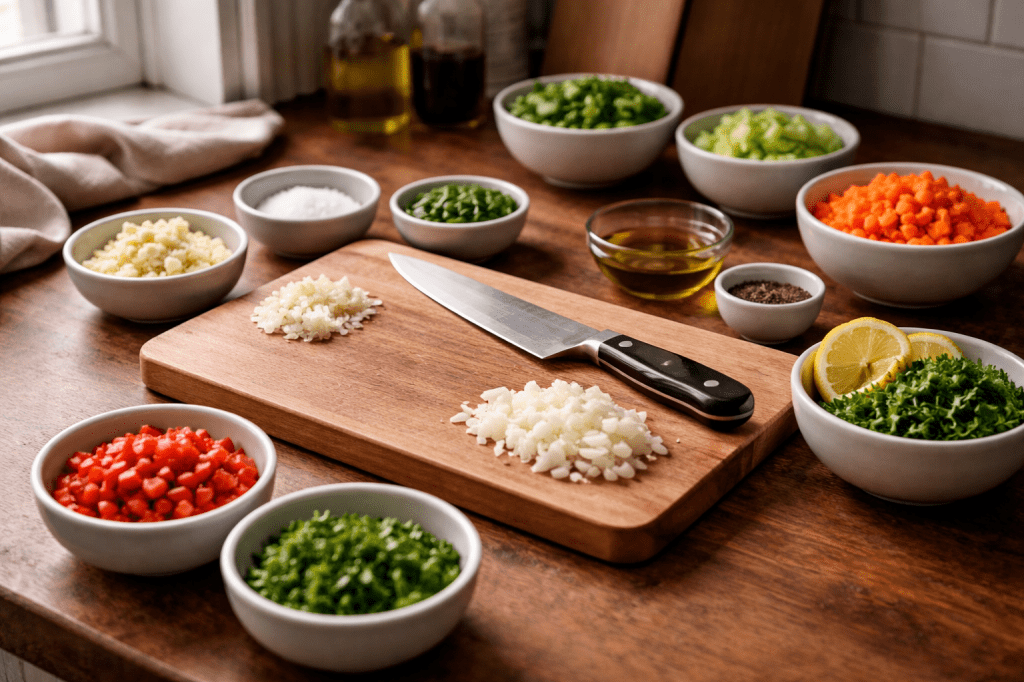
    You start by reading the recipe.

    All of it.

    Not just the parts you think you need.

    Because understanding what’s coming changes how you move.

    Then you gather.

    Everything.

    The obvious ingredients. The small ones. The things you assume you won’t forget—until you do.

    Because you will.

    Then you prepare.

    You chop before the heat starts. You measure while your mind is still clear. You take your time while time still belongs to you.

    And in doing that, something shifts.

    You’re no longer reacting.

    You’re deciding.

    Then you separate. You organize. You place.

    And what you begin to notice is that the space around you starts to feel different.

    Clearer.

    Quieter.

    More intentional.

    Because a cluttered space doesn’t just slow your hands.

    It scatters your thinking.

    And most of us, if we’re honest, didn’t learn how to move through life in an organized way.

    Some of us learned to move quickly.

    To adapt.

    To figure things out in motion because there wasn’t another option.

    So we bring that with us.

    Into the kitchen. Into our work. Into the way we handle pressure.

    That urgency.

    That feeling of being just a step behind.

    Mise en place doesn’t erase that.

    But it offers you another way.

    I recognized this before I understood it.

    In another role. Another environment.

    Setting things up the same way every time. Same tools. Same order. Same rhythm.

    Not because everything would go smoothly.

    But because it wouldn’t.

    Because when pressure rises, your thoughts don’t always arrive the way you need them to.

    But your preparation does.

    Your hands remember.

    The kitchen asks for the same thing.

    Now, when I know I’m about to cook something that matters—a meal that will stretch across days, or one meant to be shared—I don’t wait until the moment begins.

    I start the night before.

    I chop. I portion. I set things aside.

    I make sure everything I need is already there.

    No last-minute store runs.

    No 3-leaving a pot on the stove while I go searching for something I should have already had.

    No panic.

    Just movement.

    Steady. Intentional. Present.

    And the food reflects that.

    Not just in how it tastes.

    But in how it feels to make it.

    Because cooking, when you allow it to be, is a form of care.

    And care does not rush.

    I know people get tired of hearing this.

    They want the shortcut. The quicker way. The version that skips the preparation and still delivers the result.

    But it doesn’t work like that.

    Not in the kitchen.

    Not in anything that matters.

    There are things you can rush.

    Clarity is not one of them.

    Mise en place teaches you that.

    It teaches you that preparation is not wasted time.

    That slowing down is not falling behind.

    That respect—for the process, for what you’re working with, for yourself—changes the outcome in ways you can’t always measure, but you can always feel.

    And maybe that’s why I keep coming back to it.

    Because it’s not just about cooking.

    It’s about choosing not to live in constant reaction.

    It’s about creating space before things begin.

    It’s about giving yourself a chance to meet the moment with something steadier than panic.

    Everything in its place.

    Not because life is perfect.

    But because you’re learning how to move through it with intention.

    And sometimes…

    That’s enough to change everything.

    Kyle J. Hayes

    kylehayesblog.com

    If this found you at the right time,

    Feel free to like, comment, or share it with someone who might need it too.

    Resources for Hard Times

    If you’re looking for practical help, food support, or community resources, you can visit the Salt, Ink & Soul Resources Page.
    👉 Resources for Hard Times

  • The Lessons I Wish Someone Had Taught Me Sooner

    The Lessons I Wish Someone Had Taught Me Sooner

    There’s a certain kind of teaching that doesn’t happen at a chalkboard.

    It happens later in the quiet. When you’re old enough to look back at the boy you were and realize he didn’t need tougher lessons—he needed better language for what he was already carrying. He needed someone to name the weight, not just tell him to lift it. He needed instructions that didn’t feel like shame.

    I write children’s stories, and if you look closely, there’s a lesson tucked inside each one like a warm note in a pocket. People sometimes think that’s cute. Sometimes it is. But it’s also a confession.

    Because the truth is: I’m not only writing for children.

    I’m writing for the younger version of me.

    I’m writing for the boy who kept hearing “you’ll learn the hard way” like it was a rite of passage. Like pain was a badge you earned. Like wasted time was the price of admission. Like you had to bleed to be considered real.

    And maybe that’s the oldest lie we tell boys—that the only education that counts is the kind that bruises.

    I grew up in a world that didn’t always teach feelings the way it taught survival. It taught stamina. It taught silence. It taught the art of looking fine. It taught you how to swallow your own questions whole so nobody would see you chewing.

    And then, later—when you’re old enough to know you’ve been living with a hunger you couldn’t name—you realize what you were missing wasn’t toughness.

    It was guidance.

    The kind that says: Here’s how to be human without hardening into a weapon.

    So I started writing the lessons I wish had been offered to me without the threat attached.

    Not sermons. Not lectures. Just small stories.

    A fox who checks on his friends.

    A quiet day that gives permission to rest.

    A soup that doesn’t look fancy but still warms the room.

    A cloud that doesn’t stay forever but leaves growth behind.

    These aren’t just plots.

    They’re repairs.

    They’re me trying to do something with what I’ve learned, instead of letting it sit inside me as regret.

    Because I’ve learned the hard way. I’ve paid for the information for years. With missteps. With stubborn pride. With the kind of loneliness that doesn’t announce itself—it just rearranges your life until you forget what joy used to sound like.

    There’s a particular kind of waste that hurts the most—not wasted money or missed chances, but wasted time becoming. The years you spend thinking you’re broken, or behind, or unworthy of gentleness. The years you spend trying to earn what should have been given freely: permission to grow.

    That’s why the lessons keep showing up in my stories.

    Not because I believe children are empty and need to be filled, but because children are already full—full of questions, full of fear, full of hope they don’t yet know how to protect. And too often they inherit a world that tells them their softness is a flaw.

    So I write to tell them the opposite.

    I write to tell them that kindness is not weakness. That asking for help is not failure. That being unseen isn’t proof you don’t matter. That the quiet parts of you deserve a home.

    That you can be strong without being cruel.

    That you can become a good man without becoming a hard one.

    And I write to tell the adults reading over their shoulders something too: it’s not too late to offer yourself the lesson you never got. It’s not too late to sit beside the younger version of yourself and say, I see what you went through. You didn’t deserve to go through it alone.

    People sometimes assume empathy is just a personality trait, like eye color. But I think empathy is often the leftover heat from a life that could have gone colder. It’s what happens when you’ve been hurt and decide—quietly, stubbornly—that you don’t want to hand that hurt forward.

    That’s what my stories are.

    My refusal to hand it forward.

    I don’t write because I’m better than anyone. I write because I know what it costs when we don’t have maps. I know what it costs when boys are told that confusion is weakness and tenderness is something to outgrow.

    I know how easy it is to turn “learned the hard way” into an identity instead of a warning.

    I’m trying to offer a different inheritance.

    Not perfection. Not a shortcut around life. Life will still be life—wild, unfair, beautiful, sometimes brutal. But maybe we can spare someone a few needless miles. Maybe we can keep a kid from mistaking pain for a teacher and loneliness for a personality.

    We can help them spend less time surviving and more time becoming.

    That’s the hope under every story I write: that someone—somewhere—will feel seen sooner than I did. That they’ll recognize themselves in a gentle fox or a patient cloud and understand, without being told too bluntly, that they’re allowed to be human.

    And if that happens, even once, then none of this is wasted.

    Not the stories.

    Not the lessons.

    Not even the hard way.

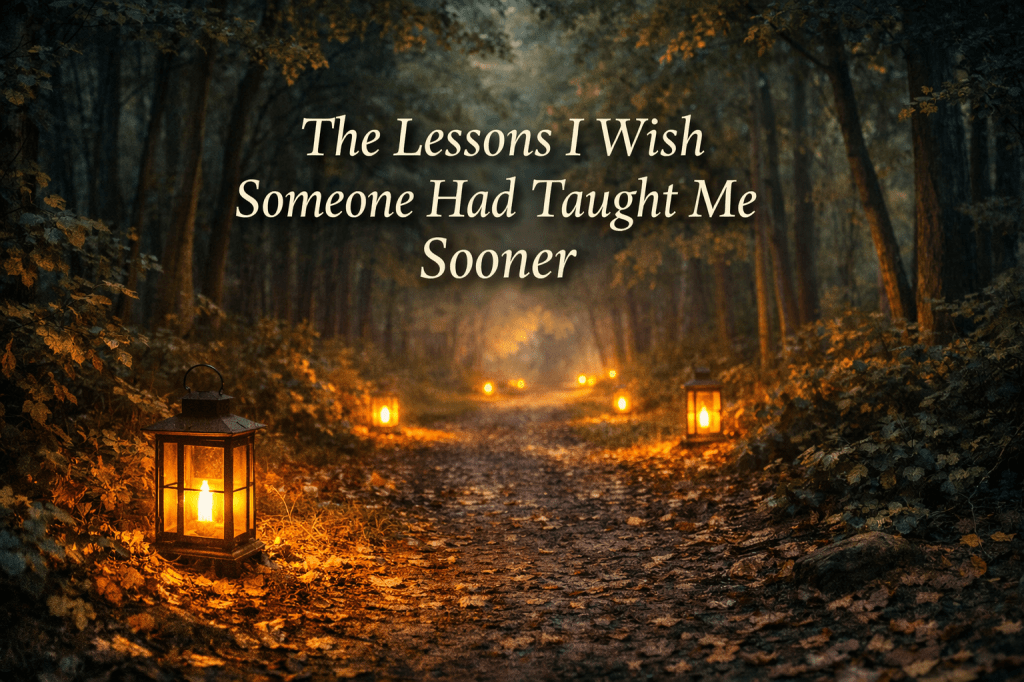
    Maybe that’s what these stories really are — small lanterns placed along the path I once had to walk in the dark.

    If someone younger finds one of them sooner than I did, then the years it took me to learn those lessons won’t have been wasted.

    Kyle J. Hayes

    kylehayesblog.com

    Please like, comment, and share

    Resources for Hard Times

    If you’re looking for practical help, food support, or community resources, you can visit the Salt, Ink & Soul Resources Page.
    👉 Resources for Hard Times

    Links

  • The Weight of Showing Up

    The Weight of Showing Up

    In Two Birds, One Road, I wrote about the quiet importance of simply being there—about how showing up can matter more than any polished speech or perfect gesture. Lately, that truth has pressed heavier against my chest.

    It started with something I saw on television. An airman, just graduated from basic training, stood alone in formation. Families swarmed around others—hugs, laughter, the chaotic joy of reunion. But he stayed rooted in place, scanning the crowd for a face that never appeared. Until a stranger, seeing what should not have been, stepped forward to tap him out. It was an act of kindness, yes, but one born of a glaring absence.

    I know that absence too well.

    When I graduated from high school early, I went straight into the military. On the day of my departure, I sat in an empty house waiting for my recruiter to pick me up. No one hugged me goodbye. No one told me they were proud. I carried my own bags to the bus station, the silence trailing me like a shadow. That kind of loneliness doesn’t leave quickly—it carves out a space in you.

    It’s part of why I try so hard to show up now. To be the kind of presence I once needed. But showing up isn’t always easy for me. Crowds set my nerves on edge. The press of bodies, the overlapping voices, the restless energy—they fray something in me. My instincts tell me to avoid it, to stay in the quiet where I can breathe. And yet, when someone I care about has a moment worth witnessing, I make myself go.

    Sometimes that means gripping the steering wheel tighter than I should, rehearsing what I’ll say when I walk in. It means steadying my breath as I step into a room where the noise swells and my pulse quickens. It means feeling my throat tighten but staying anyway—standing in that space because my discomfort is not more important than their moment.

    I’ve driven to ceremonies, funerals, celebrations—times when joy or grief filled the air so thick it felt almost physical. I’ve stood in crowds with my heart racing, willing my hands not to shake, because I refuse to let the people I care for stand alone.

    Showing up doesn’t erase the mornings I sat by myself, waiting for someone who never came. But it’s how I keep that emptiness from spilling into someone else’s story. It’s how I say: You matter. I am here. 

    Because I know, better than most, that sometimes the greatest gift you can give is your presence—uncomfortable, nervous, imperfect, but real.

    By Kyle J. Hayes

    kylehayesblog.com

    Please like, comment, and share