Tag: love

  • The Weight of Staying

    The Weight of Staying

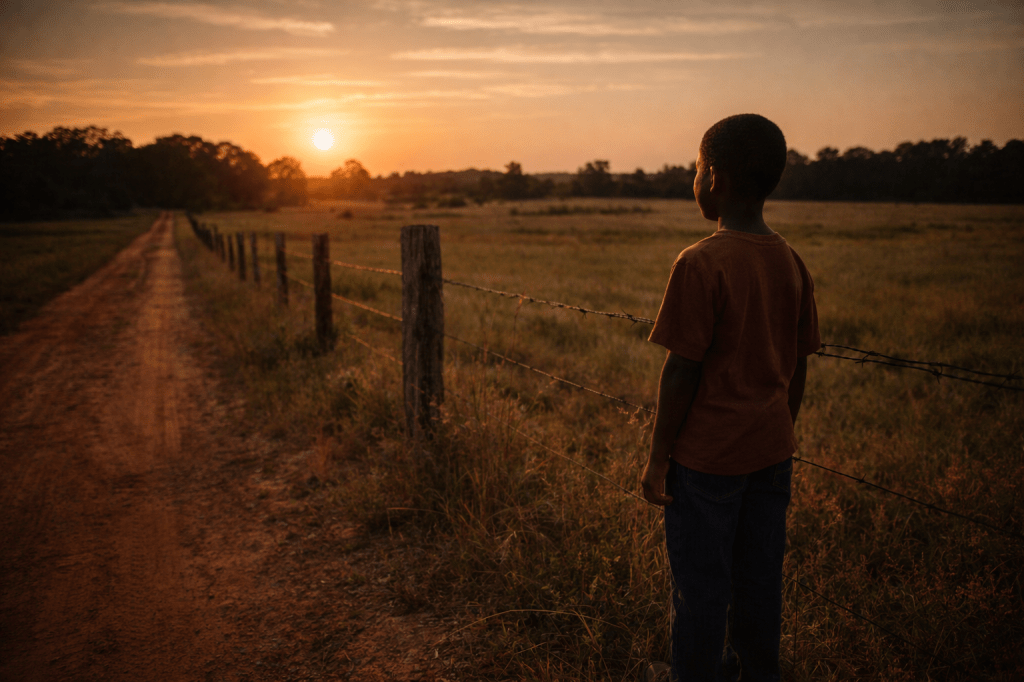
    Kofi lived in the low, breathing cradle of a Southern town where the sun didn’t just rise—it pressed.

    It leaned into the red dirt and the wooden porches, into the backs of people who worked outside because that’s what their lives required.

    The town wasn’t large. It didn’t need to be.

    Every face carried history.

    Every house leaned a little with age, like it had listened to too many stories and decided to rest into them.

    The land itself felt watched over, not owned—held carefully, as something fragile and sacred is.

    Kofi spent his days moving through open fields and fence lines, helping his family tend what little they had: a few animals, a garden, the kind of labor that teaches a boy where his strength ends and his patience must begin.

    He learned the rhythm of the place—the slow insistence of heat, the way time stretched instead of rushed.

    His father was a quiet man.

    Not the kind who filled rooms with speeches, but the kind whose words stayed with you because they were never wasted.

    “To live right,” his father told him once, leaning against a fence post worn smooth by generations of hands, “is to stand straight even when nobody’s watching.

    Especially then.”

    One afternoon, a stranger came into town.

    He arrived in a clean truck that looked too new for the road it traveled, carrying papers instead of tools. He spoke of opportunity. Of development. Of progress.

    He pointed at maps and lines drawn where lives already existed.

    He talked about money the way some people talk about salvation.

    The town gathered.

    Some listened closely.

    Some crossed their arms.

    Everyone felt the weight of the moment, even if they didn’t yet know how to name it.

    The land he wanted wasn’t empty. It was layered—with memories, with loss, with people who had already been moved once before in stories their grandparents told quietly.

    Kofi stood at the edge of the crowd, absorbing more than anyone realized.

    The stranger noticed him.

    Later, away from the others, the man crouched down and handed Kofi something small and shining.

    A token.

    A promise wrapped in metal.

    “Just tell them it’s good,” the man said softly. “They’ll listen to you.”

    Kofi felt the pull of it—the way temptation doesn’t shout but suggests.

    The way it pretends to be harmless.

    He remembered his father’s voice.

    Calm.

    Certain.

    Unbending.

    When the moment came, Kofi stepped forward.

    His hands trembled, but his feet held.

    “This land,” he said, his voice carrying farther than he expected, “isn’t just dirt. It’s where our people learned how to stay. It’s where they buried what they lost and planted what they hoped for.

    You can’t sell something that’s still holding us up.”

    The town grew quiet.

    Not shocked.

    Not dramatic.

    Just still—like something important had been named out loud.

    The stranger gathered his papers.

    He left the same way he came, promises evaporating in the heat.

    Kofi didn’t feel proud the way stories sometimes pretend you should.

    He felt steady.

    Anchored.

    As if he had chosen to belong rather than to escape.

    That evening, his father sat beside him without speaking for a long while.

    Then he nodded once.

    Integrity, Kofi learned, wasn’t loud.

    It didn’t glitter.

    It didn’t offer shortcuts.

    It was the decision to stay rooted when leaving looked easier.

    To speak truth even when silence offered comfort.

    And as Kofi grew, the town grew with him—not richer, not shinier—but intact.

    Still standing.

    Kyle J. Hayes

    kylehayesblog.com

    Please like, comment, and share

    Resources for Hard Times

    If you’re looking for practical help, food support, or community resources, you can visit the Salt, Ink & Soul Resources Page.

    👉 Resources for Hard Times

  • I Cook. I Am Not a Chef.

    I Cook. I Am Not a Chef.

    I Cook.

    I say that carefully, almost defensively, the way someone says I write but refuses the title that would make it sound like a performance. I cook, but I am not a chef. Not because I lack skill, but because I reject what that word has come to mean—at least in the way it’s been packaged, televised, plated, and praised.

    Turn on a screen or scroll long enough and you’ll find yourself staring at a meal made by someone with a coat, a pedigree, and an accent—something arranged with tweezers, built from ingredients you have to Google, let alone locate. The lighting is perfect. The language around it is reverent. The price is astronomical.

    And somewhere in the middle of all that spectacle, a quiet question tries to form:

    Does this feed anyone?

    Not the ego. That’s already been fed.

    Not the reputation. That’s the point.

    I mean the body. The soul. The tired person who’s been chewed up by the world and needs something warm, steady, and honest to bring them back to themselves.

    What Food Is Supposed to Do

    Food is meant to do two things at once.

    It should send you out into the world strong, grounded, nourished, capable of standing upright in whatever waits for you. And it should welcome you home, comforting you after the world has taken its cut.

    A good meal says, Sit down. You made it. You’re safe here for a moment.

    Too much of what passes for “great food” today does neither.

    Some of these five-star, white-tablecloth experiences leave you not with fullness, but with confusion. You spend the first five minutes asking how you’re supposed to eat it. The next five are asking what it even is. And the last few wondering, was that it?

    A smear.

    A foam.

    A reduction of something that once had a spine.

    You leave with a taste and a question mark. No warmth. No grounding. No sense that your body was actually consulted in the process.

    When Difficulty Gets Mistaken for Care

    Then come the reviews.

    Long, florid essays written by people who seem less interested in being fed than in proving they understood the meal. As if complexity itself were nourishment. As if difficulty were virtue. As if decoding were the same thing as being cared for.

    Sometimes I suspect those reviews exist not to describe the food, but to inflate it—to stretch a small experience into something larger than it was. To reassure the diner, the chef, and the culture that the emperor’s plate is, in fact, wearing clothes.

    About That Word “Chef”

    Maybe the problem starts with the word chef itself.

    At its root, a chef is a person trained in traditional French cooking. That’s not an insult. It’s a definition. But definitions matter—especially when they quietly turn into hierarchies.

    And here’s where I say the thing that makes people uncomfortable:

    I do not believe the French know how to cook.

    Not in the way that matters to me.

    They drown everything in sauce, then congratulate themselves for having learned how to drown properly. Technique over instinct. Presentation on nutrition. Control over generosity. The dish becomes a demonstration rather than an offering.

    The sauce isn’t always there to enhance. Sometimes it’s there to hide—to obscure the fact that without it, the food has nothing to say.

    What troubles me more is how that tradition looks down on everything that didn’t come from Europe—especially the cuisines built without academies, without written rules, without approval. The foods made by people who cooked because they had to. People who turned scraps into sustenance. Who learned flavor not from textbooks, but from hunger, memory, and survival.

    The Truth Told by Bread

    Ironically, the best thing to come out of France isn’t a sauce at all.

    It’s bread.

    The baguette.

    The food of the poor.

    Flour. Water. Yeast. Time. Crisp crust. Soft interior. No performance. No confusion. No question about what it is or what it’s for.

    You tear it.

    You eat it.

    You’re fed.

    Perfect in its simplicity.

    And that tells the truth the rest of the cuisine tries to avoid.

    The Lineage I Claim

    The true food of any people comes from those who make something out of nothing. From those who cook not to impress, but to sustain. From kitchens where the question isn’t Is this innovative? But will this carry us through the night?

    That’s the lineage I claim.

    I cook food meant to hold you together. Food that understands fatigue. Food that doesn’t need a narrator. Food that respects the eater enough not to turn them into an audience.

    When I cook, I’m not trying to challenge you.

    I’m trying to care for you.

    I want the meal to say, You don’t have to think so hard right now. I want it to meet you where you are—hungry, worn down, hopeful, human.

    Good food doesn’t leave you with questions.

    It leaves you with strength.

    It leaves you with comfort.

    It leaves you ready to go back out into the world—or prepared to rest from it.

    So no, I’m not a chef.

    Cooking is an act of hospitality, not hierarchy. An offering, not a performance. A quiet declaration that survival deserves pleasure—and pleasure doesn’t need permission.

    And if that means my food will never be plated with tweezers or praised in paragraphs, so be it.

    The people I cook for don’t need convincing.

    They just need to be fed.

    Kyle J. Hayes

    kylehayesblog.com

    Please like, comment, and share

    Resources for Hard Times

    If you’re looking for practical help, food support, or community resources, you can visit the Salt, Ink & Soul Resources Page.

    👉 Resources for Hard Times

  • On February 14, and the Myth of Being Chosen

    On February 14, and the Myth of Being Chosen

    Tomorrow, the world will bloom red.

    Restaurants will fill.

    Phones will glow.

    Flowers will be delivered with little folded cards that say what some of us wish had been said years ago.

    And if you are coupled, I hope it feels warm. I hope it feels earned. I hope the love beside you is steady and kind.

    But if you are alone tomorrow, I want to say something gently:

    Being single is not a verdict.

    February 14 has a way of turning solitude into suspicion. As if love were a draft and some of us simply weren’t picked. As if being chosen by another person were the highest confirmation of our worth.

    It isn’t.

    Some of us are in the middle of becoming.

    Some of us are healing.

    Some of us are learning how not to confuse intensity for intimacy.

    Some of us are finally strong enough to wait for something healthy.

    And waiting is not a weakness.

    There is a quieter love that doesn’t trend.

    The love of cooking a meal for yourself and sitting down without distraction.

    The love of calling your mother.

    The love of forgiving your younger self.

    The love of walking away from what almost fit.

    We don’t talk about that love enough.

    We celebrate spectacle. The bouquet. The dinner reservation. The filtered photos.

    But real love — the kind that lasts — is patient. It is disciplined. It is often invisible before it is public.

    And sometimes, the bravest thing a person can do is refuse to rush into something just to silence the loneliness.

    If tomorrow feels light and joyful for you, hold it with gratitude.

    If it feels heavy, hold yourself with the same tenderness you would offer someone you care about.

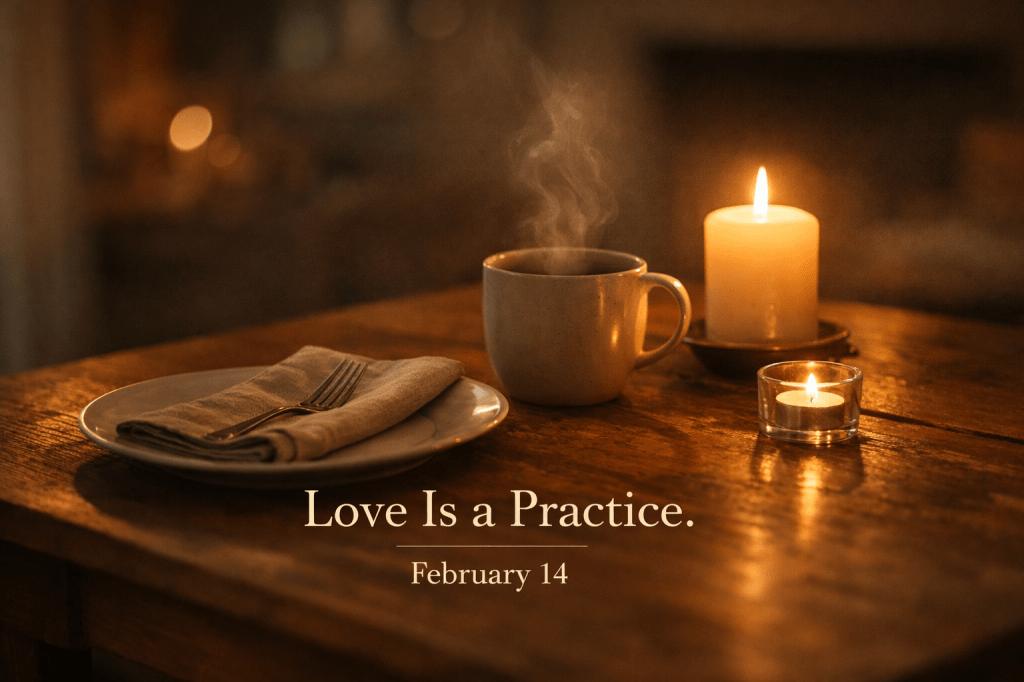
    Love is not a holiday.

    It is a practice.

    And no matter your relationship status, you are not behind. You are not unfinished. You are not unchosen.

    You are becoming.

    And that is enough.

    Kyle J. Hayes

    kylehayesblog.com

    Please like, comment, and share

    Resources for Hard Times

    If you’re looking for practical help, food support, or community resources, you can visit the Salt, Ink & Soul Resources Page.
    👉 Resources for Hard Times

  • Breakfast Pizza

    Breakfast Pizza

    Saturday cooking carries a different kind of permission. There’s no need to optimize or behave. No reason to keep things spare. Breakfast pizza lives in that space — playful, familiar, and generous. It’s built on a crust you already trust, topped with things you already love, and meant to be sliced, shared, and eaten without apology.

    This isn’t reinvention.

    It’s reuse with confidence.

    Breakfast pizza says: we’re still cooking at home — we’re just allowed to smile about it.

    Why This Works

    • Uses your existing pizza crust recipe
    • Familiar breakfast ingredients, easy to customize
    • Feels special without becoming a project
    • Perfect for slow Saturdays and shared tables

    Recipe Details

    Serves: 4–6

    Prep Time: 15 minutes

    Cook Time: 12–15 minutes

    Total Time: About 30 minutes

    Ingredients

    Base

    • 1 prepared pizza crust (your existing recipe, par-baked if needed)
    • Olive oil, for brushing

    Toppings

    • 6–8 large eggs
    • ½ lb breakfast sausage or bacon, cooked and crumbled
    • 1½–2 cups shredded cheese (mozzarella, cheddar, or a blend)
    • Salt and cracked black pepper, to taste

    Optional Add-Ins

    • Sautéed onions
    • Wilted spinach or arugula
    • Scallions
    • Roasted peppers
    • Hot honey or chili oil, for finishing

    Instructions

    1. Preheat the oven

    Preheat oven to 425°F, or to the temperature recommended by your pizza crust recipe.

    If your crust requires par-baking, do that first.

    2. Prepare the eggs

    In a bowl, lightly whisk the eggs with a pinch of salt and cracked black pepper.

    You’re not cooking them thoroughly — just breaking them up so they spread evenly.

    (For a softer finish, you can also crack whole eggs directly onto the pizza instead.)

    3. Assemble the pizza

    Place the prepared crust on a baking sheet or pizza stone.

    Brush lightly with olive oil.

    Sprinkle half the cheese evenly over the crust.

    Add the cooked sausage or bacon.

    Spoon the eggs evenly across the pizza.

    Top with the remaining cheese.

    4. Bake

    Bake for 12–15 minutes, until:

    • The crust is golden
    • The cheese is melted and bubbling
    • The eggs are just set

    If using whole cracked eggs, keep an eye on the yolks so they stay soft.

    5. Finish and serve

    Remove from the oven and let rest for 2–3 minutes.

    Finish with:

    • freshly cracked black pepper
    • sliced scallions
    • or a light drizzle of hot honey or chili oil

    Slice and serve warm.

    Notes

  • What Would He Think of the Dream Now?

    What Would He Think of the Dream Now?

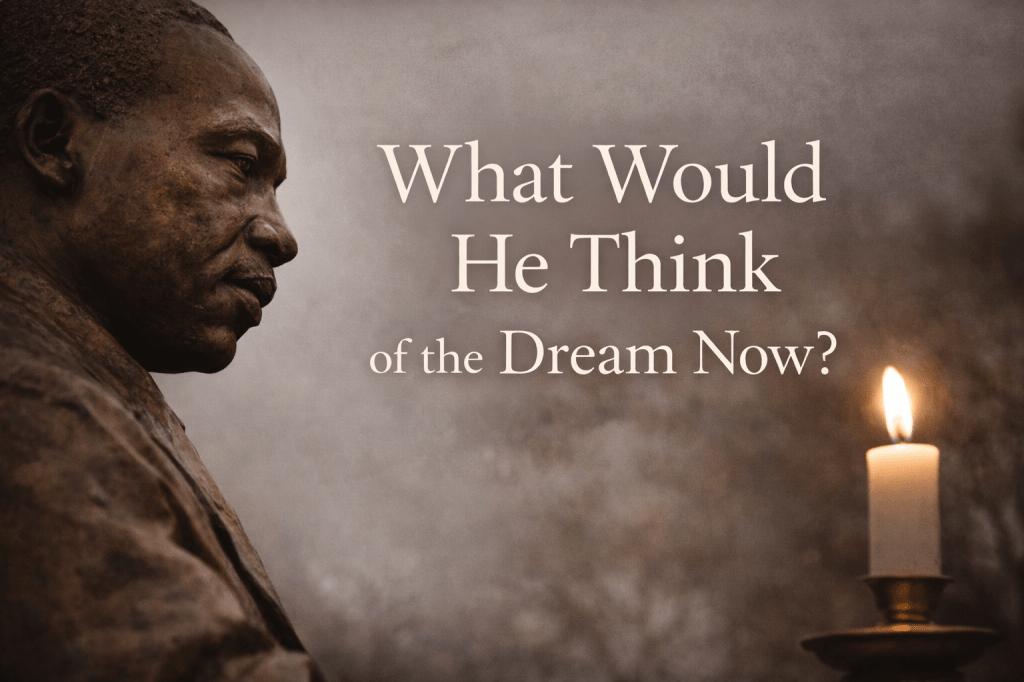
    Today, we celebrate the birthday of a man who gave so much of himself that there was nothing left to take.

    A man who understood—long before the rest of us were ready to admit it—that speaking the truth in a country built on denial comes with a cost. A man who seemed to know, on some level, where the road he was walking would end, and chose to walk it anyway.

    As I look around today, I find myself wondering what he would think.

    Not in a ceremonial way.

    Not in a quote-for-the-day way.

    But honestly.

    Would he still have the same dream?

    Would he look at his people—their survival, their brilliance, their contradictions, their victories, and their wounds—and feel pride? Relief? Concern? All of it braided together?

    Would he believe the dream survived him?

    Or would he recognize it for what it has always been: unfinished work.

    What many people forget—or choose not to remember—is that his vision was never narrow. He did not fight for a single group at the expense of others. He fought for all who were crushed beneath unfair systems: Black and white, poor and working, seen and ignored. He stood against injustice itself, not just the version that wore familiar faces.

    That kind of fight costs more than slogans admit.

    As I sat wondering what to write today, I found myself at a loss. Not because there was nothing to say, but because the weight of the man and the moment does not lend itself easily to neat paragraphs. So I went back and learned again.

    I learned again about the discipline of nonviolence—not the softened version we like to remember, but the demanding one. The kind that requires you to absorb blows without letting your spirit turn brittle. The kind that asks you to restrain your hand even when your body is screaming to defend itself.

    That kind of restraint does not come naturally.

    It has to be practiced.

    I learned again how often he was arrested. How frequently he was removed from the streets not because he was wrong, but because he was effective. How some of his most enduring words were written while confined—stripped of movement, forced into stillness.

    Something is sobering about that.

    A reminder that confinement has never stopped truth from finding its way onto paper. That history’s sharpest insights are often written by people who were told to sit down and be quiet.

    And while others preached more aggressive paths—paths that made sense, paths that spoke directly to rage—he held to peace. Not because he was unfamiliar with anger, but because he understood what it could become if left unguided.

    That choice cost him credibility with some. It cost him patience with others. It cost him comfort. And eventually, it cost him his life.

    Which brings me back to the question I can’t quite put down:

    What would he think now?

    Would he be encouraged by the doors that have opened?

    Would he be troubled by the ones that quietly closed behind us?

    Would he recognize progress—and still point out how uneven it remains?

    I don’t believe he would be surprised by our divisions. He knew human nature too well for that. And I don’t think he would be shocked by our impatience either. When you’ve waited generations for justice, patience becomes a complicated request.

    But he would ask us something uncomfortable.

     Are you angry?

    But what are you building with that anger?

     Have you suffered?

    But have you learned how to keep your suffering from hardening your heart?

    Because the dream was never about perfection.

    It was about direction.

    About bending the arc—not snapping it in half. About insisting on dignity even when the world refuses to recognize it. About believing that the measure of a society is not how loudly it celebrates its heroes, but how faithfully it carries their work forward when they are gone.

    Today, we celebrate his birth. But birthdays are not only about candles and remembrance. They are about legacy—about what continues because someone once chose courage over safety.

    So the better question isn’t what he would think of us.

    The question is what we think of ourselves in light of what he gave.

    Are we still committed to fairness when it is inconvenient?

    Are we still willing to restrain ourselves from becoming what we oppose?

    Are we still able to imagine a future that extends beyond our own survival?

    Nonviolence, at its core, was never passive.

    It was active care.

    Care for the soul of a people.

    Care for the future they would have to live in.

    Care for the possibility that justice, pursued without hatred, might actually last.

    That kind of care is exhausting.

    And maybe that is why his life still speaks.

    Because it reminds us that change does not come from comfort. That the work is never finished. That the dream was not a destination, but a responsibility handed forward.

    Today, on his birthday, we are not asked to rehearse his words or turn his life into a symbol we can safely admire from a distance. We are asked something more complex and more honest: to sit with the cost of what he chose, to recognize that nonviolence was not comfort but discipline, not silence but intention.

    To consider whether we are still willing to be shaped by a dream that demands more than applause.

    A dream like that does not survive on remembrance alone. It survives only if someone, somewhere, decides—quietly and without cameras—to carry it forward.

    Kyle J. Hayes

    kylehayesblog.com

    Please like, comment, and share

    Resources for Hard Times

    If you’re looking for practical help, food support, or community resources, you can visit the Salt, Ink & Soul Resources Page.

    👉 Resources for Hard Times

  • Sweet Cornmeal Pancakes with Honey Butter

    Sweet Cornmeal Pancakes with Honey Butter

    These pancakes sit somewhere between breakfast and memory. Cornmeal gives them texture and weight — not heavy, just honest. They’re the kind of pancakes that don’t collapse under syrup, that hold warmth a little longer, that feel like something meant to last through a slow morning.

    Cornmeal stretches what you have. It always has. And here, it does so quietly, turning a simple batter into something worth lingering over.

    Recipe Details

    Serves: 4

    Prep Time: 10 minutes

    Cook Time: 15 minutes

    Total Time: About 25 minutes

    Ingredients

    Pancakes

    • 1 cup cornmeal
    • 1 cup all-purpose flour
    • 2 tbsp sugar
    • 2 tsp baking powder
    • 1½ cups milk or buttermilk
    • 1 large egg
    • 2 tbsp oil or melted butter

    Honey Butter (for serving)

    • Softened butter
    • Honey
    • Pinch of salt

    Instructions

    1. Mix the dry ingredients

    In a large bowl, whisk together:

    • cornmeal
    • flour
    • sugar
    • baking powder

    Whisk until evenly combined.

    2. Mix the wet ingredients

    In a separate bowl, whisk together:

    • milk (or buttermilk)
    • egg
    • oil or melted butter

    3. Make the batter

    Add the wet ingredients to the dry ingredients.

    Stir gently just until combined.

    The batter should be thick but pourable.

    If it feels too stiff, add a splash more milk.

    4. Cook the pancakes

    Heat a lightly oiled skillet or griddle over medium heat.

    Pour about ¼ cup batter per pancake onto the hot surface.

    Cook until bubbles form, and the edges begin to set, about 2–3 minutes.

    Flip and cook another 1–2 minutes, until golden and cooked through.

    5. Serve

    Serve warm with a pat of honey butter melting over the top.

    Honey Butter (Quick Mix)

    Stir together:

    • softened butter
    • honey
    • pinch of salt

    Adjust sweetness to taste.

    Budget Tip

    Cornmeal adds texture and stretches the flour — a small shift that feeds more people with the same pantry. Leftover batter can be poured into muffin tins and baked for quick cornbread muffins later in the week.

  • A Quiet Thank You at Year’s End

    A Quiet Thank You at Year’s End

    There are twenty of you here—readers who chose to subscribe, to return, and to spend time with this blog over the past year. That number may look small from the outside, but it doesn’t feel small to me. It means that twenty people, in a world that’s moving faster every day, chose to slow down and read words without being in a hurry.

    This year, Salt, Ink & Soul became a place I didn’t fully understand until I was already inside it. A place where food could carry memory without needing to justify itself. Where children’s stories could sit beside reflections on grief, resilience, and the quiet weight of being human. Where the idea of “enough” could be asked gently, without demanding an answer right away.

    Some of you read every post.

    Some of you arrive when a title catches something familiar.

    Some of you read quietly, without ever commenting or leaving a trace.

    All of that is welcome here.

    What I’ve learned this year is that writing doesn’t have to shout to be heard. It only has to be honest. Showing up—again and again—even when the words come slowly, even when the questions remain unfinished, has felt like its own kind of discipline. And knowing readers are willing to sit with that uncertainty has meant more than I can adequately say.

    If you’re reading this as a subscriber, thank you for choosing to stay. Thank you for trusting this space enough to let it arrive in your inbox. Your presence—steady, patient, unassuming—has helped shape what this place is becoming.

    And if you’re reading this for the first time, know this: this is a quiet corner. A place for stories about food, memory, children, and the small moments that often get overlooked. You’re welcome here, whether you pass through once or decide to stay awhile.

    As the year turns, I don’t have grand promises. What I do have is intention. I’ll keep writing. I’ll keep paying attention. I’ll keep trying to make this space feel warm, thoughtful, and human—a place where reflection can breathe.

    Thank you for being here at the beginning. Thank you for reading slowly. Thank you for taking the time to read words written with care.

    If there’s a story you’re still waiting for, or a question you carry quietly, I hope you’ll continue to walk through this space with me. There will be more stories ahead, more moments to sit with, more chances to pause together—and I’m grateful for every reader who chooses to return.

    With gratitude and hope

    Kyle Hayes

    Salt, Ink & Soul

    If you’d like to spend more time with these themes, my books explore food, memory, resilience, and emotional truth in greater depth.

    Explore the books here → Felix collections or on Amazon

  • If You’re Going to Be Something, Be the Best

    If You’re Going to Be Something, Be the Best

    When I was young, my mother used to say things that felt like knives wrapped in wisdom. Sharp. Precise. And always cutting a little too close to the bone.

    “If you’re going to be something,” she said once, “be the best. If you’re going to be a thief, be the best thief.”

    I remember sitting there, seething—convinced she was calling me a failure in advance, like she saw a mugshot waiting in my future. I was a dramatic child, sure. But I also heard the world louder than most, and in her tone I thought I heard the echo of disappointment.

    It took years—decades, really—for me to understand that she wasn’t predicting my downfall.

    She was warning me about mediocrity.

    About sleepwalking through life.

    About the quiet tragedy of wasting whatever small fire was burning inside me.

    Craft, Seen and Unseen

    My Uncle Michael understood this before I did.

    He was the janitor at my elementary school—a man whose name most kids probably never knew. But I knew him. I knew the way his shirts were always pressed, his shoes always were always shined, the faint smell of Pine-Sol that followed him like a badge of honor.

    He wasn’t just cleaning floors.

    He was restoring order to chaos, one hallway at a time.

    That school gleamed. The floors reflected the ceiling lights like calm water. Even as a kid, I could tell that he took pride in what most people never noticed.

    Years later, I heard he started his own cleaning company. Built something from nothing. Took what the world might have dismissed and made it into a craft.

    That’s the word that sticks with me now.

    Craft.

    Learning to Show Up

    I didn’t realize it at the time, but when I sat alone in my room scribbling stories, I was chasing the same truth my uncle had already mastered.

    The art of showing up.

    The quiet dignity of repetition.

    The beauty of care.

    I thought I was just escaping—drawing worlds because the real one felt too heavy. But now I see it.

    Every sentence was me learning how to hold a broom, so to speak.

    Every paragraph, another hallway swept clean of doubt.

    My mother’s words echo differently now.

    If you’re going to be something—be all the way in.

    Don’t just stand at the doorway of your own potential, waiting for someone else to invite you through.

    Keep Showing Up

    Because the world will always give you a reason to stop.

    It’ll whisper that you’re too late.

    Too tired.

    Too small.

    Too unimportant.

    But the work—your work—doesn’t care about any of that.

    It only asks that you keep showing up.

    So this is what I tell myself now:

    If you’re going to be something, be the best.

    If you’re going to write, write until your fingers hurt and your heart feels seen.

    If you’re going to clean, make the floor shine like truth.

    If you’re going to live, live like the world is watching—even when it’s not.

    Somewhere between my mother’s harsh tone and my uncle’s quiet excellence, I found my own reflection.

    And maybe that’s what this whole life is about—not becoming what they wanted you to be, but becoming what they were trying to show you all along.

    Not perfection.

    Just presence.

    Just care.

    Just the craft.

    Kyle J. Hayes

    kylehayesblog.com

    Please like, comment, and share

    Resources for Hard Times

    If you’re looking for practical help, food support, or community resources, you can visit the Salt, Ink & Soul Resources Page.

    👉 Resources for Hard Times

    Want to Go Deeper?

    If you’d like to spend more time with these themes, my books explore food, memory, resilience, and emotional truth in greater depth.

    👉 [Explore the books here →] Felix book collection

  • I Wonder How

    I Wonder How

    The snow fell in slow spirals outside the dimly lit bar, where three men sat around the same scarred oak table they had claimed for nearly a decade.

    Every Christmas Eve, without fail, they gathered—not for family, not for faith, but for the impossible question that kept them human.

    “How does he do it?” the artist said, brushing paint flecks from his fingers as if they were stardust. “How does one being deliver joy to billions in one night?”

    The engineer chuckled, swirling the ice in his glass. “You mean how he could do it. There’s a difference between wonder and logistics.”

    The physicist adjusted his glasses, his eyes reflecting the amber light of the bar’s tiny bulbs. “Or perhaps you mean: how could we ever understand it?”

    They clinked glasses.

    Tradition began.

    The Artist’s Theory: The Magic of Belief

    The artist leaned forward, voice low and fervent.

    “You’re both missing the point. Santa doesn’t deliver gifts because of physics or mechanics—he delivers because he exists where belief still lives. Each child who imagines him gives him form, and that collective imagination becomes his sleigh, his speed, his magic.”

    The engineer rolled his eyes. “So you’re saying it’s powered by… dreams?”

    “Not dreams—faith,” the artist replied. “Not in a man, but in what he represents. Every painted card, every glowing ornament, every whispered wish is an act of creation. The laws of art and emotion are stronger than any law of thermodynamics.”

    The physicist tilted his head, intrigued despite himself.

    “You’re saying belief collapses probability into existence—like a kind of human-driven wave function.”

    The artist smiled. “Exactly. Magic isn’t the opposite of science. It’s the poetry of it.”

    For a moment, all three sat silent, letting that notion settle like dust on candlelight—the idea that wonder itself could move matter.

    The Engineer’s Theory: The Machinery of Miracles

    The engineer cracked his knuckles and set his glass down.

    “Alright, my turn. No offense to your ‘poetry,’ but the only way to deliver that many packages is through an automated system on an impossible scale.”

    He began sketching on a napkin—tiny sleighs branching from one great mothership like snowflakes from a storm cloud.

    “Imagine a global delivery network built centuries ahead of its time. Millions of drones, each guided by data—weather patterns, children’s locations, behavioral algorithms. The sleigh’s just a symbol. The real Santa is an entire system of precision.”

    The artist frowned. “That sounds cold. Heartless.”

    “Not heartless,” the engineer said softly. “Efficient. The greatest gift humanity ever built wasn’t the sleigh—it was coordination. Santa isn’t one man. He’s the sum of our capacity to create order out of chaos.”

    The physicist smiled faintly. “A machine of goodwill.”

    “Exactly,” the engineer said. “A machine that runs not on gears or wires—but on intention. Every parent who wraps a present, every neighbor who donates a coat, they’re all nodes in the network. Each act of kindness becomes an operation in a vast machine that never stops working.”

    For a moment, even the artist nodded.

    There was something beautiful in the practicality of it—the poetry of precision.

    The Physicist’s Theory: The Paradox of Time

    When it was his turn, the physicist spoke with the quiet certainty of someone who had seen equations that could unmake worlds.

    “You’re both right,” he said. “But you’re both limited by the assumption that time moves forward.”

    He drew three lines on his coaster.

    “One moment, he’s in New York. Next, Tokyo. But what if time isn’t linear for him? What if his sleigh doesn’t move through time, but across it—like a needle weaving through a tapestry?”

    The engineer raised an eyebrow. “A temporal loop?”

    “Exactly,” said the physicist. “He delivers gifts in a single eternal instant—a quantum superposition of giving. To us, it appears as one night. To him, it’s… forever.”

    The artist whispered, “That’s lonely.”

    The physicist nodded, staring into his untouched drink.

    “Perhaps. To bring joy to every child, he must live in the stretch between seconds, never aging, never resting. An immortal bound by kindness—not by choice, but by consequence.”

    They sat with that thought.

    The bar’s jazz faded into silence.

    Snow pressed against the windows like quiet applause.

    The Farewell

    Eventually, the clock struck midnight. The bartender flipped the Closed sign, and the three men stood.

    Outside, the world glowed soft and white.

    The artist pulled his coat close. “You think he’s out there now?”

    The engineer shrugged. “If he is, he’s right on schedule.”

    The physicist smiled faintly. “Or maybe he’s always been.”

    They stood together for a heartbeat longer—three fragments of human thought, bound by ritual, mystery, and the stubborn need to believe.

    The artist extended his hand. “Same time next year?”

    The engineer clasped it. “Same bar.”

    The physicist joined them, a slight grin forming.

    “Same question.”

    They parted in three directions—into the falling snow, into the hum of unseen machinery, into the quiet folds of time—each carrying a piece of wonder they couldn’t prove, yet refused to let die.

    And somewhere, in that eternal instant between belief and logic, a sleigh bell rang once—clear and bright.

    Merry Christmas

    Kyle J. Hayes

    kylehayesblog.com

    Please like, comment, and share

    Resources for Hard Times

    If you’re looking for practical help, food support, or community resources, you can visit the Salt, Ink & Soul Resources Page.

    👉 Resources for Hard Times

  • Light the Candle Anyway

    Light the Candle Anyway

    I like Christmas.

    I like the lights strung too tightly across porches, the decorations that appear overnight as if the neighborhood agreed on a quiet truce with darkness. I like the music—some of it at least—and the movies most of all. The old ones. The ones that arrive every year like familiar witnesses, reminding you that time keeps moving whether you’re ready or not.

    I genuinely like these things.

    All of them.

    And still, something is missing.

    There’s supposed to be a warmth that comes with this season, a fullness that settles somewhere in the chest, a feeling people speak about as if it’s inevitable—like snowfall or sunrise. But for me, that space feels hollow. Not empty exactly. More like a room that remembers being lived in, but hasn’t been occupied in a long time.

    I’ve noticed that absence more acutely as the years pass. Christmas doesn’t hurt.

    It just… echoes.

    The Space Between

    For a long time, I responded to that hollowness by quietly opting out.

    No decorations.

    No tree.

    No deliberate effort to invite the season inside my walls.

    Not out of bitterness—just a kind of emotional economy. Why set a place at the table for a feeling that might not show up?

    But this year, something shifted.

    Not dramatically. Not with a revelation or a promise to feel differently. Just a small, stubborn thought that kept returning, dressed up as a borrowed line from a movie I’ve carried with me for decades:

    If I build it, it will come.

    So this year, I’m decorating.

    Not because I suddenly feel festive.

    Not because joy has arrived early and knocked politely.

    But because sometimes hope isn’t about how you feel—it’s about what you do anyway.

    Choosing Hope Without Demanding Joy

    There’s an unspoken rule around the holidays: you’re supposed to feel something specific.

    Gratitude.

    Warmth.

    Cheer.

    A sense of completion.

    And if you don’t, it can feel like a personal failure—like you missed a memo everyone else received.

    But Christmas Eve, if you really look at it, isn’t about arrival.

    It’s about waiting.

    It’s the night before. The space between. The moment when nothing has happened yet, and that’s precisely the point. Christmas Eve doesn’t ask you to open gifts, sing loudly, or prove anything.

    It asks you to sit with anticipation—however fractured that anticipation might be.

    For some people, that anticipation is joyful.

    For others, it’s complicated.

    For many, it’s heavy with memory, absence, and unfinished grief.

    And still, the night remains.

    The Candle

    That’s where the Candle comes in.

    Lighting a candle isn’t a declaration of happiness. It isn’t a performance of belief or a promise that everything is fine. It’s an acknowledgment of darkness—and a refusal to let it have the final word.

    A candle doesn’t banish the night.

    It simply says:

    I’m still here.

    The Quiet Work of Building Something First

    I haven’t decorated my home in years. Not because I hate the season, but because I didn’t want to confront the gap between what Christmas is supposed to feel like and what it actually feels like inside me.

    Decorating means effort.

    It means intention.

    It means admitting you want something to happen—even if you’re not sure it will.

    This year, I’m doing it anyway.

    Not as a ritual of joy, but as an act of survival.

    I’m hanging lights not because my heart is full, but because it isn’t. I’m placing decorations not to summon nostalgia, but to acknowledge that I’m still capable of making space. Still willing to try. Still open enough to say, maybe.

    Maybe warmth doesn’t arrive on its own.

    Maybe it needs scaffolding.

    Maybe it needs permission.

    Or maybe it never comes at all—and the effort still matters.

    Because the real loss isn’t failing to feel the right thing.

    It’s giving up on the possibility of feeling anything.

    Holding Space

    Christmas Eve doesn’t need you to be joyful.

    It needs you to be present.

    It needs you to recognize that choosing hope doesn’t always look like celebration. Sometimes it looks like lighting a candle in a room that feels too quiet and letting that small flame testify on your behalf.

    Sometimes hope is understated.

    Sometimes it’s tired.

    Sometimes it shows up without confidence.

    But it shows up.

    And tonight, that’s enough.

    If your heart feels full, celebrate.

    If it feels heavy, you’re not broken.

    If it feels hollow, you’re not alone.

    Light the Candle anyway.

    Not because you’re sure something will come—but because the act itself is a declaration:

    I am still willing to make room.

    And on Christmas Eve, that may be the most honest form of hope there is.

    Kyle J. Hayes

    kylehayesblog.com

    Please like, comment, and share

    Resources for Hard Times

    If you’re looking for practical help, food support, or community resources, you can visit the Salt, Ink & Soul Resources Page.

    👉 Resources for Hard Times