I have often wondered why we keep renaming things that never needed renaming.
Soul music, for example.
At one time, those two words seemed sufficient. They described something beyond a particular rhythm, an arrangement of instruments, or the voice at the microphone.
They described a feeling.
Of course, rhythm and blues existed before soul became a familiar name. The two traditions grew alongside one another, sometimes overlapping, sometimes diverging. Then there was R&B, and eventually the industry began using terms like urban, a word I have never been entirely comfortable with.
Urban what?
The music? The audience? The people making it?
I sometimes wonder whether, in our effort to make music easier to market, we have made its history easier to overlook.
Because soul was never simply a sound.
It was an experience.
And experiences are not always transferable.
I have heard extraordinary singers perform music rooted in the Black American experience. Singers of every background, gifted with remarkable voices and the ability to move an audience.
And yet, occasionally, something seems to be missing.
I have never been able to explain exactly what that something is.
It isn’t necessarily talent. It isn’t technique. And it certainly isn’t the ability to make beautiful music.
Perhaps it existed long before the singer ever approached the microphone.
There was even a name for white artists whose music drew deeply from the traditions of Black soul and rhythm and blues.
Blue-eyed soul.
Some of those artists were exceptional.
Bobby Caldwell comes to mind.
His recording of “What You Won’t Do for Love” has become so deeply woven into Black musical culture that generations have grown up hearing it at family gatherings, cookouts, and those evenings when somebody decides the house needs a little music.
And there was something wonderful about the surprise people experienced when they discovered that the man behind that unmistakable voice was white.
The music had already been accepted.
The song had already found its home.
Nobody needed to see his face to appreciate what his voice made them feel.
I have always liked that.
It reminds me that music can travel beyond the circumstances of its creation. That an artist can love a tradition, respect it, and contribute something meaningful.
But it also leaves me with a question.
Is there a difference between singing soul music and carrying the memories from which it was born?
I believe there is.
Perhaps the best way I can explain that belief is through a song I have heard more times than I could count.
“Precious Lord, Take My Hand.”
Not just any recording.
Mahalia Jackson’s.
There have been other performances. Beautiful ones. Voices trained to perfection, arrangements polished until every note settles exactly where it belongs.
But when Mahalia sings, something happens to me that I cannot fully explain.
Her voice doesn’t simply perform the song.
It remembers it.
And something in me remembers with her.
I have come to believe that soul music has a life of its own. That somehow, certain songs find us when we need them most. They arrive in moments of uncertainty, sadness, or exhaustion, offering comfort we may not have known how to ask for.
Sometimes a familiar melody gives me goosebumps before I have even recognized why. My skin responds before my mind catches up, as though the music understands something about what I am carrying that I have yet to put into words.
I cannot explain it. I only know that there have been moments when a song seemed to arrive exactly when I needed it, reminding me that someone before me had felt something like what I was feeling and found a way to turn it into music.
Perhaps that is part of what makes soul music so extraordinary.
It doesn’t always wait for us to come looking.
Sometimes, it finds us.
I don’t mean that I suddenly recall events I witnessed or lives I lived. I understand the difference between my own memories and the history of those who came before me.
But we inherit things that cannot be folded into a family Bible or preserved in a photograph.
Ways of praying.
Ways of mourning.
Ways of holding ourselves together when life gives us very little reason to believe we can.
And when Mahalia sings, I recognize something of that inheritance.
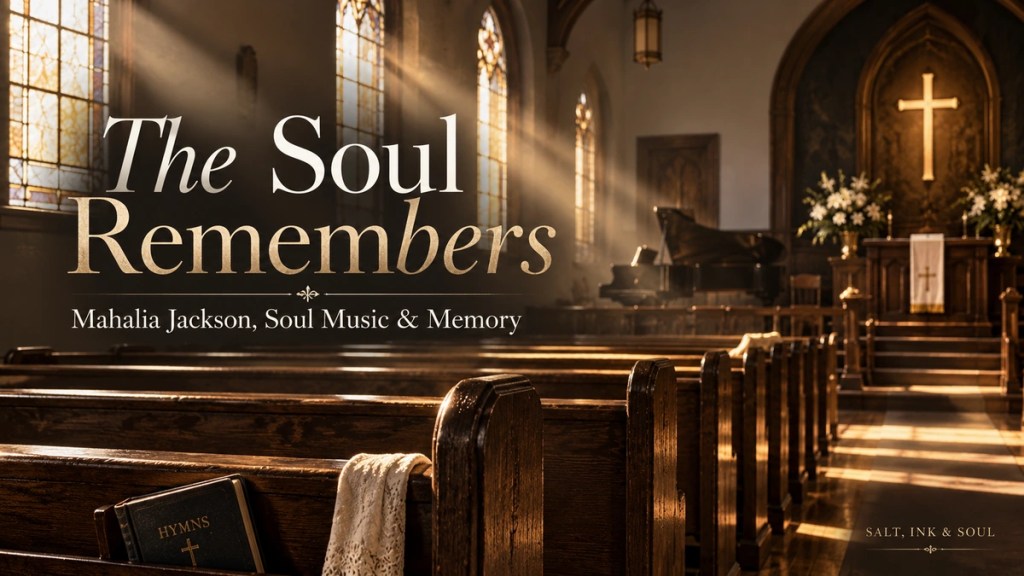
I hear the Black church.
Not the grand cathedrals with stained glass and polished marble.
I hear the smaller churches.
The ones built and maintained by people who often had little to give beyond their labor, their faith, and their willingness to show up.
I think about the church of my childhood. The church my family helped establish and sustain. The voices that filled those rooms before I was old enough to understand what those people had endured.
I remember how a song could begin with one person and, before long, become something everyone was carrying.
I remember the elders sometimes closing their eyes, lifting their heads, or wiping away tears.
As a child, I didn’t understand.
I think I understand a little more now.
Because when Mahalia sings, I hear history.
I think about sharecroppers whose freedom came with conditions. About people who emerged from slavery only to discover that freedom could exist in law while remaining painfully absent from everyday life.
I think about families who left the South searching for something better, and those who stayed, building communities in places that often refused to recognize their humanity.
I don’t pretend one song contains all those experiences.
But I hear their echoes.
I hear exhaustion.
Not the kind that disappears after a good night’s sleep.
Something deeper.
The weariness of people who spent their lives enduring things no one should have asked of them.
And yet, they sang.
That is the part I keep returning to.
They sang.
Not because everything was right with the world. Not because their prayers had always been answered. Not because they were untouched by anger or despair.
They sang because sometimes the human spirit needs somewhere to place what the body can no longer carry.
And the church gave them that place.
The music gave them that place.
There is something extraordinary about that.
We often speak of strength as though it means never bending, never admitting fear, never allowing the world to see what has wounded us.
But listen carefully to Mahalia.
You don’t need to pretend in that voice.
There is strength, certainly.
But there is also weariness. There is pleading. It acknowledges that the road has been long and that the person traveling it cannot continue alone.
The song does not ask for power.
It asks for a hand.
Not a guarantee that suffering will disappear.
Just the comfort of knowing that someone will walk beside you.
I think about that more often as I grow older.
I think about my grandparents, the church, and the music that surrounded me long before I possessed the experience to appreciate what it meant.
I wonder how many times I heard those songs without really listening.
How many times did I watch older people become emotional without understanding that they might have been remembering someone?
Perhaps they were mourning.
Perhaps they were giving thanks.
Or perhaps they were simply tired.
And the music allowed them to say so.
That brings me back to soul music.
I don’t believe Black people have exclusive ownership of sorrow, joy, faith, or the ability to express those things beautifully. Human beings have always found ways to turn their experiences into art.
But I do believe Black American music carries a history that deserves recognition, not dissolution into whatever commercially convenient category.
The spirituals. The blues. Gospel. Jazz. Soul.
These traditions didn’t emerge out of nowhere.
They grew from communities whose lives are inseparable from the music they created.
Others can enter those traditions with love, respect, and extraordinary talent. And they have.
But we shouldn’t have to forget where the music came from to celebrate where it has traveled.
Perhaps that is what troubles me about all the renaming.
I worry that when we remove history from the language, we eventually begin to remove it from the conversation.
And somewhere along the way, a tradition becomes merely a sound.
Something to reproduce.
Something to package.
Something to sell.
But when I listen to Mahalia Jackson, none of that matters.
I am no longer thinking about genres, record companies, or who belongs in which category.
I am thinking about home.
About the church.
About generations of people whose names I may never know, but whose existence made mine possible.
And then, almost without realizing it, I begin to hum along.
If something here speaks to you, please like, comment, and share.
Support Salt, Ink & Soul
The stories, recipes, and reflections continue beyond the page. Visit the Salt, Ink & Soul Store to explore merchandise inspired by Food. Memory. Meaning.
👉 Visit the Salt, Ink & Soul Store
Resources for Hard Times
For practical help, food support, or community resources, visit the Salt, Ink & Soul Resources Page.

