Tag: Mental Health

  • What’s the Best Way to Deal with Negative Thoughts?

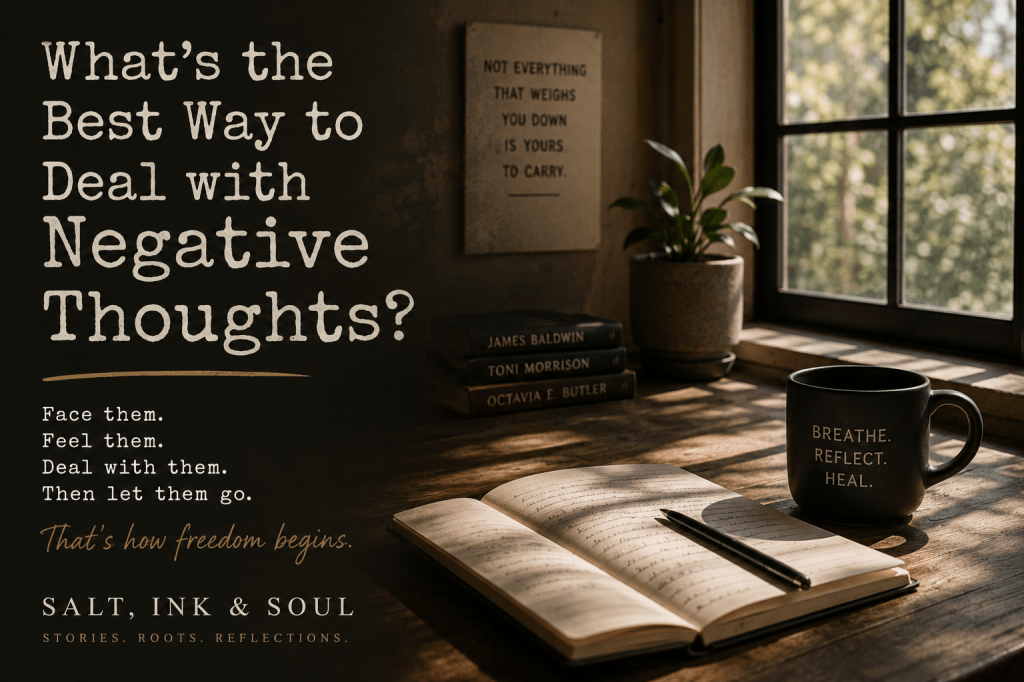
    What’s the Best Way to Deal with Negative Thoughts?

    The best way to deal with negative thoughts is not to pretend they are not there.

    I know that because I have tried.

    I have tried to push them down.

    Tried to laugh them off.

    I tried to tell myself I was fine when I knew I wasn’t 

    It worked for a while.

    Until it didn’t.

    It could be anything: a word, a look, clutter, anything 

    A moment that should not have mattered as much as it did.

    And suddenly all those buried thoughts, all that hurt, all that anger, all that disappointment came rushing out at once. Sometimes toward someone who did not deserve to receive what I had refused to deal with.

    That is the danger of burying things.

    They do not stay buried.

    Negative thoughts are not always the enemy. Sometimes they are messengers. Sometimes they are telling us there is something we have not faced, something we have not grieved, something we have not forgiven, something we have been carrying too long without admitting how heavy it has become.

    The first step is to deal with them.

    Not while you are in the middle of the fire.

    Not while your emotions are loud and your judgment is clouded.

    But when you can sit with yourself honestly.

    When you can ask, Why did that hurt me? Why did that thought come back? What am I afraid of? What am I still holding onto?

    There is strength in being able to sit alone with your thoughts.

    But there is also wisdom in knowing when not to sit with them alone forever.

    There is nothing wrong with talking to someone.

    For me, it took A counselor.

    Someone safe enough to hear you without making you feel small.

    I know sometimes that sounds like a lot. Especially when you are used to keeping things to yourself. Especially when silence has become a kind of armor. But silence can also become a prison if we never let anything out.

    Negative thoughts are like poison when they stay trapped inside you.

    They change you

    They make love feel suspicious.

    They make peace feel temporary.

    So the best way I know to deal with negative thoughts is to stop pretending they are harmless just because no one else can see them.

    Name them.

    Sit with them.

    Let the emotion pass long enough for you to think clearly.

    Then deal with what is underneath.

    And when it becomes too heavy, talk to someone.

    That is not a weakness.

    That is maintenance of the soul.

    Kyle J. Hayes

    kylehayesblog.com

    Please like, comment, and share

    Resources for Hard Times

    If you’re looking for practical help, food support, or community resources, you can visit the Salt, Ink & Soul Resources Page.
    👉 Resources for Hard Times

  • “The Weight Beneath the Mask: On Patience, Rage, and the Quiet War for Empathy”

    “The Weight Beneath the Mask: On Patience, Rage, and the Quiet War for Empathy”

    Every morning, before the sun gets up and the world begins to call itself civilized again, I sit with myself. I try to be better than I was the day before. That’s the promise I’ve made, not to the world, but to the little boy I used to be—the one who deserved more tenderness than he received. The one who saw too much too early and still had the nerve to keep dreaming.

    I learn patience.

    I try to learn empathy.

    And most days, it feels like trying to catch rain in a sieve.

    Being a Foundational Black American in this country is to walk a tightrope stretched across a minefield. You must smile with your teeth clenched, laugh without humor, and nod when what you really want to do is roar.

    I try to treat everyone equally.

    That’s the goal, isn’t it? That’s the thing we’re taught to believe in. Equality. Fairness. The golden rule and the silver-tongued lies that follow it. But some days, it feels like I’m trying to hug a fist. Some days, the evidence of this country’s contempt for my existence is not anecdotal—it’s algorithmic. Baked into news cycles, comment sections, and the careful silence of the people who walk past injustice without blinking.

    You hear it. You feel it.

    There is discomfort in their voice when you speak with authority.

    The glance at your hands when you’re simply reaching for your ID.

    The way your masculinity is questioned when you don’t perform it on their terms, and criminalized when you do.

    Empathy feels dangerous some days.

    Softness feels like an invitation to be taken advantage of. And still, I reach for it. Not because I believe I’ll be met with it in return, but because I know what happens when you let anger do all the talking. You lose the part of yourself that still believes in healing.

    But let me say this plainly, because it needs to be said:

    Empathy is not weakness.

    It is resistance in its most refined form. It is the choice to keep your humanity intact when the world insists on stripping it from you.

    Still, I struggle.

    I struggle not to let the bitterness set in.

    I struggle to hold my tongue when my dignity is disregarded.

    I struggle not to internalize the weight of microaggressions—those paper cuts that don’t bleed but never quite heal either.

    And underneath it all is a rage most people don’t want to acknowledge.

    Not because it isn’t real. But if they acknowledged it, they’d have to admit they helped cause it.

    What would they think, these coworkers and strangers and casual acquaintances,

    if they knew what it takes for me to walk through the world as calmly as I do?

    What would they feel if they could feel the heat I have to suppress just to make them comfortable?

    What if they knew that beneath this patience is a warrior holding his sword with the blade facing inward?

    We are not angry without reason.

    We are angry because we are still here, and still treated like ghosts.

    We are angry because we know what our fathers swallowed.

    Because we watched our mothers turn crumbs into miracles.

    Because we are still expected to smile while being slowly erased.

    And yet…

    We rise early. We go to work. We raise children. We love.

    We choose empathy when anger would be easier.

    We wear the mask, not because we are afraid, but because we know the cost of taking it off.

    Some mornings I fail.

    I lose my temper. I withdraw. I despair.

    But most mornings, I try again.

    Because the work isn’t just surviving.

    The work is staying human in a world that profits off your dehumanization.

    And so, I practice patience.

    Not because the world deserves it.

    But because I do.

    By Kyle Hayes

    Please like, comment, and subscribe.