There are some things the world rediscovers only because it has forgotten how long they have been living inside it.
That is how I feel watching people circle back to Thriller now, with all this renewed attention around Michael Jackson because of the movie, the trailers, the conversations, the clips, the younger people discovering what some of us never lost. The biopic “Michael” has brought his name back into the center of popular conversation, though for many of us, his name never really left. His music has continued to find new ears, new dance floors, new bedrooms, new cookouts, new children standing in front of mirrors, trying to make their feet obey something their spirit already understands. Even now, Jackson’s catalog keeps returning to the charts and to public memory in fresh ways.
But Thriller is different.
I can keep this short, but that would feel dishonest. Thriller is not simply an album I admire. It is one of those cultural monuments that sits so deeply in the landscape that people sometimes stop seeing how large it is. It becomes weather. It becomes background. It becomes one of those things everyone knows, and because everyone knows it, we risk forgetting how impossible it once was.
There are albums, and then there are events.
Thriller was an event.
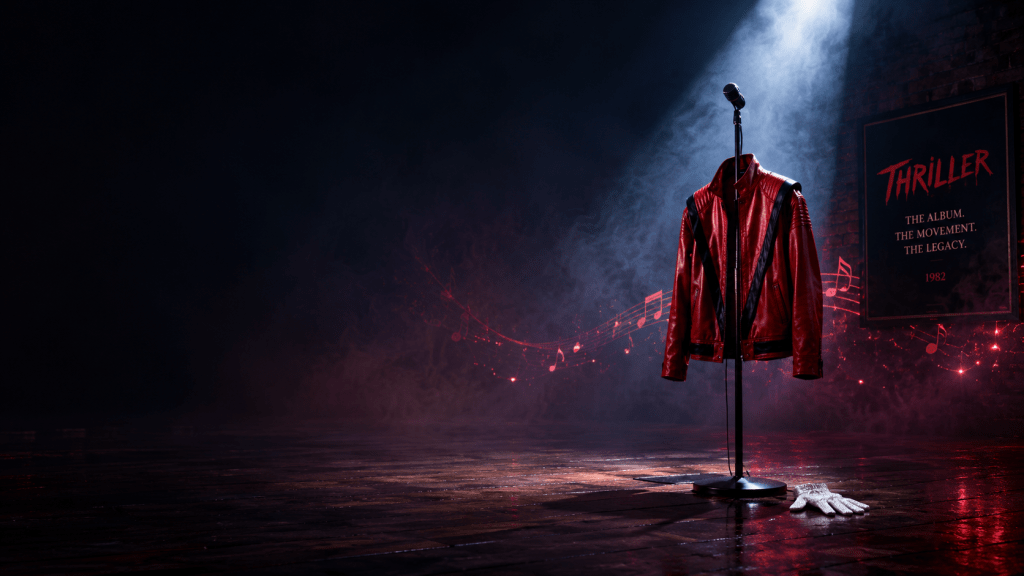
Not just a release date. Not just a collection of songs pressed into vinyl, cassette, and memory. It was a door being kicked open with polished shoes, a red jacket, a white glove, and a sound so precise it felt engineered by lightning. Released in 1982, it became the kind of record that did not merely dominate its time. It bent time around itself. It went on to become widely recognized as the best-selling album of all time. It was later preserved by the Library of Congress for its cultural, historical, and aesthetic significance.
But numbers only tell part of the story.
Numbers can count sales.
They cannot count the way a room changes when “Billie Jean” begins.
They cannot measure the way the bass line walks in before the man does. That quiet, dangerous pulse. That sound of suspicion dressed as elegance. That feeling that something has entered the room wearing a fedora and secrets.
They cannot count how many children ruined socks trying to moonwalk across kitchen floors.
They cannot count how many shoulders moved before permission was granted.
They cannot count the first time somebody saw him lean forward at an angle that seemed to argue with gravity itself and realized that the human body, under the right command, could become punctuation.
Thriller was music, yes.
But it was also proof.
Proof that Black artistry did not need to be translated into something smaller to be understood by the world. Proof that soul, funk, pop, rock, theater, horror, dance, precision, and spectacle could sit at the same table and not fight for space. Proof that a Black artist could become the center of the machine, not as a guest, not as a novelty, not as someone grateful to be let in, but as the reason the doors had to be widened.
That part matters.
It mattered then, and it matters now.
Because there was a time when the industry loved Black sound but feared Black centrality. It loved the rhythm, the invention, the sweat, the church, the moan, the hips, the hunger, the heat. It loved what we made, but not always us standing in the bright middle of it. And then came Michael, not asking permission so much as revealing that permission had always been too small a thing for what he carried.
He did not just cross over.
He made the crossing look foolish.
He made the border disappear.
That is one of the reasons Thriller remains so difficult to reduce. It was not merely “Black music” becoming acceptable to white audiences. It was Black excellence arriving so fully formed, so undeniable, so complete in its craft, that the old categories began to buckle. The album did not abandon Blackness to become universal. It showed that Blackness had always contained the universal.
That is the thing some people still struggle to understand.
The universal does not always begin in the middle.
Sometimes it begins in Gary, Indiana.
Sometimes it begins in Motown rehearsal rooms.
Sometimes it begins in gospel phrasing, James Brown feet, street-corner rhythm, Sunday-morning ache, and the discipline of a child who learned too early that applause could be both love and labor.
And that is where the beauty of Thriller becomes complicated.
Because when we talk about Michael Jackson, we are never only talking about music. We are talking about genius and cost. We are talking about what America does to its brightest children, especially the ones it wants to consume. We are talking about the strange bargain of being loved by the world and still somehow being alone inside yourself.
There is joy in Thriller, but there is also pressure.
You can hear the perfectionism.
You can hear the reach.
You can hear a man trying to become larger than every room that ever tried to contain him.
Maybe that is why the album still feels alive. It is polished, but not empty. It is immaculate, but not bloodless. Even at its most dazzling, there is something haunted running beneath it. “Billie Jean” is not a party song, though people dance to it. “Wanna Be Startin’ Somethin’ moves like celebration, but it carries anxiety in its bones. “Beat It” has the muscle of rock, but the wisdom of survival. Even “Thriller,” with its monsters and choreography and graveyard theater, knows something serious about fear: that sometimes the only way to face it is to dance directly in front of it.
That is the secret.
The album moves because it understands movement as more than entertainment.
Movement is escape.
Movement is resistance.
Movement is testimony.
Movement is a child saying, “Look what I can do.”
Movement is a man saying, “You will not look away.”
And we did not look away.
We still have not.
The visuals changed everything. “Billie Jean” helped push Michael onto MTV at a time when Black artists were not being given the same access to that new visual marketplace. The “Thriller” short film took the music video and stretched it into cinema, into an event, into a ritual. After that, a song was no longer just something you heard. It could be something you entered. Something you watched. Something you wore. Something you practiced in the mirror until your body began to remember what your mind could not explain.
The red jacket became scripture.
The glove became a symbol.
The loafers became instruments.
The choreography became a language passed down without formal instruction.
Nobody had to explain it to us. We saw it once, and the body understood.
That is rare.
That is not marketing.
That is culture.
And culture, real culture, does not stay where it is placed. It travels. It leaks under doors. It crosses oceans. It lands in countries where people do not speak the language but know exactly when to throw their shoulders back. It becomes a wedding reception, a school talent show, a Halloween party, a family reunion, a halftime routine, a child alone in a hallway trying to spin without falling.
That is why I smile a little when people say Michael Jackson is “back.”
Back from where?
He has been in the grocery store aisle.
He has been in the skating rink.
He has been at the cookout.
He has been in the DNA of every pop star who has ever learned that the body could sell the song as much as the voice.
He has been in the architecture field.
The truth is, some artists do not disappear. The world only changes its volume.
For those of us who lived with the music, Thriller was never a relic. It was never just nostalgia. It was not trapped in the 1980s with the jackets, the hair, the posters, the television specials, the moonwalk, and the glow of a world beginning to understand the power of images. It kept breathing. It kept showing up, generation after generation, because great work does not ask permission to survive.
It survives because it is useful.
It gives people joy.
It gives people movement.
It gives people memory.
And maybe that is what I return to most when I think about Thriller: memory.
I think about how music marks us. How a song can become a room. How a bass line can bring back a floor, a television set, a cousin, a summer, a mother’s voice from another room. I think about how the records we love become part of the family even when we do not say it that way. They sit with us. They raise us a little. They teach us rhythm, confidence, drama, and escape. They teach us that ordinary life can suddenly become cinematic if the right song comes on.
That is what Thriller did.
It made the world feel bigger.
It made possibility feel visible.
It made a Black boy from Indiana into a global language.
And it did so with craft.
That part should never be forgotten. The magic was not accidental. Quincy Jones and Michael Jackson built that album with care, discipline, taste, and hunger. Nothing feels wasted. Every song knows what it is doing. Every groove has a purpose. Every silence has shape. The album is joyful, but it is not careless. It is smooth, but not soft. It is commercial, but not hollow. It is accessible without being simple.
That is a hard thing to do.
To make something everybody can enter, without making it cheap.
To make something polished enough for the whole world, but still alive enough to sweat.
That is why the greatness of Thriller is not really up for debate.
People may debate Michael.
People may debate legacy, celebrity, myth, memory, pain, and all the complicated human wreckage that surrounds a life lived too publicly.
But Thriller?
The work stands.
It stands because the work still works.
Drop the needle. Press play. Let the first few seconds hit. Watch what happens.
The body answers before the mind can form an argument.
And maybe that is the final proof.
Not the sales.
Not the awards.
Not the records.
Not even the history.
The proof is in the involuntary response.
The foot taps.
The shoulders loosen.
The room wakes up.
Somebody smiles before they mean to.
That is not just an album.
That is inheritance.
That is architecture.
That is a force of nature dressed in melody and leather.
That is Thriller.
Please like, comment, and share
Resources for Hard Times
If you’re looking for practical help, food support, or community resources, you can visit the Salt, Ink & Soul Resources Page.