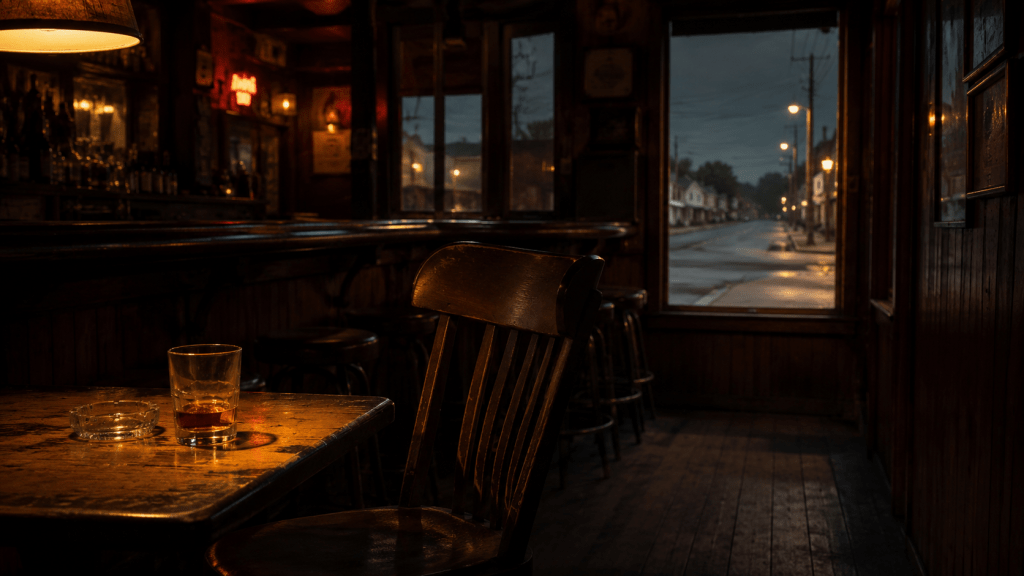
Thoughts on the life I escaped.
Maybe escaped is too much. There was no dramatic chase. No single door kicked open. No heroic music swelling in the background while a man heads to the southwest with all his wounds packed neatly in the trunk.
It was quieter than that.
It was the kind of escape that happens after years of feeling the walls move closer and closer until one day you realize the room has been shrinking around you. Not because anyone touched the walls. Not because anyone admitted what was happening. But because the life around you had already decided its limits for you, and if you were not careful, you would mistake those limits for destiny.
I come from the Quad Cities.
I say that with no hatred.
A place can wound you and still feed you. A place can raise you and still not have room for you to become. A place can know your name and still never know what lives inside you.
That is the complicated truth of home.
People from the outside sometimes imagine the Midwest as simple. Quiet. Polite. Decent. Hardworking. Neighborly. They imagine front porches, snow shovels, church fish fries, factory shifts, Friday night bars, and grocery stores where everybody knows somebody’s cousin.
And some of that is true.
But truth is rarely clean.
The Midwest has a way of hiding its knives in soft cloth.
The racism was not always loud.
That was part of the trouble.
It did not always come wearing a hood or shouting from the street. It came smiling. It came with a handshake. It came with a joke you were supposed to laugh at if you wanted to keep the peace. It came in the silence after you spoke too well. It came in the promotion you were never quite right for. It came in the form of people making you feel grateful for being tolerated.
Polite racism is a special kind of poison.
It asks you to pretend you have not been poisoned.
It asks you to be reasonable. Professional. Mature. Understanding. It asks you to bow your head and call it patience. It asks you to keep working, keep smiling, keep proving, keep swallowing. And because jobs are few and far between, because opportunity is treated like a chair in a crowded room, once you get a seat, you are expected to sit there and be thankful, no matter how hard the wood cuts into you.
That is how a life gets built smaller than the soul.
One concession at a time.
You get a job and keep it.
Good or not.
Fair or not.
Respectful or not.
You keep it because there may not be another one waiting. You keep it because rent does not care about dignity. Groceries do not care about dreams. The light bill does not lower itself because your spirit is tired. So you learn the mathematics of survival. You calculate the insult against the paycheck. You measure humiliation against health insurance. You teach yourself to be quiet because quiet pays on Friday.
And then one day, the quiet becomes you.
That is the thing I fear most when I think about what might have been.
Not poverty.
Not struggle.
Not even failure.
I fear becoming quiet.
I fear being a man who learned to live without asking what living was supposed to mean.
There is a version of me who stayed.
I can see him sometimes.
He is not a bad man. That may be the saddest part. He is not foolish. He is not weak. He is not lazy. He is smart. Maybe too smart for the room and too tired to do anything about it.
He works because work is what men are told to do. He buys the house he can afford because that is what responsibility looks like from the outside. He keeps his head down. He takes the jokes. He lets certain comments pass through him like winter air through an old window.
He tells himself this is adulthood.
He tells himself everybody compromises.
He tells himself dreams are for people with softer lives.
And every evening, maybe he ends up in some corner bar where the same songs from the eighties keep playing like time got drunk and forgot to leave.
Maybe Springsteen comes through the speakers, singing about glory days, and everybody smiles because they know the words. They know the rhythm. They know the ache, even if they would never call it grief.
But I never wanted to become that man.
The man sitting under the dim light, nursing a drink, telling the same stories about who he used to be because the present has become too small to speak of. The man who once had promise, once had fire, once had some bright and dangerous thing inside him, but somewhere along the way learned to trade becoming for remembering.
That was the life I feared.
Not the bar itself.
Not the music.
Not even nostalgia, because memory can be holy when handled with care.
What I feared was getting trapped there. Becoming fluent in the language of almost.
Almost left.
Almost wrote.
Almost tried.
Almost became.
A man with intelligence enough to know the cage had a lock, but not enough courage left to reach for the door.
Which is to say, a man dying of recognition in a room too small for his questions.
That is no life.
Not because bars are bad.
Not because familiar music is bad.
Not because staying in your hometown is a failure.
Some people stay and build beautiful lives. Some people remain and become pillars. There are people whose roots run deep enough to turn the soil around them into fertile ground.
But for me, staying would have been a kind of burial.
I know that now.
The Quad Cities are not ignorant. That is one of the lies people tell about places like that. People are educated there. People read. People think. People work hard. People earn degrees. But a degree is not the key if every door in the city is already full of people waiting for the same narrow opening.
I have seen baggers at local stores with college degrees.
That image stays with me.
Not because honest work is shameful. There is dignity in all work done with care. But there is something brutal about a place where education does not always become movement. Where intelligence gets folded into survival. Where ambition learns to speak softly because there is nowhere for it to go. The local economy can make a person feel ridiculous for wanting more than what is available.
You learn to lower your voice around your own dreams.
You stop saying certain things out loud.
Writing would have been one of those things.
Writing, in that life, would have sounded absurd. Not because writing is absurd, but because harsh places train people to distrust anything that does not immediately pay the bills. Art becomes suspicious. Expression becomes indulgence. A man saying he wants to write sounds like a man saying he wants to starve beautifully.
So the dream would have been crushed.
Not all at once.
Crushed slowly.
Under overtime.
Under politeness.
Under fatigue.
Under the need to be practical.
Under the look people give you when you reveal some secret part of yourself, and they do not know whether to laugh or feel sorry for you.
I might have stopped writing before I ever truly began.
That thought troubles me.
Because now I know what writing has become for me.
It is not a hobby.
It is not decoration.
It is not some charming little side project meant to make me feel interesting.
Writing is the place where I tell the truth before the world edits it. It is where I gather the broken pieces and make them speak. It is where I take what hurt me and refuse to let it die without meaning.
But in the life I escaped, meaning might have had to wait.
And wait.
And wait.
Until one day, it forgot my name.
That is what small lives can do when they are not chosen freely. They do not always destroy you by violence. Sometimes they destroy you by routine. You wake up. You work. You endure. You pay. You sleep. You repeat. You become reliable. You become respected in the acceptable ways. You become the kind of man people point to and say, “He’s doing all right,” while something sacred inside you sits in the dark, starving.
I could have become that man.
That is why I do not speak of leaving lightly.
Leaving was not only about geography.
Leaving was disobedience.
It was a refusal to let the place that shaped me become the place that sealed me shut. It was me saying, perhaps before I even had the language, that survival was not enough if survival required the death of everything tender, strange, creative, and true inside me.
New Mexico did not make me from nothing.
I brought myself here.
I brought the scars, the questions, the intelligence, the anger, the hunger, the ache. I brought the boy who read because books were doors. I brought the man who wanted more but did not always believe more was allowed. I brought the Midwestern discipline, the working-class suspicion of easy promises, the memory of what it means to keep going when nothing romantic is happening.
But New Mexico gave me room.
And room can feel like grace when you come from a place where every dream had to crouch.
Here, the sky does not crouch.
The land stretches out like it is daring you to unclench. The mountains do not ask you to justify your existence. The light falls on everything with a kind of ancient indifference that somehow feels merciful. You can be small here without being erased. You can be quiet without disappearing. You can be alone without being trapped.
And somehow, in that space, the writing came.
The life that might have been still visits me sometimes.
I see the house I could have bought because it was affordable, not because it held my future. I see the job I would have kept because leaving felt too dangerous. I see the polite insults swallowed whole. I see the younger men at the bar becoming older men at the same bar, telling the same stories under the same neon signs while the same songs play and the years pass without asking permission.
I see myself there.
And I feel grief.
Not superiority.
Grief.
Because there are many brilliant people trapped in lives too narrow for them. Many gifted people never leave because leaving requires money, courage, timing, madness, or some combination of all four. There are many dreams buried under good sense. Many books have never been written. Many songs have never been sung. Many meals were never made. Many paintings were never painted. Many selves never met.
The world calls that reality.
Sometimes it is.
But sometimes, reality is just a cage everybody’s gotten used to.
I do not want to romanticize leaving. It costs. It takes things from you. It makes you a stranger. It removes the comfort of being easily understood. It teaches you that reinvention is not clean. There are lonely nights in new places. There are moments when the old life, for all its limits, looks warm simply because it is known.
But I would rather be lonely in the direction of becoming than comfortable in the direction of disappearance.
That is the truth I keep returning to.
If I had stayed, maybe I would have been fine.
That is the haunting part.
Fine is a dangerous word.
Fine can hide a thousand funerals.
Fine can mean the bills are paid, but the soul has gone quiet. Fine can mean nobody worries about you because you have learned to maintain stability. Fine can mean the dream died so politely that even you forgot to mourn it.
I did not want to be fine.
I wanted to be alive.
Not loud.
Not famous.
Not untouched by pain.
Alive.
Aware of my own mind. Responsible for my own becoming. Free enough to write badly until I wrote honestly. Free enough to tell the truth. Free enough to sit with the anger and ask whether it was protecting me or imprisoning me. Free enough to discover that I was more than the smartest man in a room I had outgrown.
That is what New Mexico gave me.
Or helped me claim.
A life where writing became possible.
A life where the old bitterness began to lose its authority.
A life where the boy who once dreamed in silence could finally put words on the page and let them breathe.
And maybe that is why New Mexico feels less like a place I moved to and more like the land that let me become. Because I know the life I might have stayed long enough to inherit. I know the man I might have become. And I know, with a gratitude I still cannot fully explain, that I was given room before the dream went quiet.
I do not hate the place I came from.
I carry it.
The Quad Cities are in me. The Midwest is in me. The gray winters. The modest houses. The factory logic. The polite cruelty. The educated frustration. The bars with old songs playing. The people are doing their best with what the place allows. The aching knowledge that intelligence does not always become freedom.
All of it is in me.
But it is not over me.
Not anymore.
And maybe that is what escape really means.
Not that you outrun the past.
But that you live long enough, and choose bravely enough, to stop letting the past decide the size of your future.
There is a life I did not stay long enough to become.
I mourn him sometimes.
I honor him, too.
Because he reminds me of what was at stake.
He reminds me that every page I write is not merely a page. It is evidence.
Evidence that the dream survived the harshness.
Evidence that the man did not bow his head forever.
Evidence that the corner bar did not become the whole world.
Evidence that I left.
Kyle J. Hayes
kylehayesblog.com
Please like, comment, and share
Resources for Hard Times
If you’re looking for practical help, food support, or community resources, you can visit the Salt, Ink & Soul Resources Page.