Tag: New Mexico

  • If You Could Live Anywhere in the World, Where Would It Be?

    If You Could Live Anywhere in the World, Where Would It Be?

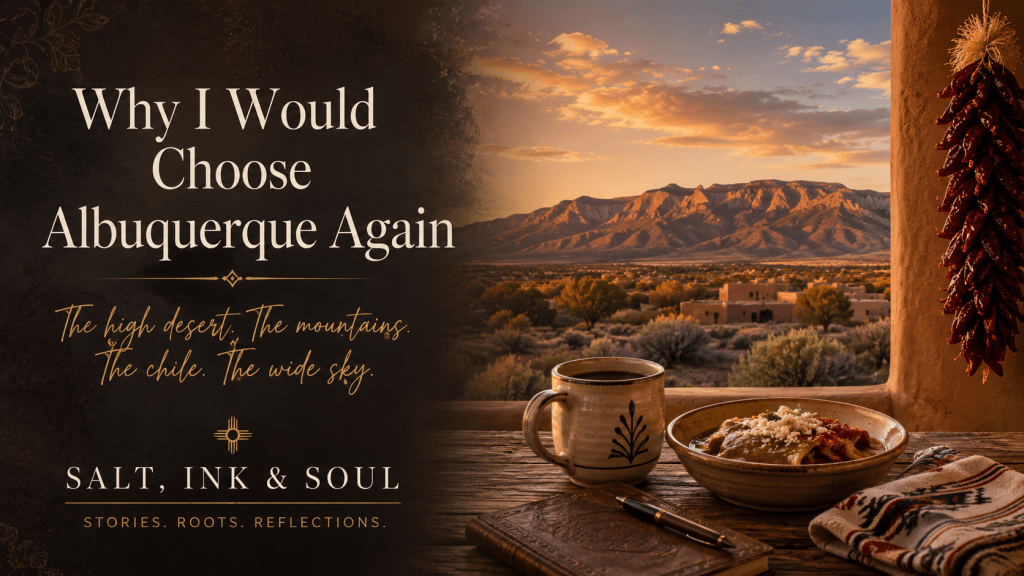
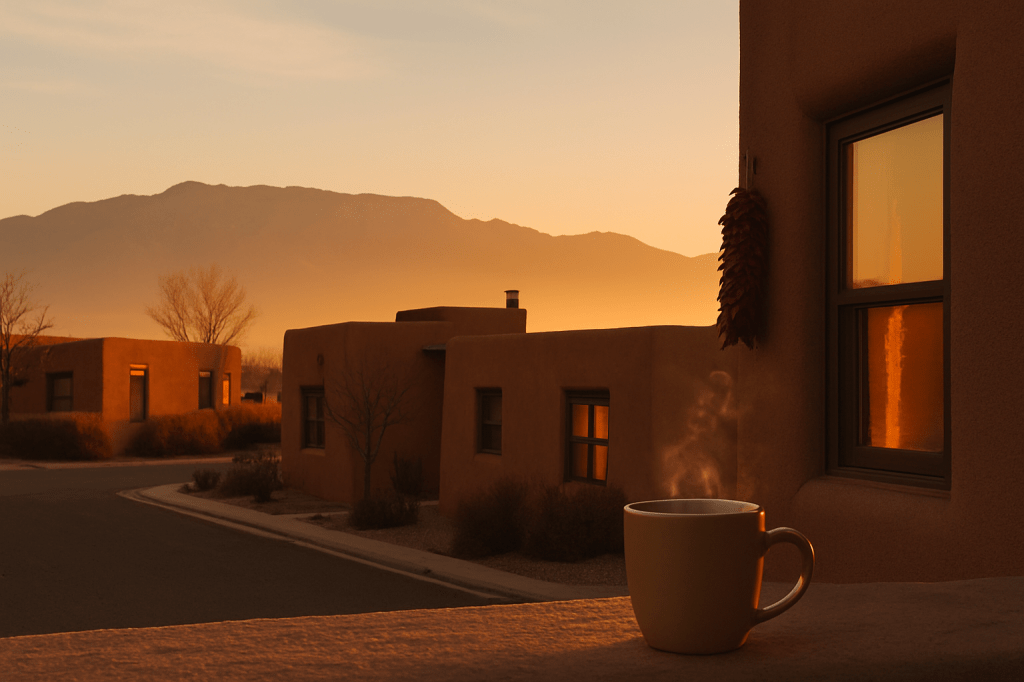
    If I could live anywhere in the world, I would still choose Albuquerque.

    And I am proud to say that.

    I know that might sound strange to some people.

    There are places with bigger skylines.

    Places with more water.

    Places people put on postcards, bucket lists, and travel shows.

    But I have lived in different places around the world, and sometimes the place you choose says more than the place you came from.

    I was raised in the Midwest.

    That part of the country has its own beauty. Its own rhythm. Its own kind of strength. But it is also the home of tornado alley, and I learned early that I do not need the sky turning dark and angry above me to feel alive.

    I am not a fan of hurricanes.

    I am not a fan of earthquakes either.

    Yes, I know New Mexico has earthquakes, but not like the West Coast. And yes, we have monsoon season, but to me, that does not compare to the hurricanes of the East Coast.

    The constant rain of the Northwest would be too much for me.

    Some people need green everywhere.

    Some people need water close enough to hear it.

    I understand that.

    But I have fallen in love with the high desert.

    There is something about the open sky here.

    Something about the mountains standing in the distance like witnesses.

    Something about the way the light changes everything it touches.

    Albuquerque has a quiet honesty to it. It does not try too hard to convince you of what it is. It simply is.

    There is beauty in that.

    There is also the food.

    The kind of food that does not feel like decoration, but memory. Food with heat, history, and personality. Food that tells you where you are before anyone says a word.

    Green chile does that.

    Red chile does that.

    A plate here can feel like a map.

    A reminder that place is not just where you sleep at night. Place is what seasons you. What teaches your tongue. What slows your pace. What makes you look up and notice the sky.

    I did not end up in Albuquerque by accident and stay by mistake.

    I chose it.

    And if I had to choose again, I would choose it again.

    Not because it is perfect.

    No place is.

    But because it fits something in me.

    The high desert has a way of making room for a person. It gives you space to think. Space to breathe. Space to become quieter without becoming smaller.

    And maybe that is what home is after a while.

    Not the place everyone else understands.

    Not the place with the best reputation.

    Not the place that looks most impressive from the outside.

    But the place where your spirit unclenches.

    The place where the weather, the food, the land, and the light begin to feel like part of your own language.

    For me, that place is Albuquerque.

    The high desert.

    The mountains.

    The chile.

    The wide sky.

    The quiet invitation to keep becoming.

    Kyle J. Hayes

    kylehayesblog.com

    Please like, comment, and share

    Resources for Hard Times

    If you’re looking for practical help, food support, or community resources, you can visit the Salt, Ink & Soul Resources Page.
    👉 Resources for Hard Times

  • The Land That Let Me Become 

    The Land That Let Me Become 

    People still look at me strangely when I tell them I chose New Mexico.

    Not passed through.

    I didn’t end up here by accident.

    Not got stranded by work, family, disaster, or one of those wrong turns life has a way of dressing up as destiny.

    I chose it.

    And I understand why that sounds strange to some people. New Mexico is not always the place people are taught to imagine when they are dreaming out loud. It does not shout for your attention the way other places do. It does not beg to be admired. It sits there beneath that impossible sky, all red earth and distance, all wind and silence, all mountains watching like old witnesses, and waits to see if you are the kind of person who can be still long enough to understand it.

    I may not have understood it when I came here.

    I only know that I came.

    And the longer I stay, the more I wonder whether choosing is sometimes only the name we give to being led.

    I know how that sounds.

    I know how strange it can feel to speak of God in a world that has learned to explain everything, leaving nothing sacred. We want clean answers. We want maps, logic, strategy, relocation plans, job prospects, rental prices, and practical reasons that fit neatly in the mouth.

    But some things do not fit.

    Some things happen below language.

    Some places do not just receive you.

    They work on you.

    New Mexico has worked on me.

    I know there is another life I might have lived. A smaller one. Not evil. Not worthless. Just narrow enough to make me forget the sound of my own becoming. Maybe that is why I look at New Mexico with such wonder. It did not simply give me a place to live. It gave me distance from the life that might have closed around me.

    Not loudly. Not all at once. Not with some grand cinematic gesture where the sky opens, and the old self falls away. It has been quieter than that. More patient. More humiliating, in the way healing can be humiliating when it shows you how long you mistook your wounds for your personality.

    The anger I carried for most of my life did not disappear overnight. Anger rarely does. It had roots. It had memory. It had reasons. Some of them were honest. Some of them were old defenses that had outlived their usefulness. Anger had been my armor, my witness, my proof that what happened mattered. Resentment had been a bitter little fire I kept alive because I feared that if I let it go, the world would get away with what it had done.

    But something about this place began to make the fire unnecessary.

    Maybe it was the sky.

    That sounds too simple, but the sky here is not simple. It is a thing with depth. It can make a man feel both small and held. It stretches over you like a question you cannot answer quickly. Morning light hits the Sandias and makes them look less like mountains than scripture written in stone. Evening comes down slow, blue and gold and purple, as if the day itself is reluctant to leave.

    Some places crowd you.

    New Mexico opened something.

    It gave me room to hear myself without the old noise. Room to ask what I was carrying. Room to wonder if every burden deserved to be carried forever.

    And in that room, my writing changed.

    Or maybe I changed, and the writing followed.

    Before New Mexico, I wrote from a harder place. A place of clenched teeth. A place where every sentence had to prove I had survived. There was power in that. I will not insult the old version of myself by pretending he had nothing to offer. He kept me alive. He carried me through years I still do not always know how to name. He wrote with blood because blood was what he had.

    But here, something began to soften.

    Not weaken.

    Soften.

    There is a difference.

    Softening is not surrender. It is not becoming harmless. It is learning that tenderness can be a form of strength when it has survived the furnace and still chooses not to become cruel.

    My writing blossomed here because I was finally allowed to become more than my pain.

    That may be the deepest gratitude I have.

    New Mexico did not ask me to stop telling the truth. It simply showed me that truth had more than one temperature. It could burn, yes. But it could also warm. It could feed. It could sit at a kitchen table beside green chile, coffee, bread, and silence, and still say what needed to be said.

    I found people here who cared.

    That sentence looks small on the page, but it isn’t to me.

    I found people who did not treat art like foolishness. People who did not look at writing as some strange indulgence, some childish dream a grown man should outgrow. I found writers. Artists. Chefs. Jewelry designers. Makers of beautiful things. People who understood that creation is not always decoration. Sometimes creation is survival. Sometimes it is testimony. Sometimes it is the only way a person can turn the pieces of himself into something that may help somebody else breathe.

    They let me know it was okay to write.

    Okay to express.

    Okay to find out who I truly was.

    Okay to share it.

    That kind of permission can change a life.

    Not because a person should need permission to become himself, but because many of us come from places, families, histories, and wounds where the self was something we learned to hide. We learned to be useful before we learned to be honest. We learned to endure before we learned to speak. We learned to make ourselves smaller so the world would not notice how much we were carrying.

    And then, somehow, I found myself here.

    In a place where art is not hidden away.

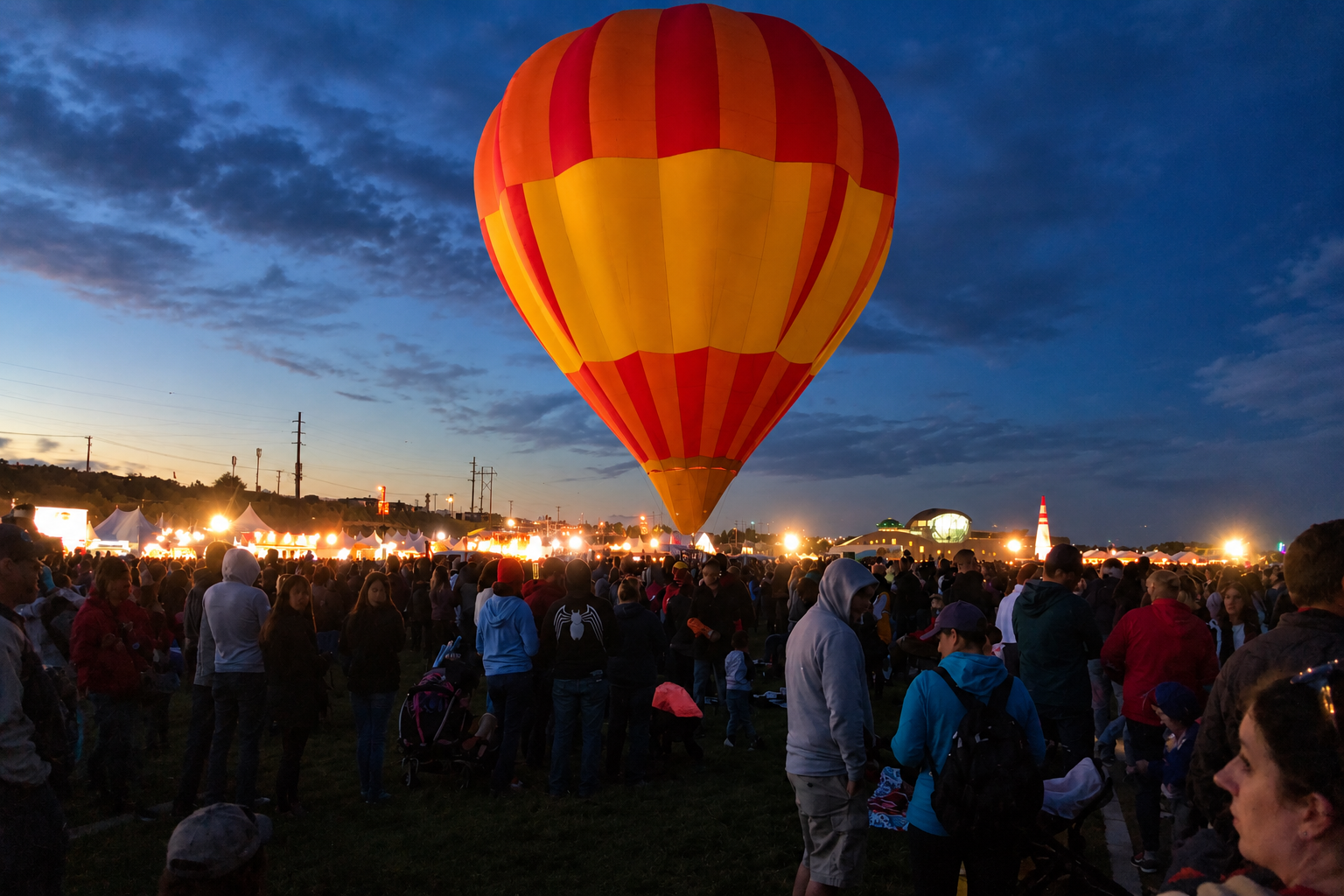
    It is on the walls. Around necks. In markets. In kitchens. In books. In the hands of people who shape silver, clay, chile, sentences, bread, paint, and memory. Here, beauty is not always polished. Sometimes it is rough-edged and sun-baked. Sometimes it smells like roasting chile and dust after rain. Sometimes it is turquoise against brown skin, a bowl of posole, a poem read in a room full of strangers, a balloon rising into the morning while I stand firmly on the ground, grateful to admire what I have no intention of riding.

    I still look at those balloons with wonder.

    A field full of color lifting into the sky like somebody decided joy needed a body.

    And no, I doubt I will ever ride one.

    There are still fears I have not conquered.

    I can admit that now without shame.

    Once, I might have seen every fear as evidence against me. As proof that I had not become enough. But I am learning that life is not conquered all at once. Some fears remain not to mock us, but to remind us that we are still human. I can stand beneath the balloons and marvel. I can watch them rise. I can honor the courage of those who climb into the basket and float into the open air.

    And I can keep my feet on the earth.

    That, too, is a kind of wisdom.

    New Mexico has taught me that becoming does not always look dramatic. Sometimes becoming is waking up and realizing you are less angry than you used to be. Sometimes it is noticed that the old resentment does not answer as quickly when called. Sometimes it is writing a sentence and realizing it came from peace, not injury. Sometimes it is looking around your life and seeing, with a kind of stunned humility, that what once felt impossible has quietly become real.

    I have changed here.

    I do not say that lightly.

    My problems did not vanish because I crossed a state line. Pain is not that simple. A man brings himself wherever he goes. His ghosts pack light. They know how to travel.

    But here, many of mine began to lose their grip.

    Some of that was time.

    Some of that was work.

    Some of that was people.

    And some of it, I believe, was God.

    I cannot prove that in the way the world likes proof. I cannot show a receipt for grace. I cannot chart mercy on a map. I only know that I came here carrying things I thought would always be mine, and now some of them no longer fit in my hands.

    That feels like God to me.

    Not always thunder.

    Sometimes release.

    Sometimes a door opens in a place you never expected to call home.

    So this is my gratitude.

    For the desert that did not ask me to explain myself.

    For the mountains that stood there while I became quieter.

    For the artists who made expression feel possible.

    For the cooks who reminded me that food is memory and care.

    For the writers who made the page feel less lonely.

    For the people who showed me that community does not always announce itself with noise. Sometimes it comes gently, through encouragement, through conversation, through a simple belief that what you are making matters.

    For the balloons, I will admire from below.

    For the sky that keeps making me look up.

    For the anger that is leaving.

    For the words that came back changed.

    For the man I was.

    For the man I am becoming.

    For New Mexico.

    The land I chose.

    Or maybe the land that was chosen for me.

    Kyle J. Hayes

    kylehayesblog.com

    Please like, comment, and share

    Resources for Hard Times

    If you’re looking for practical help, food support, or community resources, you can visit the Salt, Ink & Soul Resources Page.

    👉 Resources for Hard Times

  • What Could Have Been

    What Could Have Been

    Thoughts on the life I escaped.

    Maybe escaped is too much. There was no dramatic chase. No single door kicked open. No heroic music swelling in the background while a man heads to the southwest with all his wounds packed neatly in the trunk.

    It was quieter than that.

    It was the kind of escape that happens after years of feeling the walls move closer and closer until one day you realize the room has been shrinking around you. Not because anyone touched the walls. Not because anyone admitted what was happening. But because the life around you had already decided its limits for you, and if you were not careful, you would mistake those limits for destiny.

    I come from the Quad Cities.

    I say that with no hatred.

    A place can wound you and still feed you. A place can raise you and still not have room for you to become. A place can know your name and still never know what lives inside you.

    That is the complicated truth of home.

    People from the outside sometimes imagine the Midwest as simple. Quiet. Polite. Decent. Hardworking. Neighborly. They imagine front porches, snow shovels, church fish fries, factory shifts, Friday night bars, and grocery stores where everybody knows somebody’s cousin.

    And some of that is true.

    But truth is rarely clean.

    The Midwest has a way of hiding its knives in soft cloth.

    The racism was not always loud.

    That was part of the trouble.

    It did not always come wearing a hood or shouting from the street. It came smiling. It came with a handshake. It came with a joke you were supposed to laugh at if you wanted to keep the peace. It came in the silence after you spoke too well. It came in the promotion you were never quite right for. It came in the form of people making you feel grateful for being tolerated.

    Polite racism is a special kind of poison.

    It asks you to pretend you have not been poisoned.

    It asks you to be reasonable. Professional. Mature. Understanding. It asks you to bow your head and call it patience. It asks you to keep working, keep smiling, keep proving, keep swallowing. And because jobs are few and far between, because opportunity is treated like a chair in a crowded room, once you get a seat, you are expected to sit there and be thankful, no matter how hard the wood cuts into you.

    That is how a life gets built smaller than the soul.

    One concession at a time.

    You get a job and keep it.

    Good or not.

    Fair or not.

    Respectful or not.

    You keep it because there may not be another one waiting. You keep it because rent does not care about dignity. Groceries do not care about dreams. The light bill does not lower itself because your spirit is tired. So you learn the mathematics of survival. You calculate the insult against the paycheck. You measure humiliation against health insurance. You teach yourself to be quiet because quiet pays on Friday.

    And then one day, the quiet becomes you.

    That is the thing I fear most when I think about what might have been.

    Not poverty.

    Not struggle.

    Not even failure.

    I fear becoming quiet.

    I fear being a man who learned to live without asking what living was supposed to mean.

    There is a version of me who stayed.

    I can see him sometimes.

    He is not a bad man. That may be the saddest part. He is not foolish. He is not weak. He is not lazy. He is smart. Maybe too smart for the room and too tired to do anything about it.

    He works because work is what men are told to do. He buys the house he can afford because that is what responsibility looks like from the outside. He keeps his head down. He takes the jokes. He lets certain comments pass through him like winter air through an old window.

    He tells himself this is adulthood.

    He tells himself everybody compromises.

    He tells himself dreams are for people with softer lives.

    And every evening, maybe he ends up in some corner bar where the same songs from the eighties keep playing like time got drunk and forgot to leave.

    Maybe Springsteen comes through the speakers, singing about glory days, and everybody smiles because they know the words. They know the rhythm. They know the ache, even if they would never call it grief.

    But I never wanted to become that man.

    The man sitting under the dim light, nursing a drink, telling the same stories about who he used to be because the present has become too small to speak of. The man who once had promise, once had fire, once had some bright and dangerous thing inside him, but somewhere along the way learned to trade becoming for remembering.

    That was the life I feared.

    Not the bar itself.

    Not the music.

    Not even nostalgia, because memory can be holy when handled with care.

    What I feared was getting trapped there. Becoming fluent in the language of almost.

    Almost left.

    Almost wrote.

    Almost tried.

    Almost became.

    A man with intelligence enough to know the cage had a lock, but not enough courage left to reach for the door.

    Which is to say, a man dying of recognition in a room too small for his questions.

    That is no life.

    Not because bars are bad.

    Not because familiar music is bad.

    Not because staying in your hometown is a failure.

    Some people stay and build beautiful lives. Some people remain and become pillars. There are people whose roots run deep enough to turn the soil around them into fertile ground.

    But for me, staying would have been a kind of burial.

    I know that now.

    The Quad Cities are not ignorant. That is one of the lies people tell about places like that. People are educated there. People read. People think. People work hard. People earn degrees. But a degree is not the key if every door in the city is already full of people waiting for the same narrow opening.

    I have seen baggers at local stores with college degrees.

    That image stays with me.

    Not because honest work is shameful. There is dignity in all work done with care. But there is something brutal about a place where education does not always become movement. Where intelligence gets folded into survival. Where ambition learns to speak softly because there is nowhere for it to go. The local economy can make a person feel ridiculous for wanting more than what is available.

    You learn to lower your voice around your own dreams.

    You stop saying certain things out loud.

    Writing would have been one of those things.

    Writing, in that life, would have sounded absurd. Not because writing is absurd, but because harsh places train people to distrust anything that does not immediately pay the bills. Art becomes suspicious. Expression becomes indulgence. A man saying he wants to write sounds like a man saying he wants to starve beautifully.

    So the dream would have been crushed.

    Not all at once.

    Crushed slowly.

    Under overtime.

    Under politeness.

    Under fatigue.

    Under the need to be practical.

    Under the look people give you when you reveal some secret part of yourself, and they do not know whether to laugh or feel sorry for you.

    I might have stopped writing before I ever truly began.

    That thought troubles me.

    Because now I know what writing has become for me.

    It is not a hobby.

    It is not decoration.

    It is not some charming little side project meant to make me feel interesting.

    Writing is the place where I tell the truth before the world edits it. It is where I gather the broken pieces and make them speak. It is where I take what hurt me and refuse to let it die without meaning.

    But in the life I escaped, meaning might have had to wait.

    And wait.

    And wait.

    Until one day, it forgot my name.

    That is what small lives can do when they are not chosen freely. They do not always destroy you by violence. Sometimes they destroy you by routine. You wake up. You work. You endure. You pay. You sleep. You repeat. You become reliable. You become respected in the acceptable ways. You become the kind of man people point to and say, “He’s doing all right,” while something sacred inside you sits in the dark, starving.

    I could have become that man.

    That is why I do not speak of leaving lightly.

    Leaving was not only about geography.

    Leaving was disobedience.

    It was a refusal to let the place that shaped me become the place that sealed me shut. It was me saying, perhaps before I even had the language, that survival was not enough if survival required the death of everything tender, strange, creative, and true inside me.

    New Mexico did not make me from nothing.

    I brought myself here.

    I brought the scars, the questions, the intelligence, the anger, the hunger, the ache. I brought the boy who read because books were doors. I brought the man who wanted more but did not always believe more was allowed. I brought the Midwestern discipline, the working-class suspicion of easy promises, the memory of what it means to keep going when nothing romantic is happening.

    But New Mexico gave me room.

    And room can feel like grace when you come from a place where every dream had to crouch.

    Here, the sky does not crouch.

    The land stretches out like it is daring you to unclench. The mountains do not ask you to justify your existence. The light falls on everything with a kind of ancient indifference that somehow feels merciful. You can be small here without being erased. You can be quiet without disappearing. You can be alone without being trapped.

    And somehow, in that space, the writing came.

    The life that might have been still visits me sometimes.

    I see the house I could have bought because it was affordable, not because it held my future. I see the job I would have kept because leaving felt too dangerous. I see the polite insults swallowed whole. I see the younger men at the bar becoming older men at the same bar, telling the same stories under the same neon signs while the same songs play and the years pass without asking permission.

    I see myself there.

    And I feel grief.

    Not superiority.

    Grief.

    Because there are many brilliant people trapped in lives too narrow for them. Many gifted people never leave because leaving requires money, courage, timing, madness, or some combination of all four. There are many dreams buried under good sense. Many books have never been written. Many songs have never been sung. Many meals were never made. Many paintings were never painted. Many selves never met.

    The world calls that reality.

    Sometimes it is.

    But sometimes, reality is just a cage everybody’s gotten used to.

    I do not want to romanticize leaving. It costs. It takes things from you. It makes you a stranger. It removes the comfort of being easily understood. It teaches you that reinvention is not clean. There are lonely nights in new places. There are moments when the old life, for all its limits, looks warm simply because it is known.

    But I would rather be lonely in the direction of becoming than comfortable in the direction of disappearance.

    That is the truth I keep returning to.

    If I had stayed, maybe I would have been fine.

    That is the haunting part.

    Fine is a dangerous word.

    Fine can hide a thousand funerals.

    Fine can mean the bills are paid, but the soul has gone quiet. Fine can mean nobody worries about you because you have learned to maintain stability. Fine can mean the dream died so politely that even you forgot to mourn it.

    I did not want to be fine.

    I wanted to be alive.

    Not loud.

    Not famous.

    Not untouched by pain.

    Alive.

    Aware of my own mind. Responsible for my own becoming. Free enough to write badly until I wrote honestly. Free enough to tell the truth. Free enough to sit with the anger and ask whether it was protecting me or imprisoning me. Free enough to discover that I was more than the smartest man in a room I had outgrown.

    That is what New Mexico gave me.

    Or helped me claim.

    A life where writing became possible.

    A life where the old bitterness began to lose its authority.

    A life where the boy who once dreamed in silence could finally put words on the page and let them breathe.

    And maybe that is why New Mexico feels less like a place I moved to and more like the land that let me become. Because I know the life I might have stayed long enough to inherit. I know the man I might have become. And I know, with a gratitude I still cannot fully explain, that I was given room before the dream went quiet.

    I do not hate the place I came from.

    I carry it.

    The Quad Cities are in me. The Midwest is in me. The gray winters. The modest houses. The factory logic. The polite cruelty. The educated frustration. The bars with old songs playing. The people are doing their best with what the place allows. The aching knowledge that intelligence does not always become freedom.

    All of it is in me.

    But it is not over me.

    Not anymore.

    And maybe that is what escape really means.

    Not that you outrun the past.

    But that you live long enough, and choose bravely enough, to stop letting the past decide the size of your future.

    There is a life I did not stay long enough to become.

    I mourn him sometimes.

    I honor him, too.

    Because he reminds me of what was at stake.

    He reminds me that every page I write is not merely a page. It is evidence.

    Evidence that the dream survived the harshness.

    Evidence that the man did not bow his head forever.

    Evidence that the corner bar did not become the whole world.

    Evidence that I left.

    Kyle J. Hayes

    kylehayesblog.com

    Please like, comment, and share

    Resources for Hard Times

    If you’re looking for practical help, food support, or community resources, you can visit the Salt, Ink & Soul Resources Page.
    👉 Resources for Hard Times

  • Notes for the Road

    Notes for the Road

    Salt, Ink & Soul — Field Journal Series, Part II

    We’ve all heard the phrase, “I’m not as young as I used to be.”

    But for me, it’s never really been about age — it’s about gravity. The pull of places, the way life settles you down unless you fight to stay awake inside it. Some people live where they were born, their stories looping through familiar streets and steady skies. I’ve always lived apart — even when I was close, I was at the edge.

    People call it a wandering spirit.

    I prefer searching spirit. Wandering implies lostness. Searching carries intent — a hunger for something not yet found but deeply felt.

    The Pull

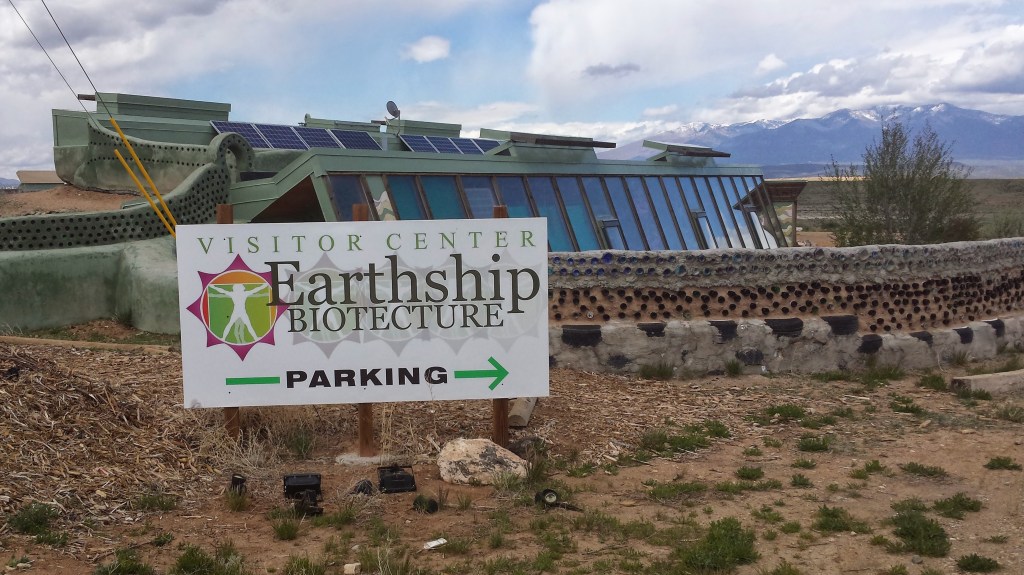
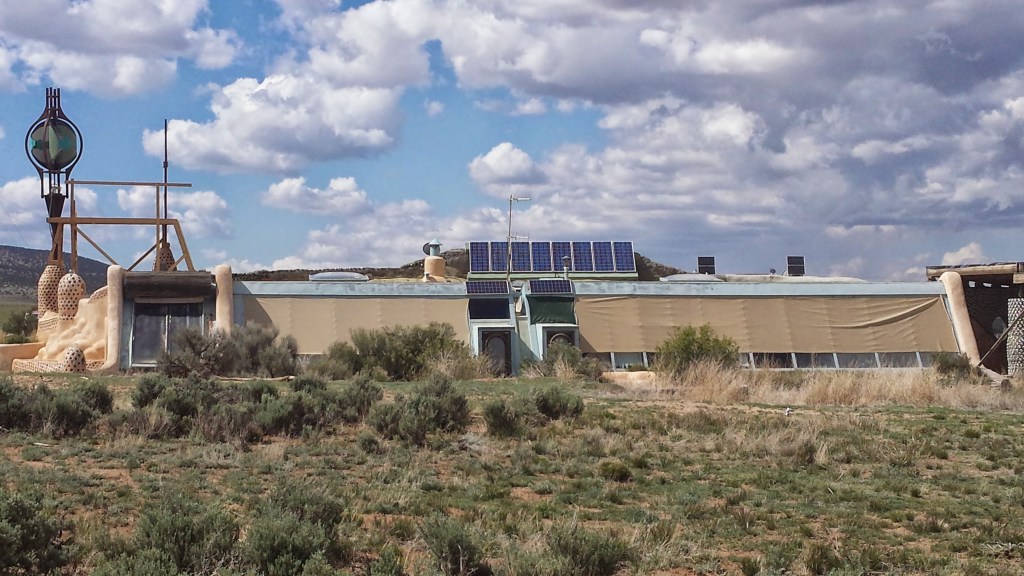
    When I first moved to Albuquerque, the desert had its own kind of whisper. The space between things felt wider here — room for thoughts to stretch, for silence to mean something. I learned about  Earthship homes — houses built from recycled materials, designed to sustain themselves off-grid and to live with the land rather than against it.

    It wasn’t just their design that intrigued me — it was their defiance. They refused permission. They were proof that you could live differently and still live beautifully.

    So I made the trip north.

    The Earthships

    The drive into Taos feels like crossing a threshold — sagebrush to sand, sky expanding until it seems to hum. Then, at the edge of nowhere, the Earthships appear like a dream half-finished — domed roofs, bottle walls shimmering in sunlight, glass catching sky.

    I took the tour slowly. Inside, the air felt calm, held. The walls glowed faintly green where glass bottles caught the light. Planters of herbs ran along windows, drinking sunlight and water collected from the rain. It was quiet — not empty, just balanced.

    The guide spoke about sustainability, but I was hearing something else — a kind of philosophy of living: build with what’s been discarded, make beauty out of survival. It reminded me that creation isn’t always new; sometimes it’s just rearranged endurance.

    “Exterior of Earthship home near Taos, New Mexico”
    exterior of earthship

      The Staircase

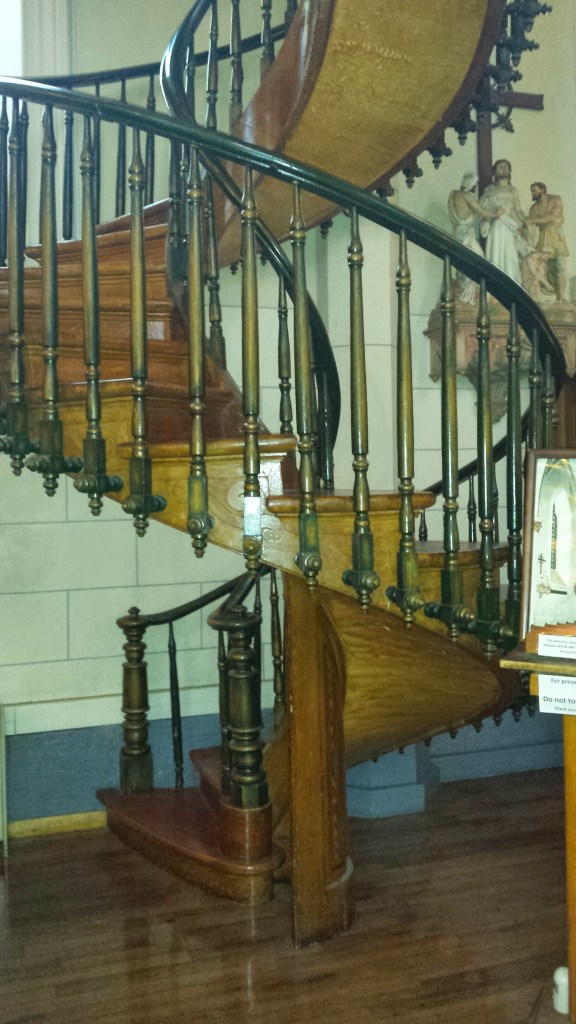
    From Taos, I drove south to Santa Fe, to the Loretto Chapel. I’d heard the story — the mysterious carpenter, the spiral staircase with no visible supports, built after the nuns prayed for a solution. Seeing it in person was something else.

    The staircase curves upward like a question that answers itself — no nails, no center post, just precision and faith. I stood beneath it, tracing the grain of the wood with my eyes, thinking about the people who build because they have to believe it will stand.

    Stairs said to be made by an Angel

      The Gorge

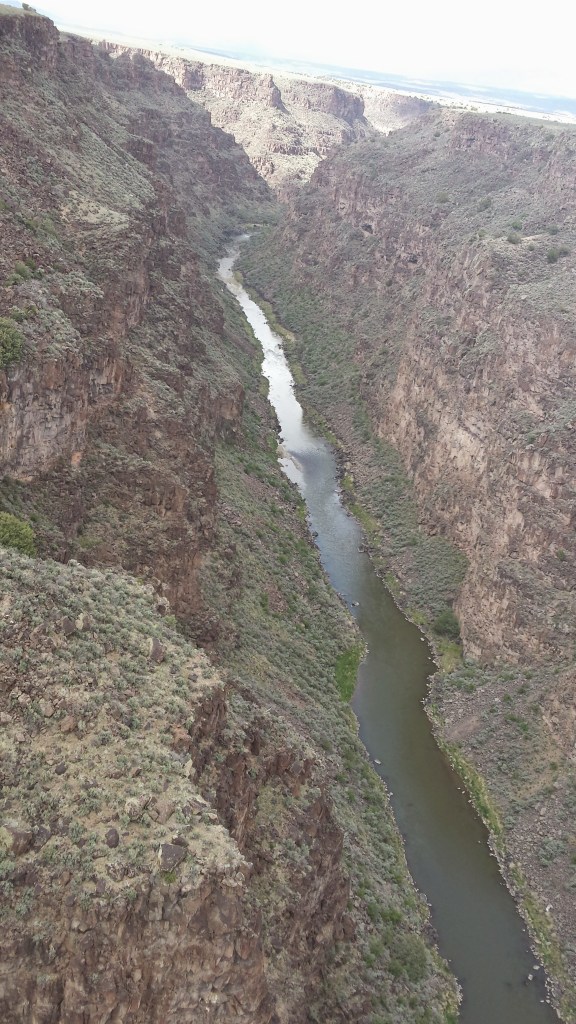
    Then there was the Rio Grande Gorge — where the land simply falls away.

    I parked, stepped out, and felt the wind announce itself. Heights and I have never been friends. I walked to the railing anyway.

    Below, the river glinted like a silver thread stitching through time. When a semi-truck passed, the bridge shuddered beneath my feet, and I gripped the rail tighter than I’d admit. But I stayed long enough to feel it — that strange marriage of fear and awe.

    breathtaking View
    View from the bridge

    That’s what this road was always about. Not conquering fear — just walking out far enough to meet it honestly.

    On the drive home, I realized I wasn’t chasing wonder anymore. I was studying it — seeing what remains when the awe fades and only understanding is left.

    Maybe the Earthship homes, the staircase, and the gorge were all saying the same thing:

    Build something that endures.

    Trust what you can’t see holding you.

    Look down, but don’t stay afraid.

    The road home was quieter. The car hummed its low prayer, tires counting miles of reflection. I thought about all I’d seen, and how every place had its lesson written in silence.

    Maybe I’m still searching, but it’s a better kind of searching now. Not for arrival — but for alignment. For the places and people that hold when the ground trembles.

    The road doesn’t always offer answers.

    Kyle J. Hayes

    kylehayesblog.com

    Please like, comment, and share

  • The Invisible Hand and the Road Not Taken

    The Invisible Hand and the Road Not Taken

    I bought a vehicle that can go anywhere—mountains, mesas, the forgotten roads that stretch like veins across the desert. Yet somehow, I’ve gone nowhere. There’s an invisible hand that holds me in place, the same quiet force that makes stepping into a restaurant alone feel like walking into a storm. I need purpose, or company, or both, to push past it.

    Lately, though, the sky has been whispering louder than my fear. During the Balloon Fiesta, I watched people from every corner of the world stand in awe of the same morning light I’ve taken for granted. Strangers were out there feeling the beauty of this place—my place—while I stood behind my walls, waiting for permission to belong. That realization loosened the hand’s grip just enough for me to move.

    So I began small.

    Tiguex Park

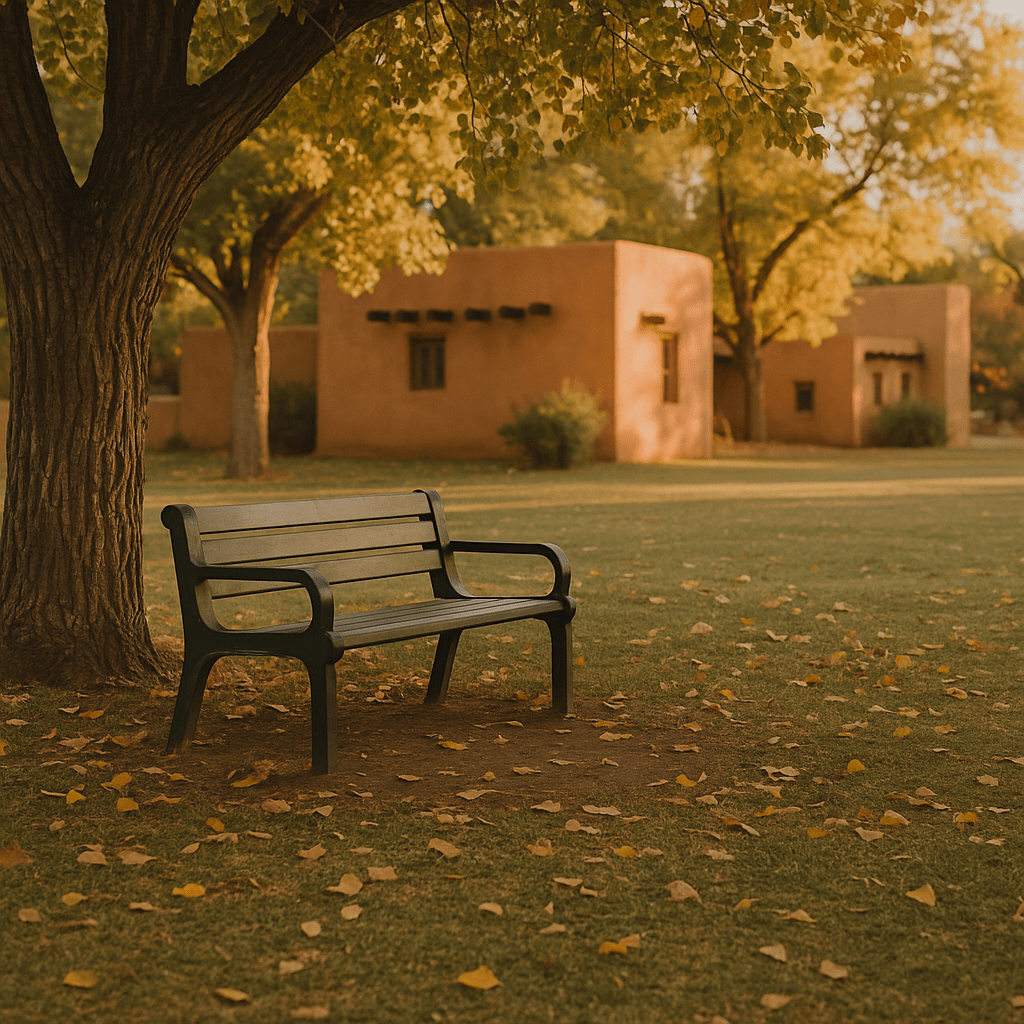
    Tiguex Park isn’t large or loud. It’s one of those places that feels like an exhale—the kind of open green that reminds you the desert can still be gentle. Cottonwoods border its edges, their leaves whispering stories to anyone who’ll listen. The grass carries the echo of a thousand family picnics, soccer games, and lazy afternoons.

    I sat on a bench and listened. The wind carried the faint clang of church bells from San Felipe de Neri. A child laughed somewhere behind me; a dog barked once and then twice. The air smelled faintly of dust and Pinon Coffee from stores nearby. I could almost feel the heartbeat of Albuquerque pulsing under the soil—slow, steady, stubborn.

    For a few minutes, I wasn’t thinking about where I should be. I was simply here. And that was enough.

    Old Town

    When I left the park, I drifted toward Old Town, a place I wasn’t even sure I’d ever been. The streets were narrower than I expected, like they were designed to make people slow down and see. My vehicle felt too big for this kind of space, a metaphor I didn’t miss—how often have I felt too big, too loud, too something for the places I wanted to fit into?

    I found parking near a cluster of adobe buildings washed in warm earth tones and trimmed in turquoise. Every corner seemed alive with color: handwoven blankets, clay pottery, silver jewelry glinting in the sun. But the crowds pressed close, a river of bodies and voices that threatened to sweep me away. Anxiety whispered, You don’t belong here, and I believed it for a moment.

    Still, I stayed long enough to see what I needed to see. The history in the walls. The persistence of beauty. The courage of people who choose to create, to sell, to share, even when the world is watching. Eventually, the noise became too much, and my anxiety reminded me it was time to go. But as I left, I felt something else—I had gone.

    Sometimes that’s the victory: motion.

    Chile Addict

    Leaving Old Town, I wasn’t ready for home yet. I wanted something that spoke to the culture I had only brushed against. A museum? A gallery? Maybe food? I found all three at Chile Addict on Eubank.

    If passion had a smell, it would be chile. Inside, every inch of space was filled—ristras hanging from the ceiling like red jewelry, shelves lined with sauces from every corner of New Mexico, even dish towels embroidered with peppers in every shade of fire. I bought a bottle of Albuquerque Hot Sauce, labeled “Extra Hot.” I didn’t realize “extra” meant something different here—this was heat meant for native tongues, not transplants like me. But I loved that. It was honest. It burned like truth.

    There was something sacred in that store: the way it celebrated an ingredient that’s more than food—it’s memory, identity, inheritance. It reminded me that culture isn’t confined to museums or galleries. Sometimes it’s bottled, hanging, or simmering quietly in someone’s kitchen.

    What Comes Next

    Driving home, I thought about how long I’ve let that invisible hand dictate my movements. How many experiences have I let anxiety edit out before they began? This small journey—Tiguex Park, Old Town, Chile Addict—felt like a rebellion against that stillness.

    Maybe I should do this every week? Not for content or performance, but as a ritual of re-entry into life. To see my city not as a backdrop but as a living text—one I’ve been too afraid to read.

    Exploration doesn’t always begin on the open road. Sometimes it starts at the park down the street, or in the narrow lanes of a place you’ve always avoided. Sometimes the bravest thing you can do is just go.

    Maybe that’s what growth really looks like—not grand adventures, but small acts of motion. What do you think… Should I keep going?

    Kyle J. Hayes

    kylehayesblog.com

    Please like, comment, and share

  • Where the Fire Lives Now

    Where the Fire Lives Now

    Salt, Ink, & Soul — Albuquerque Notes

    So what now?

    The mornings feel sharper. The kind of air that bites before it kisses. The city exhales from weeks of color and noise, and what’s left is us — the ones who stay when the cameras leave. The ones who know the rhythm of this place when it’s quiet, when the wind has room to think again. Albuquerque becomes smaller in these weeks, but in a way that feels true. The traffic slows. The conversations drift toward what’s next: the cold, the holidays, the bills that never rest.

    It’s a different kind of work now.

    We pull coats from closets and test the heater before sunrise. We sweep the porch, watch the last leaves blow down Central, and start talking about green chile stew the way other cities talk about snow. The vendors pack away their tents. The small diners on Lomas fill again with regulars who know the servers by name. It’s quieter — but not empty. Just changed.

    Everywhere you look, people are preparing. For the cold. For the gatherings. For the weight of the months that close a year. The woman at the laundromat folds blankets that smell faintly of cedar. A man in line at Albertsons mutters about the cost of food. Someone carries a bag of tamales wrapped in a towel to keep them warm. In this city, even small talk turns to survival — not in the desperate sense, but the sacred one. How to endure. How to soften the edges of a hard season.

    That may be where the fire lives now, not in the spectacle or the season’s headline, but in the quiet gestures that keep life lit. The pan was warming on the stove before dawn. The neighbor is checking on an elder before the cold snap. The smell of roasted chile still lingering in backyards is proof that something good happened here and will again. The city glows from within, not above.

    Albuquerque people are built for this. For the ebb between celebration and solitude. For the ordinary days that still ask for presence. The heat of chile, the hum of space heaters, the scratch of ristras hanging against stucco walls — these are our small flames. We feed them daily, without thinking, and call it living.

    Outside, the Sandias sit there, massive yet intimate, like an old friend you’re used to ignoring until the seasons remind you she’s still here. The river runs thin but steady. Somewhere, a child’s jacket zipper sticks, and a parent sighs with the patience of love. It’s all so ordinary — and maybe that’s the point. The fire doesn’t need to be loud to mean something.

    The city keeps moving, slower now, softer. We return to work, to families, to whatever version of hope we can hold through December. The light fades earlier, but it carries a particular mercy with it — the permission to rest, to reflect, to begin again quietly.

    Where the fire lives now is in us — in every New Mexican who stays when the noise dies down. In the ones who keep the coffee warm, who open the shop before dawn, who find beauty in a simple meal shared under a cold sky. The spectacle was never the point. The people were.

    Kyle J. Hayes

    kylehayesblog.com

    Please like, comment, and share

  • The First Meal After the Fiesta

    The First Meal After the Fiesta

    On cold fronts, memory, and a bowl of green chile chicken soup

    The end of the Balloon Fiesta carries a silence you can taste. The burners dim, the silhouettes fold, and the field turns back into earth. Vendors pack away their sugar and smoke. Children in fleece hats tug at sleeves, still seeing balloons in the corner of their eyes. For days, we’ve lived by flame and lift, the city strung between propane thunder and the hush that follows. But when the sky empties, another truth arrives—the one I pretend not to notice until I feel it creep beneath the door: the cold is coming.

    Cold has its own clock. It doesn’t show up with a shouted announcement; it settles in the way light changes, the way cottonwood leaves rattle like tiny bones, the way you reach for a heavier blanket without thinking. The air takes on a metallic taste of first frost. Someone you love says, “hot chocolate?” and you both hear the unspoken word tucked behind it—home.

    Cold, for me, also means a summons to the kitchen. Not the glossy kind with copper pots and exacting vocabulary, but the honest room where you stand in your socks and let breath fog the window. It’s the season of dishes that do more than warm you. Some fight colds; some fight loneliness; some fight the old story that you have to carry this winter by yourself. They’re the soups and stews you make because the answer to wind against glass is heat you can hold in both hands.

    My winter has always begun with chicken soup. Not the postcard version with perfect coins of carrot and noodles set like train tracks, not even the kind anchored by rice. Chicken and vegetables—that’s what I knew. We were too broke to make it from scratch. We had cans, and when we moved up in the world to name brand, I felt like we’d crossed into a secret country. That red-and-white label was royal. I’d watch it burp into the pot in one heavy ring, smell the thin broth turn obedient under the coil burner, and think: What could be better than this?

    Later came food shows and glossy knives, the promise that technique could turn a life. I tried noodles. I tried rice. I tried the whole geography of starch. I learned to sweat onions until they are sweet and glassy, to coax flavor from bones, to salt early rather than late. I knew the swagger of stock that whispers from the next room before you taste it. I learned that cooking is a ledger of small decisions, and that poverty teaches you something chefs can’t: make do until make do turns into this is mine.

    But the most important lesson came from this place I call home. New Mexico has a way of editing your palate. You can live here long enough and discover that your mouth has a memory separate from your mind. The wind smells like roasting chile in the fall, and you salivate like a bell’s been rung. Someone says, “Christmas or red?”—it’s not a question so much as a doorway. If I were going to keep chicken soup as my winter prayer, I had to tell the truth of where I lived. The answer wasn’t noodles or rice. It was what the land keeps teaching: heat is not just temperature; heat is story.

    So I started folding green chile into the pot.

    At first, I was cautious, like meeting a new neighbor on the sidewalk—polite nods, measured conversation, and an exit plan. But Chile does what honest neighbors do: it shows up with a casserole and asks about your people. It doesn’t simply add spice; it adds clarity. The broth stands a little straighter. The vegetables stop playing in the background. Chicken remembers it used to be a living thing and offers you something back—protein and humility. The whole bowl finds its voice.

    And yet, I’ll confess: I made it mild. I told myself I was being considerate of guests, or cautious of colds, or faithful to my childhood memory. Truth is, I was worried about changing the soup I’d used as a map out of boyhood. I didn’t want to betray the tinny comfort of cans we could barely afford, or the later triumph of stepping up to Campbell’s. But a place will tell you when you’re hedging. The longer I lived here, the more I wanted the bowl to match the sky. The sunsets are not shy. The mountains do not whisper. Why should the soup?

    I need it spicier now.

    Not recklessly hot; not pain for performance. I’m talking about the warmth that starts in the throat and blooms behind the sternum like a lantern. Heat that doesn’t drown the other notes but conducts them, the way a good conductor doesn’t overpower an orchestra—just raises a hand and brings brass, strings, woodwinds into a single breath. I want a bowl that can meet the first real wind of winter at the door and say, kindly, not today.

    The strange gift of getting older is realizing that comfort and challenge aren’t enemies. The same bowl that holds your hands steady can also invite you forward. Green chile does that to me. It keeps the humble truth of chicken soup—one bird, a few vegetables, a pot, patience—while insisting on place and present tense. It says: This is New Mexico, and you live here now. It says: memory is better with light.

    That’s why I like making it after the Fiesta. The week is a public exhale. The city has been up early, shoulder to shoulder with strangers, heads tilted back until necks ache—faith expressed as attention. We return home with digital evidence that wonder still exists, then wake up to leaf blowers, coffee, and a fridge that needs a plan. The world becomes regular again. You could call that a comedown. I call it a kitchen.

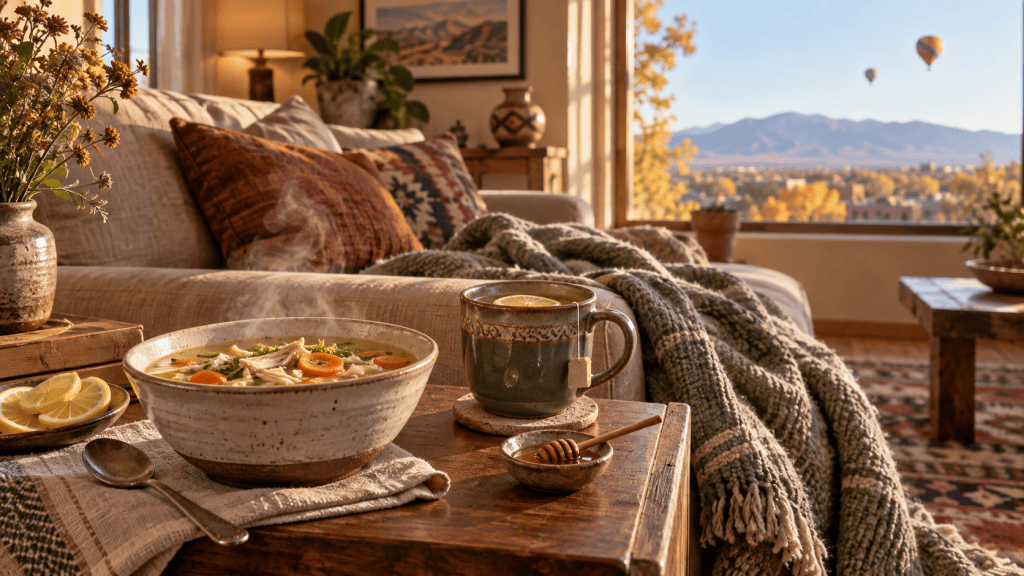
    I set a pot on the stove. The onions hit oil and give up their sweetness. Bell pepper follows. Turkey sausage crumbles and browns. The room starts to smell like we’re going to make it. I add broth, the kind that listens when it boils. The chicken goes in—shredded, humble, sure. And then the green chile. The pot takes a small, ceremonial breath. It becomes a place.

    There’s no need for noodles. No need for rice. I thought I needed them for ballast, for respectability, for proof. Turns out I wanted space—room for pepper and onion to have their say, room for chile to tell me that winter is not a punishment but a way of paying attention. A bowl without ballast can still carry you, if you trust the hands that hold it.

    When it’s done, I taste for salt and let a little cheese drift in at the end. Sometimes I whisk an egg and pour it slowly, like a soft snowfall meeting steam. I stand by the stove in my sock feet with the window fogged and the mountains beginning their evening trick of becoming larger while pretending to recede. I think of canned soup and coil burners, of the day the label meant we’d made it, of the shows that taught me vocabulary for feelings I already had. I think of how love sneaks into your life disguised as minor improvements: a better pot, a sharper knife, a chile that bites and then forgives.

    Outside, the cold is practicing its scales. Inside, the spoon finds the bottom of the bowl and returns with proof. This is how we winter where I live now: not by refusing the season but by seasoning our refusal to quit. The Fiesta will return. The sky will bloom again. Between now and then, we’ll build our own heat—quiet, steady, shared.

    If you ask me what I’d change about my soup, I’ll say the same thing I want for the coming months: a little more fire. Not to scorch. To clarify. To remind me that comfort can have a backbone, and that home, at its best, is a place that warms you and wakes you up.

    The cold is coming. Good. I’ve got a pot on.

    ➤ Read the recipe: Keto Green Chile Chicken Soup →

    A bowl of warmth, reflection, and the quiet work of the soul.

    Kyle J. Hayes

    kylehayesblog.com

    Please like, comment, and share

  • When the Sky Empties: Remembering the Ground We Stand On

    When the Sky Empties: Remembering the Ground We Stand On

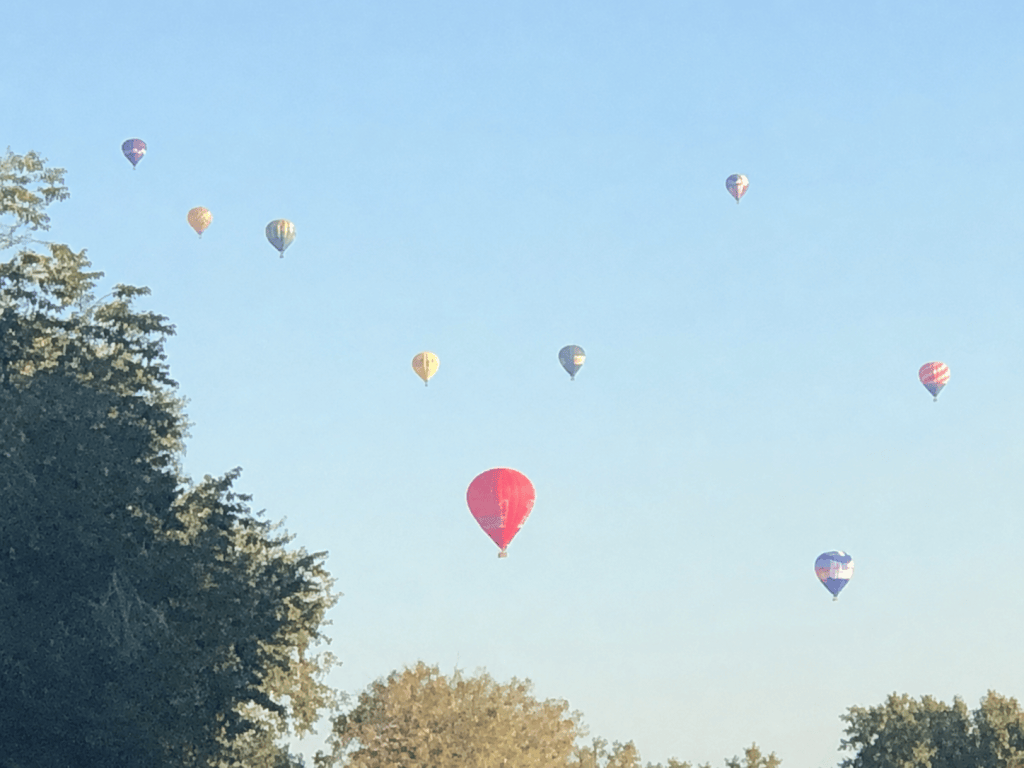
    When the last balloon disappears beyond the Sandias and the roar of burners fades into quiet, the city feels different. The sky, so alive just yesterday, now stretches bare and endless — as if catching its breath after carrying so much wonder. The fields that once pulsed with color and laughter have returned to stillness, the smell of dust and fried dough lingering in the cool morning air. Vendors pack their tents, families drive home, and the wind takes its time moving through what’s left — paper cups, flattened grass, and the memory of joy.

    I live here in Albuquerque, where Native American culture isn’t a festival you visit — it’s a pulse that moves through every day. You see it in the food — fry bread sizzling beside green chile stew — in the jewelry stands where turquoise catches sunlight like captured sky, and in the murals where ancestors watch from painted adobe walls. You hear it in languages that exist nowhere else, carried in song and conversation. This is the place where the Gathering of Nations fills the air each spring, where drums thunder and dancers move like prayers made visible — a spotlight on cultures that never stopped burning, even when the world looked away.

    So when Indigenous Peoples’ Day arrives, it doesn’t feel like an isolated moment — it feels like recognition of what’s always been. It’s a day that reminds us this land isn’t borrowed or bought; it’s lived in, sung to, and remembered. It honors those who first called these mesas home, who understood the sacredness of the earth beneath their feet long before any balloon lifted toward the sky.

    The irony isn’t lost on me — how one day we fill the heavens with color, and the next we honor those who’ve always found meaning in the ground. Maybe that’s the lesson of this timing: that flight and foundation were never intended to be separate things. The balloons rise because the land allows them to. The beauty of the sky depends on the reverence of the soil.

    Standing in the empty field, I feel both awe and humility. The footprints, the dust, the faint hum of the Rio Grande nearby — it all feels alive, like the land is reminding us that celebration doesn’t end when the sky clears. It just changes form.

    Maybe the trick isn’t to choose between the two — not flight or foundation — but to remember that we rise best when we know what we’re rising from.

    As the sun warms the quiet city, I watch one last balloon drifting alone, far to the east — small, defiant, and free. And I think of next year, when the sky will once again bloom with color, and the land will hold us steady beneath it all.

    Because here, in Albuquerque, both sky and soil have stories. And we honor them best when we remember we belong to both.

    Kyle J. Hayes

    kylehayesblog.com

    Please like, comment, and share

  • The Sky After the Fire

    The Sky After the Fire

      There’s a stillness that settles in the air when something beautiful begins to end.

    You can almost feel it—like the warmth that lingers after a fire dies down, or the echo that hangs in the air long after the music stops.

    That’s what Albuquerque feels like tonight.

    The Balloon Fiesta is winding toward its final days. The crowds are still here, the balloons will still rise, but there’s a quiet awareness—something in the way people talk, the way they linger at the park gates a little longer, or look up just a bit differently, knowing that soon the sky will be empty again.

    By Sunday, the burners will hiss one last time. The night glow will fade into memory, the food stalls will close, and the field will return to stillness. But for now, we are in that sacred in-between—the pause before goodbye.

    I think back to how it all started.

    The first flames in France—men daring the sky with nothing but fire, silk, and faith. That was the beginning of this story, the first breath of what would become centuries of wonder. Then came the dawn patrols—those early risers who carried hope into the dark, proving that courage often burns brightest before sunrise. And then, the chase—crews and families and strangers all following what cannot be caught, learning that beauty was never meant to be possessed, only witnessed.

    And now, here we are, standing at the edge of it all—at the night glow, where the sky turns into a mirror for our longing.

    If you’ve never stood there, it’s hard to explain. Balloons tethered to the ground, illuminated from within, flickering to life like lanterns in the desert. The sound of burners—deep, thunderous breaths breaking the cool air. Families sitting together, children wrapped in blankets, their faces bathed in orange light. The laughter, the awe, the warmth—it’s all there, suspended for a few hours in the thin October air.

    I’ve stood among them, camera in hand, burrito and coffee long gone cold, watching as the sky became a living painting. It’s strange how something as simple as hot air and fabric can stir something so deep. Maybe it’s the fire—how it connects us back to something ancient, something communal. Long before we had cities or machines, people gathered in the dark, their faces lit by flames, sharing warmth and stories.

    That’s what the night glow feels like—an echo of the first fires that made us human.

    Somewhere between the bursts of flame and the cheers of the crowd, I found myself thinking of next year. That’s the quiet magic of the Fiesta—it always leaves you wanting more, not in greed, but in gratitude. It doesn’t end so much as it plants something in you, a small spark that waits all year for October to return.

    By Sunday night, the last balloons will glow against the dark, one final dance between fire and air. The crowd will cheer, children will wave goodbye, and the sky will go black again. But everyone who’s been here will carry a piece of it home—the sound, the color, the feeling of standing still in a world that, for a few fleeting days, felt united in wonder.

    I think about the first fire in France and how they must have felt as they watched their creation lift into the air, untethered. I think about the dawn pilots who rise before light, guided by faith in the unseen. I think about the chasers who follow, knowing the joy is in the pursuit, not the catch. And I realize that each of us here—spectator or pilot, child or elder—is a part of that same story.

    We rise.

    We drift.

    We land.

    And somewhere between those moments, we learn what it means to live.

    So yes, the Fiesta is nearing its end, but endings are just quiet beginnings waiting for their turn. The fire will go out. The balloons will rest. But next October, when the air turns crisp again and the Sandias blush pink at dawn, we’ll all return.

    Because the sky after the fire isn’t empty.

    It’s waiting.

    And so are we.

    Kyle J. Hayes

    kylehayesblog.com

    Please like, comment, and share

  • The Children of the Fiesta

    The Children of the Fiesta

    There’s something sacred about growing up beneath a sky that remembers.

    Every October, as the desert air thins and the mornings turn cold enough to see your breath, a new generation of children is carried—still half-asleep—into the breaking dawn of the Albuquerque Balloon Fiesta. They come wrapped in blankets, wearing oversized beanies that slip down over their eyes, perched on their fathers’ shoulders, or tucked into strollers like small explorers in a world that hasn’t yet decided whether it’s dream or daybreak.

    They don’t know yet what they’re seeing. Not really. They just know the sound—the low thunder of burners roaring to life. The smell—dust, coffee, roasted chiles, and earth waking up. And then the color—balloons swelling and lifting into the soft blue light, hundreds of them, each a slow-moving miracle that drifts into their memory long before they know to call it that.

    To be born here, in this place, is to inherit the ritual. Every October, you wake early and drive into the crowd. You grow used to the sight of strangers sharing cocoa and cameras, to the soft murmur of awe when the first balloons glow against the dark, and to that one fleeting moment when the entire sky becomes a mosaic of light and patience. You grow up beneath those colors, and without realizing it, they paint the way you see the world—how you believe in beauty, how you trust in the possibility of flight.

    But not every child is born into this sky. Some grow up elsewhere—in places where the air smells of corn or sea salt, where October means harvests or hurricanes. And then one day, their parents tell them they’re going on a trip. They pack the car with snacks and stories, and they drive. They drive past the endless quilt of farmland, past fields that roll like green oceans, over mountains sharp enough to remind you that beauty often comes with a climb. And when the land changes—when the desert appears in its red-brown quiet, when the sky seems too large to name—they arrive here.

    And what they see can’t be translated. Words don’t hold it. You can describe the colors, the way the morning sun hits the fabric, or the hum of joy that passes through the crowd like shared breath. But to experience it—to feel it—is to understand something ancient. It’s to stand beneath hundreds of balloons rising at once and feel a small part of yourself rise, too.

    It’s not just a show. It’s a communion.

    Because what happens here every October isn’t only for tourists, pilots, or photographers who line up before dawn. It’s for the children—the ones watching wide-eyed from below. It’s for the ones who will grow up remembering how the world looked when it was still possible to believe in flight without fear. It’s for the ones who will one day bring their own children, explaining in half-whispers how it used to feel when they were young—the smell, the light, the sound of burners roaring like a heartbeat at the edge of morning.

    And somewhere in that cycle—between the past and the next generation—something timeless happens. The children who once looked up will become the parents pointing skyward. The memories that once belonged to them will become the inheritance they pass on. And each October, the desert will bloom again—not with flowers, but with fire and fabric and the shared wonder of people who refuse to forget what it means to look up.

    Because even as the world changes, even as screens replace stories and speed replaces stillness, there will always be this—this sky, this season, this reminder that we can still be humbled by color and air.

    The children of the Fiesta will grow up. They’ll go away, as children do. But the sky will call them back. And when they return—holding the hands of their own—they’ll realize what their parents knew:

    Some memories don’t fade.

    They lift.

    Kyle J. Hayes

    kylehayesblog.com

    Please like, comment, and share