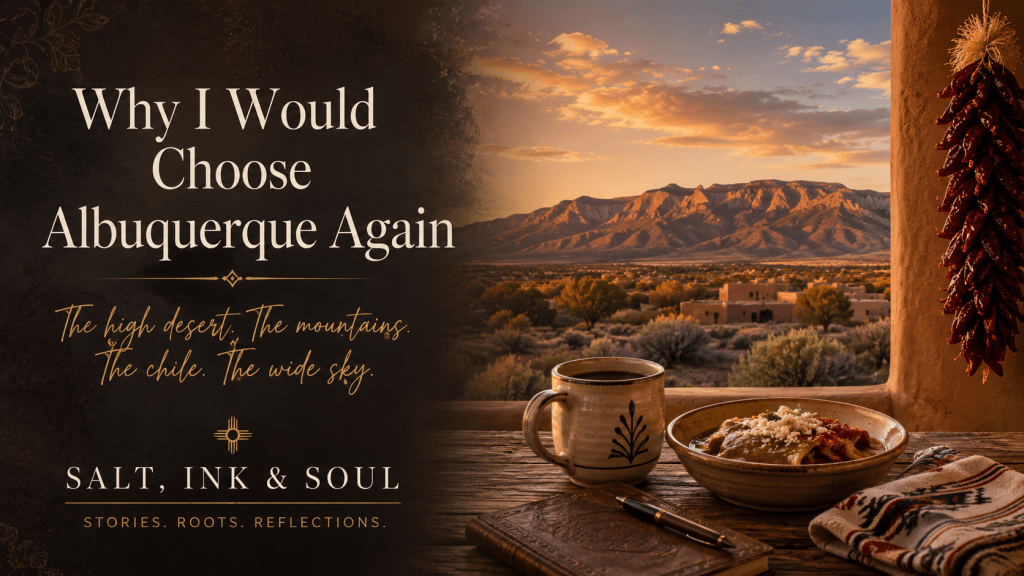
Whenever I travel outside the Southwest, someone eventually asks.
“Do you want to go out for Mexican food?”
They mean it kindly.
They are trying to offer me something familiar. Something they believe might remind me of home.
And my answer is almost always no.
Not because I dislike Mexican food.
Because I have learned to love it too much.
I am spoiled now.
There are things you can unlearn. Facts you can forget. Names that slip loose from memory. Roads that disappear after enough years away.
But once you have eaten certain foods prepared in certain places, your mouth becomes an unreliable diplomat.
It no longer wishes to be polite.
Before I moved west, Mexican food mostly meant Taco Bell.
This is not an insult to Taco Bell. Taco Bell has been there for many of us at times when few others were willing to answer the call. It has fed college students, night-shift workers, road-weary travelers, and people who suddenly discovered at 11:43 p.m. that they had made no plans for dinner.
There is nothing wrong with that.
But a considerable distance separates a drive-through taco from somebody’s grandmother standing over a pot that has been simmering since morning.
Before the Southwest, I did not understand that distance.
My earliest knowledge of tamales came from a can.
Hormel tamales.
Wrapped in paper.
Yes, paper.
Whenever I tell people this, I have to stop and explain because they look at me as if I have confessed that my family ate soup with a fork.
But they existed.
You opened the can, slid out a stack of soft cylinders covered in sauce, and peeled the paper from each one. There was no corn husk. No assembly line of aunties around a kitchen table. No family recipe guarded more carefully than a Social Security number.
Just a can.
And paper.
I ate them without complaint because children rarely question the borders of the world they inherit. If the can said tamales, then tamales were what they were.
We believe many things simply because no one has yet taken us somewhere better.
Arizona was my first real experience with Mexican food—not the idea of it, not the national chain interpretation, but food connected to people, place, heat, memory, and migration.
The flavors were brighter than I expected. The chiles carried more than pain. The tortillas were not merely edible plates designed to keep your hands clean. They had texture. Warmth. A life before they reached the table.
I began to understand that salsa was not just a thing in a jar.
This felt important.
Some salsa announced itself with tomatoes and freshness. Some arrived dark and smoky. Some offered a gentle handshake before setting fire to the furniture.
You learned to respect them all.
Then there was Texas.
I had Mexican food there too, although Tex-Mex is its own country with its own laws. Cheese appears to hold elected office. Cumin has voting rights. Plates arrive carrying enough food to make you reconsider whatever plans you had for the afternoon.
It is not lesser.
It is simply itself.
That distinction matters because we have a habit in this country of flattening other people’s food. We take cuisines with regions, histories, arguments, migrations, and generations of memory, then place them beneath one convenient name.
Mexican food.
As if Mexico were not an enormous nation.
As if the border had not moved.
As if families had not carried recipes across it.
As if Indigenous traditions, Spanish colonization, African influence, geography, poverty, ingenuity, and survival had not all left fingerprints on the plate.
Then I came to New Mexico.
New Mexican food is also its own thing.
People unfamiliar with it sometimes mistake that statement for regional pride.
It is regional pride.
But it is also true.
Here, chile isn’t merely something added to food. Chile is a declaration of citizenship. Red or green is not a casual question. It is an inquiry into your character.
“Christmas” is an acceptable answer, though it can feel like refusing to choose sides in a family argument.
After enough years of eating this way, something happens.
Your standards change.
Not because you become sophisticated. I remain a man who can remember canned tamales with something dangerously close to affection. We should never become so refined that we start lying about where we came from.
But experience widens the world.
You learn the difference between heat and flavor. You learn that a dish can be spicy without being cruel. You learn the difference between a freshly made tortilla and one that came off a factory line.
You learn that food tastes different when it belongs where it is being served.
That may be why I hesitate when someone outside the Southwest asks if I want Mexican food.
I know they are being hospitable.
I also know someone in the kitchen might be preparing to place shredded lettuce, cold tomatoes, and orange cheese inside a hard shell, then charge eighteen dollars for the experience.
I can’t do it.
Not when I know what is waiting for me back home.
This is one of the quieter ways a place claims you.
We often think of home as the place where we were born, where our family lives, or where we made our oldest memories. But sometimes home is also the place that taught us what something is supposed to taste like.
I did not grow up in the Southwest.
I came here carrying other foods, other memories, other definitions. I came from a world where tamales emerged from a can wearing little paper coats.
The Southwest did not erase that boy.
It fed him.
Phoenix introduced him to something larger. Texas showed him another variation. Albuquerque gave him red chile, green chile, stacked enchiladas, warm sopaipillas, and the understanding that cuisine is not a fixed object. It is a living record of who remained, who arrived, what survived, and what people learned to make together.
Food does that.
It enters through the mouth and quietly rearranges the heart.
So when I travel, and someone asks whether I want Mexican food, my refusal may sound arrogant.
It is not meant that way.
It is the caution of a man who has seen too much.
I have smelled chile roasting beneath the New Mexico sky. I have eaten tortillas that arrived warm and soft, carrying the small imperfections that reveal the presence of human hands. I have watched people debate red and green with the seriousness normally reserved for theology and football.
There are some disappointments a person should avoid when he can.
I would rather eat what the place I am visiting does well. Give me its neighborhood restaurant. Its old diner. Its beloved sandwich. Give me the dish the locals defend when outsiders make jokes about it.
I will meet that place through its own food.
Then, when I return to Albuquerque, I will order my enchiladas.
Maybe Christmas.
And I will think, with gratitude, of the strange journey that carried me from Taco Bell, through the canned tamales wrapped in paper, and into a life where I know better.
Not better than other people.
Just better than to order Mexican food too far from home.
Please like, comment, and share
Resources for Hard Times
If you’re looking for practical help, food support, or community resources, you can visit the Salt, Ink & Soul Resources Page.