Tag: salt ink and soul

  • The Quiet

    The Quiet

    Salt, Ink & Soul — Albuquerque Notes

    It’s not silence I’m afraid of.

    It’s what it asks me to notice.

    After the city winds down and the last porch light clicks off, a different gravity settles over Albuquerque. The air thins and sharpens. The clock doesn’t tick so much as announce—each second a footstep down an empty hall. Even the refrigerator hum sounds like a confession. Outside, the street goes soft: figures moving like ghosts, wind pushing fine dust into corners as if to whisper, look closer.

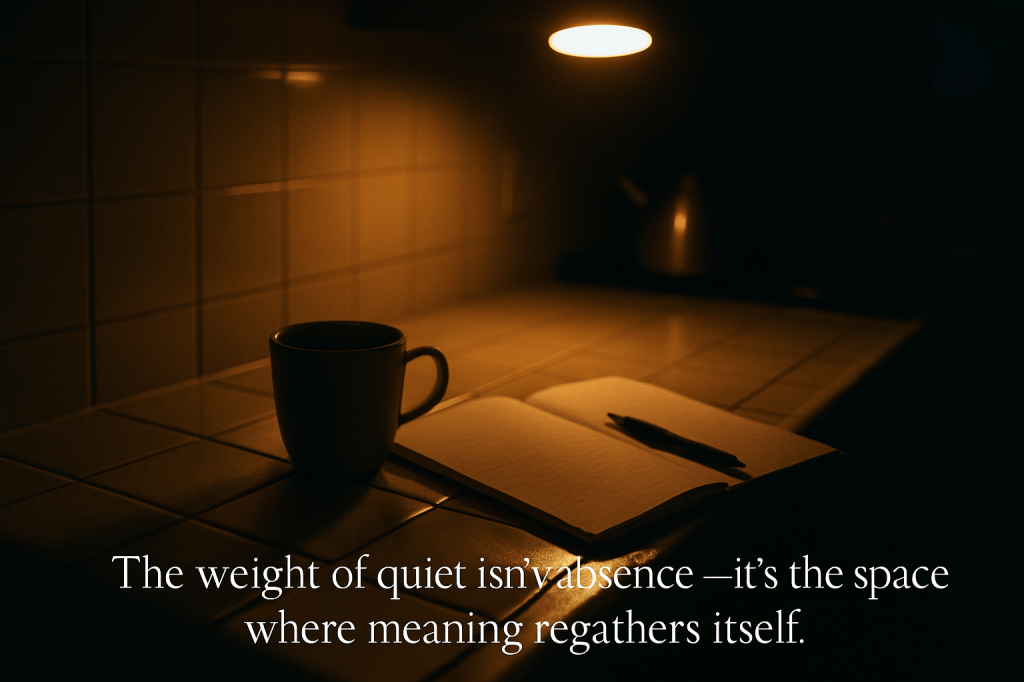
    In the kitchen at night, I stand there, unsure. Wanting to make something, not knowing if I’m even hungry. Under one dim bulb, a small pool of gold forms on the counter. Tile throws the light back in fragments—little squares of moon you can touch. The sink holds its breath. Somewhere above the cabinets, the house settles into itself, wood remembering the day it was a tree. The room is stocked—spices, onions, bones for broth—but hunger doesn’t arrive on command. The emptiness isn’t in the pantry. It lives somewhere between the throat and the hands.

    They say a writer’s greatest enemy is the blank page. They’re not wrong, but that’s not all. Emptiness has cousins: a cook’s dim kitchen when the body isn’t hungry; a road at midnight when the destination is gone and home hasn’t yet declared itself. The quiet asks for something you can’t measure—faith in a spark you cannot see.

    What does it mean to keep creating when the world around you—and inside you—goes still? What do you do when the excitements of special events are gone?

    There’s a restlessness inside the calm, like ducks on a pond—serene on the surface, paddling like hell beneath. After the community’s noise, the quiet feels heavier than the rest. It carries expectation without applause, work without witnesses. You can hold peace and pressure at once: the relief of not performing, the terror that maybe the next sentence, the next meal, won’t arrive.

    So I walk the rooms, listen to the house breathe, look out at adobe walls silvered by the moon, at porch lights fluttering like low-altitude stars. In this desert city, quiet isn’t absence—it’s landscape. Wind hums in the eaves. A lone car slips past, tires whispering secrets to the asphalt. Somewhere, behind a thin wall, soft laughter breaks and fades—the way a match surrenders after doing its job.

    If I cook, I begin with what listens back: onion, oil, salt, low flame. I don’t chase a masterpiece; I court a whisper. Heat slowly, until the room remembers its purpose. If I write, I let the hands move before the story arrives—detail by detail: the scrape of chair legs, the nick on the cutting board shaped like a small country, the clock insisting it is the only drummer left. I ask the night to tell me what it knows that daylight talks over.

    Quiet becomes a compass if you let it. It points not north but inward. It wants fewer clever sentences and more honest ones. It returns me to the first question: Who taught you to make something from almost nothing? Who fed you when there wasn’t much to eat? What did their hands look like under this same small bulb?

    I used to treat stillness like a problem to solve. I believed I should always be doing something—don’t waste time. Now I try to honor it as part of the work. The pause isn’t an intermission between lives; it’s the dark soil where the next season’s roots grow. It’s where endurance gathers; where healing grows legs.

    So I keep the rituals small and faithful. I leave a clean spoon on the counter. I set a glass of water by the notebook. I promise myself ten minutes of heat—words or stove, I don’t care which—then I let the ember decide. Some nights it becomes soup for nobody but me. Some nights it becomes a paragraph that holds after morning. The work is quiet, and it is enough.

    Outside, the Sandias keep their shape against deeper blue—mountain patience refusing to be hurried. Inside, the kitchen bulb halos the room like a blessing I didn’t think I’d earned. The page accepts a first line. The pan agrees with the first hiss. The world does not erupt in applause. It doesn’t need to.

    The fire worth trusting now is the low one—the barely visible ring that keeps the pot honest; the internal pilot light that refuses extinction. Creation isn’t the thunder of a finale; it’s the stubborn heat that stays when the audience goes home.

    The quiet isn’t asking me to fill it—only to listen long enough to remember why I speak.

    Kyle J. Hayes

    kylehayesblog.com

    Please like, comment, and share
  • Where the Fire Lives Now

    Where the Fire Lives Now

    Salt, Ink, & Soul — Albuquerque Notes

    So what now?

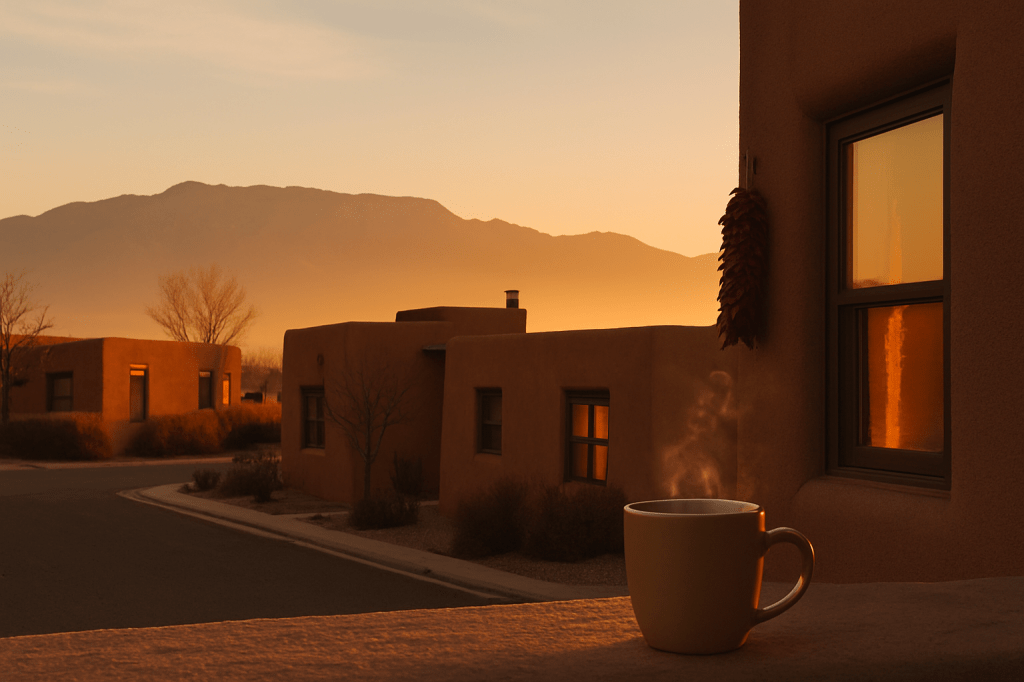
    The mornings feel sharper. The kind of air that bites before it kisses. The city exhales from weeks of color and noise, and what’s left is us — the ones who stay when the cameras leave. The ones who know the rhythm of this place when it’s quiet, when the wind has room to think again. Albuquerque becomes smaller in these weeks, but in a way that feels true. The traffic slows. The conversations drift toward what’s next: the cold, the holidays, the bills that never rest.

    It’s a different kind of work now.

    We pull coats from closets and test the heater before sunrise. We sweep the porch, watch the last leaves blow down Central, and start talking about green chile stew the way other cities talk about snow. The vendors pack away their tents. The small diners on Lomas fill again with regulars who know the servers by name. It’s quieter — but not empty. Just changed.

    Everywhere you look, people are preparing. For the cold. For the gatherings. For the weight of the months that close a year. The woman at the laundromat folds blankets that smell faintly of cedar. A man in line at Albertsons mutters about the cost of food. Someone carries a bag of tamales wrapped in a towel to keep them warm. In this city, even small talk turns to survival — not in the desperate sense, but the sacred one. How to endure. How to soften the edges of a hard season.

    That may be where the fire lives now, not in the spectacle or the season’s headline, but in the quiet gestures that keep life lit. The pan was warming on the stove before dawn. The neighbor is checking on an elder before the cold snap. The smell of roasted chile still lingering in backyards is proof that something good happened here and will again. The city glows from within, not above.

    Albuquerque people are built for this. For the ebb between celebration and solitude. For the ordinary days that still ask for presence. The heat of chile, the hum of space heaters, the scratch of ristras hanging against stucco walls — these are our small flames. We feed them daily, without thinking, and call it living.

    Outside, the Sandias sit there, massive yet intimate, like an old friend you’re used to ignoring until the seasons remind you she’s still here. The river runs thin but steady. Somewhere, a child’s jacket zipper sticks, and a parent sighs with the patience of love. It’s all so ordinary — and maybe that’s the point. The fire doesn’t need to be loud to mean something.

    The city keeps moving, slower now, softer. We return to work, to families, to whatever version of hope we can hold through December. The light fades earlier, but it carries a particular mercy with it — the permission to rest, to reflect, to begin again quietly.

    Where the fire lives now is in us — in every New Mexican who stays when the noise dies down. In the ones who keep the coffee warm, who open the shop before dawn, who find beauty in a simple meal shared under a cold sky. The spectacle was never the point. The people were.

    Kyle J. Hayes

    kylehayesblog.com

    Please like, comment, and share
  • The First Meal After the Fiesta

    The First Meal After the Fiesta

    On cold fronts, memory, and a bowl of green chile chicken soup

    The end of the Balloon Fiesta carries a silence you can taste. The burners dim, the silhouettes fold, and the field turns back into earth. Vendors pack away their sugar and smoke. Children in fleece hats tug at sleeves, still seeing balloons in the corner of their eyes. For days, we’ve lived by flame and lift, the city strung between propane thunder and the hush that follows. But when the sky empties, another truth arrives—the one I pretend not to notice until I feel it creep beneath the door: the cold is coming.

    Cold has its own clock. It doesn’t show up with a shouted announcement; it settles in the way light changes, the way cottonwood leaves rattle like tiny bones, the way you reach for a heavier blanket without thinking. The air takes on a metallic taste of first frost. Someone you love says, “hot chocolate?” and you both hear the unspoken word tucked behind it—home.

    Cold, for me, also means a summons to the kitchen. Not the glossy kind with copper pots and exacting vocabulary, but the honest room where you stand in your socks and let breath fog the window. It’s the season of dishes that do more than warm you. Some fight colds; some fight loneliness; some fight the old story that you have to carry this winter by yourself. They’re the soups and stews you make because the answer to wind against glass is heat you can hold in both hands.

    My winter has always begun with chicken soup. Not the postcard version with perfect coins of carrot and noodles set like train tracks, not even the kind anchored by rice. Chicken and vegetables—that’s what I knew. We were too broke to make it from scratch. We had cans, and when we moved up in the world to name brand, I felt like we’d crossed into a secret country. That red-and-white label was royal. I’d watch it burp into the pot in one heavy ring, smell the thin broth turn obedient under the coil burner, and think: What could be better than this?

    Later came food shows and glossy knives, the promise that technique could turn a life. I tried noodles. I tried rice. I tried the whole geography of starch. I learned to sweat onions until they are sweet and glassy, to coax flavor from bones, to salt early rather than late. I knew the swagger of stock that whispers from the next room before you taste it. I learned that cooking is a ledger of small decisions, and that poverty teaches you something chefs can’t: make do until make do turns into this is mine.

    But the most important lesson came from this place I call home. New Mexico has a way of editing your palate. You can live here long enough and discover that your mouth has a memory separate from your mind. The wind smells like roasting chile in the fall, and you salivate like a bell’s been rung. Someone says, “Christmas or red?”—it’s not a question so much as a doorway. If I were going to keep chicken soup as my winter prayer, I had to tell the truth of where I lived. The answer wasn’t noodles or rice. It was what the land keeps teaching: heat is not just temperature; heat is story.

    So I started folding green chile into the pot.

    At first, I was cautious, like meeting a new neighbor on the sidewalk—polite nods, measured conversation, and an exit plan. But Chile does what honest neighbors do: it shows up with a casserole and asks about your people. It doesn’t simply add spice; it adds clarity. The broth stands a little straighter. The vegetables stop playing in the background. Chicken remembers it used to be a living thing and offers you something back—protein and humility. The whole bowl finds its voice.

    And yet, I’ll confess: I made it mild. I told myself I was being considerate of guests, or cautious of colds, or faithful to my childhood memory. Truth is, I was worried about changing the soup I’d used as a map out of boyhood. I didn’t want to betray the tinny comfort of cans we could barely afford, or the later triumph of stepping up to Campbell’s. But a place will tell you when you’re hedging. The longer I lived here, the more I wanted the bowl to match the sky. The sunsets are not shy. The mountains do not whisper. Why should the soup?

    I need it spicier now.

    Not recklessly hot; not pain for performance. I’m talking about the warmth that starts in the throat and blooms behind the sternum like a lantern. Heat that doesn’t drown the other notes but conducts them, the way a good conductor doesn’t overpower an orchestra—just raises a hand and brings brass, strings, woodwinds into a single breath. I want a bowl that can meet the first real wind of winter at the door and say, kindly, not today.

    The strange gift of getting older is realizing that comfort and challenge aren’t enemies. The same bowl that holds your hands steady can also invite you forward. Green chile does that to me. It keeps the humble truth of chicken soup—one bird, a few vegetables, a pot, patience—while insisting on place and present tense. It says: This is New Mexico, and you live here now. It says: memory is better with light.

    That’s why I like making it after the Fiesta. The week is a public exhale. The city has been up early, shoulder to shoulder with strangers, heads tilted back until necks ache—faith expressed as attention. We return home with digital evidence that wonder still exists, then wake up to leaf blowers, coffee, and a fridge that needs a plan. The world becomes regular again. You could call that a comedown. I call it a kitchen.

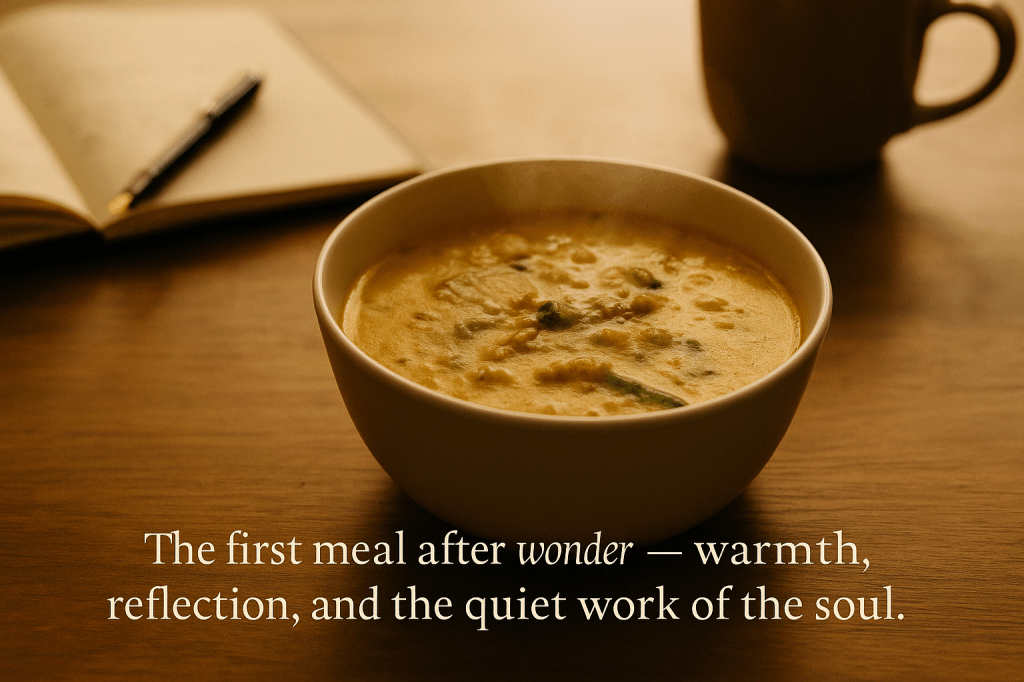
    I set a pot on the stove. The onions hit oil and give up their sweetness. Bell pepper follows. Turkey sausage crumbles and browns. The room starts to smell like we’re going to make it. I add broth, the kind that listens when it boils. The chicken goes in—shredded, humble, sure. And then the green chile. The pot takes a small, ceremonial breath. It becomes a place.

    There’s no need for noodles. No need for rice. I thought I needed them for ballast, for respectability, for proof. Turns out I wanted space—room for pepper and onion to have their say, room for chile to tell me that winter is not a punishment but a way of paying attention. A bowl without ballast can still carry you, if you trust the hands that hold it.

    When it’s done, I taste for salt and let a little cheese drift in at the end. Sometimes I whisk an egg and pour it slowly, like a soft snowfall meeting steam. I stand by the stove in my sock feet with the window fogged and the mountains beginning their evening trick of becoming larger while pretending to recede. I think of canned soup and coil burners, of the day the label meant we’d made it, of the shows that taught me vocabulary for feelings I already had. I think of how love sneaks into your life disguised as minor improvements: a better pot, a sharper knife, a chile that bites and then forgives.

    Outside, the cold is practicing its scales. Inside, the spoon finds the bottom of the bowl and returns with proof. This is how we winter where I live now: not by refusing the season but by seasoning our refusal to quit. The Fiesta will return. The sky will bloom again. Between now and then, we’ll build our own heat—quiet, steady, shared.

    If you ask me what I’d change about my soup, I’ll say the same thing I want for the coming months: a little more fire. Not to scorch. To clarify. To remind me that comfort can have a backbone, and that home, at its best, is a place that warms you and wakes you up.

    The cold is coming. Good. I’ve got a pot on.

    ➤ Read the recipe: Keto Green Chile Chicken Soup →

    A bowl of warmth, reflection, and the quiet work of the soul.

    Kyle J. Hayes

    kylehayesblog.com

    Please like, comment, and share

  • When the Sky Empties: Remembering the Ground We Stand On

    When the Sky Empties: Remembering the Ground We Stand On

    When the last balloon disappears beyond the Sandias and the roar of burners fades into quiet, the city feels different. The sky, so alive just yesterday, now stretches bare and endless — as if catching its breath after carrying so much wonder. The fields that once pulsed with color and laughter have returned to stillness, the smell of dust and fried dough lingering in the cool morning air. Vendors pack their tents, families drive home, and the wind takes its time moving through what’s left — paper cups, flattened grass, and the memory of joy.

    I live here in Albuquerque, where Native American culture isn’t a festival you visit — it’s a pulse that moves through every day. You see it in the food — fry bread sizzling beside green chile stew — in the jewelry stands where turquoise catches sunlight like captured sky, and in the murals where ancestors watch from painted adobe walls. You hear it in languages that exist nowhere else, carried in song and conversation. This is the place where the Gathering of Nations fills the air each spring, where drums thunder and dancers move like prayers made visible — a spotlight on cultures that never stopped burning, even when the world looked away.

    So when Indigenous Peoples’ Day arrives, it doesn’t feel like an isolated moment — it feels like recognition of what’s always been. It’s a day that reminds us this land isn’t borrowed or bought; it’s lived in, sung to, and remembered. It honors those who first called these mesas home, who understood the sacredness of the earth beneath their feet long before any balloon lifted toward the sky.

    The irony isn’t lost on me — how one day we fill the heavens with color, and the next we honor those who’ve always found meaning in the ground. Maybe that’s the lesson of this timing: that flight and foundation were never intended to be separate things. The balloons rise because the land allows them to. The beauty of the sky depends on the reverence of the soil.

    Standing in the empty field, I feel both awe and humility. The footprints, the dust, the faint hum of the Rio Grande nearby — it all feels alive, like the land is reminding us that celebration doesn’t end when the sky clears. It just changes form.

    Maybe the trick isn’t to choose between the two — not flight or foundation — but to remember that we rise best when we know what we’re rising from.

    As the sun warms the quiet city, I watch one last balloon drifting alone, far to the east — small, defiant, and free. And I think of next year, when the sky will once again bloom with color, and the land will hold us steady beneath it all.

    Because here, in Albuquerque, both sky and soil have stories. And we honor them best when we remember we belong to both.

    Kyle J. Hayes

    kylehayesblog.com

    Please like, comment, and share

  • Night Glow: A Fire for the People

    Night Glow: A Fire for the People

    There are moments in life that feel less like events and more like rituals — moments not designed for necessity, not crafted for competition, but for nothing more than the simple wonder of being alive together. The Night Glow at the Balloon Fiesta is one of those moments.

    It is not about the chase, or the science of wind, or the mechanics of lift. It is not even about the sky. This one belongs to the ground. To the people. To us.

    If you’ve never been, go. Find yourself in the crowd as the sun slips beneath the Sandias, as the night takes its place in the sky. The balloons stay tethered, their great bodies still and waiting, while the pilots prepare their burners. Then it happens — one flame, then another, and suddenly the field becomes a cathedral of fire and color. Sometimes the burners roar in unison, turning the night into daylight for a breath. Sometimes it is a dance, coordinated bursts that ripple across the horizon like notes of a song too big for words.

    The sound of the burners is guttural, alive — a rush that shakes you in your chest. Around you, there is laughter. Children dart through the grass with glow sticks in their hands. Families huddle together, necks tilted back, faces painted in red and orange light. Strangers turn into companions, caught in the same breathless silence when the balloons flare together, and the park glows as though the earth itself has caught fire.

    It feels ancient in its way. Humanity has been gathering around flame for as long as we’ve been here — caves, camps, hearths, bonfires. Fire has always been the place we return to, the place we make our myths and find our meaning. The Night Glow is no different. It is our modern bonfire, our ritual of light against the dark, a spectacle that reminds us that not everything we do needs to point forward. Some things, like this, simply point inward.

    You don’t think about this when you’re there. You’re too busy taking it in — the heat that flashes across your face, the squeals of the children, the cameras held up like prayer offerings. But later, as you walk to your car and join the crawl of taillights trying to leave Balloon Fiesta Park, you feel it settling in. You carry it with you. And one day, maybe weeks later, maybe years, something will spark it again — a flame in a grill, a child’s laugh at dusk — and you’ll remember. The glow, the crowd, the sound. And you’ll smile, because you were there, part of it.

    The balloons will always belong to the sky. But the glow — the glow belongs to us.

    Kyle J. Hayes

    kylehayesblog.com

    Please like, comment, and share
  • Beneath the Steam: On Illness and the Old Ways

    Beneath the Steam: On Illness and the Old Ways

    It began like a thief who knew my schedule better than I did—slow, deliberate, testing every door before finding the one left unlocked. A scratch in the throat. A heaviness in the limbs. The faint suspicion that breathing had become less casual, less thoughtless, than it had been yesterday. I told myself I’d push through. I said to myself that sickness is for other people, those who have the time for it. But sickness does not bargain. By midweek, it had settled in fully, an uninvited tenant pressing down on my lungs, hijacking one of the things I hold dearest—my taste.

    Something is humbling about losing your sense of taste. I have crossed oceans for flavor. I have eaten in alleys and palaces alike, chasing the elusive truth of a dish. Food, to me, is not just sustenance—it is memory, culture, love made tangible. And now it was gone. My morning coffee could’ve been hot water from a radiator. My favorite bowl of ramen tasted like broth poured through gauze. Even the memory of taste felt muted, as though my brain were looking for a file that had been deleted.

    We live in an age where you can treat almost anything with a credit card and a ten-minute visit to the pharmacy. Pills for the fever, sprays for the throat, syrups that coat the lungs in menthol haze. Convenience at the ready. But the best cures—the ones that live in the marrow of memory—require no prescription. For me, it begins with green tea, lemon, and honey. My mother’s go-to remedy. The scent alone brings her into the room: the citrus brightness cutting through the air, the floral sweetness of honey sinking into the steam, the earthiness of green tea grounding it all. She swore by it. I still do.

    And then, there is chicken soup. I’ve traveled the country, eaten at the tables of strangers, but if America has a single unifying folk remedy, it is this. In Southern kitchens, Italian kitchens, and even kitchens in California, it’s the same idea, different dialects. Chicken, water, vegetables, salt. Sometimes noodles, sometimes rice. Always the intention to heal. And it works. I don’t know if it’s the steam easing the lungs, the broth coaxing warmth back into your bones, or the simple fact that someone cared enough to make it. But it works.

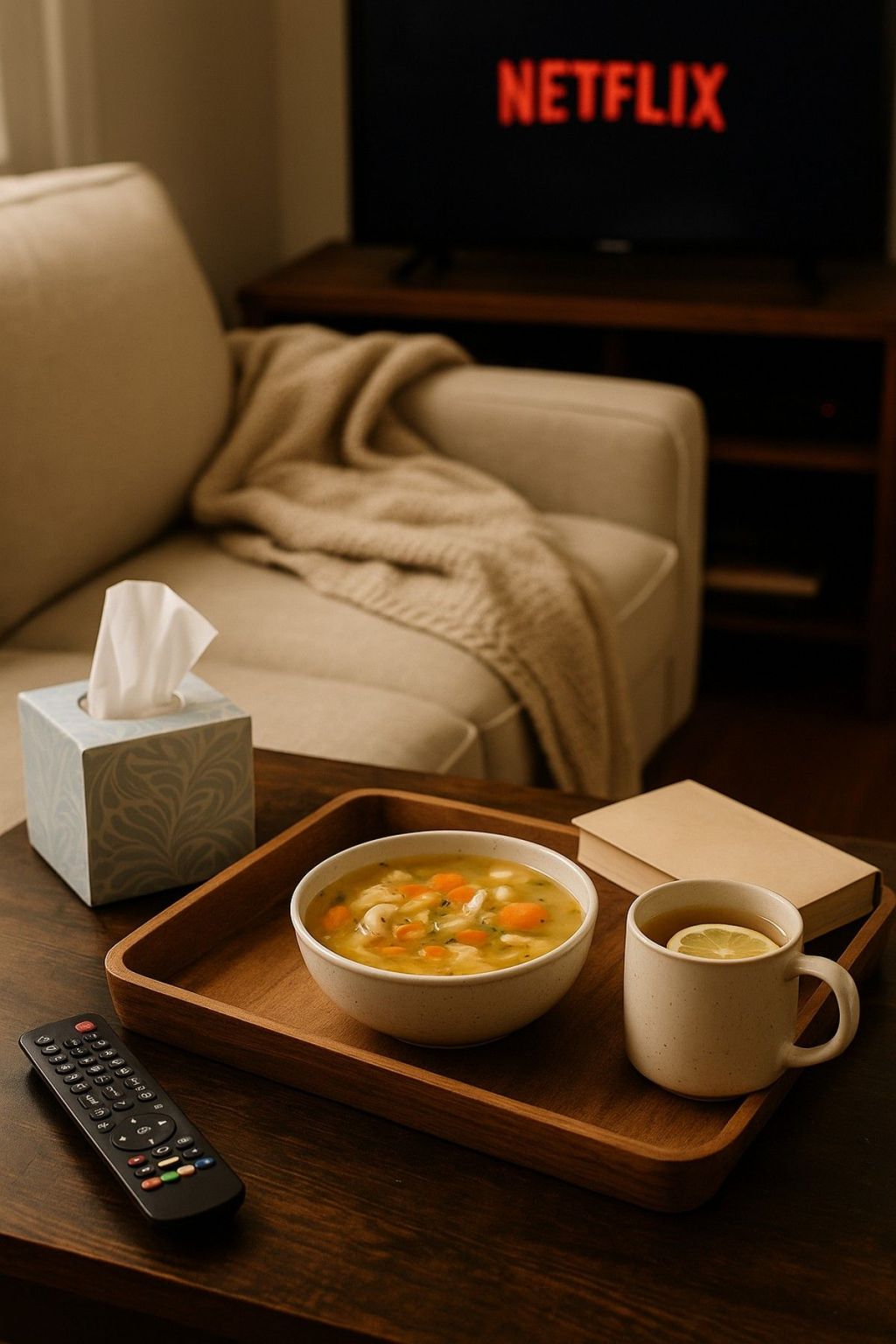
    There’s a ritual to it. Once the soup is simmering, you find your spot. For me, it’s the sofa, where the sun pools in late afternoon. Pillows arranged just so, blanket at the ready. A remote within arm’s reach, Netflix queue prepared to swallow the next several hours. This is not indulgence; this is convalescence. You let the warmth from the bowl linger in your hands before each spoonful, breathing in the scent as if it were a prayer. You sip slowly, allowing the broth to seep into the cracks that sickness has made in you.

    Recovery isn’t just about medicine. It’s about surrender—admitting that you are, in fact, mortal, and in need of care. It’s about allowing yourself to slow down, to be still, to let the old ways work their magic while the world spins on without you. Green tea and lemon. Honey. Chicken soup. These are not just cures for the body—they are acts of remembrance, of connection to the people and places that shaped you. They remind you that before we had walk-in clinics and urgent cares, we had each other. And sometimes, that was enough.

    By the time my taste returns, I know the sickness will already be loosening its grip. But the tea and the soup will remain, as they always have, waiting for the next time life reminds me that I am breakable—and that the cure is as much about being fed as it is about being healed.

    Click here for the full chicken soup recipe

    https://kylehayesblog.com/simple-garlic-chicken-soup/

    By Kyle J. Hayes

    kylehayesblog.com

    Please like, comment, and share