Tag: slow living

  • Cheeseburger Casserole

    Cheeseburger Casserole

    A familiar meal, made to be shared

    Some people look at the recipes I make and wonder why they lean so heavily toward casseroles.

    It’s a fair question.

    I eat well when I can. To be mindful. To make choices that feel like they’re moving me in the right direction. But I also love food—real food, the kind that doesn’t pretend to be anything other than what it is.

    This dish comes from something simple. I like cheeseburgers. Always have. The bun… I can take or leave. What stays with me is everything inside it—the beef, the cheese, the sharpness of mustard, the quiet tang of pickles. That’s the part that matters.

    And somewhere along the way, the idea shifted.

    If the bun isn’t necessary, then what’s left?

    Something you can gather. Something you can make once and return to. Something that holds for a few days without losing what made it good in the first place.

    So it became this.

    Not a replacement. Not a shortcut.

    Just another way of holding on to a flavor I wasn’t ready to let go of.

    Cheeseburger Casserole

    Serves

    6–8

    Ingredients

    • 1 pound ground beef
    • 1 small onion, diced
    • 2 cloves garlic, minced
    • Salt and pepper, to taste
    • 1 cup chopped tomatoes
    • 1 cup diced pickles
    • 1 cup shredded cheddar cheese
    • 1 cup shredded mozzarella cheese
    • 1 cup milk
    • 2 eggs
    • 2 tablespoons ketchup
    • 2 tablespoons mustard
    • 1 teaspoon Worcestershire sauce

    Instructions

    1. Preheat the oven

    Set your oven to 350°F (175°C).

    Let it warm slowly. No need to rush it.

    2. Build the base

    In a skillet over medium heat, cook the ground beef with the diced onion and garlic.

    Let it brown. Let the onions soften.

    Season with salt and pepper.

    Drain off any excess fat. What remains should feel clean, not heavy.

    3. Bring in the familiar

    Stir in the chopped tomatoes and diced pickles.

    This is where it starts to feel like something you already know.

    Transfer the mixture to a greased 9×13 baking dish and spread it evenly.

    4. Add the cheese

    Sprinkle the cheddar and mozzarella over the top.

    Nothing precise. Just enough to cover what’s there.

    5. Prepare the sauce

    In a separate bowl, whisk together:

    • milk
    • eggs
    • ketchup
    • mustard
    • Worcestershire sauce

    It won’t look like much yet.

    It doesn’t need to.

    6. Bring it together

    Pour the mixture evenly over the casserole.

    Let it settle into the spaces between everything else.

    7. Bake

    Place the dish in the oven and bake for 25–30 minutes.

    Until the top is melted, slightly golden, and the edges begin to bubble.

    8. Let it rest

    Remove from the oven and let it sit for a few minutes before serving.

    Some meals need that pause.

    This is one of them.

    To Serve

    Serve warm.

    You can finish it with:

    • a few extra diced pickles
    • chopped herbs
    • Or leave it just as it is

    It doesn’t need much.

    Serve This As a Complete Table

    This dish was never meant to stand alone.

    It belongs beside something that brings balance.

    • Low-Carb Coleslaw (coming Friday)
    • Almond Cream Cake  (coming Saturday)

    Together, they create something steady.

    Not heavy.

    Not complicated.

    Just enough.

    Kyle J. Hayes

    kylehayesblog.com

    If this found you at the right time,

    Feel free to like, comment, or share it with someone who might need it too.

    Resources for Hard Times

    If you’re looking for practical help, food support, or community resources, you can visit the Salt, Ink & Soul Resources Page.


    👉 Resources for Hard Times

  • Notes from the Kitchen: What I Learned Slowly

    Notes from the Kitchen: What I Learned Slowly

    There are things the kitchen teaches you slowly.

    Not in a single recipe. Not in a moment where everything finally makes sense. But over time. Through repetition. Through small mistakes. Through paying attention in ways you didn’t know you needed to.

    Some of those lessons stay with you.

    Quiet things. Practical things. The kind that don’t feel important until you realize they’ve changed the way you move through the room.

    If there is ever a question about washing your meat, the answer is yes.

    I learned that in a place that didn’t leave much room for guessing—a summer spent working in a beef processing plant. Some lessons don’t need to be debated after you’ve seen how things are handled before they reach your kitchen.

    At home, I keep it simple.

    A little vinegar. Half a lemon.

    Not complicated. Just care.

    Flour is one of those things I didn’t understand until I did.

    I used to avoid it without knowing why. Something about it never sat right with me. It wasn’t until I started paying attention—really paying attention—that I realized not all flour is the same.

    Now I buy unbleached, unfortified flour. I use King Arthur.

    And yes… I can tell the difference.

    Not just in the way it bakes. In the way it feels afterward.

    Sometimes the body knows things before the mind catches up.

    For a long time, I bought boneless, skinless chicken.

    Convenient. Clean. Quick.

    But convenience has a way of taking something away without telling you.

    At some point, I stopped.

    Started buying whole chickens instead.

    Learning how to break them down. Learning where each cut comes from. Learning how much more you get when you take the time.

    What you don’t use right away becomes broth.

    What used to be thrown away becomes something that feeds you again later.

    There’s a quiet satisfaction in that.

    Some tools make the kitchen easier, not louder.

    A digital thermometer.

    A digital scale.

    They don’t take anything away from the experience. They give you clarity. They remove the guessing that sometimes turns simple cooking into frustration.

    The same goes for learning the metric system.

    Especially when baking.

    It’s not about being technical. It’s about being consistent.

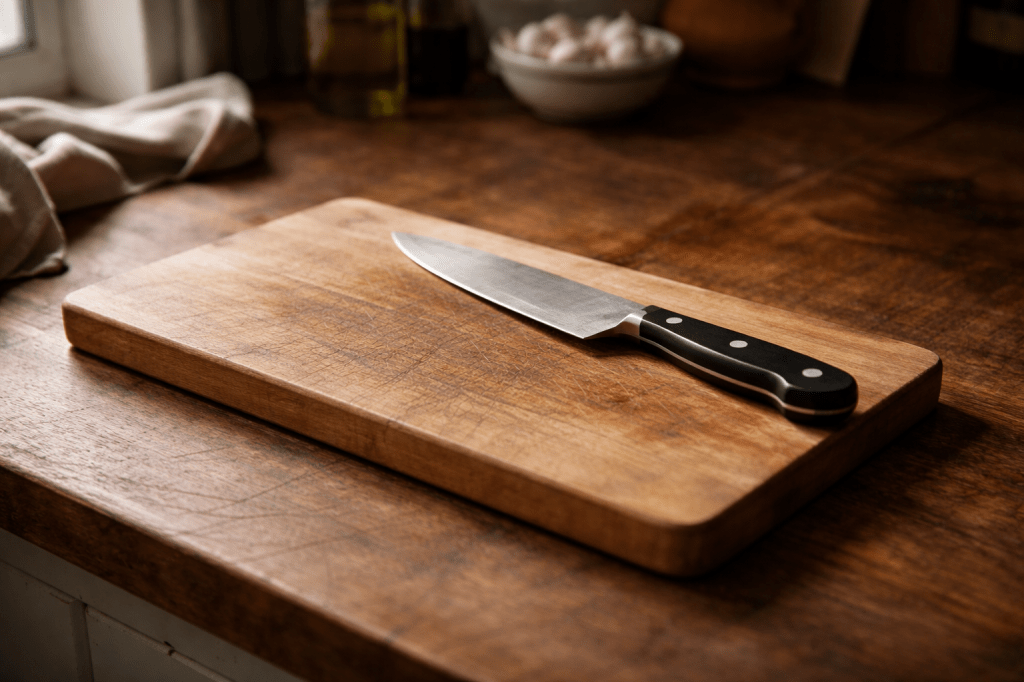
    A sharp knife changes everything.

    I didn’t realize how much effort I was wasting until I didn’t have to anymore.

    There’s a difference between fighting your tools and working with them.

    The kitchen feels different when things move the way they’re supposed to.

    I wear gloves in the kitchen.

    Some people might not.

    That’s fine.

    But I’ve come to appreciate finishing a meal without the smell of onions or garlic following me around for the rest of the day.

    Small choices. Small comforts.

    They add up.

    One of the simplest things I’ve learned is also one of the most important.

    Read the recipe all the way through.

    Not while you’re cooking. Not halfway in.

    At the moment you think about making it.

    Some recipes take time. Some take planning. Some ask more of you than they let on at first glance.

    It’s better to know that before you begin.

    And maybe the most practical lesson of all:

    Plan your meals.

    Not in a rigid way. Not like a schedule you have to obey.

    Just with a little intention.

    Think about what’s coming next. Think about what leftovers can become. Think about how one meal can lead to another.

    It makes things easier.

    More affordable.

    Less wasteful.

    More thoughtful.

    None of these things is complicated.

    That’s the point.

    The kitchen doesn’t always ask for more skill.

    Sometimes it just asks for more attention.

    And over time, that attention becomes something else.

    Something quieter.

    Something steady.

    Something that feels a lot like care.

    Kyle J. Hayes

    kylehayesblog.com

    If this found you at the right time,

    Feel free to like, comment, or share it with someone who might need it too.

    Resources for Hard Times

    If you’re looking for practical help, food support, or community resources, you can visit the Salt, Ink & Soul Resources Page.
    👉 Resources for Hard Times

  • A Quiet Beginning to the Week

    A Quiet Beginning to the Week

    Monday mornings have a reputation.

    They’re supposed to arrive with urgency. With lists already waiting. With alarms that sound less like invitations and more like instructions. Somewhere along the way, we decided the beginning of a week should feel like stepping onto a moving train.

    But the truth is, not every Monday begins that way.

    Some Mondays begin quietly.

    The house is still. The light comes slowly through the window. Coffee warms the room before anything else has a chance to speak. For a few minutes, the world feels almost suspended—like the week hasn’t quite decided what it wants from you yet.

    I’ve come to appreciate those moments more than I used to.

    When I was younger, I thought the beginning of a week meant proving something. Proving you were working hard enough. Moving fast enough. Getting somewhere important. The world has a way of convincing us that motion is the same thing as progress.

    But life teaches different lessons if you pay attention long enough.

    It teaches that most of the meaningful parts of living happen in ordinary moments that no one applauds. The first cup of coffee in a quiet kitchen. The familiar rhythm of preparing something simple to eat. The small acts of care that keep a household moving forward.

    None of it looks impressive from the outside.

    But it matters.

    In a world that rewards noise and speed, gentleness can start to feel like a forgotten language. Yet it’s often the gentlest things that steady us the most. A calm voice. A patient moment. A small kindness offered without expectation.

    Even toward ourselves.

    Monday mornings are a good place to practice that kind of kindness.

    Not every week has to begin with pressure. Not every day needs to be measured against a list of accomplishments before it has even begun. Sometimes the best way to start is to arrive in the moment you’re in.

    Make the coffee.

    Open the window.

    Let the day begin at the pace it needs.

    The week will unfold the way weeks always do—one hour at a time, one small decision at a time, one quiet act of care after another.

    And somewhere inside those ordinary moments, the real work of living continues.

    So if today begins slowly, that’s alright.

    If you find yourself easing into the day instead of charging into it, that’s alright too.

    Sometimes the kindest way to start a week is to start gently.

    Kyle J. Hayes

    kylehayesblog.com

    Please like, comment, and share

    Resources for Hard Times

    If you’re looking for practical help, food support, or community resources, you can visit the Salt, Ink & Soul Resources Page.

    👉 Resources for Hard Times

  • A Quiet Thank You at Year’s End

    A Quiet Thank You at Year’s End

    There are twenty of you here—readers who chose to subscribe, to return, and to spend time with this blog over the past year. That number may look small from the outside, but it doesn’t feel small to me. It means that twenty people, in a world that’s moving faster every day, chose to slow down and read words without being in a hurry.

    This year, Salt, Ink & Soul became a place I didn’t fully understand until I was already inside it. A place where food could carry memory without needing to justify itself. Where children’s stories could sit beside reflections on grief, resilience, and the quiet weight of being human. Where the idea of “enough” could be asked gently, without demanding an answer right away.

    Some of you read every post.

    Some of you arrive when a title catches something familiar.

    Some of you read quietly, without ever commenting or leaving a trace.

    All of that is welcome here.

    What I’ve learned this year is that writing doesn’t have to shout to be heard. It only has to be honest. Showing up—again and again—even when the words come slowly, even when the questions remain unfinished, has felt like its own kind of discipline. And knowing readers are willing to sit with that uncertainty has meant more than I can adequately say.

    If you’re reading this as a subscriber, thank you for choosing to stay. Thank you for trusting this space enough to let it arrive in your inbox. Your presence—steady, patient, unassuming—has helped shape what this place is becoming.

    And if you’re reading this for the first time, know this: this is a quiet corner. A place for stories about food, memory, children, and the small moments that often get overlooked. You’re welcome here, whether you pass through once or decide to stay awhile.

    As the year turns, I don’t have grand promises. What I do have is intention. I’ll keep writing. I’ll keep paying attention. I’ll keep trying to make this space feel warm, thoughtful, and human—a place where reflection can breathe.

    Thank you for being here at the beginning. Thank you for reading slowly. Thank you for taking the time to read words written with care.

    If there’s a story you’re still waiting for, or a question you carry quietly, I hope you’ll continue to walk through this space with me. There will be more stories ahead, more moments to sit with, more chances to pause together—and I’m grateful for every reader who chooses to return.

    With gratitude and hope

    Kyle Hayes

    Salt, Ink & Soul

    If you’d like to spend more time with these themes, my books explore food, memory, resilience, and emotional truth in greater depth.

    Explore the books here → Felix collections or on Amazon