Tag: Summer Cooking

  • The Rice Cooker Was Up There the Whole Time

    The Rice Cooker Was Up There the Whole Time

    I have written before about my air fryer and its role in my ongoing battle against kitchen heat.

    When it is hot outside, I have very little interest in making it hotter inside.

    There are meals worth suffering for.

    There are also days when I don’t particularly feel like suffering for dinner.

    The air fryer became one of my weapons in that fight. It lets me cook something good without turning on the oven and making the kitchen feel like somewhere I immediately regret being.

    But lately, I have recruited another appliance.

    My rice cooker.

    The funny thing is, it was already here.

    It had been sitting on top of my kitchen cabinets for who knows how long, quietly watching me complain about the heat while apparently knowing it could have helped the entire time.

    I just wasn’t really using it.

    I had always thought of a rice cooker as exactly what the name says it is.

    You put rice in.

    You put water in.

    You push a button.

    Rice comes out.

    Useful, certainly.

    Exciting, not particularly.

    Then the YouTube algorithm did what the YouTube algorithm does.

    You watch one video.

    Then another appears.

    Then another.

    Before long, I started seeing people making entire meals in rice cookers.

    Not just rice.

    Chicken.

    Vegetables.

    Seasonings.

    Sauces.

    Everything going into one pot and coming out as dinner.

    I looked up at the top of my cabinets.

    Apparently, I had been underestimating an employee.

    The Beauty of One Pot

    There is something deeply appealing to me about a meal that doesn’t require much ceremony.

    Maybe that comes from getting older.

    Maybe it comes from cooking enough meals to understand that good food doesn’t always need to announce how hard you worked to make it.

    Sometimes you want to chop a few things, put them into a pot, push a button, and go about your business.

    Especially when it is hot.

    And especially when you are meal prepping.

    That was the other thing that caught my attention.

    One cup of uncooked rice becomes roughly three cups once cooked. Add a chicken breast, some seasoning, and green onion, and suddenly I have about three portions of food without dirtying three pans or spending an hour standing over the stove.

    There is something satisfying about that kind of efficiency.

    Not the efficiency of eating something you don’t particularly want simply because it is convenient.

    The efficiency of making actual food convenient.

    I think there is a difference.

    I still want dinner to taste like somebody cared about it.

    Even when the somebody is me.

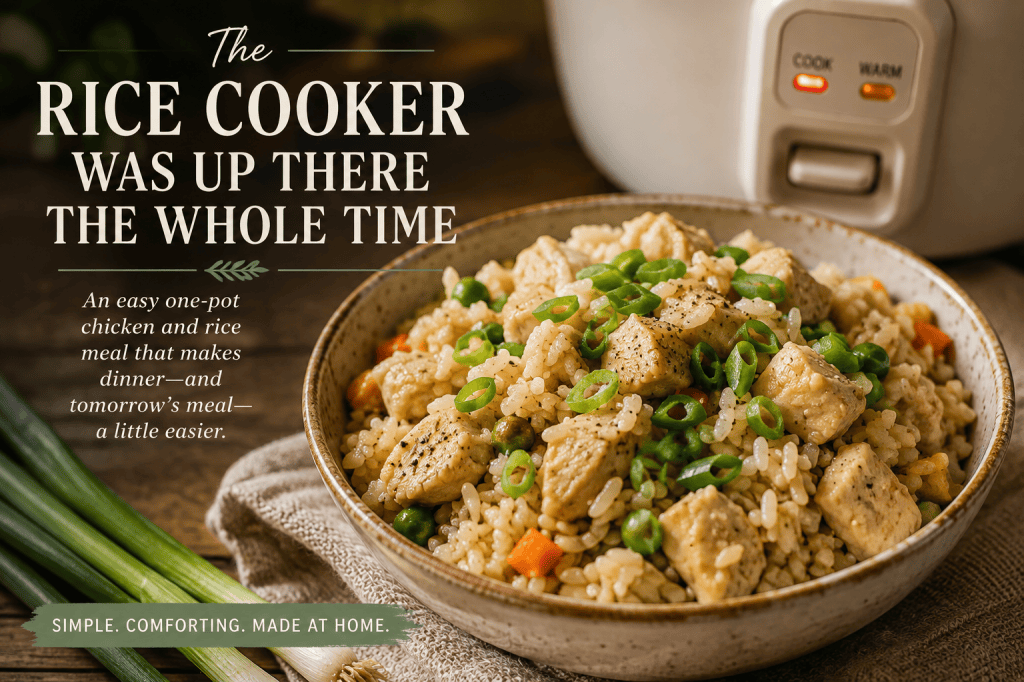
    Rice Cooker Chicken & Rice with Green Onion

    Makes approximately 3 servings

    This is deliberately simple.

    It isn’t supposed to be the kind of recipe that sends you searching three grocery stores for an ingredient you will use once and then discover in the back of the cabinet two years from now.

    Most of this is probably already somewhere in the kitchen.

    Ingredients

    • 1 cup uncooked white rice, rinsed
    • 1 boneless, skinless chicken breast, cut into small bite-size pieces
    • 2 cups chicken broth or water (or the amount recommended on your rice package)
    • 1 tablespoon soy sauce
    • 1 teaspoon sesame oil
    • 1 teaspoon honey or brown sugar, optional
    • ½ teaspoon garlic powder
    • ¼ teaspoon onion powder
    • ½ teaspoon ground ginger, optional
    • Black pepper to taste
    • 2 green onions, thinly sliced
    • ½–1 cup frozen peas and carrots, optional

    Directions

    1. Prepare the green onions.

    Slice the green onions and separate the white and light-green portions from the darker green tops.

    Add the lighter portions to the rice cooker. Save those beautiful dark-green pieces for the end.

    2. Make the sauce.

    Pour the chicken broth into the rice cooker.

    Add the soy sauce, sesame oil, honey or brown sugar, garlic powder, onion powder, ginger, and a little black pepper.

    Give everything a quick stir.

    3. Add the rice.

    Add the rinsed rice to the liquid and gently stir it once so everything is evenly distributed.

    4. Add the chicken.

    Spread the uncooked chicken pieces evenly over the rice.

    Sprinkle the white and light-green portions of the green onions over everything.

    Close the lid.

    5. Push the button.

    Use your rice cooker’s normal white-rice setting.

    Then leave it alone.

    This may actually be the most difficult part of the recipe.

    There is a temptation when cooking to keep looking at things.

    To stir.

    To check.

    To interfere.

    Resist it.

    The machine knows what it is doing.

    6. Make sure the chicken is done.

    When the rice cooker finishes, check one of the largest pieces of chicken with a food thermometer.

    The chicken needs to reach an internal temperature of 165°F (74°C).

    If it hasn’t reached that temperature, continue cooking until it does.

    7. Finish with the green onions.

    Fluff the chicken and rice together.

    Stir in some of the dark-green onion tops and sprinkle the rest over each serving.

    If you are adding frozen peas and carrots, stir them into the piping-hot chicken and rice, close the lid again, and let everything sit for about five minutes, or until the vegetables are thoroughly heated.

    Taste.

    If it needs a little more soy sauce, add it now.

    Then eat.

    Or, if you are meal prepping like I am, divide everything into three containers.

    Tomorrow’s dinner has already been handled.

    Use What You Already Have

    I think there may be a small lesson hiding somewhere in all of this.

    We accumulate things with good intentions.

    Appliances.

    Books.

    Tools.

    Ideas.

    We tell ourselves we are going to use them.

    Then life happens.

    They sit there.

    And sometimes all it takes is seeing an old thing differently.

    My rice cooker hasn’t changed.

    I stopped seeing it as something that only makes rice and started seeing what else it could do for me.

    It gives me another way to cook without heating up the kitchen.

    It makes meal prep easier.

    It gives me three meals from one pot.

    There is less cleanup.

    Less standing over the stove.

    Less thinking about what I am going to eat tomorrow.

    And most importantly, it still allows me to eat something that feels like dinner.

    Something made at home.

    I think that matters.

    Because convenience has somehow become associated with not caring.

    Fast food.

    Frozen dinners.

    Something eaten standing over the sink because we don’t feel like making anything.

    But convenience doesn’t have to mean neglect.

    Sometimes convenience can be another form of care.

    It can mean making things a little easier for the person you’ll be tomorrow.

    The person who will open the refrigerator, tired and hungry, and discover that someone already thought about dinner.

    Even if that someone was you yesterday.

    Cook’s Note: Rice varieties and rice cookers can behave differently. The rice I used calls for 2 cups of liquid for every 1 cup of uncooked rice. I initially tried less and ended up with rice that was undercooked and burned in places. Check the directions on your rice package and adjust the liquid if necessary.

    Kyle J. Hayes

    kylehayesblog.com

    Please like, comment, and share

    Resources for Hard Times

    If you’re looking for practical help, food support, or community resources, you can visit the Salt, Ink & Soul Resources Page.

    👉 Resources for Hard Times

  • It’s Too Hot to Cook, But We Still Have to Eat

    It’s Too Hot to Cook, But We Still Have to Eat

    It has been hot here in New Mexico.

    Not simply summer hot, where you expect the afternoon to be uncomfortable and learn to live with it. This has been the kind of heat that makes you reconsider ordinary decisions.

    Like cooking dinner.

    There is something almost absurd about standing in a kitchen on a hundred-degree day and deciding that what the house really needs is a 400-degree oven.

    You walk into the kitchen.

    You look at the stove.

    You think about what you planned to cook.

    And suddenly, a sandwich sounds pretty good.

    There is nothing wrong with that.

    A good sandwich, some chips, maybe a salad or some cold fruit can feel almost perfect when the heat outside seems determined to follow you into the house.

    But you can only eat that way for so many days.

    Eventually, you want something cooked.

    Something hot.

    Something that feels like dinner.

    And hunger, unlike the rest of us, has never been particularly impressed by the weather.

    We still have to eat.

    So after thinking about it for a while, I finally bought an air fryer.

    I had resisted getting one.

    I’ve lived long enough to watch plenty of kitchen appliances arrive with promises that they were about to revolutionize the way we eat. Some of them eventually found permanent homes in cabinets, sitting beside other machines that had once promised to change breakfast forever.

    But this time, the heat made a better argument than any commercial could.

    An air fryer is small. It cooks quickly. Most importantly right now, I can make dinner without turning the kitchen—and eventually the rest of the house—into an extension of the desert outside.

    So I’ve been using it.

    And I like it.

    I know not everyone has one.

    That is worth saying.

    Because conversations about food have a way of becoming conversations about privilege without anyone noticing.

    We assume everybody has the same kitchen.

    The same appliances.

    The same grocery budget.

    The same amount of time.

    The same energy when the day is over.

    They don’t.

    Food writing sometimes forgets that.

    Cooking can become theater.

    Beautiful kitchens. Expensive cookware. Perfect ingredients arranged across countertops. Recipes requiring twenty ingredients, three pans, and an afternoon nobody seems to have to work through.

    There is nothing inherently wrong with any of that.

    Cooking can be art.

    It can be recreation.

    It can be something we do simply because creating something beautiful with our hands gives us pleasure.

    I understand that.

    I love cooking.

    But cooking has another purpose that existed long before anybody photographed a dinner plate.

    Somebody has to eat.

    And somewhere tonight, somebody will come home tired from work, stand in front of a refrigerator, and try to figure out what can be made with what is inside.

    Somebody else will look at a grocery bill and quietly put something back.

    Someone will be feeding children who do not care that the person making dinner has had a difficult day.

    And somebody will be standing in a hot kitchen wondering what they can cook without making an already uncomfortable home even hotter.

    They are cooking too.

    Maybe that is cooking in its most honest form.

    It doesn’t matter that you worked late.

    It doesn’t matter that you’re tired.

    It doesn’t matter that groceries cost more than you expected.

    And it certainly doesn’t matter that it is a hundred degrees outside.

    Eventually, someone still has to answer one of the most ordinary questions in family life:

    What are we going to eat?

    It is such a simple question.

    But those words can conceal an extraordinary amount of labor.

    Because somebody has usually been thinking about the answer long before anyone asks.

    They checked the refrigerator.

    They know what is left.

    They remember what everybody ate yesterday.

    They know what needs to be used before it spoils.

    They know what the family likes and what somebody will complain about.

    They have considered the weather.

    They have considered the money.

    And perhaps most importantly, they have considered how tired they are.

    Then, somehow, food appears.

    We rarely call this extraordinary.

    Maybe because it happens too often.

    Care has a way of becoming invisible when it becomes dependable.

    Dinner appears.

    People eat.

    The dishes are washed.

    Tomorrow comes.

    And eventually the question returns.

    What are we going to eat?

    Families have been answering that question under conditions far more difficult than mine for generations.

    Before air conditioning cooled our kitchens, people still cooked through the summer.

    Before refrigerators kept everything safely cold, people found ways to preserve food.

    Before supermarkets offered strawberries in winter and nearly anything else we wanted regardless of season, people learned to make meals from what grew nearby, what could be preserved, what could be stretched, and what could be shared.

    Somewhere inside that history are countless people whose names will never appear in a cookbook.

    Mothers.

    Fathers.

    Grandmothers.

    Grandfathers.

    Aunts.

    Uncles.

    Older brothers and sisters.

    Neighbors.

    People who stood in kitchens while everyone else waited somewhere cooler.

    I remember some of this from my own childhood.

    When food was being prepared, we children were often chased out of the kitchen.

    We didn’t belong in there underfoot while somebody was trying to cook. There were hot pans, sharp knives, grease popping on the stove, cabinet doors opening and closing, and grown folks trying to finish a meal.

    So we were sent somewhere else.

    Go play.

    Go sit down.

    Get out of this kitchen.

    At the time, I don’t remember thinking very deeply about it.

    I was a child.

    The kitchen was simply where the food came from.

    Only later do you begin to understand what was happening in the room after you were chased out.

    Someone kept track of what was cooking, what needed stirring, what was almost done, and what still needed another few minutes.

    Then, when everything was ready, the rest of us came back.

    I remember something else too.

    My grandmother would bring my grandfather his food before she sat down and joined the rest of us.

    That was simply how things were in her kitchen.

    And in so many other kitchens.

    As a child, I didn’t question it.

    Children inherit rituals long before they understand them. We watch how the adults move around one another and assume this is simply how the world works.

    Grandpa sat.

    Grandma brought his plate.

    Then eventually she sat down too.

    I know people may look at that differently now.

    Some may see an old expectation placed upon women. Others may recognize a particular language of marriage, family, and care from another generation.

    Maybe both things can be true.

    I don’t need to turn my grandmother’s kitchen into an argument.

    I only need to remember what I saw.

    Because what stays with me now isn’t simply that she brought my grandfather his food.

    It is that she brought his food before she sat down herself.

    There is a difference.

    As children, we tend to remember the meal from the chair.

    Someone else remembers that same meal from their feet.

    We remember what was on the plate.

    We remember whether we liked it.

    We remember asking for seconds.

    We remember the conversations around the table.

    The grown folks talking about things we weren’t supposed to understand while we quietly listened anyway.

    Maybe that is one of the strange things about getting older.

    You begin revisiting childhood memories from the perspective of the adults who were standing just outside the frame.

    You finally notice what their hands were doing while yours were empty.

    We remember the food.

    Sometimes I wonder whether we remember the heat.

    We remember fried chicken.

    Greens.

    Beans that seemed to cook all afternoon.

    Cornbread pulled hot from an oven.

    We remember smells that could travel through an entire house and tell us what was coming before we ever saw the plate.

    We remember sitting down.

    We remember eating.

    We remember asking for seconds.

    Memory is generous to the person being fed.

    It can erase the sweat from the person doing the feeding.

    There was labor inside those meals.

    There was time.

    There was planning.

    Sometimes there was sacrifice.

    And sometimes there was simply someone who would have preferred to sit down but remained standing a little longer because the people they loved needed to eat.

    I didn’t understand any of that when I was a child.

    I only knew that eventually we would be called back into the kitchen. There would be food on the table, my grandfather would have his plate, and my grandmother would finally take her seat.

    Back then, I thought that was simply dinner.

    Kyle J. Hayes

    kylehayesblog.com

    Please like, comment, and share

    Resources for Hard Times

    If you’re looking for practical help, food support, or community resources, you can visit the Salt, Ink & Soul Resources Page.
    👉 Resources for Hard Times

  • Black-Eyed Peas & Sweet Corn Salad

    Black-Eyed Peas & Sweet Corn Salad

    Every summer, when the garden feels generous.

    The tomatoes finally ripen.

    The cucumbers seem to multiply overnight.

    Fresh herbs spill over the edges of their containers as if they have forgotten where they were supposed to stop growing.

    And the corn arrives.

    Sweet and bright, tasting like sunshine somehow found its way into a vegetable.

    This salad reminds me that some of the best summer meals do not require an oven, a grill, or much planning at all.

    Just a bowl.

    A knife.

    And ingredients that already know how to be delicious.

    The black-eyed peas bring substance and tradition.

    The sweet corn brings brightness.

    The vegetables bring freshness.

    Together they create something that feels at home beside barbecue, fried chicken, or a plate of macaroni and cheese.

    A reminder that summer cooking is often at its best when we simply let the ingredients speak for themselves.

    Serves

    6 to 8

    Ingredients

    For the Salad

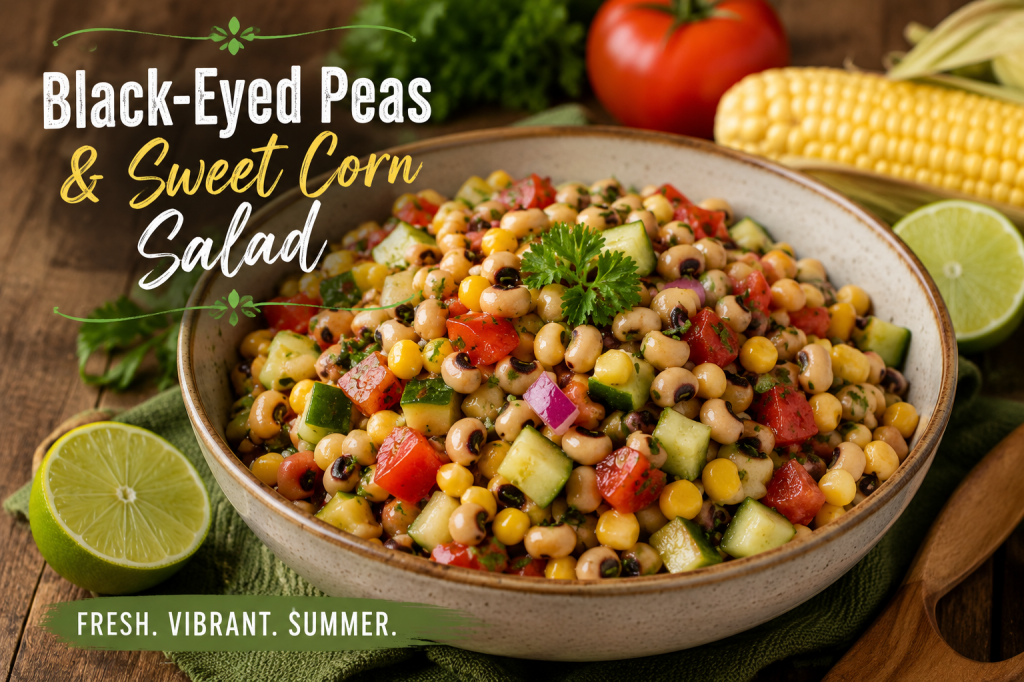
    • 2 cups cooked black-eyed peas, drained and cooled
    • 2 cups sweet corn kernels (fresh, grilled, or thawed frozen corn)
    • 2 medium tomatoes, diced
    • 1 cucumber, diced
    • ½ red bell pepper, diced
    • ¼ red onion, finely diced
    • ¼ cup fresh parsley, chopped
    • 2 tablespoons fresh basil, chopped

    For the Dressing

    • 3 tablespoons olive oil
    • 2 tablespoons apple cider vinegar
    • Juice of 1 lime
    • 1 teaspoon honey
    • ½ teaspoon kosher salt
    • ½ teaspoon black pepper

    Directions

    1. Prepare the Vegetables

    Wash and dry all vegetables thoroughly.

    Dice the tomatoes, cucumber, bell pepper, and red onion into bite-sized pieces.

    Chop the parsley and basil.

    If using fresh corn, remove the kernels from the cob.

    2. Build the Salad

    In a large bowl, combine the black-eyed peas, sweet corn, tomatoes, cucumber, bell pepper, red onion, parsley, and basil.

    Gently toss until everything is evenly distributed.

    The colors alone should make you smile.

    3. Make the Dressing

    In a small bowl, whisk together the olive oil, apple cider vinegar, lime juice, honey, salt, and pepper.

    Taste and adjust the seasoning as needed.

    A little more lime for brightness.

    A little more honey if the vegetables need balance.

    4. Bring Everything Together

    Pour the dressing over the salad.

    Toss gently until every ingredient is lightly coated.

    Be careful not to overmix.

    The tomatoes will appreciate your patience.

    5. Rest Before Serving

    Allow the salad to sit for 15 to 20 minutes before serving.

    Not because it has to.

    Because it benefits from the pause.

    The flavors settle in and begin working together.

    What to Serve With It

    This salad was made for summer tables.

    Serve it alongside Peach BBQ Chicken and baked macaroni and cheese for a meal that feels both celebratory and familiar.

    The chicken brings sweetness and smoke.

    The macaroni and cheese brings comfort.

    The salad brings freshness and color.

    Each dish does something different.

    Together, they feel complete.

    From the Kitchen

    Black-eyed peas have long carried a reputation for luck and prosperity.

    Whether you believe that or not, I think something is comforting about foods that carry stories.

    Recipes are rarely just ingredients.

    They are memories.

    Traditions.

    Conversations passed from one generation to another.

    This salad is simple.

    A handful of vegetables.

    A few pantry staples.

    Nothing complicated.

    But sometimes the simplest dishes are the ones people return to for years.

    Not because they are fancy.

    Because they remind us of summer.

    And summers have a way of staying with us.

    Kyle J. Hayes

    kylehayesblog.com

    Please like, comment, and share

    Resources for Hard Times

    If you’re looking for practical help, food support, or community resources, you can visit the Salt, Ink & Soul Resources Page.

    👉 Resources for Hard Times

  • Peach BBQ Chicken

    Peach BBQ Chicken

    Some foods seem to know exactly when they are supposed to arrive.

    Peaches are one of them.

    For most of the year, they are simply another fruit sitting quietly in the produce section. Then summer arrives, and suddenly they become something else entirely. Sweeter. Juicier. Full of sunshine and possibility.

    Around Juneteenth, peaches begin appearing in markets across much of the country. Their arrival feels like a reminder that summer has finally settled in.

    Not rushed.

    Not hurried.

    Just here.

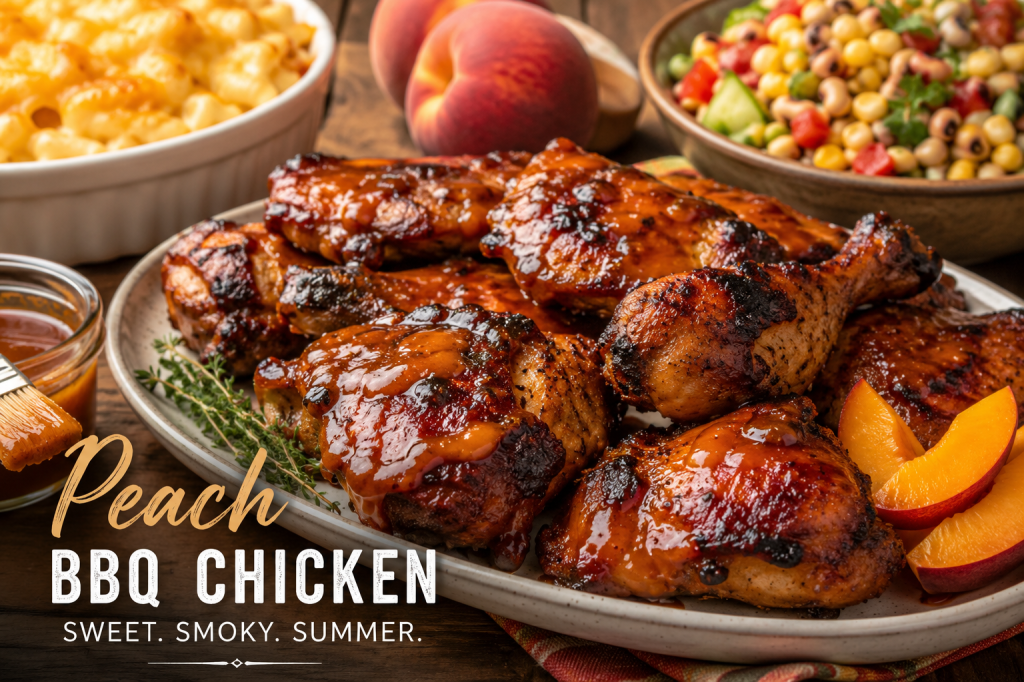
    This recipe brings together that sweetness with a little vinegar, a little garlic, and enough heat to keep things interesting. The result is a sticky barbecue glaze that clings to chicken and caramelizes beautifully over the grill.

    The peaches bring sweetness.

    The hot sauce brings attitude.

    The smoke does the rest.

    Serves

    4 to 6

    Ingredients

    For the Chicken

    • 2 pounds chicken thighs or drumsticks
    • 1 tablespoon olive oil
    • 1 teaspoon kosher salt
    • 1 teaspoon black pepper
    • 1 teaspoon smoked paprika
    • ½ teaspoon garlic powder

    For Cleaning the Chicken

    • ½ cup white vinegar
    • ½ lemon

    For the Peach BBQ Glaze

    • 1 cup peach preserves
    • ¼ cup apple cider vinegar
    • 2 tablespoons hot sauce
    • 2 cloves garlic, finely minced
    • ½ teaspoon black pepper
    • Pinch of salt

    Directions

    1. Clean the Chicken

    Begin by washing the chicken under cool running water.

    Place the chicken in a large bowl and add the Vinegar. Squeeze the juice from half a lemon over the chicken, then use the lemon itself to gently rub and scrub the chicken pieces.

    Rinse thoroughly under cool water and pat dry with paper towels.

    This step was common in many kitchens long before recipes ever found their way online. It is one of those habits passed from one generation to another, a small ritual before the cooking begins.

    2. Season the Chicken

    Drizzle the chicken with olive oil and season evenly with the salt, pepper, smoked paprika, and garlic powder.

    Allow the chicken to rest for about 20 minutes while you prepare the glaze.

    3. Make the Peach Glaze

    In a small saucepan, combine the peach preserves, apple cider vinegar, hot sauce, Garlic, black pepper, and salt.

    Bring the mixture to a gentle simmer over medium-low heat.

    Cook for 5 to 7 minutes, stirring occasionally, until smooth and slightly thickened.

    Remove from the heat and set aside.

    4. Cook the Chicken

    Preheat a grill to medium heat.

    Place the chicken on the grill and cook, turning occasionally, until nearly cooked through, about 25 to 30 minutes.

    If cooking indoors, roast the chicken at 400°F for 35 to 40 minutes.

    5. Glaze and Finish

    During the final 10 minutes of cooking, brush the chicken generously with the peach glaze.

    Turn and brush several times, allowing the glaze to build into layers.

    As the sugars caramelize, the chicken will develop a beautiful shine and a little char around the edges.

    That is where the magic happens.

    6. Rest and Serve

    Transfer the chicken to a platter and allow it to rest for a few minutes before serving.

    Reserve a little extra glaze for the table.

    Nobody ever complains about extra sauce.

    What to Serve With It

    For a Juneteenth table, I like to serve this chicken alongside a pan of baked macaroni and cheese and a Summer Garden Salad filled with black-eyed peas, sweet corn, tomatoes, cucumbers, and fresh herbs.

    The combination works because each dish brings something different.

    The chicken is sweet, smoky, and just a little spicy.

    The macaroni and cheese is rich and comforting.

    The salad adds brightness, freshness, and a reminder that summer gardens are beginning to wake up.

    Together, they create the kind of meal that encourages people to linger at the table a little longer.

    To go back for seconds.

    To tell one more story before the sun goes down.

    From the Kitchen

    Food has a way of marking the seasons.

    Peaches arrive.

    Gardens begin producing more than we can eat.

    Families gather around tables that seem to grow larger with every chair that gets pulled up.

    This meal reminds me that celebration does not always require extravagance.

    Sometimes it is chicken glazed with peaches and heat.

    A bubbling dish of macaroni and cheese.

    A bowl of vegetables gathered from the season.

    And the people sitting around the table.

    The food matters.

    But the company matters more.

    The meal ends.

    The memories stay.

    Kyle J. Hayes

    kylehayesblog.com

    Please like, comment, and share

    Resources for Hard Times

    If you’re looking for practical help, food support, or community resources, you can visit the Salt, Ink & Soul Resources Page.

    👉 Resources for Hard Times