Tag: traditions

  • You Know Fall Is Coming When the Balloons Go Up

    You Know Fall Is Coming When the Balloons Go Up

    I grew up in the Midwest, where fall knew how to make an entrance.

    The trees announced it.

    Green gave way to yellow, orange, and red, as though the whole landscape had decided to burn beautifully before going quiet. Then the leaves began to fall, collecting along curbs and sidewalks, gathering beneath tires, crunching under your feet.

    You didn’t have to wonder whether the season was changing.

    All you had to do was look.

    New Mexico is different.

    Here, fall arrives a little more quietly.

    At first, it is something in the morning air.

    Not cold exactly.

    Just cooler.

    Enough that when you step outside early, you notice. Enough that you remember there will eventually come a morning when you will need a jacket.

    Then comes the smell.

    Green chile roasting.

    If you have lived here long enough, you know the smell before you see the roaster.

    Smoke and chile and flame carried through a grocery store parking lot. Those big metal drums turning over fire while people stand nearby, waiting for bags of roasted chile still warm enough to steam.

    And naturally, there are decisions to make.

    Where are you buying yours this year?

    Who has the best chile?

    More importantly:

    Who has the hot stuff?

    Not the chile somebody politely described as hot.

    The chile that makes you reconsider your confidence about halfway through dinner.

    These are serious questions.

    Or at least we treat them that way.

    And while you’re thinking about chile, while the morning is still cool and the smell of roasting peppers is floating through the air, you happen to look up.

    And there they are.

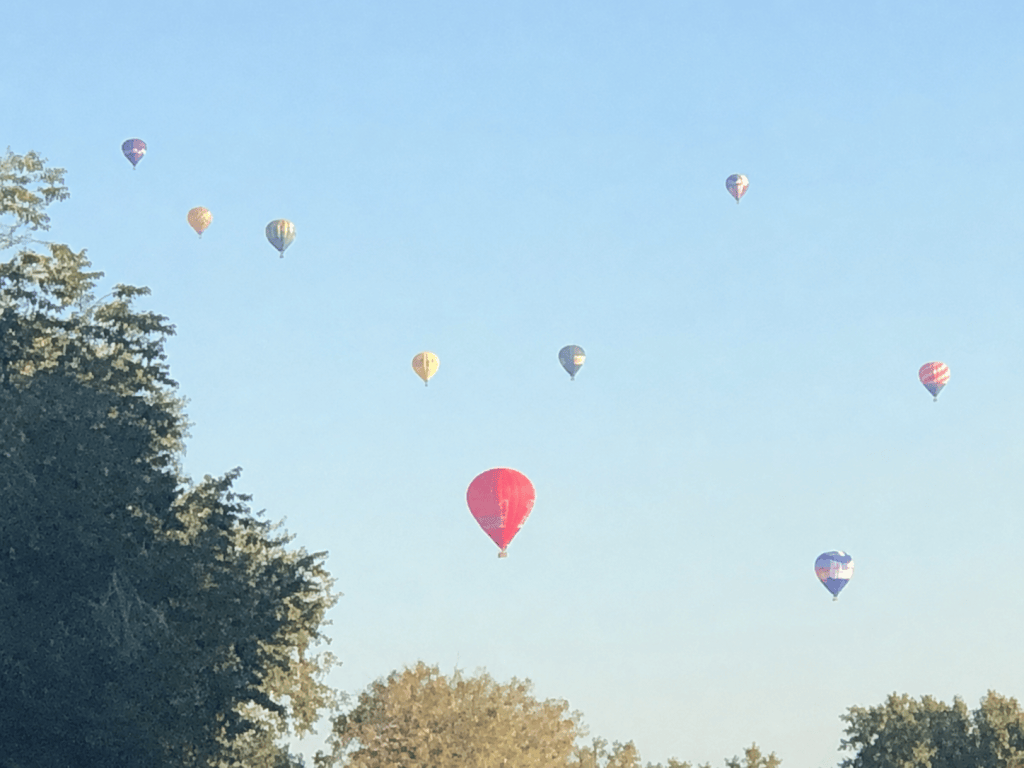
    The balloons are up.

    I have lived here for years.

    Long enough that none of this should surprise me anymore.

    But I still look.

    I still stop.

    I still reach for my phone.

    I still take pictures.

    There is something wonderfully impractical about a hot-air balloon.

    It doesn’t rush.

    It doesn’t seem particularly concerned about productivity.

    It just floats.

    A splash of color moving slowly across a blue New Mexico sky while the rest of us are down here trying to get somewhere on time.

    Maybe that’s part of why I still look.

    We spend so much of our lives training ourselves not to be impressed.

    We get used to things.

    The mountain becomes the mountain.

    The sunset becomes another sunset.

    The strange and beautiful thing we once stopped to admire becomes part of the scenery we pass without noticing.

    Familiarity can be a kind of blindness.

    I don’t want that.

    I don’t ever want to live somewhere so long that beauty becomes furniture.

    So I take another picture of a balloon.

    Even though I already have plenty.

    Probably too many.

    Maybe that’s all right.

    Growing up, autumn meant leaves.

    Here, it means something else.

    Cool mornings.

    Green chile.

    Balloons.

    Different signs for the same ancient turning.

    And maybe that is one of the quiet things a place teaches you when you stay long enough.

    You arrive with one definition of how the world is supposed to work.

    Then life gives you another.

    You learn that fall does not require red maple leaves.

    Home does not require the landscape where you were born.

    Tradition does not always have to be inherited.

    Sometimes you live somewhere long enough that new rituals begin attaching themselves to you.

    You don’t notice it happening.

    Until one morning you smell chile roasting and think:

    It’s that time again.

    Until you see the first balloons and instinctively reach for your phone.

    Until something that once belonged to somebody else’s place has quietly become part of your own calendar.

    Maybe belonging happens that way.

    Not with an announcement.

    Not with a ceremony.

    Just repetition.

    One season after another.

    One familiar smell.

    One cooler morning.

    One balloon drifting overhead.

    And a person standing beneath it who has seen this many times before—

    and still looks up.

    Kyle J. Hayes

    kylehayesblog.com

    Please like, comment, and share

    Resources for Hard Times

    If you’re looking for practical help, food support, or community resources, you can visit the Salt, Ink & Soul Resources Page.
    👉 Resources for Hard Times

  • Every Family Has That Story

    Every Family Has That Story

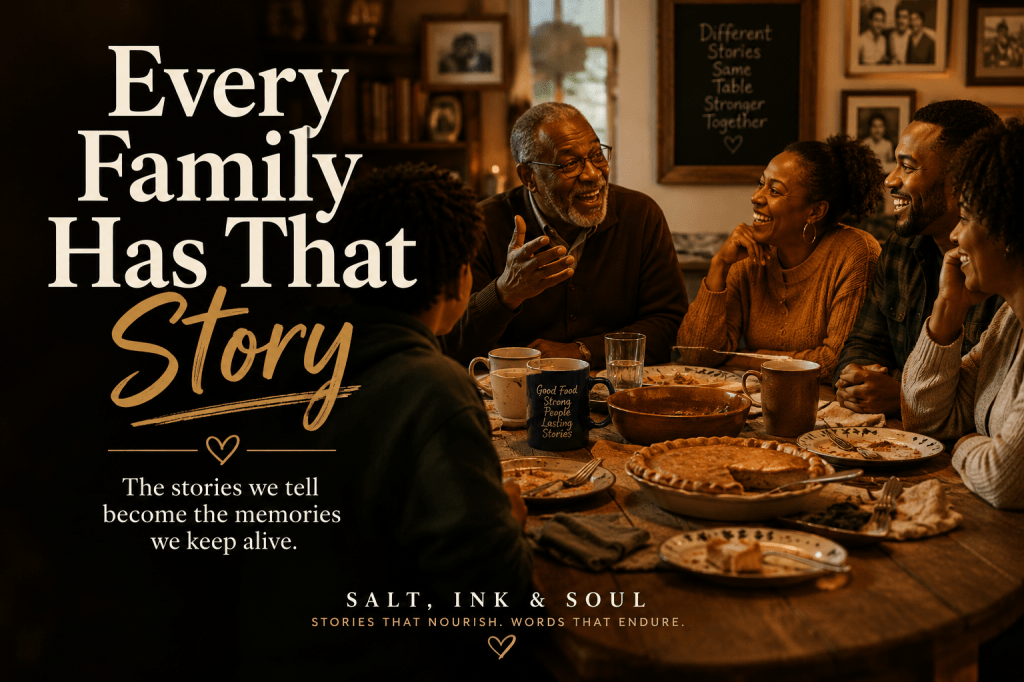
    Every family remembers it a little differently. That’s what makes it ours.

    Some of the best conversations I’ve ever had didn’t begin with someone asking a question.

    They began while pouring another cup of coffee.

    While washing dishes after dinner.

    While someone looked out the window and quietly said,

    “You know what I’ve been thinking about lately…”

    That’s all it takes.

    Not an agenda.

    Not an interview.

    Not a carefully prepared topic.

    Just a moment when life slows down enough for someone to open a door to a memory.

    I’ve come to believe that families don’t stay together because everyone remembers every detail the same way.

    They stay together because they keep telling the stories.

    Every family has that story.

    The one that somehow finds its way into the conversation whenever everyone is together.

    The one everyone laughs about before it’s even finished.

    The one each person remembers just a little differently.

    For my family, there is one story that always seems to make its way back to the table.

    I was too young to know all of the details.

    Even today, I don’t know everything that happened.

    What I do know is that it involved a corrupt landlord, my uncle getting out of his car without putting it in park, a dog, and somehow several members of my family ending up in jail.

    Even writing that now makes me smile.

    It sounds unbelievable.

    Yet every person in my family who remembers it tells a slightly different version.

    My older brother remembers one part.

    My older sister remembers another.

    Someone interrupts to correct a detail.

    Someone else starts laughing before the funniest part has even been told.

    Then another memory surfaces that no one had thought about in years.

    The story changes a little every time it’s told.

    Not because anyone is trying to rewrite history.

    Because memory isn’t a recording.

    It’s something we carry together.

    Each of us holds a different piece.

    When we gather around the table, those pieces somehow begin finding one another again.

    Two of the people who were involved in that story—my uncle and my favorite aunt—have since passed away.

    Every time someone begins telling that story, it’s as if they find their way back to the table.

    For a little while, we aren’t just remembering what happened.

    We’re remembering them.

    Their voices.

    Their laughter.

    The way they told the story themselves.

    What begins as a funny family memory quietly becomes something more.

    It’s one of the ways we bring them back to the surface, if only for a little while.

    I’ve started to think that’s one of the quiet purposes of sharing a meal.

    The food brings us to the table.

    The stories remind us why we came.

    We spend a lot of time making sure family recipes don’t disappear.

    We write them down.

    We pass them from one generation to the next.

    We treasure the handwritten recipe cards tucked inside old cookbooks.

    Those things matter.

    But stories matter too.

    Maybe even more.

    A recipe can tell you how to make dinner.

    Only a story can tell you who was sitting around the table.

    Only a story can make someone who has been gone for years suddenly feel close enough to hear them laugh again.

    I’ve noticed something else over the years.

    The stories we tell most often usually aren’t about our greatest accomplishments.

    They’re about the unexpected moments.

    The family disasters that somehow became family legends.

    The misunderstandings.

    The road trips.

    The holidays that didn’t go according to plan.

    The moments that seemed impossible at the time but somehow became the ones that make everyone laugh the hardest years later.

    Time has a gentle way of sanding down some of life’s rough edges.

    Not all of them.

    Some memories deserve to remain exactly as serious as they were.

    But others become reminders that we survived together.

    That we laughed again.

    That we kept going.

    Maybe that’s why the best conversations don’t start with a question.

    They start with a memory.

    Someone quietly says,

    “You know what I’ve been thinking about lately…”

    And before long, one story becomes another.

    Coffee gets poured again.

    The dishes can wait.

    Nobody is looking at the clock.

    For a little while, the people we’ve lost pull up a chair beside us once more.

    They live in the stories we continue to tell.

    Maybe that’s one of the greatest gifts we can give the people we love.

    Not perfect memories.

    Not flawless stories.

    Just the willingness to keep telling them.

    Because as long as someone around the table can begin with,

    “Do you remember when…”

    they’re never really gone.

    Every family has that story.

    I hope we never stop telling ours.

    Kyle J. Hayes

    kylehayesblog.com

    Please like, comment, and share

    Resources for Hard Times

    If you’re looking for practical help, food support, or community resources, you can visit the Salt, Ink & Soul Resources Page.

    👉 Resources for Hard Times

  • A Love Letter to Potlucks, Church Basements, and Aluminum Trays

    A Love Letter to Potlucks, Church Basements, and Aluminum Trays

    Salt, Ink & Soul — Humanity Through Food Series

    There’s a special kind of magic that happens when a community decides—quietly, without fuss—that everyone needs to be fed.

    Not in some grand, official sense.

    Not with grants or committees or agendas.

    Just fed.

    Fed the old-fashioned way:

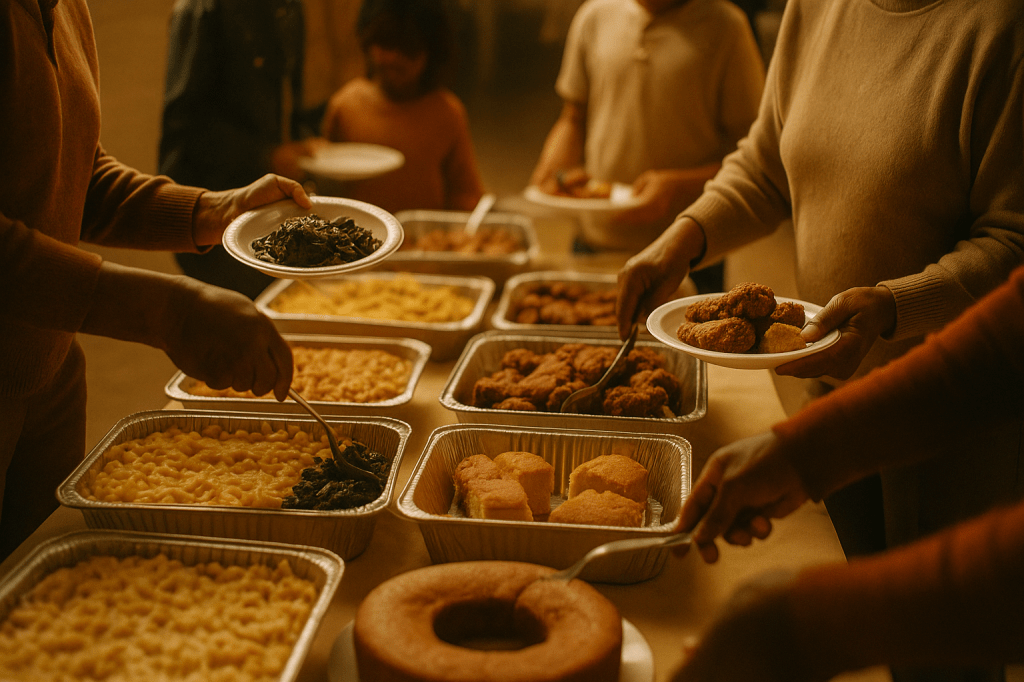
    On a folding table in a warm room that smells like memory, grief, pride, and somebody’s auntie’s best Fried Chicken.

    I’ve always had a soft spot for potlucks. Maybe it’s because people bring their best selves to those tables—literally. Every dish arrives covered in foil and hope, carried by someone who has spent the whole morning stirring and tasting and adjusting because they wanted to show what they could do. Not to brag. But to share.

    A potluck is a quiet confession:

    This is the dish I trust to speak for me.

    And there’s something beautiful about the way people place their food on the table and then pretend not to watch. They hover from a distance—not out of ego, but out of longing. Waiting for that smile. That small nod. That moment when someone tastes their dish and closes their eyes, just for a heartbeat, because something familiar touched them.

    You can’t buy that moment.

    You can only feed it.

    Church basements have their own flavor of truth.

    The ceilings are low. The chairs wobble. The lighting flickers. But none of that matters, because the food—the real food—is honest. Greens cooked down until they surrendered. Cakes that lean to the left but taste like heaven. Macaroni and cheese that could heal almost anything.

    People don’t come to impress in those spaces.

    They come to belong.

    They come to be held by the warmth of a room that has seen everything: baptisms, funerals, heartbreak, and survival. And in every season of life, the table stays set.

    Long before the world used terms like mutual aid, this was it.

    This was the safety net.

    This was how communities kept each other alive.

    No one asked, “What can I bring?”

    They asked, “Who needs to eat?”

    And somehow the table always balanced itself—one person bringing meat, another bringing bread, someone else bringing something sweet, and a few saints making sure the greens showed up so the ancestors wouldn’t fuss.

    It wasn’t organized.

    It was instinctual.

    Care doesn’t need a sign-up sheet.

    It just needs a kitchen.

    I think about those aluminum trays—the ones that bend if you hold them wrong. They don’t look like much, but they’ve carried entire histories. Weddings. Funerals. Reunions. Wednesday nights where people just needed a reason not to be alone.

    Aluminum trays are our generation’s scarred cast-iron skillets: humble, overlooked, essential.

    And they remind me of something I fear we’re losing in our digital, curated world:

    We were feeding each other long before we were performing for each other.

    A potluck isn’t content.

    It’s a community.

    It’s generosity without ceremony.

    It’s survival disguised as Sunday comfort.

    That’s probably why I love them so much.

    Because in a culture obsessed with individualism, a potluck is a rebellion.

    It says: We do this together.

    It says: Come as you are, and bring whatever you can.

    It says: There is room for you at this table, even if life hasn’t been kind, even if you feel small, even if all you could manage today was paper plates.

    Food has always been the language that makes room for the parts of us we don’t know how to name.

    So here’s my love letter—

    to the potlucks, the church basements, the community centers, the too-small living rooms, the aluminum trays carried in trembling hands.

    To the people who show up with their best dishes and their quiet hopes.

    To those who feed others before feeding themselves.

    To the tables that held us long before we had the words for what we were carrying.

    May we never forget how to gather like this.

    May we always remember that survival was never meant to be a solo act.

    And may we keep spreading these tables—wherever we can, with whatever we have—so no one has to face the world hungry, unseen, or alone.

    Kyle J. Hayes

    kylehayesblog.com

    Please like, comment, and share

    Resources for Hard Times

    If you’re looking for practical help, food support, or community resources, you can visit the Salt, Ink & Soul Resources Page.

    👉 Resources for Hard Times