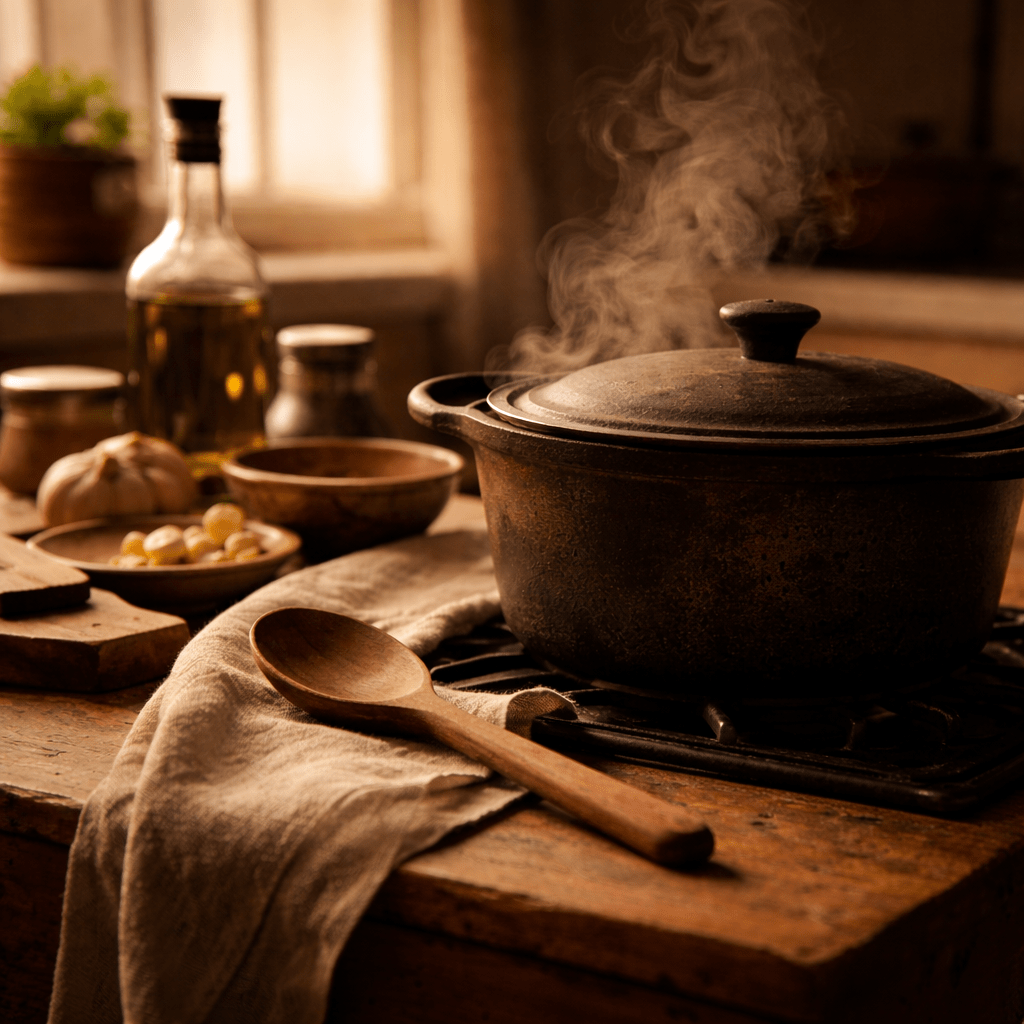
A Salt, Ink & Soul opening to a month of food, memory, and refusal
For now, the calendar still gives us February.
For now, it still calls it Black History Month—like history is something you can contain inside thirty-one little squares. Like the story fits neatly between a Valentine’s aisle and a President’s Day sale. Like you can honor a people with a banner and then go right back to pretending you don’t owe them anything.
But I keep saying for now because I can feel the drag of erasure in the air.
Not the dramatic kind.
Not the kind that arrives with sirens.
The quiet kind.
The administrative kind.
The kind that wears a clean shirt and says, We’re just updating the curriculum.
The kind that edits a paragraph, removes a name, deletes a program, and calls it “neutral.”
The kind that pretends it isn’t doing violence because it isn’t shouting while it does it.
It is a strange thing to watch a country try to forget the very hands that helped hold it together.
Stranger still to watch it happen while the evidence is everywhere—under glass in museums, in the bones of cities, in the laws written to contain us, and in the culture that gets celebrated only after it’s been drained of its origin.
Because that’s the trick, isn’t it?
America loves Blackness the way it loves seasoning.
It wants the flavor without the farm.
The rhythm without the bruises.
The sweetness without the sweat.
So yes—for now.
And since forgetting seems to be trending, I’m going to do what Black folks have always done in the face of people trying to erase us.
I’m going to make something undeniable.
I’m going to cook.
Not the kind of cooking meant to impress strangers.
Not the kind that performs.
Not the kind that comes with tweezers and a lecture.
I mean the real kind.
The kind that stains the wooden spoon.
The kind that fogs the windows.
The kind you smell in your clothes the next morning and don’t even mind—because it reminds you that you fed somebody. That you survived another week. That you made a house feel like a home.
This month, I’m focusing on one part of our contribution that no one can remove from me because it’s been in me since birth:
Food.
Not as a trend.
Not as content.
As inheritance.
Because even if they remove our names from the walls, they can’t remove the way we seasoned what we were given. They can’t remove the improvisation—how we learned to make a feast out of “not much.” They can’t remove the genius of turning what was dismissed into something worth gathering around.
They can’t remove the way our people built entire philosophies of care from pots and pans and whatever showed up in the week’s hands.
Food is history you can taste.
And the beautiful, complicated truth is this: our food is not one thing.
It is regional the way our lives have always been regional—shaped by migration, soil, water, weather, what was available, what was stolen, what was traded, what was shared, what was guarded.
A dish can have the same name and still be a different story depending on where you’re standing when you make it.
Someone in Louisiana will tell you the right way and mean it.
Someone in Georgia will tell you the right way and mean it, too.
Someone in Mississippi will roll their eyes at both of them and start cooking anyway.
All three are telling the truth.
Because food isn’t just ingredients. It’s teaching. It’s what your auntie did when you were sick. It’s how your granddad ate when money was tight. It’s the way your family made the ordinary feel sacred without ever using the word sacred.
So what I’m offering this month won’t claim to be universal. It won’t pretend to be the official version of anything.
These dishes will be mine—shaped by what I was taught, what I learned the hard way, and what I had to make work when there wasn’t time, money, or energy for anything fancy.
That’s what makes them honest.
And if you come from your own line of recipes, your own set of we don’t do it like that, understand this:
You belong here, too.
This isn’t about declaring a winner.
It’s about keeping the record alive.
It’s about refusing the lie that our culture is just a vibe anyone can borrow without context.
It’s about saying:
We were here.
We are here.
And we fed this country in more ways than it can admit.
Because food is one of the most intimate ways people leave fingerprints on the world.
Laws can be rewritten.
Statues can be removed.
Books can be banned.
But try taking a taste memory from somebody.
Try telling someone to forget greens cooked right.
Try telling them to forget cornbread that actually means something.
Try telling them to forget a kitchen that felt like safety.
You can’t. Not fully.
That’s why they try to package it.
Rebrand it.
Sell it back.
Make it “comfort food” without ever naming the discomfort it came from.
But we know.
And this month, I want to honor what we know—not with speeches, but with a plate.
So yes, please enjoy.
And yes, you will probably have to walk a few extra steps.
Not because this is indulgence for indulgence’s sake, but because our food was never meant to be eaten with shame. It was meant to be eaten with gratitude. In the community. Without apology.
Walk your steps.
Drink your water.
Take your time.
Then come back to the table.
Because this month—for now—I’m choosing to tell Black history the way I learned it first:
Not from a textbook.
From a kitchen.
From a hand that loved me enough to season what little we had.
From a people who refused to disappear.
Welcome to February.
Kyle J. Hayes
kylehayesblog.com
Please like, comment, and share
Resources for Hard Times
If you’re looking for practical help, food support, or community resources, you can visit the Salt, Ink & Soul Resources Page.


Leave a comment