Author: Kyle Hayes

  • What Could Have Been

    What Could Have Been

    Thoughts on the life I escaped.

    Maybe escaped is too much. There was no dramatic chase. No single door kicked open. No heroic music swelling in the background while a man heads to the southwest with all his wounds packed neatly in the trunk.

    It was quieter than that.

    It was the kind of escape that happens after years of feeling the walls move closer and closer until one day you realize the room has been shrinking around you. Not because anyone touched the walls. Not because anyone admitted what was happening. But because the life around you had already decided its limits for you, and if you were not careful, you would mistake those limits for destiny.

    I come from the Quad Cities.

    I say that with no hatred.

    A place can wound you and still feed you. A place can raise you and still not have room for you to become. A place can know your name and still never know what lives inside you.

    That is the complicated truth of home.

    People from the outside sometimes imagine the Midwest as simple. Quiet. Polite. Decent. Hardworking. Neighborly. They imagine front porches, snow shovels, church fish fries, factory shifts, Friday night bars, and grocery stores where everybody knows somebody’s cousin.

    And some of that is true.

    But truth is rarely clean.

    The Midwest has a way of hiding its knives in soft cloth.

    The racism was not always loud.

    That was part of the trouble.

    It did not always come wearing a hood or shouting from the street. It came smiling. It came with a handshake. It came with a joke you were supposed to laugh at if you wanted to keep the peace. It came in the silence after you spoke too well. It came in the promotion you were never quite right for. It came in the form of people making you feel grateful for being tolerated.

    Polite racism is a special kind of poison.

    It asks you to pretend you have not been poisoned.

    It asks you to be reasonable. Professional. Mature. Understanding. It asks you to bow your head and call it patience. It asks you to keep working, keep smiling, keep proving, keep swallowing. And because jobs are few and far between, because opportunity is treated like a chair in a crowded room, once you get a seat, you are expected to sit there and be thankful, no matter how hard the wood cuts into you.

    That is how a life gets built smaller than the soul.

    One concession at a time.

    You get a job and keep it.

    Good or not.

    Fair or not.

    Respectful or not.

    You keep it because there may not be another one waiting. You keep it because rent does not care about dignity. Groceries do not care about dreams. The light bill does not lower itself because your spirit is tired. So you learn the mathematics of survival. You calculate the insult against the paycheck. You measure humiliation against health insurance. You teach yourself to be quiet because quiet pays on Friday.

    And then one day, the quiet becomes you.

    That is the thing I fear most when I think about what might have been.

    Not poverty.

    Not struggle.

    Not even failure.

    I fear becoming quiet.

    I fear being a man who learned to live without asking what living was supposed to mean.

    There is a version of me who stayed.

    I can see him sometimes.

    He is not a bad man. That may be the saddest part. He is not foolish. He is not weak. He is not lazy. He is smart. Maybe too smart for the room and too tired to do anything about it.

    He works because work is what men are told to do. He buys the house he can afford because that is what responsibility looks like from the outside. He keeps his head down. He takes the jokes. He lets certain comments pass through him like winter air through an old window.

    He tells himself this is adulthood.

    He tells himself everybody compromises.

    He tells himself dreams are for people with softer lives.

    And every evening, maybe he ends up in some corner bar where the same songs from the eighties keep playing like time got drunk and forgot to leave.

    Maybe Springsteen comes through the speakers, singing about glory days, and everybody smiles because they know the words. They know the rhythm. They know the ache, even if they would never call it grief.

    But I never wanted to become that man.

    The man sitting under the dim light, nursing a drink, telling the same stories about who he used to be because the present has become too small to speak of. The man who once had promise, once had fire, once had some bright and dangerous thing inside him, but somewhere along the way learned to trade becoming for remembering.

    That was the life I feared.

    Not the bar itself.

    Not the music.

    Not even nostalgia, because memory can be holy when handled with care.

    What I feared was getting trapped there. Becoming fluent in the language of almost.

    Almost left.

    Almost wrote.

    Almost tried.

    Almost became.

    A man with intelligence enough to know the cage had a lock, but not enough courage left to reach for the door.

    Which is to say, a man dying of recognition in a room too small for his questions.

    That is no life.

    Not because bars are bad.

    Not because familiar music is bad.

    Not because staying in your hometown is a failure.

    Some people stay and build beautiful lives. Some people remain and become pillars. There are people whose roots run deep enough to turn the soil around them into fertile ground.

    But for me, staying would have been a kind of burial.

    I know that now.

    The Quad Cities are not ignorant. That is one of the lies people tell about places like that. People are educated there. People read. People think. People work hard. People earn degrees. But a degree is not the key if every door in the city is already full of people waiting for the same narrow opening.

    I have seen baggers at local stores with college degrees.

    That image stays with me.

    Not because honest work is shameful. There is dignity in all work done with care. But there is something brutal about a place where education does not always become movement. Where intelligence gets folded into survival. Where ambition learns to speak softly because there is nowhere for it to go. The local economy can make a person feel ridiculous for wanting more than what is available.

    You learn to lower your voice around your own dreams.

    You stop saying certain things out loud.

    Writing would have been one of those things.

    Writing, in that life, would have sounded absurd. Not because writing is absurd, but because harsh places train people to distrust anything that does not immediately pay the bills. Art becomes suspicious. Expression becomes indulgence. A man saying he wants to write sounds like a man saying he wants to starve beautifully.

    So the dream would have been crushed.

    Not all at once.

    Crushed slowly.

    Under overtime.

    Under politeness.

    Under fatigue.

    Under the need to be practical.

    Under the look people give you when you reveal some secret part of yourself, and they do not know whether to laugh or feel sorry for you.

    I might have stopped writing before I ever truly began.

    That thought troubles me.

    Because now I know what writing has become for me.

    It is not a hobby.

    It is not decoration.

    It is not some charming little side project meant to make me feel interesting.

    Writing is the place where I tell the truth before the world edits it. It is where I gather the broken pieces and make them speak. It is where I take what hurt me and refuse to let it die without meaning.

    But in the life I escaped, meaning might have had to wait.

    And wait.

    And wait.

    Until one day, it forgot my name.

    That is what small lives can do when they are not chosen freely. They do not always destroy you by violence. Sometimes they destroy you by routine. You wake up. You work. You endure. You pay. You sleep. You repeat. You become reliable. You become respected in the acceptable ways. You become the kind of man people point to and say, “He’s doing all right,” while something sacred inside you sits in the dark, starving.

    I could have become that man.

    That is why I do not speak of leaving lightly.

    Leaving was not only about geography.

    Leaving was disobedience.

    It was a refusal to let the place that shaped me become the place that sealed me shut. It was me saying, perhaps before I even had the language, that survival was not enough if survival required the death of everything tender, strange, creative, and true inside me.

    New Mexico did not make me from nothing.

    I brought myself here.

    I brought the scars, the questions, the intelligence, the anger, the hunger, the ache. I brought the boy who read because books were doors. I brought the man who wanted more but did not always believe more was allowed. I brought the Midwestern discipline, the working-class suspicion of easy promises, the memory of what it means to keep going when nothing romantic is happening.

    But New Mexico gave me room.

    And room can feel like grace when you come from a place where every dream had to crouch.

    Here, the sky does not crouch.

    The land stretches out like it is daring you to unclench. The mountains do not ask you to justify your existence. The light falls on everything with a kind of ancient indifference that somehow feels merciful. You can be small here without being erased. You can be quiet without disappearing. You can be alone without being trapped.

    And somehow, in that space, the writing came.

    The life that might have been still visits me sometimes.

    I see the house I could have bought because it was affordable, not because it held my future. I see the job I would have kept because leaving felt too dangerous. I see the polite insults swallowed whole. I see the younger men at the bar becoming older men at the same bar, telling the same stories under the same neon signs while the same songs play and the years pass without asking permission.

    I see myself there.

    And I feel grief.

    Not superiority.

    Grief.

    Because there are many brilliant people trapped in lives too narrow for them. Many gifted people never leave because leaving requires money, courage, timing, madness, or some combination of all four. There are many dreams buried under good sense. Many books have never been written. Many songs have never been sung. Many meals were never made. Many paintings were never painted. Many selves never met.

    The world calls that reality.

    Sometimes it is.

    But sometimes, reality is just a cage everybody’s gotten used to.

    I do not want to romanticize leaving. It costs. It takes things from you. It makes you a stranger. It removes the comfort of being easily understood. It teaches you that reinvention is not clean. There are lonely nights in new places. There are moments when the old life, for all its limits, looks warm simply because it is known.

    But I would rather be lonely in the direction of becoming than comfortable in the direction of disappearance.

    That is the truth I keep returning to.

    If I had stayed, maybe I would have been fine.

    That is the haunting part.

    Fine is a dangerous word.

    Fine can hide a thousand funerals.

    Fine can mean the bills are paid, but the soul has gone quiet. Fine can mean nobody worries about you because you have learned to maintain stability. Fine can mean the dream died so politely that even you forgot to mourn it.

    I did not want to be fine.

    I wanted to be alive.

    Not loud.

    Not famous.

    Not untouched by pain.

    Alive.

    Aware of my own mind. Responsible for my own becoming. Free enough to write badly until I wrote honestly. Free enough to tell the truth. Free enough to sit with the anger and ask whether it was protecting me or imprisoning me. Free enough to discover that I was more than the smartest man in a room I had outgrown.

    That is what New Mexico gave me.

    Or helped me claim.

    A life where writing became possible.

    A life where the old bitterness began to lose its authority.

    A life where the boy who once dreamed in silence could finally put words on the page and let them breathe.

    And maybe that is why New Mexico feels less like a place I moved to and more like the land that let me become. Because I know the life I might have stayed long enough to inherit. I know the man I might have become. And I know, with a gratitude I still cannot fully explain, that I was given room before the dream went quiet.

    I do not hate the place I came from.

    I carry it.

    The Quad Cities are in me. The Midwest is in me. The gray winters. The modest houses. The factory logic. The polite cruelty. The educated frustration. The bars with old songs playing. The people are doing their best with what the place allows. The aching knowledge that intelligence does not always become freedom.

    All of it is in me.

    But it is not over me.

    Not anymore.

    And maybe that is what escape really means.

    Not that you outrun the past.

    But that you live long enough, and choose bravely enough, to stop letting the past decide the size of your future.

    There is a life I did not stay long enough to become.

    I mourn him sometimes.

    I honor him, too.

    Because he reminds me of what was at stake.

    He reminds me that every page I write is not merely a page. It is evidence.

    Evidence that the dream survived the harshness.

    Evidence that the man did not bow his head forever.

    Evidence that the corner bar did not become the whole world.

    Evidence that I left.

    Kyle J. Hayes

    kylehayesblog.com

    Please like, comment, and share

    Resources for Hard Times

    If you’re looking for practical help, food support, or community resources, you can visit the Salt, Ink & Soul Resources Page.

    👉 Resources for Hard Times

  • No-Bake Lemon Icebox Pie

    No-Bake Lemon Icebox Pie

    A Cold Sweet Mercy

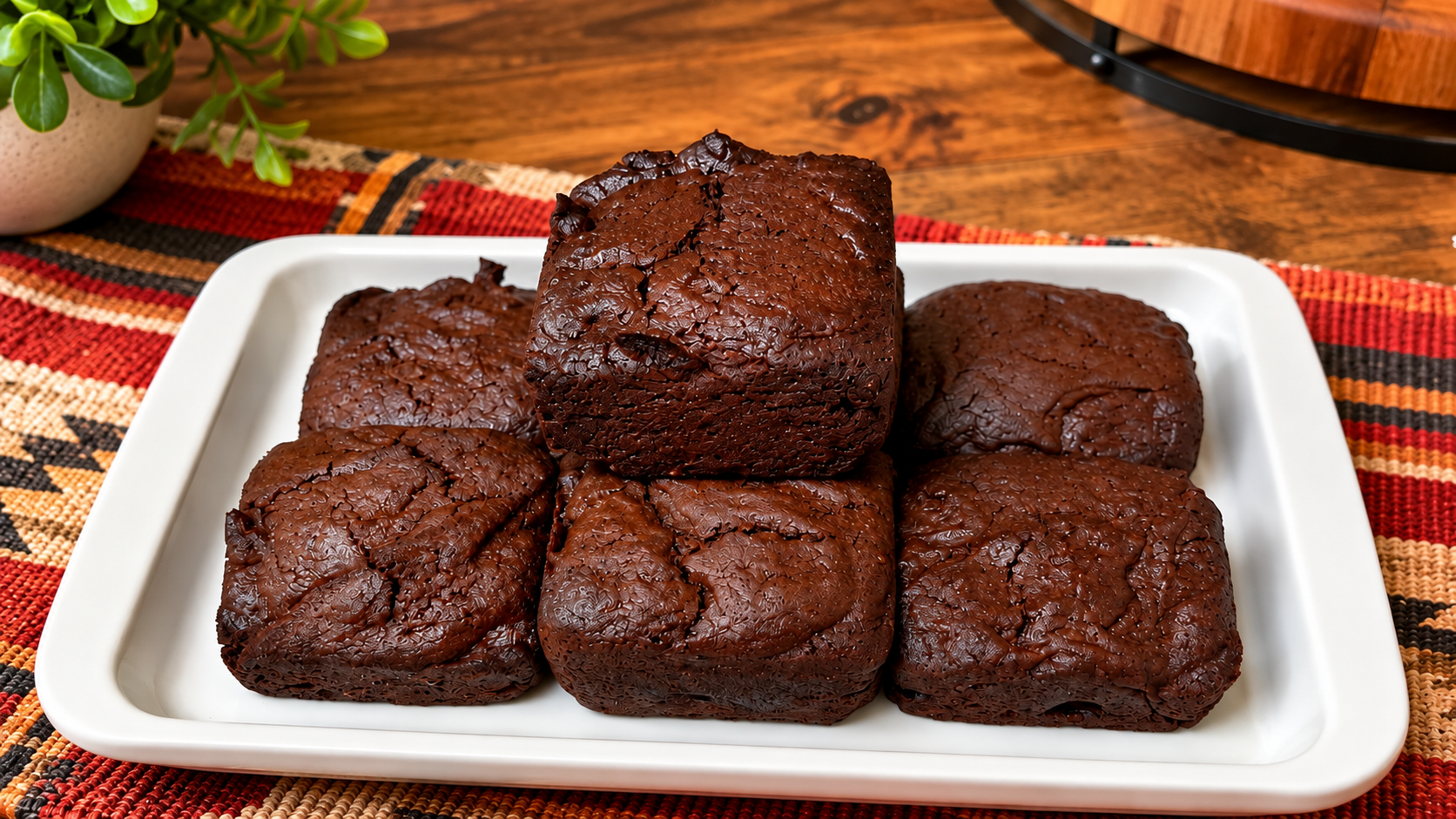
    Some desserts are built for relief.

    Not the loud kind. Not the kind that needs fire, timing, layers, or faith in an oven. Just something cold, bright, sweet, and simple enough to make the day feel a little less heavy.

    That is what this No-Bake Lemon Icebox Pie is here to do.

    After the heat of the Green Chile Chicken Melt on Focaccia, and the brightness of the Corn, Tomato, and Cucumber Salad, the week needs something cool at the end. Something that does not ask much from you. Something that waits in the refrigerator and improves with time because you gave it time.

    This pie is simple.

    Graham cracker crust. Sweetened condensed milk. Lemon juice. Lemon zest. Whipped topping or whipped cream. A little patience.

    That is it.

    No oven. No complicated crust. No scratch cake drama. Just a pie that sits in the cold and gives back something clean, sharp, creamy, and kind.

    It tastes like summer without having to make a speech about summer.

    It tastes like somebody opened the refrigerator after dinner and remembered there was still one good thing waiting.

    No-Bake Lemon Icebox Pie

    Ingredients

    • 1 prepared graham cracker crust
    • 1 can sweetened condensed milk, 14 ounces
    • ½ cup fresh lemon juice
    • 1 tablespoon lemon zest
    • 1 teaspoon vanilla extract
    • 1 container whipped topping, 8 ounces, thawed
    • or 2 cups homemade whipped cream
    • Pinch of salt, optional
    • Extra lemon zest or whipped cream, for topping

    Method

    1. Make the lemon filling

    In a large bowl, whisk together the sweetened condensed milk, lemon juice, lemon zest, vanilla, and a small pinch of salt if using.

    The mixture will begin to thicken as the lemon juice meets the condensed milk.

    Let it happen.

    Some things do not need force. They just need the right conditions.

    2. Fold in the whipped topping

    Gently fold in the whipped topping or whipped cream.

    Do not beat it hard. You want the filling smooth and light, not tired.

    Fold until everything is combined and no large streaks remain.

    3. Fill the crust

    Spoon the lemon filling into the graham cracker crust.

    Smooth the top with a spatula.

    It does not have to be perfect. A few soft waves on top look more human anyway.

    4. Chill

    Cover the pie and refrigerate for at least 4 hours, or overnight if possible.

    The longer it chills, the better it sets.

    This is the rare dessert that rewards waiting.

    5. Garnish and serve

    Before serving, add extra lemon zest, whipped cream, or a few thin lemon slices to finish it.

    Slice cold and serve straight from the refrigerator.

    Notes From My Kitchen

    Fresh lemon juice is best here. Bottled lemon juice will work in a pinch, but fresh lemon gives the pie its brightness.

    The Graham cracker crust can be store-bought. There is no shame in that. This dessert is about ease.

    If you want a firmer pie, freeze it for 1 to 2 hours before serving. It will slice cleaner and feel almost like a frozen lemon cream pie.

    For more lemon flavor, add extra zest. For more sweetness, add a little more whipped topping.

    A pinch of salt helps balance the sweetness.

    If using homemade whipped cream, make sure it is whipped to medium peaks before folding it into the lemon mixture.

    What to Serve With It

    This pie closes the week’s Salt, Ink & Soul arc.

    The Green Chile Chicken Melt on Focaccia brought the heat.

    The Corn, Tomato, and Cucumber Salad brought the brightness.

    This No-Bake Lemon Icebox Pie brings the relief.

    Cold. Sweet. Simple. Kind.

    Read more recipes and reflections at Salt, Ink & Soul.

    Kyle J. Hayes

    kylehayesblog.com

    Please like, comment, and share

    Resources for Hard Times

    If you’re looking for practical help, food support, or community resources, you can visit the Salt, Ink & Soul Resources Page.

    👉 Resources for Hard Times

  • Corn, Tomato, and Cucumber Salad

    Corn, Tomato, and Cucumber Salad

    Some food is there to cool the room down.

    Not in temperature alone, though this salad should be served cold. I mean in spirit. Some food on the plate changes the whole mood. It brings color. It brings crunch. It brings a little acid, a little sweetness, a little relief.

    That is what this Corn, Tomato, and Cucumber Salad is here to do.

    After the heat and melted cheese of the Green Chile Chicken Melt on Focaccia, the meal needs something bright beside it. Not heavy. Not complicated. Not another thing, asking for a pan, a timer, and your last good nerve.

    Just corn. Tomatoes. Cucumber. Red onion. Lime. Olive oil. A little salt. A little pepper. Maybe cilantro if you like it. Maybe cotija or feta if you want a little salty crumble.

    This salad does not feel like punishment.

    It feels like summer being reasonable.

    It feels like a bowl you can make before the day gets too hot. Something crisp enough to wake up the plate. Something fresh enough to make a sandwich feel balanced instead of heavy.

    And sometimes that is all a side dish needs to do.

    Stand there.

    Bring brightness.

    Let the meal breathe.

    Corn, Tomato, and Cucumber Salad

    Ingredients

    • 2 cups corn, fresh, frozen and thawed, or canned and drained
    • 1 cup cherry or grape tomatoes, halved
    • 1 large cucumber, diced
    • ¼ cup red onion, thinly sliced or finely diced
    • 2 tablespoons olive oil
    • 1 ½ tablespoons lime juice
    • 1 teaspoon honey or sugar, optional
    • ½ teaspoon salt, plus more to taste
    • ¼ teaspoon black pepper
    • 2 tablespoons chopped cilantro or parsley, optional
    • ¼ cup crumbled cotija or feta, optional

    Method

    1. Prepare the vegetables

    Add the corn, tomatoes, cucumber, and red onion to a large bowl.

    If using canned corn, drain it well. If using frozen corn, thaw it first and pat it dry. Too much water will dull the flavor and weaken the dressing.

    2. Make the dressing

    In a small bowl, whisk together the olive oil, lime juice, honey or sugar if using, salt, and black pepper.

    Taste it.

    It should be bright, lightly tangy, and just rounded enough to bring the vegetables together.

    3. Toss the salad

    Pour the dressing over the corn, tomatoes, cucumber, and onion.

    Toss gently until everything is coated.

    Add cilantro or parsley if using.

    Add cotija or feta for a salty finish.

    4. Let it rest

    Let the salad sit in the refrigerator for 15 to 20 minutes before serving.

    Not too long.

    This is a fresh salad. You want the flavors to meet, not move in together and lose their edges.

    5. Serve chilled

    Serve cold or lightly chilled.

    Taste once more before serving and adjust the salt, pepper, or lime juice if needed.

    Notes From My Kitchen

    Fresh corn is beautiful here, especially grilled or roasted. But frozen or canned corn works just fine. This is practical food, not a loyalty test.

    English cucumbers work well because they have fewer seeds, but regular cucumbers are fine. Peel it if the skin feels tough.

    Cherry tomatoes hold up better than large chopped tomatoes, but use what you have.

    Red onion gives the salad bite. Slice it thin or dice it small so it does not take over.

    Cotija gives it a more Southwestern feel. Feta brings a sharper, brinier edge. Both work. Neither is required.

    For a little heat, add diced jalapeño or a pinch of chili powder.

    For more sweetness, add a little extra corn or a touch more honey.

    What to Serve With It

    This salad was made to sit beside the Green Chile Chicken Melt on Focaccia.

    The sandwich brings heat, cheese, bread, and weight. This salad brings crunch, lime, freshness, and color.

    Together, they keep the plate balanced.

    And on Saturday, the week can finish with something cold and sweet: No-Bake Lemon Icebox Pie.

    Heat. Brightness. Relief.

    That is the rhythm this week.

    Read more recipes and reflections at Salt, Ink & Soul.

    Kyle J. Hayes

    kylehayesblog.com

    Please like, comment, and share

    Resources for Hard Times

    If you’re looking for practical help, food support, or community resources, you can visit the Salt, Ink & Soul Resources Page.
    👉 Resources for Hard Times

  • Do you believe in soulmates?

    Do you believe in soulmates?

    Daily writing prompt
    Do you believe in soulmates? Why or why not?

    I want to.

    That is the honest answer.

    Not the polished one. Not the answer dressed up for people who need certainty. Not the answer that pretends I have made peace with everything the world has shown me.

    I want to believe in soulmates.

    I want to believe there is someone out there whose spirit recognizes yours before language has to explain anything. Someone who sees the strange shape of your silence and does not run from it. Someone who understands the parts of you that came from pain, not because they enjoy the wound, but because they know healing does not happen when a person is asked to hide what hurt them.

    I want to believe in the kind of love that feels less like discovery and more like return.

    Like arriving somewhere your soul had been walking toward before your body knew the road.

    But the world has a way of making belief expensive.

    The world keeps showing me something else.

    That people leave.

    That promises can be made sincerely and still break under the weight of ordinary life.

    That chemistry is not destiny.

    That wanting someone deeply does not mean they are meant for you.

    That longing can dress itself up as fate if you are lonely enough.

    And that is the part that bothers me.

    Because I would love for soulmates to be true.

    I would love for there to be some sacred architecture beneath all this confusion. Some quiet design. Some person placed in the world with a heart shaped closely enough to mine that, when we finally found each other, the ache would make sense.

    But reality is rarely that gentle.

    In reality, love is not a fairytale.

    It is not guaranteed.

    It does not arrive because you have suffered enough to deserve it. It does not guarantee a reward for endurance. It does not always find the people who are ready for it. It does not always stay with the people who would have honored it.

    And maybe that is why the idea of soulmates hurts.

    Not because it is childish.

    Because it is beautiful.

    And beautiful things are painful when the world keeps refusing to confirm them.

    There is a sadness in wanting to believe something your experience keeps disproving. A private kind of grief. The kind you do not always say out loud because people will either mock you for being too romantic or scold you for being too bitter.

    But I do not think it is bitter to tell the truth.

    I think it is human.

    I think most of us carry some version of this question.

    Is there someone made for me?

    Or am I supposed to keep becoming whole without waiting for anyone to recognize the pieces?

    Maybe the truth is that soulmates do not exist the way we were taught to imagine them. Maybe no one is born as the missing half of us. Maybe no one comes fully equipped to understand, heal, rescue, and complete another person.

    Maybe that is too much to place on any human being.

    Maybe it is unfair.

    But still.

    Still, I understand the wanting.

    I understand wanting one person whose presence makes the room feel less hostile. One person who sees you without turning you into a project. One person who chooses you without needing you to become easier to love.

    That desire is not foolish.

    It is tender.

    It is proof that some part of us still believes connection should be deeper than convenience. That love should be more than timing, attraction, shared interests, and fear of being alone.

    But if I am honest, I do not know if I believe in soulmates anymore.

    I believe in compatibility.

    I believe in effort.

    I believe in kindness repeated over time.

    I believe in people choosing each other after the first spell wears off.

    I believe in friendship as the spine of love.

    I believe in patience.

    I believe in the quiet work of learning someone honestly, not the fantasy version, not the convenient version, but the real person standing there with their history, habits, wounds, and weather.

    Maybe that is less magical.

    But maybe it is more merciful.

    Because if soulmates are not real, then love is not about finding the one person the universe assigned to you.

    It is about finding someone willing to build something true.

    And being willing to build it too.

    Still, I will not pretend the loss of the fairytale does not make me sad.

    It does.

    There is a grief in outgrowing certain hopes.

    There is a loneliness in realizing the world may not be arranged around our deepest desires.

    But maybe there is also freedom there.

    A hard freedom.

    The freedom to stop waiting for fate to prove we are lovable.

    The freedom to know that love, if it comes, will not be less meaningful because it was not written in the stars.

    Maybe it will matter more because two people, with every reason to be selfish, distracted, afraid, and wounded, chose tenderness anyway.

    Not because destiny forced them.

    Because they decided.

    And maybe that is the closest thing we get.

    Not soulmates as a fairytale.

    Not one perfect person made to complete us.

    But two imperfect people choosing, again and again, not to make the world harder for each other.

    I wish I believed in soulmates.

    I truly do.

    But maybe what I believe in now is quieter.

    Less certain.

    Less romantic in the old way.

    I believe in the ache that makes us hope for them.

    I believe in the sadness that comes when we doubt they exist.

    I believe in the courage it takes to keep a soft place inside yourself, even after the world keeps showing you reasons to harden.

    And maybe that softness is the soul’s real mate.

    The part of us that still wants love to be true.

    Even when we are no longer sure the fairytale is

    Kyle J. Hayes

    kylehayesblog.com

    Please like, comment, and share

    Resources for Hard Times

    If you’re looking for practical help, food support, or community resources, you can visit the Salt, Ink & Soul Resources Page.
    👉 Resources for Hard Times

  • Green Chile Chicken Melt on Focaccia

    Green Chile Chicken Melt on Focaccia

    Some meals know where they come from.

    They carry a place in them. Not loudly. Not as decoration. Not as some culinary costume put on for effect. But quietly, in the way heat rises from a pan. In the way cheese softens over chicken. In the way green chile announces itself without needing permission.

    This Green Chile Chicken Melt on Focaccia belongs to that kind of food.

    It is practical. It is warm. It is simple enough for a weekday, but it still feels like somebody cared. Chopped or shredded chicken. Roasted green chile. A little mayo or sour cream to pull it together. Pepper Jack or Monterey Jack melted over the top. Red onion for bite. Focaccia to hold everything with enough backbone to matter.

    This is not a delicate sandwich.

    It does not need to be.

    It is the kind of sandwich that understands hunger as more than appetite. Sometimes hunger is the body asking for warmth. Sometimes it is the mind asking for something familiar. Sometimes it is the quiet part of you saying, “Please, just make something good enough to bring me back into the day.”

    And that is what this sandwich does.

    Green chile has a way of making food feel awake. It brings heat, yes, but not just heat. It brings depth. Earth. Smoke. A little sharpness. A little memory. It makes the chicken more interesting. It makes the cheese more necessary. It turns a simple melt into something with a sense of place.

    And the focaccia matters here.

    Soft bread would surrender too easily. Focaccia holds its ground. It has chew. It has oil. It has salt. It understands that a sandwich with melted cheese and warm chicken needs a foundation strong enough to carry the weight.

    That is the quiet lesson of this meal.

    Warmth needs something to rest on.

    So does a person.

    After a week of BBQ, slaw, and sweet peach cobbler, this sandwich begins a new rhythm. Not a hard reset. Not a performance. Just another step back into the kitchen. Another meal made from ordinary things. Another small act of feeding yourself, like you are still worth the effort.

    Because you are.

    Even on the tired days.

    Especially then.

    Green Chile Chicken Melt on Focaccia

    Ingredients

    For the chicken filling

    • 1 ½ cups cooked chicken, chopped or shredded
    • ½ cup roasted green chile, chopped
    • 2 tablespoons mayonnaise or sour cream
    • 1 teaspoon lime juice, optional
    • ½ teaspoon garlic powder
    • ¼ teaspoon onion powder
    • ¼ teaspoon cumin, optional
    • Salt and black pepper, to taste

    For the sandwich

    • 1 large piece of focaccia, sliced in half horizontally
    • 3 to 4 slices of pepper jack or Monterey Jack cheese
    • Thinly sliced red onion
    • 1 tablespoon butter or olive oil, for toasting
    • Optional: extra green chile, pickled jalapeños, or cilantro

    Method

    1. Make the chicken filling

    In a bowl, combine the cooked chicken, roasted green chile, mayonnaise or sour cream, lime juice if using, garlic powder, onion powder, cumin if using, salt, and black pepper.

    Stir until everything is coated.

    You are not trying to drown the chicken. You are trying to bring it together. The mixture should be moist enough to hold, but not so wet that it turns the bread soft before the heat comes into play.

    Taste it.

    If it needs more chile, add more chile. If it needs salt, give it salt. If it needs a little brightness, add a bit of lime.

    Food usually tells you what it needs if you slow down long enough to listen.

    2. Prepare the focaccia

    Slice the focaccia in half horizontally.

    If the bread is thick, press it gently with your hands or remove a little from the inside so the filling has somewhere to sit.

    Focaccia is strong, but even strong things need room.

    3. Build the sandwich

    Layer the bottom half of the focaccia with cheese.

    Add the green chile chicken mixture.

    Add thinly sliced red onion.

    Add another slice of cheese if you want the sandwich richer.

    Place the top half of the focaccia over everything and press gently.

    Not hard. Just enough to remind the sandwich that it has a job to do.

    4. Toast the melt

    Heat a skillet over medium heat. Add butter or olive oil.

    Place the sandwich in the skillet and press it gently with a spatula, another pan, or a sandwich press.

    Cook for about 3 to 4 minutes per side, until the focaccia is golden and the cheese has melted.

    If the bread browns too quickly, lower the heat. Melting cheese takes patience. So does returning to yourself.

    5. Rest and slice

    Let the sandwich rest for a minute before cutting.

    Slice in half and serve warm.

    This is good with chips, a simple salad, sliced cucumbers, pickles, or the corn, tomato, and cucumber salad coming later this week.

    Notes From My Kitchen

    Use roasted green chile if you can. Fresh-roasted is beautiful, but canned or jarred green chile will still do the job. This is home cooking. Use what you have to make the meal.

    Pepper jack brings more heat. Monterey Jack keeps it mild and creamy. Both belong here.

    Sour cream adds a little tang to the filling. Mayo makes it richer. You can use either. You can also use a little of both if you are the kind of person who believes peace is sometimes found in compromise.

    If your green chile is watery, drain it before adding it to the chicken. Too much liquid will make the sandwich heavy in the wrong way.

    Red onion gives the melt bite and color. Slice it thin so it does not take over.

    For extra heat, add pickled jalapeños. For freshness, add cilantro. For more richness, add a little extra cheese and accept who you are.

    What to Serve With It

    This sandwich marks the start of the next Salt, Ink & Soul food arc.

    It brings heat, cheese, chicken, and bread.

    On Friday, the meal needs something bright beside it: Corn, Tomato, and Cucumber Salad. Something fresh. Something colorful. Something with enough acid and crunch to cool the heat without dulling it.

    Then, on Saturday, it can bring relief: No-Bake Lemon Icebox Pie. Cold, sweet, simple, and kind.

    Together, the week becomes:

    Heat. Brightness. Relief.

    A meal does not have to be complicated to have structure. Sometimes it only needs to know what each part is there to do.

    Kyle J. Hayes

    kylehayesblog.com

    Please like, comment, and share

    Resources for Hard Times

    If you’re looking for practical help, food support, or community resources, you can visit the Salt, Ink & Soul Resources Page.
    👉 Resources for Hard Times

  • Do you believe in minimalism?

    Do you believe in minimalism?

    Daily writing prompt
    Do you believe in minimalism?

    Yes.

    But not as a trend.

    Not as a clean white room arranged for somebody else’s approval. Not as a performance of emptiness. Not as another way for the world to sell us less, package it beautifully, and convince us we have become more enlightened because the shelf looks better in the photograph.

    I believe in minimalism as a kind of quiet.

    A kind of release.

    A way of asking yourself, again and again, What am I actually carrying?

    For the past few years, I have felt myself moving in that direction. Slowly. Not perfectly. Not with some grand announcement. Just little decisions. Fewer things. Less clutter. Less noise sitting in corners. Less to clean around. Less to keep track of. Less to worry about when the mind is already full.

    There is a kind of exhaustion that comes from owning too much.

    Not just physically.

    Spiritually.

    Every object asks something of you. It wants space. It wants attention. It wants maintenance. It wants to be remembered, moved, dusted, stored, protected, justified. And after a while, a room can become crowded with versions of yourself you no longer are.

    The shoes you thought would make you someone else.

    You bought the gadget because it promised convenience.

    The clothes for a life you imagined but never lived.

    The things kept out of guilt.

    The things kept out of fear.

    The things were kept because maybe someday.

    Minimalism, for me, is not about having nothing.

    It is about learning what deserves to remain.

    That is the part people miss sometimes. They think minimalism is about denial. About stripping life down until it becomes cold and severe. But I do not want a life without warmth. I do not want a home without memory. I do not want a table with no evidence of living.

    I want enough.

    That word has become more important to me with time.

    Enough.

    Not the latest.

    Not the greatest.

    Not the thing everyone is praising this week, only to forget it next month.

    Enough to live.

    Enough to think.

    Enough to breathe.

    Enough to make a meal, write a page, sit in quiet, and not feel chased by my own possessions.

    There is something powerful about discovering what you truly need. Because once you begin to see it clearly, the world’s noise loses some of its authority. The advertisement becomes less convincing. The upgrade becomes less urgent. The hunger to prove something through ownership begins to weaken.

    And maybe underneath all of that, you find the harder question.

    What is important?

    Not what looks impressive.

    Not what fills the room.

    Not what makes other people assume you are doing well.

    But what actually matters when the door is closed, and no one is watching.

    Peace matters.

    Clarity matters.

    A good chair.

    A quiet morning.

    A clean counter.

    A notebook.

    A meal made without hurry.

    A home that does not feel like a storage unit for anxiety.

    A life with enough space left in it to hear yourself think.

    That is what I am moving toward.

    Not perfection.

    Not aesthetic purity.

    Just less of what weighs me down.

    More of what lets me breathe.

    Because the truth is, I do not want to spend my life managing things I never truly needed. I do not want to be buried beneath my wants and call it abundance. I do not want my attention scattered across objects that cannot love me back.

    I want a life that feels honest.

    Simple.

    Quiet.

    Mine.

    So yes, I believe in minimalism.

    But more than that, I believe in making room.

    Room for peace.

    Room for thought.

    Room for gratitude.

    Room for the person I am still becoming.

    Kyle J. Hayes

    kylehayesblog.com

    Please like, comment, and share

    Resources for Hard Times

    If you’re looking for practical help, food support, or community resources, you can visit the Salt, Ink & Soul Resources Page.

    👉 Resources for Hard Times

  • When a Book Makes Room for You

    When a Book Makes Room for You

    I had written before about Pawn of Prophecy being the first grown-up book I truly remember finishing.

    I called it grown-up because, to the boy I was then, grown-up meant weight. It meant no pictures waiting kindly on the page to tell me where to look. It meant more than two hundred pages. It meant holding a book in my hands and realizing that the story was not going to bend down to meet me. I would have to rise toward it.

    That book pulled me into fantasy.

    It showed me that reading could be more than an assignment, more than an obligation, more than something adults told children was good for them in the same dry voice they used for vegetables and bedtime. It showed me that a book could be a door. That worlds were waiting behind paper. That some maps were printed in ink, and some were built in the mind.

    But years later, another book did something different.

    It did not pull me in gently.

    It made me work.

    The author was Isaac Asimov.

    The book was Foundation.

    I had read his work before. I had read I, Robot. I knew, at least a little, the clean machinery of his imagination. I knew he could take a question and dress it in steel, logic, and circuitry until it became something larger than a question. But Foundation was different.

    Foundation did not feel like a story at first.

    It felt like being dropped into a room where every adult was already deep in conversation.

    Empire. Decay. Mathematics. Religion. Trade. Politics. Psychology. Civilization. Collapse.

    These were not the words of childhood.

    Not really.

    They were the words of men in quiet rooms deciding the shape of history. Words spoken over maps. Words carried inside institutions. Words sharpened by people who understood that power does not always arrive with a raised fist. Sometimes power arrives as a theory. Sometimes as a doctrine. Sometimes as a prediction. Sometimes, as a sentence, it is so cold and precise that it seems to have no human being behind it at all.

    I remember reading it and feeling the pressure.

    The book gave me a headache.

    Not in the way a bad book gives you a headache. Not from boredom. Not from confusion alone. It was the headache of being stretched too thin. The ache that comes when the mind is trying to grow faster than comfort allows. The ache of climbing stairs two at a time because something above you is calling, and pride will not let you turn around.

    So I kept a dictionary nearby.

    That detail matters to me now.

    A dictionary beside a child reading science fiction is a small altar to hunger.

    It says: I do not understand yet, but I want to.

    It says: I will not let this word turn me away.

    It says: there is something in here worth reaching for.

    I would come across a word I did not know, and the sentence would stop. The whole machinery of the book would halt in front of me. I could have skipped over it. Children do that. Adults do it too. We learn to walk around what we do not understand and pretend the gap did not matter.

    But I wanted to understand what I had gotten myself into.

    That is the phrase that stays with me.

    What had I gotten myself into?

    Not just a book.

    A different kind of thinking.

    With fantasy, I had entered a world of quests, prophecies, chosen people, ancient evils, and hidden destinies. That world had its own difficulty, its own language, its own inheritance. But Foundation asked something else of me. It did not ask me to believe in magic. It asked me to consider history as a force. It asked me to imagine that civilizations could be studied the way storms are studied. That human beings, in great masses, might move with patterns they could not see from inside their own lives.

    That is a heavy thing for a child to hold.

    Because children already live inside systems they cannot name.

    Family systems. School systems. Neighborhood systems. Money systems. Race systems. Silence systems. The strange laws of who gets listened to and who gets dismissed. Who is allowed to be brilliant and who is merely told to behave? Who gets called gifted? Who gets called difficult? Who is encouraged to dream, and who is warned early about the cost of dreaming too loudly.

    A child may not know the vocabulary.

    But he knows the feeling.

    Maybe that was why Foundation troubled me so much.

    The words were difficult, yes. But beneath the words was something I recognized before I could explain it. The book understood that people are not only people. They are also citizens, believers, workers, rulers, servants, merchants, cowards, visionaries, tools, threats, memories, and ghosts inside the body of history.

    It understood that a person could be swallowed by a time.

    And maybe some part of me already feared that.

    Maybe some part of me knew that being lost was not always a matter of direction. Sometimes you are lost because the world around you has already decided where you belong, and you have not yet learned the language to argue back.

    So I learned words.

    Not all at once.

    Slowly.

    One page at a time.

    I looked them up. I went back to the sentence. I read it again. Sometimes I understood. Sometimes I only understood enough to keep going. But enough is not nothing. Enough is how many of us survive the beginning of anything.

    And then, something changed.

    The book got easier.

    Or maybe I did.

    That is one of the quiet miracles of reading. You enter a book as one person and, if the book does its work and you do yours, you leave as someone slightly altered. Not healed. Not completed. But changed in some small interior way.

    At first, the world of Foundation felt like a locked room.

    Then the words began to open.

    The unfamiliar became familiar. The machinery of empire began to hum in a language I could follow. The names no longer felt distant. The ideas no longer stood over me. I started to move inside the book instead of standing outside it, knocking.

    And once I could understand the words, I began to feel something I did not expect.

    I felt welcomed.

    That sounds strange, maybe.

    A book about the fall of a Galactic Empire is not warm in the usual sense. It is not a grandmother’s kitchen. It is not a pot on the stove with steam rising and somebody telling you to sit down before your plate gets cold. It is not soft light, clean linen, or a hand on the shoulder.

    And yet I felt welcomed.

    Not because the book made itself easy.

    Because it allowed me in after I did the work.

    There is a particular dignity in that.

    Some doors open because somebody loves you enough to unlock them.

    Some doors open because you learn how the lock works.

    Both matter.

    I think about that boy with the dictionary now, and I feel tenderness for him. I see him sitting there, probably more stubborn than confident, refusing to let the book defeat him. I see him reaching for meaning. I see him being humbled and strengthened at the same time.

    He did not know then that he was doing more than reading.

    He was training.

    Training his patience.

    Training his attention.

    Training his ability to sit with difficulty without mistaking difficulty for rejection.

    That is not a small lesson.

    Too many people are taught that if something is hard, it must not be for them. They meet a closed door and assume the house was never meant to hold them. They meet a word they do not know and hear the old voices rise up: this is not your place, this is not your level, this is not your world.

    But sometimes difficulty is not a warning.

    Sometimes it is an invitation with teeth.

    Sometimes the book is not saying ‘ leave.

    Sometimes it says, “Come closer.

    Bring your dictionary.

    Bring your confusion.

    Bring your headache.

    Bring the part of you that is tired of standing outside rooms where meaning is being made.

    Come closer anyway.

    I have spent much of my life trying to understand that difference. The difference between a thing that excludes you and a thing that challenges you. The difference between a gate built to keep you out and a mountain that asks whether you are willing to climb.

    As a child, I did not have those words.

    I only had the book.

    I only had the dictionary.

    I only had the ache behind my eyes and the strange hunger that kept me turning pages.

    But I know now that something important happened there.

    A boy who had once learned that fantasy could be fun began to learn that reading could also be demanding, serious, even disciplinary. Not punishment. Discipline. The kind that teaches you to stay. The kind that asks you to become worthy of your own curiosity.

    And that, maybe, is one of the hidden gifts of difficult books.

    They do not simply give us stories.

    They give us evidence.

    Evidence that we can grow.

    Evidence that confusion is not the end.

    Evidence that language, no matter how intimidating, can be approached. Studied. Broken open. Claimed.

    There is power in learning a word.

    There is power in refusing to be embarrassed by not knowing.

    There is power in saying, quietly, even as a child: I am going to understand this.

    That kind of hunger becomes part of you.

    It follows you into adulthood.

    It follows you into the books you later write, the essays you later shape, the memories you later return to with older hands and a more wounded heart. It follows you into all the rooms where you still sometimes feel like you do not belong. It reminds you that belonging is not always given at the beginning.

    Sometimes, belonging is built.

    Page by page.

    Word by word.

    Looked up.

    Read again.

    Carried forward.

    I think that is why Foundation stayed with me. Not only because of its ideas, though the ideas were enormous. Not only because of its scope, though the scope was vast. It stayed with me because it made me participate in my own becoming.

    It did not entertain me passively.

    It required me.

    And there is a strange love in being required by something worthy.

    A book that is too easy may comfort you. There is nothing wrong with that. We need those books too. We need the ones that meet us when we are tired, when the world has scraped too much from us, when we need to be held instead of tested.

    But some books arrive like a teacher who does not raise his voice.

    They place the work in front of you.

    They trust that you can do it.

    They do not flatter you.

    They do not simplify themselves to spare you discomfort.

    They wait.

    And if you stay long enough, they open.

    That was Foundation for me.

    A headache.

    A dictionary.

    A locked room.

    A world.

    And then, eventually, a welcome.

    I did not know then how much of my life would be shaped by that pattern. How many times I would stand before something difficult and wonder whether it was beyond me. How many times I would have to decide whether to walk away or reach for the dictionary, whatever form the dictionary took.

    A book.

    A memory.

    A conversation.

    A silence.

    A wound.

    A history.

    A self I did not yet understand.

    Maybe all of us carry dictionaries of one kind or another.

    Tools for translating the parts of life that first arrive unreadable.

    We use them to understand grief. Love. Race. Family. Masculinity. Faith. Failure. Hunger. Loneliness. Hope. We use them to name what once only hurt. We use them to walk back into the sentence of our lives and read it again with more mercy.

    That boy reading Foundation did not know he was practicing for all that.

    He just wanted to understand the book.

    But maybe that is how becoming often begins.

    Not with a grand declaration.

    Not with destiny.

    Not with anyone telling you who you are.

    Just a child, alone with a difficult page.

    Kyle J. Hayes

    kylehayesblog.com

    Please like, comment, and share

    Resources for Hard Times

    If you’re looking for practical help, food support, or community resources, you can visit the Salt, Ink & Soul Resources Page.

    👉 Resources for Hard Times

  • What’s the first book you ever finished and still remember to this day?

    What’s the first book you ever finished and still remember to this day?

    Daily writing prompt
    What’s the first book you ever finished and still remember to this day?

    The first grown-up book I remember finishing was Pawn of Prophecy by David Eddings.

    I call it grown-up because, to the boy I was then, grown-up did not mean taxes, sorrow, responsibility, or learning how to carry silence in your chest without letting it spill everywhere.

    Grown-up meant no pictures.

    Grown-up meant more than two hundred pages.

    Grown-up meant opening a book and realizing nobody was going to help you with images anymore. The world was not going to be handed to you in color and ink. You had to build it yourself. You had to listen to the words, trust them, and let your own mind do part of the work.

    That was new to me.

    Before that, reading had often come with pictures. Comic books had taught me movement. They had taught me color, conflict, rhythm, and myth. They had taught me that pain could wear a cape, that responsibility could arrive before a person was ready, that the world was always asking somebody to stand up.

    But Pawn of Prophecy did something different.

    It slowed me down.

    It invited me into a world that did not appear all at once. It unfolded. A little here. A little there. A name. A road. A secret. A strange feeling that the ordinary life of one boy might not be ordinary at all.

    That is one of the great promises of fantasy.

    The idea that you may be more than you have been told.

    That the small place you begin is not the full measure of your life.

    That somewhere beyond the familiar road, there may be danger, yes, but also meaning.

    I did not know then that I was being drawn into a tradition. I did not have the language for genre, worldbuilding, archetype, quest, prophecy, or inheritance. I just knew that I wanted to keep going.

    Page after page.

    Chapter after chapter.

    Not because someone made me.

    Because I wanted to know.

    That mattered.

    Many children are taught to read as a duty. As homework. As proof. As something adults measure, grade, and turn into performance. But this book helped me learn that reading could be a pleasure. Reading could be hunger. Reading could be a private door opening inside an ordinary day.

    I read the rest of the series.

    Then I read the second series that came later.

    That is how obsession begins sometimes. Not with thunder. Not with some grand declaration. Just one book that works its way into you and leaves the door open behind it.

    And once that door is open, you become dangerous in the best possible way.

    You become a child who knows there are other worlds.

    You become someone who understands that paper can hold kingdoms.

    You become someone who can sit in a room, turn a page, and be gone.

    Gone, but not lost.

    Elsewhere, but still becoming.

    I think back on that book now not only because of the story itself, but because of what it gave me permission to feel. It told me that long books did not have to be intimidating. That imagination was not childish. That fantasy was not an escape, as people sometimes say, with judgment in their mouths.

    Fantasy was training.

    It was a rehearsal for wonder.

    It was a way of learning that the visible world is not the only world.

    And maybe that is why I remember it so clearly. Because that book did not just lead me into science fiction and fantasy. It taught me that stories could be lived inside. It taught me that a book without pictures could still fill the mind with images. It taught me that reading was not only something you did.

    It was somewhere you went.

    These days, I do not spend as much time reading what other people have created. I have been trying to build my own. Trying to take the lessons those old books left behind and shape them into something that carries my own breath, my own questions, my own ache.

    But I remember where it started.

    With more than two hundred pages and no pictures.

    Kyle J. Hayes

    kylehayesblog.com

    Please like, comment, and share

    Resources for Hard Times

    If you’re looking for practical help, food support, or community resources, you can visit the Salt, Ink & Soul Resources Page.

    👉 Resources for Hard Times

  • Peach Cobbler Dump Cake

    Peach Cobbler Dump Cake

    A Sweet Ending Without Much Fuss

    Some desserts arrive with ceremony.

    The careful measuring. The softened butter. The flour is dusting the counter. The stand mixer waits like a machine built for confidence. The kind of baking that asks you to believe, fully and without fear, that the cake will rise, the crumb will behave, and the center will not betray you.

    This is not that dessert.

    This one begins with canned peaches and a box of cake mix.

    And I am at peace with that.

    If you know my personal history with making cakes from scratch, then you understand why there is wisdom here. Some recipes are not about proving anything. Some recipes are about getting something warm and sweet on the table without turning dessert into a personal trial.

    This Peach Cobbler Dump Cake says summer backyard cookout.

    It says folding chair in the shade. Paper plates. Smoke is still hanging somewhere in the air. Somebody laughing too loud. Somebody going back for seconds before pretending they were “just evening out the pan.”

    It fits this week’s meal because it does not fight for attention. The BBQ Chicken Focaccia brought the smoke and sweetness. The Creamy Apple Slaw brought the cool crunch. This dessert brings the soft landing.

    Warm peaches. Butter. Cinnamon. Brown sugar. Cake mix turning golden and crisp at the edges.

    Nothing complicated.

    Nothing precious.

    Just something sweet enough to close the week gently.

    Peach Cobbler Dump Cake

    Ingredients

    • 2 cans sliced peaches in syrup or juice, about 15 ounces each
    • 1 teaspoon vanilla extract
    • 1 teaspoon ground cinnamon
    • 2 tablespoons brown sugar
    • 1 box yellow cake mix
    • ¾ cup butter, melted or sliced thin
    • ½ cup chopped pecans, optional
    • Pinch of salt, optional
    • Vanilla ice cream or whipped cream, optional for serving

    Method

    1. Prepare the dish

    Preheat the oven to 350°F.

    Lightly grease a 9×13-inch baking dish.

    This is not the time to make life harder. Grease the dish and keep moving.

    2. Add the peaches

    Pour the canned peaches into the baking dish, syrup and all.

    Stir in the vanilla, cinnamon, brown sugar, and a small pinch of salt if using.

    Spread the peaches into an even layer.

    The peaches are the foundation here. Sweet, soft, familiar. They do not need much help. Just a little warmth, a little spice, and enough vanilla to make the kitchen smell like somebody cared.

    3. Add the cake mix

    Sprinkle the dry yellow cake mix evenly over the peaches.

    Do not stir.

    That feels wrong the first time you do it. Trust the process.

    The cake mix will sit on top and do what it came to do.

    4. Add the butter

    Pour the melted butter evenly over the cake mix.

    Or, if using sliced butter, place thin slices across the top until most of the cake mix is covered.

    Try to cover as much dry mix as possible. The butter is what turns the top golden, tender, and crisp around the edges.

    5. Add pecans, if using

    Sprinkle chopped pecans over the top.

    They are optional, but they add a little crunch and depth. That matters when everything else is soft and sweet.

    6. Bake

    Bake for 40 to 50 minutes, or until the top is golden brown and the peach filling is bubbling around the edges.

    If there are a few dry patches of cake mix, do not panic. That is part of dump cake life. You can gently drizzle a little extra melted butter over those spots near the end if needed.

    7. Rest and serve

    Let the cake rest for 10 to 15 minutes before serving.

    Serve warm with vanilla ice cream, whipped cream, or nothing at all.

    It knows what it is.

    Notes From My Kitchen

    Use peaches in syrup for a sweeter, richer dessert. Use peaches in juice if you want it a little lighter.

    Yellow cake mix works best here, but white cake mix or butter cake mix can also work.

    Melted butter gives more even coverage. Thin slices of butter give you those golden patches that feel a little more rustic.

    The pecans are optional, but they make the dessert feel more like a cookout table.

    A little nutmeg would also work if you want more warmth, but do not overdo it. This dessert does not need to be complicated.

    This is best served warm, but leftovers are still dangerous in the refrigerator with a spoon nearby.

    What to Serve With It

    This Peach Cobbler Dump Cake completes the week’s plate.

    First came the BBQ Chicken Focaccia Sandwich — smoky, rich, sweet, and sharp.

    Then came the Creamy Apple Slaw — cool, crisp, bright, and balancing.

    Now comes this dessert — warm, simple, generous, and familiar.

    Together, they feel like a backyard cookout without needing the whole neighborhood to come over.

    Closing Reflection

    There is something kind about an easy dessert.

    Not lazy.

    Kind.

    There are weeks when the body is tired. Weeks when the routine is still coming back together. Weeks when you want to make something good, but you do not want the kitchen to become another battlefield.

    That is where this dessert belongs.

    It does not ask too much.

    It lets the peaches do what peaches do. It lets the cake mix carry what scratch baking sometimes makes heavy. It lets butter, cinnamon, and brown sugar handle the rest.

    And maybe there is wisdom in that.

    Maybe after a week of returning to rhythm, after the smoke and crunch and all the small efforts to get back to yourself, dessert does not need to be a test.

    Maybe it can simply be a soft landing.

    Something warm.

    Something sweet.

    Something easy enough to make without losing the peace you were trying to protect.

    If this dessert finds its way to your table, I hope it reminds you that simple still counts. Sometimes the kindest thing you can make is the thing that lets you keep your peace.

    Read more recipes and reflections at Salt, Ink & Soul.

    Kyle J. Hayes

    kylehayesblog.com

    Please like, comment, and share

    Resources for Hard Times

    If you’re looking for practical help, food support, or community resources, you can visit the Salt, Ink & Soul Resources Page.

    👉 Resources for Hard Times

  • Creamy Apple Slaw

    Creamy Apple Slaw

    The Cool Thing Beside the Smoke

    Some meals need a witness.

    Not something louder than the main thing. Not something trying to take over the plate. Just something on the side, keeping the whole meal honest.

    That is what this slaw does.

    After the smoke and sweetness of barbecue chicken, after the richness of smoked Gouda and focaccia, the plate needs something cool. Something crisp. Something bright enough to cut through the weight without making a speech about it.

    Creamy Apple Slaw is a simple food. Cabbage. Carrot. Apple. A little onion. A dressing made from mayo, vinegar, mustard, and just enough sweetness to bring it all together.

    It is not complicated.

    It does not need to be.

    This is the kind of side dish that understands its role. It brings crunch where the sandwich brings softness. It brings acid where the barbecue brings sweetness. It brings freshness, where the smoked Gouda brings depth.

    And sometimes balance is the quiet miracle of a meal.

    Not everything has to be heavy to be comforting.

    Sometimes comfort is cold cabbage in a bowl. Apple sliced thin. A little vinegar wakes up the dressing. A forkful of something crisp between bites of something smoky.

    A reminder that even richness needs relief.

    Creamy Apple Slaw

    Ingredients

    For the slaw

    • 4 cups shredded green cabbage
    • 1 cup shredded carrot
    • 1 apple, thinly sliced or cut into matchsticks
    • ¼ cup thinly sliced red onion
    • 2 tablespoons chopped parsley, optional
    • 1 tablespoon lemon juice, optional, for the apple

    For the dressing

    • â…“ cup mayonnaise
    • 1 tablespoon apple cider vinegar
    • 1 teaspoon Dijon mustard
    • 1 to 2 teaspoons honey or sugar
    • ½ teaspoon celery seed, optional
    • ¼ teaspoon salt, plus more to taste
    • ¼ teaspoon black pepper

    Method

    1. Prepare the apple

    Slice the apple thin or cut it into matchsticks.

    If you are making the slaw ahead of time, toss the apple with a little lemon juice to help prevent browning.

    You do not need to fuss over it. Just give the apple a little protection.

    2. Make the dressing

    In a large bowl, whisk together the mayonnaise, apple cider vinegar, Dijon mustard, honey or sugar, celery seed if using, salt, and black pepper.

    Taste it.

    It should be creamy, lightly tangy, and just sweet enough to soften the vinegar without hiding it.

    3. Add the vegetables

    Add the cabbage, carrot, apple, red onion, and parsley if using.

    Toss everything until coated.

    The dressing should touch everything without drowning it. Slaw should still have structure. It should still crunch.

    4. Let it rest

    Cover the bowl and let the slaw sit in the refrigerator for at least 20 to 30 minutes before serving.

    This gives the cabbage time to soften slightly and lets the flavors come together.

    5. Serve cold

    Serve chilled beside BBQ chicken focaccia, pulled pork, grilled chicken, burgers, fried fish, or anything smoky, rich, or heavy enough to need a little brightness.

    Notes From My Kitchen

    Use a crisp apple if you can. Honeycrisp, Granny Smith, Fuji, or Pink Lady all work well. Granny Smith gives more tartness. Honeycrisp or Fuji gives more sweetness.

    Slice the red onion thinly. A little red onion is beautiful. Too much red onion starts running the meeting.

    If you want the slaw lighter, replace part of the mayonnaise with plain Greek yogurt or sour cream.

    If you want more bite, add an extra splash of apple cider vinegar.

    If you want more sweetness, add another teaspoon of honey or sugar.

    This is best after it rests, but it should still be served the same day if you want the apple and cabbage to keep their crunch.

    What to Serve With It

    This slaw was made to sit beside the BBQ Chicken Focaccia Sandwich.

    The sandwich brings smoke, sweetness, melted cheese, and sauce. This slaw brings coolness, crunch, vinegar, and lift.

    Together, they make a meal that feels full without feeling too heavy.

    Kyle J. Hayes

    kylehayesblog.com

    Please like, comment, and share

    Resources for Hard Times

    If you’re looking for practical help, food support, or community resources, you can visit the Salt, Ink & Soul Resources Page.

    👉 Resources for Hard Times