There is a particular kind of loneliness that doesn’t arrive when you’re by yourself.
It arrives when the room is full.
The plates are set. Glasses gather little rings of water on the table. Someone reaches for the salt without asking. Someone else laughs at a story you’ve all heard before, yet somehow it still earns another smile.
And still…
Something feels absent.
Not because the chairs are empty.
Because our attention is.
I’ve watched it happen more times than I care to admit. Friends. Family. Holidays. Birthdays. A table filled with people I genuinely wanted to see.
Then the food arrives.
Almost instinctively, hands reach for phones before forks. Plates are turned toward the light. Someone asks everyone to wait while they find the right angle. Steam rises, curls into the air, and quietly disappears while filters are chosen and captions are written.
“I’ll be just a second.”
“Don’t eat yet.”
“I haven’t posted it.”
It’s become so ordinary that we rarely question it anymore.
The meal is here.
The people are here.
Yet we’re busy proving it to everyone who isn’t.
I’m not writing this as a complaint about technology. Some of my favorite conversations have happened because of it. I’ve stayed close to people who live hundreds of miles away. I’ve shared recipes with strangers who now feel like neighbors. This very blog exists because of a screen.
Technology isn’t the enemy.
Forgetfulness is.
Somewhere along the way, we began forgetting what the table was for.
Growing up, our table wasn’t remarkable. It wasn’t made from expensive wood, and nobody would’ve mistaken our dinners for something from a magazine.
But that table had a way of telling the truth.
You could tell who’d had a hard day before anyone said a word. You noticed who was quieter than usual. If someone pushed food around their plate instead of eating, someone would eventually ask, “You alright?”
Not because they had studied body language.
Because they were paying attention.
That’s what the table did.
It slowed us down just enough to notice one another.
It was never really about the food.
The fried chicken, the greens, the spaghetti, the macaroni—they were invitations. Reasons to gather. The meal gave everyone something to do with their hands while their hearts slowly caught up.
Looking back, I couldn’t tell you exactly what every Sunday dinner tasted like.
But I remember who sat beside me.
I remember the laughter that made sweet tea come out somebody’s nose.
I remember conversations that started over cornbread and somehow became lessons about life.
I remember discovering that people rarely tell you the most important things right away. They tell you after the plates have been cleared. After dessert. After everyone has settled into the comfort of simply being together.
Those moments didn’t happen because someone planned them.
They happened because nobody was trying to be somewhere else.
Today, we carry with us everywhere.
A notification from work.
A headline from across the world.
A video someone says we have to watch.
A message that feels urgent until tomorrow reminds us it wasn’t.
Little by little, our attention leaves the room before we ever do.
We call it staying connected.
Sometimes I wonder if we’ve confused being connected with being present.
They’re not the same thing.
Presence asks something more of us.
It asks us to look into someone’s eyes long enough to notice what they aren’t saying.
To hear the hesitation before the words.
To recognize that a quiet “I’m fine” can carry the weight of an entire year.
No photograph captures that.
No caption can.
I’ve been thinking lately about a small act of rebellion.
Nothing dramatic.
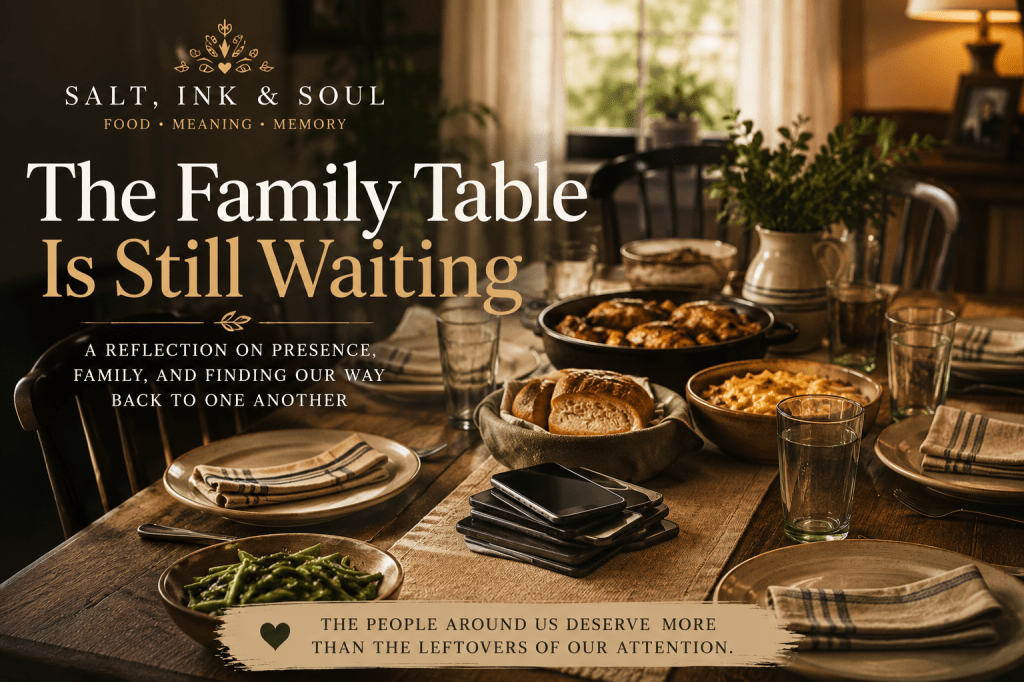
Just a stack of phones in the middle of the table.
Face down.
Not because the phones are bad.
Because the people around the table deserve our undivided attention, if only for the length of a meal.
That stack becomes its own centerpiece.
A quiet promise.
For the next hour, no one outside this room needs more of us than the people inside it.
Without the glow of our screens, we begin to notice things again.
The way your father pauses before mentioning an old friend.
The way your sister laughs a little harder than usual because she’s trying not to cry.
The way your grandmother reaches for your hand without saying why.
Those moments don’t trend.
They don’t go viral.
Most of them will never be photographed.
But they are the moments that become our lives.
The digital world will always ask us for another picture, another opinion, another performance of ourselves.
The family table asks for something much simpler.
It asks us to arrive.
Not polished.
Not interesting.
Not curated.
Just present.
Maybe that’s enough.
Maybe it always was.
The family table is still waiting.
The chairs are still there.
The empty seat still knows your name.
All it has ever wanted is the one thing no screen can offer.
You.
Please like, comment, and share
Resources for Hard Times
If you’re looking for practical help, food support, or community resources, you can visit the Salt, Ink & Soul Resources Page.


Leave a Reply