As I have said before, I have been watching The Bear.
Not quickly.
The show is often too intense for me to sit through all at once. I watch for a while, feel the pressure building in the room, and eventually step away. Sometimes I come back later that evening. Sometimes another day.
There is much about the show I admire.
The food.
The discipline.
The quiet beauty of people trying to make something precise in a world that rarely is.
But there is one thing I continue to struggle with.
Why are so many of the people who are supposed to be good at their work also written as though cruelty is part of the uniform?
Why does talent so often arrive shouting?
Why must skill enter the room convinced it is a god?
Perhaps this is only television. Perhaps the writers believe conflict is more interesting than kindness, and humiliation makes better drama than patience. Maybe Hollywood has decided that every great kitchen must be run like a battlefield, every chef must carry the emotional habits of a tyrant, and every young cook must first be broken before they can be trusted to create anything beautiful.
But I do not believe people have to be broken to become better.
I believe broken people often spend years trying to recover from those who claimed to be helping.
I know something about that.
I suffered abuse as a child.
I experienced abuse in the military.
I knew some of it in marriage.
The settings changed. The language changed. The uniforms changed. But fear has a familiar shape.
It teaches you to be afraid.
It does not teach you how to grow.
That distinction matters.
Some people will tell you fear made them stronger. Some will say the shouting sharpened them, that humiliation prepared them, that being treated like garbage was the price of excellence.
I do not doubt their experience.
But surviving a method does not prove the method was good.
A person can learn while being mistreated. Human beings are remarkably adaptive. We learn in war zones. We learn in broken homes. We learn beneath bosses who mistake intimidation for leadership.
But that does not mean the abuse was necessary.
It means the person found a way to keep growing despite it.
Too often, we give the cruelty credit for the strength that belonged to the survivor.
That is one of the oldest tricks in power’s playbook.
It wounds you, then takes credit for the scar tissue.
I keep returning to a simple question:
How do you teach someone who is constantly afraid of you?
Not how do you make them obey.
How do you actually teach them?
Fear narrows the world.
It makes the mind concentrate on survival. A frightened person is not free to be curious. They are not free to experiment. They are not free to ask the question that might sound foolish but lead somewhere useful.
They are watching you.
They are waiting for the next explosion.
They are trying not to become the day’s example.
That may produce compliance.
But compliance is not mastery.
Fear can teach a person how to avoid mistakes in front of you. It does not always teach them how to understand the work when you are gone.
Real teaching requires safety.
Not comfort at all times. Not lowered standards. Not endless praise.
Safety.
The kind that allows a person to say, “I don’t understand.”
The kind that permits them to make an honest mistake without wondering whether their dignity will be taken as payment.
A good teacher can be demanding.
But there is a difference between demanding excellence and demanding submission.
One develops the student.
The other feeds the ego of the person in charge.
I think we often confuse the two because arrogance photographs well.
The shouting chef looks powerful.
The patient teacher looks ordinary.
There is nothing glamorous about that kind of instruction.
It is slow.
It requires restraint.
It asks the person with authority to remember that knowledge is not a crown. It is something passed from one pair of hands to another.
That may be the harder discipline.
Anyone can humiliate someone who knows less.
It takes no genius to make a beginner feel small.
They have already entered the room uncertain. They already know they are behind. Their hands may shake. Their timing may be wrong. Their questions may expose how far they still have to go.
The easiest thing in the world is to use your experience as a weapon against them.
The better thing is to use it as shelter.
To say: I remember not knowing.
Let me show you again.
That does not make the standard weaker.
It makes the teacher stronger.
I sometimes wonder how many gifted people walked away from their calling because the first person entrusted to guide them decided cruelty was tradition.
How many cooks stopped cooking.
How many artists stopped drawing.
How many children stopped raising their hands.
How many soldiers learned to hide pain because someone convinced them that being human was a defect.
We count the ones who endured and call the system effective.
We rarely count the ones it drove away.
That is the trouble with cultures built on abuse. They display the survivors as evidence and bury the casualties in silence.
We see this in kitchens, offices, homes, schools, locker rooms, military units, and marriages.
The setting changes.
The wound remains familiar.
Someone says they are only trying to help.
Someone says this is how excellence is made.
Someone says you are too sensitive.
And after enough time, you begin to wonder whether dignity is something you must surrender to improve.
It is not.
You are allowed to learn without being degraded.
You are allowed to be corrected without being crushed.
You are allowed to stand in the presence of someone more skilled without kneeling before their ego.
We should not reward people merely because they are brilliant at the visible part of their work.
A chef can prepare a magnificent plate and poison the room around it.
A leader can meet every target and leave everyone beneath them diminished.
A teacher can know everything about the subject and nothing about the people sitting in front of them.
Skill matters.
But skill without humanity is incomplete.
There is no meal so beautiful that it excuses contempt.
No achievement so great that it makes cruelty noble.
No level of expertise that turns another person into something disposable.
Perhaps that is what I wish more stories understood.
The most remarkable person in the room is not always the one who can do what no one else can.
Sometimes it is the one who knows more and still chooses gentleness.
The one who remembers that the person standing in front of them is not raw material to be broken into shape.
They are already a human being.
The work is to help them become more fully themselves.
I still watch The Bear.
I still admire the craft.
I still want to see what comes out of those kitchens.
But I find myself hoping for something beyond the perfect plate.
I want to see a room where excellence does not require casualties.
A place where the lesson is not carried on the back of fear.
A kitchen where people are expected to learn, but are not required to suffer for the privilege.
Because fear may make someone move.
But if what we want is for people to grow, to think, to create, and eventually to teach someone else, then we must give them something fear never can.
Room to become good without first being made to feel worthless.
That is not softness.
That is instruction.
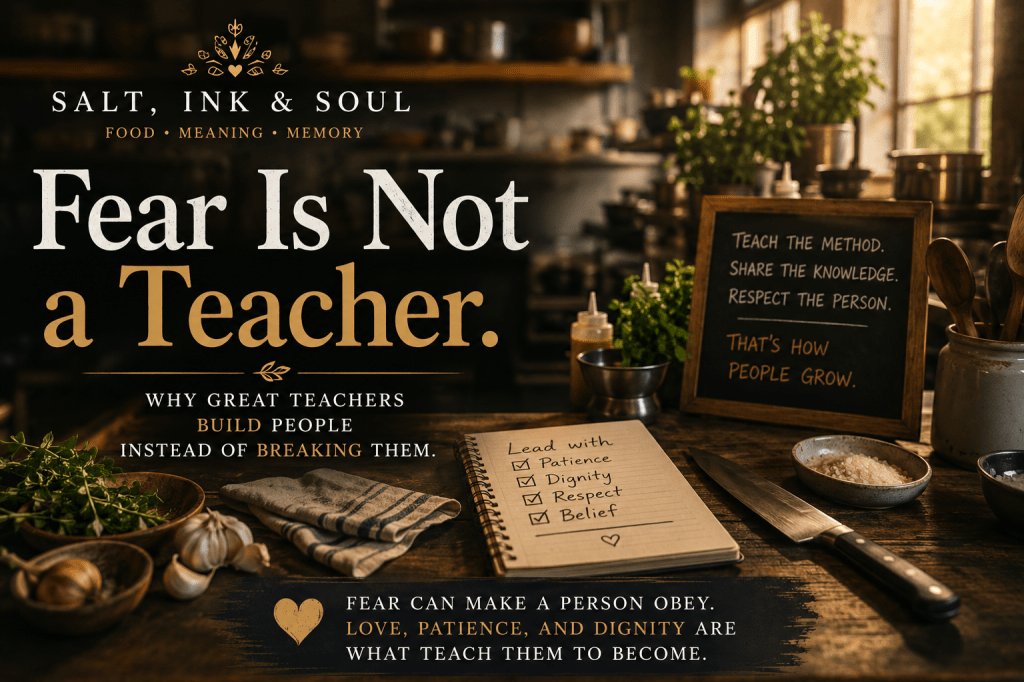
Fear can make a person obey.
Love, patience, and dignity are what teach them to become.
Please like, comment, and share
Resources for Hard Times
If you’re looking for practical help, food support, or community resources, you can visit the Salt, Ink & Soul Resources Page.


Leave a Reply