Category: Life Lessons

  • You Know Fall Is Coming When the Balloons Go Up

    You Know Fall Is Coming When the Balloons Go Up

    I grew up in the Midwest, where fall knew how to make an entrance.

    The trees announced it.

    Green gave way to yellow, orange, and red, as though the whole landscape had decided to burn beautifully before going quiet. Then the leaves began to fall, collecting along curbs and sidewalks, gathering beneath tires, crunching under your feet.

    You didn’t have to wonder whether the season was changing.

    All you had to do was look.

    New Mexico is different.

    Here, fall arrives a little more quietly.

    At first, it is something in the morning air.

    Not cold exactly.

    Just cooler.

    Enough that when you step outside early, you notice. Enough that you remember there will eventually come a morning when you will need a jacket.

    Then comes the smell.

    Green chile roasting.

    If you have lived here long enough, you know the smell before you see the roaster.

    Smoke and chile and flame carried through a grocery store parking lot. Those big metal drums turning over fire while people stand nearby, waiting for bags of roasted chile still warm enough to steam.

    And naturally, there are decisions to make.

    Where are you buying yours this year?

    Who has the best chile?

    More importantly:

    Who has the hot stuff?

    Not the chile somebody politely described as hot.

    The chile that makes you reconsider your confidence about halfway through dinner.

    These are serious questions.

    Or at least we treat them that way.

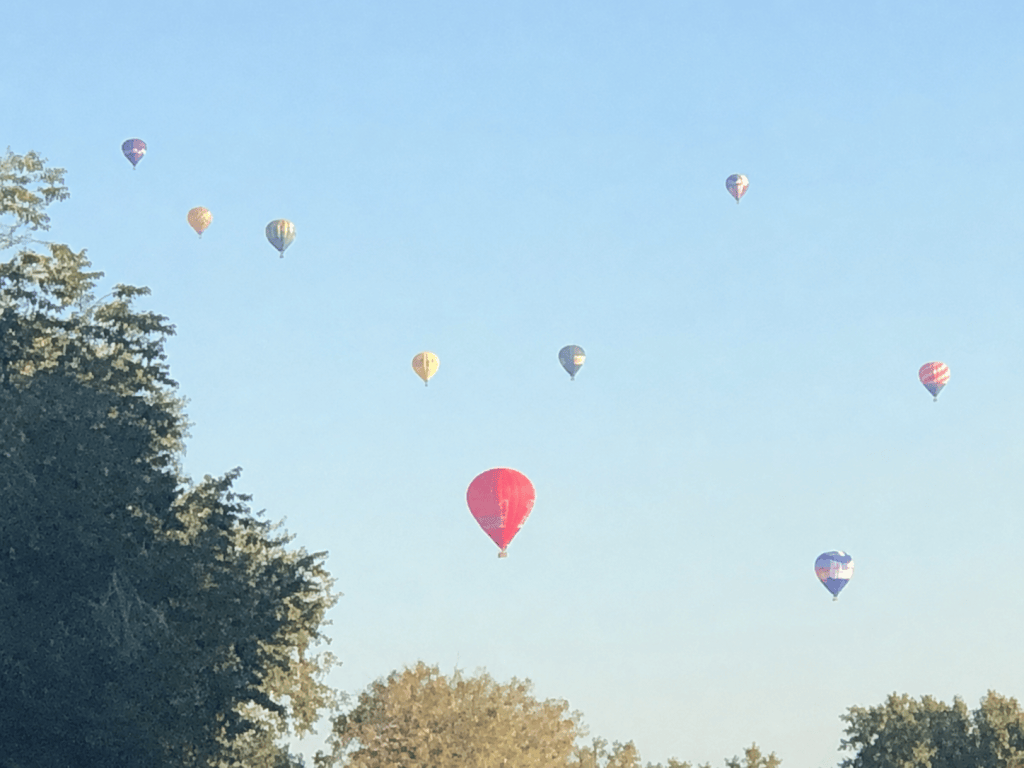
    And while you’re thinking about chile, while the morning is still cool and the smell of roasting peppers is floating through the air, you happen to look up.

    And there they are.

    The balloons are up.

    I have lived here for years.

    Long enough that none of this should surprise me anymore.

    But I still look.

    I still stop.

    I still reach for my phone.

    I still take pictures.

    There is something wonderfully impractical about a hot-air balloon.

    It doesn’t rush.

    It doesn’t seem particularly concerned about productivity.

    It just floats.

    A splash of color moving slowly across a blue New Mexico sky while the rest of us are down here trying to get somewhere on time.

    Maybe that’s part of why I still look.

    We spend so much of our lives training ourselves not to be impressed.

    We get used to things.

    The mountain becomes the mountain.

    The sunset becomes another sunset.

    The strange and beautiful thing we once stopped to admire becomes part of the scenery we pass without noticing.

    Familiarity can be a kind of blindness.

    I don’t want that.

    I don’t ever want to live somewhere so long that beauty becomes furniture.

    So I take another picture of a balloon.

    Even though I already have plenty.

    Probably too many.

    Maybe that’s all right.

    Growing up, autumn meant leaves.

    Here, it means something else.

    Cool mornings.

    Green chile.

    Balloons.

    Different signs for the same ancient turning.

    And maybe that is one of the quiet things a place teaches you when you stay long enough.

    You arrive with one definition of how the world is supposed to work.

    Then life gives you another.

    You learn that fall does not require red maple leaves.

    Home does not require the landscape where you were born.

    Tradition does not always have to be inherited.

    Sometimes you live somewhere long enough that new rituals begin attaching themselves to you.

    You don’t notice it happening.

    Until one morning you smell chile roasting and think:

    It’s that time again.

    Until you see the first balloons and instinctively reach for your phone.

    Until something that once belonged to somebody else’s place has quietly become part of your own calendar.

    Maybe belonging happens that way.

    Not with an announcement.

    Not with a ceremony.

    Just repetition.

    One season after another.

    One familiar smell.

    One cooler morning.

    One balloon drifting overhead.

    And a person standing beneath it who has seen this many times before—

    and still looks up.

    Kyle J. Hayes

    kylehayesblog.com

    Please like, comment, and share

    Resources for Hard Times

    If you’re looking for practical help, food support, or community resources, you can visit the Salt, Ink & Soul Resources Page.
    👉 Resources for Hard Times

  • Don’t Rush

    Don’t Rush

    Sometimes the people across the table are the best part of the meal.

    On Monday, I wrote about going outside.

    About realizing that I had become so focused on counting my steps that I had stopped noticing the world I was walking through.

    The mountains.

    The sky.

    The breeze.

    The ordinary beauty that had been there all along.

    After publishing that essay, I found myself wondering if the same thing happens when we eat.

    I enjoy cooking.

    If you’ve been reading Salt, Ink & Soul for a while, you already know that.

    I enjoy learning new techniques, trying new recipes, and discovering little ways to make a meal just a little better than the last one.

    And I’m perfectly comfortable eating alone.

    Sometimes it’s quiet.

    Sometimes it’s peaceful.

    Sometimes it’s exactly what I need.

    But every now and then, I find myself wanting something different.

    I want to share the table.

    A meal has always been about more than food.

    It’s about conversation.

    It’s about looking across the table and asking someone how they’re really doing.

    It’s about hearing a story you’ve heard before and laughing anyway.

    It’s about celebrating good news.

    Helping carry hard news.

    Or simply enjoying the company of someone whose presence makes the meal a little better.

    Some of my favorite meals probably weren’t the most expensive.

    They weren’t the most beautifully plated.

    If I’m honest, I don’t remember every bite.

    What I remember are the people.

    The conversations that wandered from one subject to another.

    The laughter that made us forget how much time had passed.

    The moments when no one looked at the clock because there was nowhere else we needed to be.

    I wonder if we’ve become as efficient with our meals as we’ve become with everything else.

    We eat in the car.

    At our desks.

    Standing over the kitchen sink.

    Sometimes while looking at our phones.

    We finish one meal while already thinking about the next thing on our schedule.

    Somewhere along the way, we started treating meals as another task to complete.

    Maybe they were never meant to be that.

    Maybe meals were always meant to slow us down.

    To remind us that the people sitting across from us deserve our attention just as much as everything waiting for us afterward.

    So the next time you have the chance, invite someone to lunch.

    Meet a friend for breakfast.

    Call a family member you haven’t seen in a while.

    Order dessert.

    Pour another cup of coffee.

    Tell one more story.

    Laugh a little louder.

    Stay until no one is looking at the clock anymore.

    Life gives us enough reasons to hurry.

    A shared meal doesn’t have to be one of them.

    Because one day, you may not remember exactly what was on the plate. But you’ll remember who was sitting across from you.

    Kyle J. Hayes

    kylehayesblog.com

    Please like, comment, and share

    Resources for Hard Times

    If you’re looking for practical help, food support, or community resources, you can visit the Salt, Ink & Soul Resources Page.
    👉 Resources for Hard Times

  • Why Do We Stop Noticing?

    Why Do We Stop Noticing?

    There is something I’ve been guilty of lately.

    Not noticing.

    If it were left up to me, I could happily spend most of my days at home. I’d write, cook, read, and if I needed my daily dose of sunshine, I’d probably just stand in the doorway for a few minutes and call it enough.

    I know that’s part of who I am.

    So every day I make myself go outside.

    I go for a walk to get my steps in. To spend a little time in the sunshine. To breathe fresh air. It’s become part of my routine, and I genuinely enjoy it.

    At least, I thought I did.

    Before I leave the house, I do what I’ve done almost every day for months.

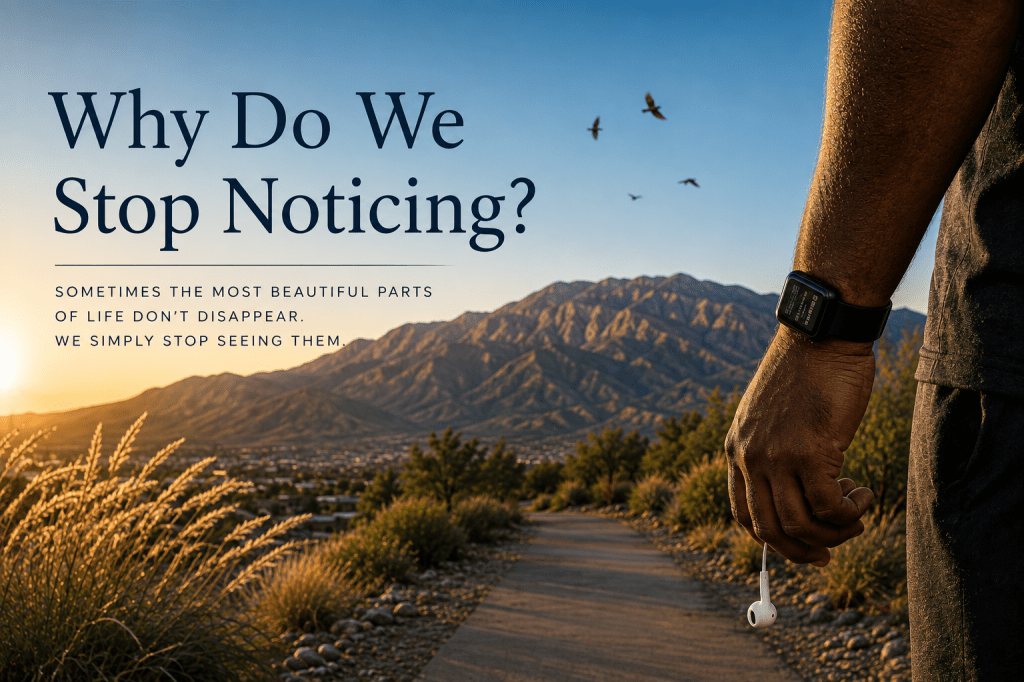
    I start my Apple Watch.

    I put in my earbuds.

    I choose something to listen to.

    Then I start walking.

    There’s nothing wrong with any of those things.

    But recently I realized something.

    Almost all of my attention was somewhere other than where I was.

    I was watching my pace.

    Checking my distance.

    Listening to music.

    Thinking about how many steps I had left before I reached my goal.

    My body had switched to autopilot.

    I was aware of people around me, but mostly as objects to walk around.

    I wasn’t really seeing my neighborhood.

    I was simply moving through it.

    One morning I caught myself looking down at my watch again.

    I looked up.

    The mountains were there.

    They had been there every morning.

    The sky was a deeper blue than I remembered.

    A breeze moved through the trees.

    Somewhere nearby, birds were carrying on a conversation I had apparently been missing for weeks.

    None of those things had suddenly appeared.

    I had.

    Or maybe that’s not quite true.

    My body had been showing up.

    My attention hadn’t.

    That made me wonder how often I was doing the same thing in the rest of my life.

    How many meals had I eaten while thinking about what came next instead of tasting what was already on my plate?

    How many conversations had I rushed through because my mind was already working on tomorrow?

    How many mornings had I traded for another item on my to-do list?

    I have spent so much of my life trying to be more efficient.

    Looking for the best way to do something.

    The quickest way.

    The smartest way.

    Anything to save a few minutes.

    And to be fair, that mindset has helped me in a lot of ways.

    My walks have improved my health.

    My Apple Watch has encouraged me to keep moving.

    The watch wasn’t the problem.

    Somewhere along the way, I realized I had become more interested in finishing my walk than experiencing it.

    I wasn’t only trying to reach a step goal.

    I was trying to live a healthier life.

    Part of living a healthier life is noticing the world you’re walking through.

    The sunshine.

    The mountains.

    The changing seasons.

    The maintenance man who always waves.

    The ordinary things that quietly become the memories we miss one day.

    Maybe beauty hasn’t become rare.

    Maybe we’ve simply become busy.

    Busy enough to walk through beautiful places without ever really seeing them.

    Tomorrow I’ll probably still wear my Apple Watch.

    I’ll probably still listen to music.

    I’ll probably still count my steps.

    But I think I’ll leave one earbud out for a little while.

    Because it would be a shame to spend my whole life moving through beautiful places…

    …without ever really noticing them.

    Kyle J. Hayes

    kylehayesblog.com

    Please like, comment, and share

    Resources for Hard Times

    If you’re looking for practical help, food support, or community resources, you can visit the Salt, Ink & Soul Resources Page.

    👉 Resources for Hard Times

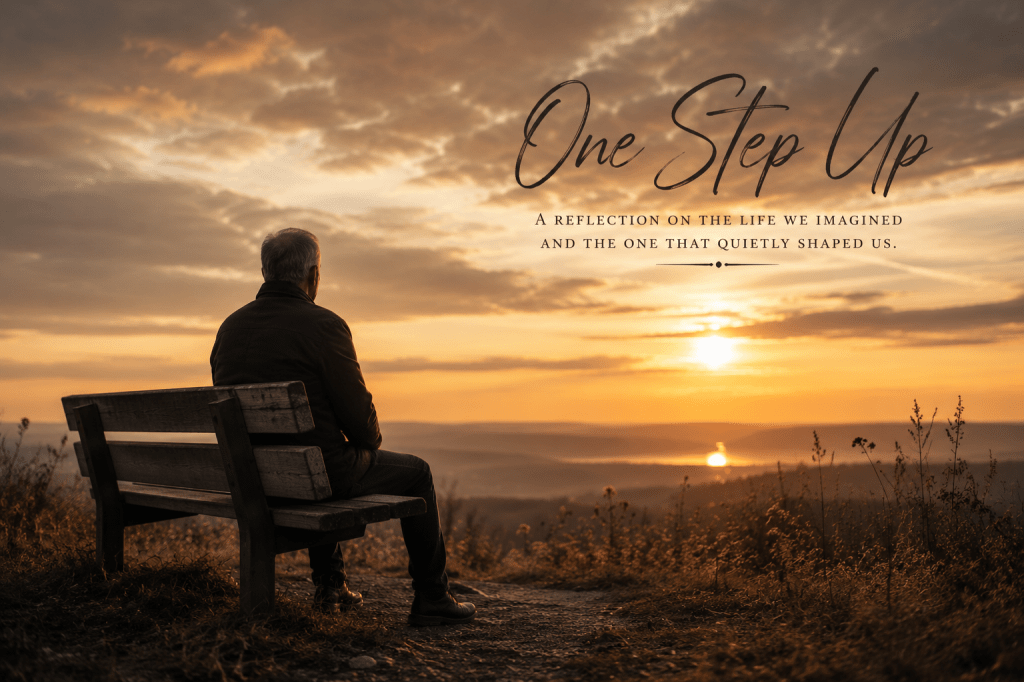
  • One Step Up

    One Step Up

    Sometimes a song stays with you because you realize it has been telling your story all along.

    There are lyrics from Bruce Springsteen’s “One Step Up” that have followed me for years:

    “When I look at myself I don’t see

    The man I wanted to be.

    Somewhere along the line I slipped off track.

    I’m caught moving one Step up and two steps back.”

    The first time I heard those words, I understood them.

    The older I’ve become, the more they’ve come to understand me.

    When I was young, I had a picture of the life I would live.

    It wasn’t extravagant. I wasn’t dreaming of fame or fortune. What I wanted was much quieter than that.

    I wanted to be married.

    I wanted a home that always felt full. Children running through the hallway. Grandchildren years later. Birthdays that needed another chair pulled up to the table. Sunday dinners that lingered long after the plates were empty because no one was in a hurry to leave.

    I thought I would grow into that man.

    Life had different plans.

    Some dreams end all at once.

    Others fade so slowly that one day you realize you’ve been mourning them without ever knowing when they disappeared.

    There isn’t always someone to blame.

    Sometimes life simply unfolds differently than the version we carried inside ourselves.

    For years, I measured my life against the man I expected to become. Every birthday became another quiet comparison. Another reminder of the distance between the future I imagined and the present I was living.

    That can become a cruel way to measure a life.

    Because the mirror only reflects what is.

    It never shows what has been survived.

    It doesn’t reveal the disappointments that taught you compassion. It doesn’t show the losses that made you gentler. It cannot measure the strength it took to keep moving after discovering life wasn’t interested in following your plans.

    Somewhere along the way, I stopped asking where I had gone wrong.

    Age has a way of changing the questions.

    I no longer ask myself as often, Why didn’t my life become what I imagined?

    Instead, I find myself asking something else.

    What kind of man would I have been?

    If I had married.

    If the house had been filled with children.

    If life had unfolded exactly as I had hoped.

    Would I have learned empathy without loneliness?

    Would I have become a writer if I had been busy living the life I thought I wanted?

    Would I have paid such close attention to ordinary moments if everything had come easily?

    I honestly don’t know.

    We spend so much time grieving the lives we never lived that we forget those lives would have shaped us differently.

    The husband I imagined.

    The father I dreamed of becoming.

    The grandfather sitting quietly at the end of a crowded table.

    He would have been another version of me.

    But not necessarily a better one.

    Maybe he would have been happier.

    Maybe he would have been wiser.

    Or maybe he would have missed the lessons this life insisted on teaching.

    Because while I didn’t become the man I expected, I became someone else.

    Someone who learned that kindness often grows where certainty once lived.

    Someone who discovered that stories matter because they remind us we aren’t walking alone.

    Someone who writes in the hope that another person, somewhere, might recognize themselves and feel just a little less alone.

    Maybe that writer could only have been born from this life.

    Not the one I planned.

    But the one I was given.

    Kyle J. Hayes

    kylehayesblog.com

    Please like, comment, and share

    Resources for Hard Times

    If you’re looking for practical help, food support, or community resources, you can visit the Salt, Ink & Soul Resources Page.
    👉 Resources for Hard Times

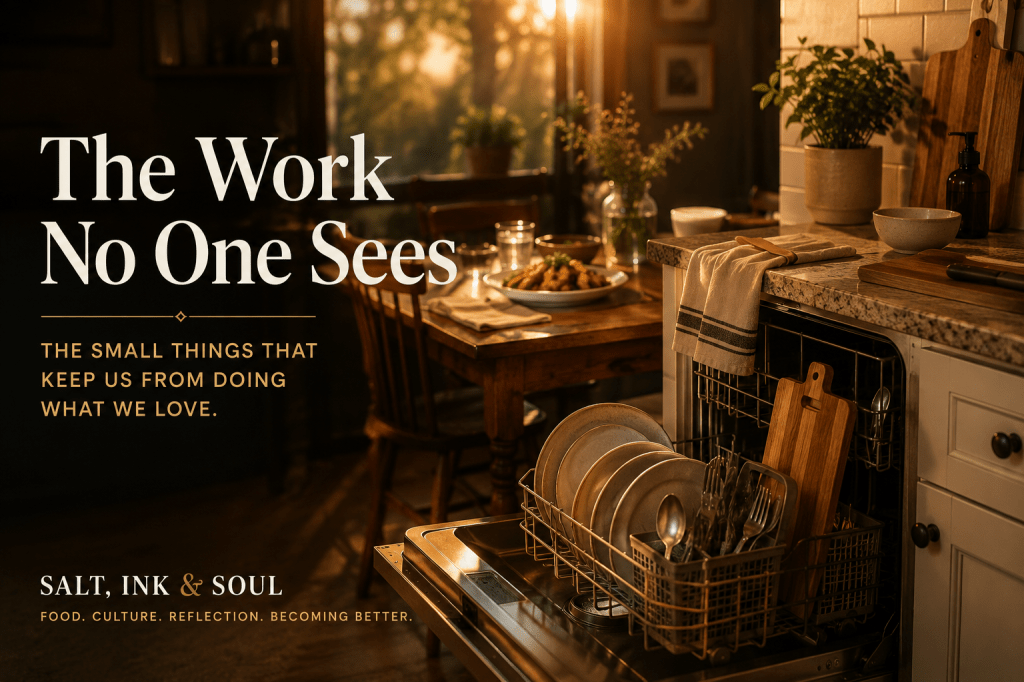
  • The Work No One Sees

    The Work No One Sees

    The Dishes Almost Kept Me From Learning to Cook.

    I write a lot about learning the metric system.

    It probably seems like an odd thing to get excited about, but switching from cups and teaspoons to weighing ingredients changed the way I cook. Recipes became more consistent. Bread rose the way it was supposed to. Sauces tasted the way I imagined they would. The more I cooked, the more I realized that precision wasn’t taking the joy out of cooking.

    It was giving me confidence.

    I started cooking because I love food.

    Good food.

    Not expensive food.

    Just food made with care.

    For a long time, I thought learning to cook would be the hardest part.

    I was wrong.

    Believe it or not, what almost kept me from cooking wasn’t the recipes.

    It was the dishes.

    The pots and pans.

    The cutting boards.

    The greasy stove.

    The food splattered across the counter.

    The crumbs on the floor.

    All the little reminders that every good meal leaves something behind.

    I can’t tell you how many times I’ve made a meal that turned out exactly the way I hoped. I’d taste as I cooked, adjusting a little salt here, another pinch of pepper there, until everything felt right.

    Then I’d sit down and realize something.

    I wasn’t hungry anymore.

    I’d spent so much time smelling the food and tasting the food that by the time dinner was finished, I was exhausted.

    The kitchen looked like a disaster.

    And now I had another job waiting for me.

    That’s when I realized something.

    Cooking isn’t just about cooking.

    It’s about planning.

    These days I rarely cook for just one meal.

    If I’m already chopping vegetables, washing dishes, heating the oven, and dirtying a sink full of bowls, I might as well make enough for a few days. I try to keep a few meal-prepped meals in the refrigerator or freezer for the evenings when I don’t feel like cooking at all.

    That one change made cooking easier.

    But another lesson changed everything.

    I learned something embarrassingly simple.

    The dishwasher has to be empty before I start cooking.

    Otherwise, everything backs up.

    Dirty dishes stay in the sink because there’s nowhere for them to go.

    Bowls pile up.

    Utensils pile up.

    Before long, one small task I skipped yesterday becomes today’s biggest obstacle.

    It was such a simple lesson.

    But I don’t think it’s only about dishwashers.

    How often do we avoid doing something we love because of one small part we don’t enjoy?

    Maybe it isn’t cooking.

    Maybe it’s writing.

    The writing isn’t the hard part.

    Editing is.

    Maybe it’s exercising.

    The workout isn’t the hard part.

    Putting on your shoes is.

    Sometimes the thing standing between us and the life we want isn’t the dream.

    It’s the cleanup.

    And then there’s another lesson every cook eventually learns.

    The food doesn’t always turn out the way you imagined.

    Sometimes you follow the recipe exactly, and something still feels off.

    Sometimes you try a new ingredient, and it simply doesn’t work.

    Sometimes dinner is just… okay.

    And that’s okay.

    Not every meal has to become your signature dish.

    Not every attempt has to be perfect.

    Every meal teaches you something.

    Every mistake teaches you something.

    The next one is usually a little better.

    I think writing works the same way.

    Most people only see the finished essay.

    They don’t see the sentences that were deleted.

    The paragraphs rewritten five times.

    The moments you stare at the screen wondering why the words won’t come.

    They don’t see the work before the work.

    The same is true of cooking.

    People see the meal.

    They don’t see the planning.

    They don’t see the grocery list.

    They don’t see the dishes.

    They don’t see the quiet work that made any of it possible.

    I’ve come to believe that’s true of almost everything worthwhile.

    The parts people applaud are usually the parts everyone can see.

    The parts that change us are usually the ones no one ever notices.

    Maybe that’s why we should give ourselves a little more grace.

    The work no one sees is still work.

    Sometimes it’s the dishes.

    Sometimes it’s the planning.

    Sometimes it’s simply emptying yesterday’s dishwasher so today’s work has somewhere to begin.

    And more often than not…

    It’s the work that matters most.

    Kyle J. Hayes

    kylehayesblog.com

    Please like, comment, and share

    Resources for Hard Times

    If you’re looking for practical help, food support, or community resources, you can visit the Salt, Ink & Soul Resources Page.
    👉 Resources for Hard Times

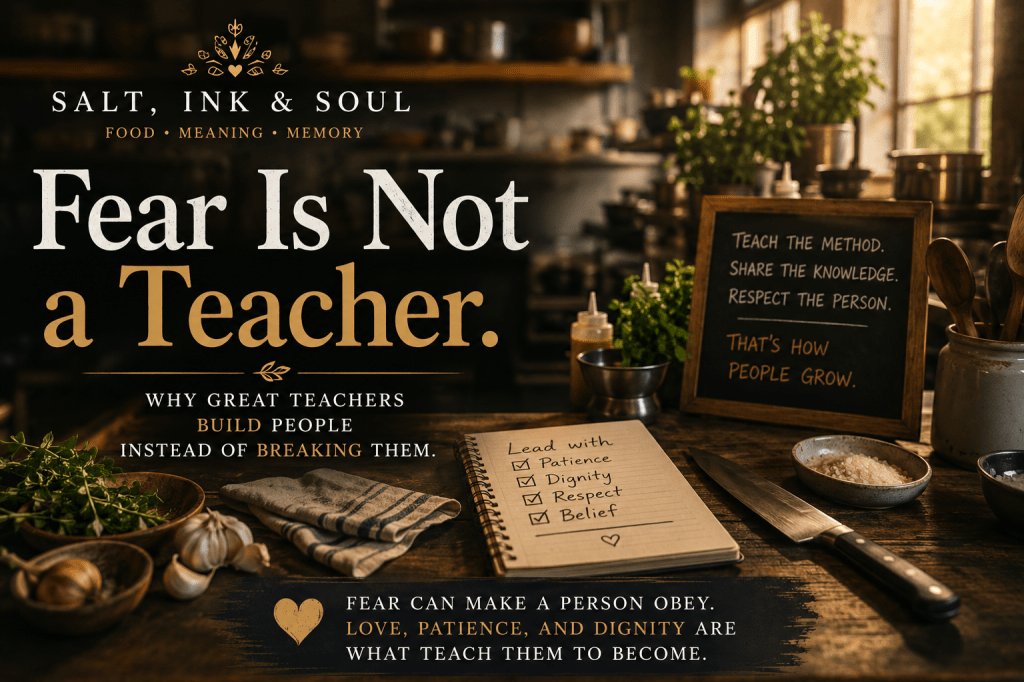
  • Fear Is Not a Teacher

    Fear Is Not a Teacher

    As I have said before, I have been watching The Bear.

    Not quickly.

    The show is often too intense for me to sit through all at once. I watch for a while, feel the pressure building in the room, and eventually step away. Sometimes I come back later that evening. Sometimes another day.

    There is much about the show I admire.

    The food.

    The discipline.

    The quiet beauty of people trying to make something precise in a world that rarely is.

    But there is one thing I continue to struggle with.

    Why are so many of the people who are supposed to be good at their work also written as though cruelty is part of the uniform?

    Why does talent so often arrive shouting?

    Why must skill enter the room convinced it is a god?

    Perhaps this is only television. Perhaps the writers believe conflict is more interesting than kindness, and humiliation makes better drama than patience. Maybe Hollywood has decided that every great kitchen must be run like a battlefield, every chef must carry the emotional habits of a tyrant, and every young cook must first be broken before they can be trusted to create anything beautiful.

    But I do not believe people have to be broken to become better.

    I believe broken people often spend years trying to recover from those who claimed to be helping.

    I know something about that.

    I suffered abuse as a child.

    I experienced abuse in the military.

    I knew some of it in marriage.

    The settings changed. The language changed. The uniforms changed. But fear has a familiar shape.

    It teaches you to be afraid.

    It does not teach you how to grow.

    That distinction matters.

    Some people will tell you fear made them stronger. Some will say the shouting sharpened them, that humiliation prepared them, that being treated like garbage was the price of excellence.

    I do not doubt their experience.

    But surviving a method does not prove the method was good.

    A person can learn while being mistreated. Human beings are remarkably adaptive. We learn in war zones. We learn in broken homes. We learn beneath bosses who mistake intimidation for leadership.

    But that does not mean the abuse was necessary.

    It means the person found a way to keep growing despite it.

    Too often, we give the cruelty credit for the strength that belonged to the survivor.

    That is one of the oldest tricks in power’s playbook.

    It wounds you, then takes credit for the scar tissue.

    I keep returning to a simple question:

    How do you teach someone who is constantly afraid of you?

    Not how do you make them obey.

    How do you actually teach them?

    Fear narrows the world.

    It makes the mind concentrate on survival. A frightened person is not free to be curious. They are not free to experiment. They are not free to ask the question that might sound foolish but lead somewhere useful.

    They are watching you.

    They are waiting for the next explosion.

    They are trying not to become the day’s example.

    That may produce compliance.

    But compliance is not mastery.

    Fear can teach a person how to avoid mistakes in front of you. It does not always teach them how to understand the work when you are gone.

    Real teaching requires safety.

    Not comfort at all times. Not lowered standards. Not endless praise.

    Safety.

    The kind that allows a person to say, “I don’t understand.”

    The kind that permits them to make an honest mistake without wondering whether their dignity will be taken as payment.

    A good teacher can be demanding.

    But there is a difference between demanding excellence and demanding submission.

    One develops the student.

    The other feeds the ego of the person in charge.

    I think we often confuse the two because arrogance photographs well.

    The shouting chef looks powerful.

    The patient teacher looks ordinary.

    There is nothing glamorous about that kind of instruction.

    It is slow.

    It requires restraint.

    It asks the person with authority to remember that knowledge is not a crown. It is something passed from one pair of hands to another.

    That may be the harder discipline.

    Anyone can humiliate someone who knows less.

    It takes no genius to make a beginner feel small.

    They have already entered the room uncertain. They already know they are behind. Their hands may shake. Their timing may be wrong. Their questions may expose how far they still have to go.

    The easiest thing in the world is to use your experience as a weapon against them.

    The better thing is to use it as shelter.

    To say: I remember not knowing.

    Let me show you again.

    That does not make the standard weaker.

    It makes the teacher stronger.

    I sometimes wonder how many gifted people walked away from their calling because the first person entrusted to guide them decided cruelty was tradition.

    How many cooks stopped cooking.

    How many artists stopped drawing.

    How many children stopped raising their hands.

    How many soldiers learned to hide pain because someone convinced them that being human was a defect.

    We count the ones who endured and call the system effective.

    We rarely count the ones it drove away.

    That is the trouble with cultures built on abuse. They display the survivors as evidence and bury the casualties in silence.

    We see this in kitchens, offices, homes, schools, locker rooms, military units, and marriages.

    The setting changes.

    The wound remains familiar.

    Someone says they are only trying to help.

    Someone says this is how excellence is made.

    Someone says you are too sensitive.

    And after enough time, you begin to wonder whether dignity is something you must surrender to improve.

    It is not.

    You are allowed to learn without being degraded.

    You are allowed to be corrected without being crushed.

    You are allowed to stand in the presence of someone more skilled without kneeling before their ego.

    We should not reward people merely because they are brilliant at the visible part of their work.

    A chef can prepare a magnificent plate and poison the room around it.

    A leader can meet every target and leave everyone beneath them diminished.

    A teacher can know everything about the subject and nothing about the people sitting in front of them.

    Skill matters.

    But skill without humanity is incomplete.

    There is no meal so beautiful that it excuses contempt.

    No achievement so great that it makes cruelty noble.

    No level of expertise that turns another person into something disposable.

    Perhaps that is what I wish more stories understood.

    The most remarkable person in the room is not always the one who can do what no one else can.

    Sometimes it is the one who knows more and still chooses gentleness. 

    The one who remembers that the person standing in front of them is not raw material to be broken into shape.

    They are already a human being.

    The work is to help them become more fully themselves.

    I still watch The Bear.

    I still admire the craft.

    I still want to see what comes out of those kitchens.

    But I find myself hoping for something beyond the perfect plate.

    I want to see a room where excellence does not require casualties.

    A place where the lesson is not carried on the back of fear.

    A kitchen where people are expected to learn, but are not required to suffer for the privilege.

    Because fear may make someone move.

    But if what we want is for people to grow, to think, to create, and eventually to teach someone else, then we must give them something fear never can.

    Room to become good without first being made to feel worthless.

    That is not softness.

    That is instruction.

    Fear can make a person obey.

    Love, patience, and dignity are what teach them to become.

    Kyle J. Hayes

    kylehayesblog.com

    Please like, comment, and share

    Resources for Hard Times

    If you’re looking for practical help, food support, or community resources, you can visit the Salt, Ink & Soul Resources Page.
    👉 Resources for Hard Times

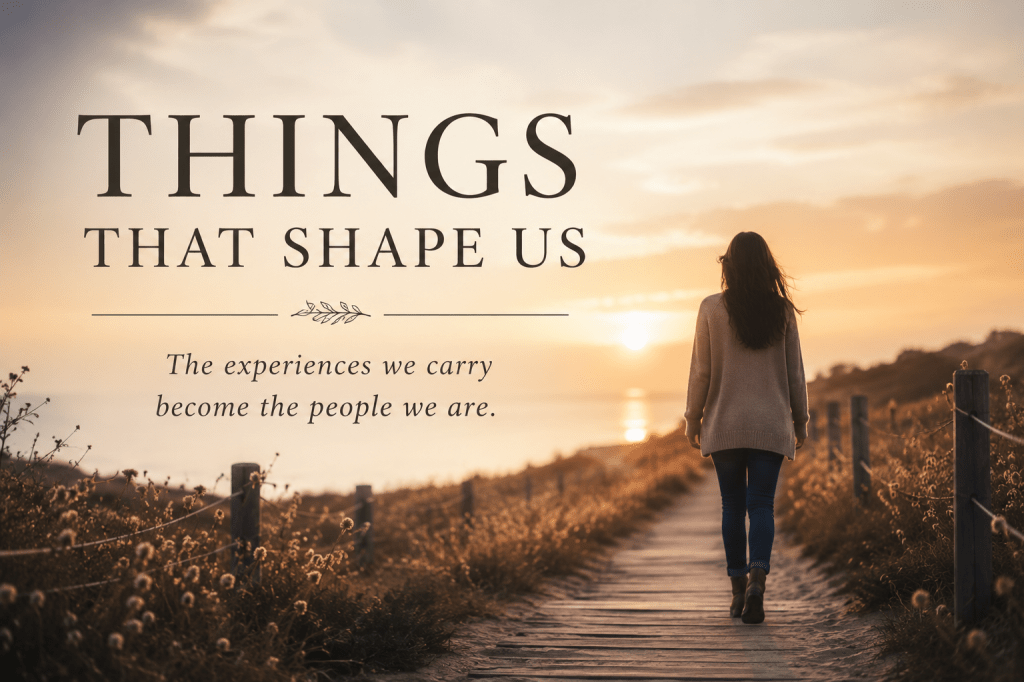
  • Things That Shape Us

    Things That Shape Us

    I have often wondered whether we become who we are because of something already inside us, or because of everything life places in our path.

    The older I get, the more I believe our experiences shape us.

    Before we learn to trust, someone has to give us a reason to.

    Before we become cautious, someone usually gives us one of those too.

    Every conversation, every disappointment, every unexpected kindness leaves something behind. We carry those moments longer than we realize. They become the lens through which we see the world, often without our permission.

    Our experiences influence who we trust. They affect how we speak to strangers, how quickly we forgive, and how willing we are to believe in people we have just met. They determine the places that feel like home and the ones we never want to return to. They shape what makes us feel safe, what makes us nervous, and what makes us hopeful.

    Even the smallest moments matter.

    A teacher who believed in us when no one else did.

    A friend who stayed.

    A parent who listened.

    A stranger who offered kindness on a day we desperately needed it.

    Just as those moments shape us for the better, so do the painful ones. Betrayal teaches caution. Loss teaches gratitude. Failure teaches resilience. Heartbreak can teach compassion, because once you’ve carried that kind of weight, you begin to recognize it in someone else.

    That doesn’t mean we are trapped by our experiences.

    I believe we always have a choice.

    We can decide that someone else’s bitterness will not become our own. We can choose to offer patience in response to impatience. We can become the kindness we wished someone had shown us years ago.

    Maybe that is where character is truly found.

    Not in pretending our experiences never happened, but in deciding what we will do with them.

    Because every experience leaves its fingerprint on us.

    Some become scars.

    Some become wisdom.

    And if we’re fortunate, the hardest moments don’t simply change who we are.

    They help us become someone worth becoming.

    Kyle J. Hayes

    kylehayesblog.com

    Please like, comment, and share

    Resources for Hard Times

    If you’re looking for practical help, food support, or community resources, you can visit the Salt, Ink & Soul Resources Page.
    👉 Resources for Hard Times

  • The Places We Choose to Live

    The Places We Choose to Live

    Over the past year, I have found myself changing more than my routines.

    I have been changing my environment.

    Not simply the places I spend my time, but the conversations I allow myself to remain in. The voices I listen to. The people I keep close enough to influence the way I see the world.

    What surprised me most was not the change itself.

    It was how uncomfortable certain environments suddenly became.

    Conversations I once tolerated now leave me exhausted. Gatherings that once felt ordinary now feel strangely heavy. I find myself noticing how easily some people can take something beautiful and immediately begin searching for what is wrong with it.

    There is an old saying about finding fault in a rose.

    Most of us know people who could walk through a garden and speak only of the thorns.

    They witness kindness and wonder what someone wants in return.

    They hear good news and begin predicting how it will end.

    They receive a blessing and instinctively search for the hidden cost.

    For a long time I wondered why.

    The older I become, the less interested I am in judging those people.

    Life has a way of teaching difficult lessons.

    Pain can narrow our vision.

    Disappointment can convince us that hope is dangerous.

    Betrayal can make suspicion feel wiser than trust.

    Many people are carrying wounds the rest of us will never fully understand.

    Remembering that has made me more compassionate.

    But it has also taught me something equally important.

    Compassion does not require residency.

    You can understand someone’s pain without moving into it.

    You can love someone without adopting their way of seeing the world.

    You can care deeply for another person while quietly protecting the peace you have worked so hard to cultivate.

    That has become one of adulthood’s quiet responsibilities.

    Not every invitation deserves acceptance.

    Not every conversation deserves your attention.

    Not every headline deserves your emotion.

    Not every opinion deserves a room inside your mind.

    We spend so much time protecting our homes from damage.

    We lock our doors.

    We replace broken windows.

    We tend our yards.

    Yet many of us leave the front door of our souls standing wide open, allowing resentment, outrage, cynicism, and fear to wander in whenever they please.

    Eventually, whatever is allowed to stay begins rearranging the furniture.

    These days I find myself less interested in what is popular and more interested in what is nourishing.

    Less interested in what demands my attention and more interested in what deserves it.

    I’m not sure what to call this change.

    Maybe it is wisdom.

    Maybe it is simply growing older.

    Or maybe it is finally understanding that peace is rarely something we find.

    More often, it is something we protect.

    I’ve noticed that when I become careful about what enters my mind, everything else begins to change.

    My thoughts become gentler.

    My patience grows longer.

    Gratitude arrives more often than complaint.

    Even in a world that still contains cruelty, injustice, and heartbreak, I begin noticing small mercies I once hurried past.

    The darkness has not disappeared.

    I simply refuse to make my home inside it.

    Perhaps that is what tending the soul has always meant.

    Not pretending evil does not exist.

    Not closing our eyes to suffering.

    But choosing, again and again, to give more of ourselves to what is true than to what is loud, more to what is beautiful than to what is broken, more to what nourishes than to what merely consumes.

    Because a soul is not unlike a garden.

    It does not become what we admire.

    It becomes what we cultivate.

    Kyle J. Hayes

    kylehayesblog.com

    Please like, comment, and share

    Resources for Hard Times

    If you’re looking for practical help, food support, or community resources, you can visit the Salt, Ink & Soul Resources Page.
    👉 Resources for Hard Times