
Tag: The Bear

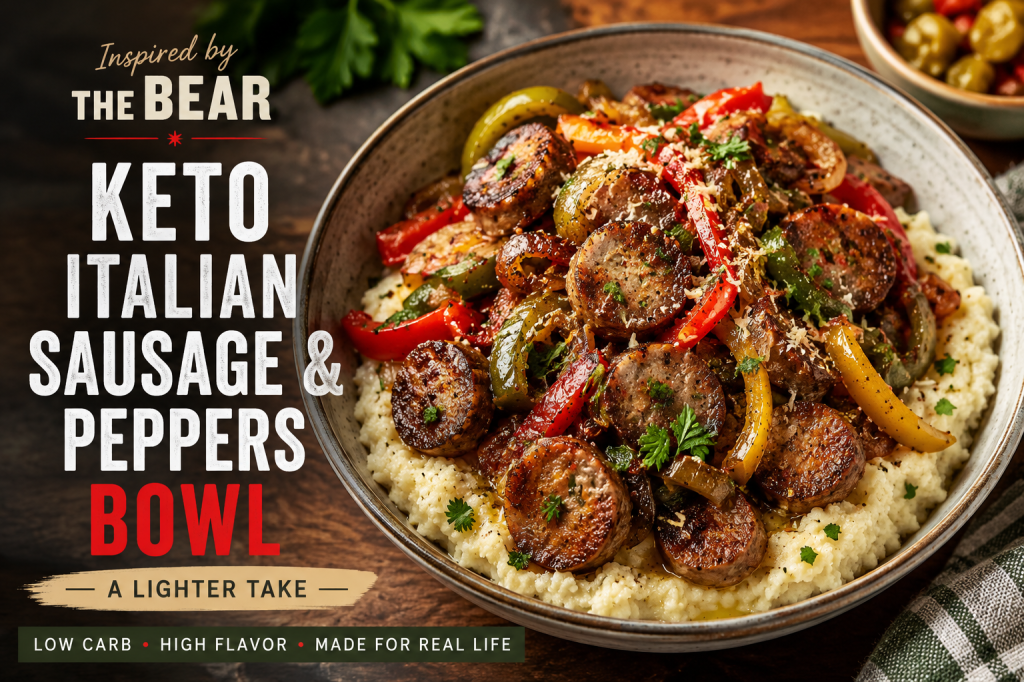
  • Keto Italian Sausage & Peppers

    Keto Italian Sausage & Peppers

    If you’ve watched Season 1 of The Bear, you’ve probably noticed that not every dish gets a close-up. During the rush at The Original Beef of Chicagoland, the kitchen fills with a constant rhythm of shouted orders. Alongside the famous Italian beef, one order comes up again and again:

    “Sausage-pepper!”

    The show never stops to explain how it’s made. It doesn’t need to. In a neighborhood Chicago sandwich shop, Italian sausage and peppers are simply part of the rhythm of the day. It’s dependable, the kind of meal regular customers order without even looking at the menu.

    This recipe imagines that classic in a way that fits today’s kitchen. Instead of serving it on a crusty Italian roll, we’re building a hearty bowl with creamy cauliflower mash, sweet roasted peppers, and juicy Italian sausage. It’s lower in carbohydrates, perfect for meal prep, and easy enough for anyone to make—even if you’re just beginning to feel comfortable in the kitchen.

    Because good food doesn’t have to be complicated.

    It just has to make people feel like someone cared enough to cook.

    Servings

    4–6

    Prep Time: 15 minutes

    Cook Time: 40 minutes

    Ingredients

    For the Sausage

    • 2 pounds Italian chicken sausage or lean Italian pork sausage (mild or hot)
    • 1 tablespoon olive oil

    For the Peppers

    • 2 red bell peppers
    • 2 green bell peppers
    • 1 yellow bell pepper
    • 1 large yellow onion
    • 4 garlic cloves
    • 1 tablespoon olive oil

    Seasonings

    • 1 teaspoon dried oregano
    • 1 teaspoon dried basil
    • 1 teaspoon garlic powder
    • ½ teaspoon smoked paprika
    • ½ teaspoon crushed fennel seed (optional, but recommended)
    • ½ teaspoon kosher salt
    • ½ teaspoon black pepper
    • Pinch of crushed red pepper flakes (optional)

    For the Cauliflower Mash

    • 1 large head cauliflower (or two bags of frozen cauliflower florets)
    • 2 tablespoons butter
    • ¼ cup grated Parmesan cheese
    • 2 tablespoons heavy cream
    • Salt and pepper to taste

    Optional Toppings

    • Fresh parsley
    • Fresh grated Parmesan
    • Giardiniera
    • Pepperoncini

    Instructions

    Step 1: Slice the Vegetables

    Wash the peppers.

    Cut them in half and remove the seeds.

    Slice the peppers into strips about the width of your finger.

    Slice the onion into thin strips.

    Peel and finely chop the garlic.

    Don’t worry if everything isn’t exactly the same size. Home cooking isn’t about perfection.

    Step 2: Brown the Sausage

    Heat a large skillet or frying pan over medium heat.

    Add the olive oil.

    Place the sausages into the pan.

    Cook them for about 8 to 10 minutes, turning every couple of minutes until browned on all sides.

    They don’t need to be fully cooked yet.

    Move them to a plate.

    Step 3: Cook the Peppers

    Using the same pan, add the peppers and onions.

    Cook them for about 10 to 12 minutes, stirring occasionally.

    They should become soft and slightly golden around the edges.

    Add the chopped garlic.

    Cook for one more minute.

    Sprinkle in:

    • oregano
    • basil
    • garlic powder
    • smoked paprika
    • fennel seed
    • salt
    • pepper
    • red pepper flakes (if using)

    Stir everything together.

    Step 4: Finish the Sausage

    Slice the browned sausage into bite-sized pieces.

    Return it to the pan with the peppers.

    Cover with a lid.

    Cook another 8 to 10 minutes, stirring once or twice, until the sausage is fully cooked.

    If the pan starts looking dry, add a few tablespoons of water or chicken broth.

    The vegetables will absorb all those wonderful flavors.

    Step 5: Make the Cauliflower Mash

    While the sausage cooks, boil or steam the cauliflower until it’s very soft.

    Drain it well.

    Place it into a food processor or blender with:

    • butter
    • Parmesan
    • heavy cream
    • a pinch of salt
    • a little black pepper

    Blend until smooth.

    If you don’t have a blender, use a potato masher. The texture will be more rustic, but just as delicious.

    Build Your Bowl

    Start with a generous scoop of cauliflower mash.

    Top with:

    • Italian sausage
    • Sweet peppers
    • Onions

    Finish with:

    • Fresh parsley
    • Parmesan
    • A spoonful of giardiniera if you like a little heat.

    Serve while everything is hot.

    Meal Prep

    This recipe was made for busy weeks.

    Divide into containers with:

    • Cauliflower mash on one side
    • Sausage and peppers on the other

    Refrigerate for up to 4 days.

    The flavors become even better overnight, making leftovers something to look forward to.

    Estimated Nutrition

    (Per serving, based on 6 servings using chicken Italian sausage)

    • Calories: Approximately 430
    • Protein: 32 grams
    • Fat: 29 grams
    • Net Carbohydrates: 9–11 grams

    Salt, Ink & Soul

    There is a quiet dignity in everyday food.

    Not every meal is meant to impress strangers on the internet. Most are meant for something much smaller, and somehow much more important. A family sitting around the table after a long day. A meal packed for tomorrow’s lunch. A friend who drops by without warning. A cook making enough so no one leaves hungry.

    Those are the meals that shape our memories.

    Kyle J. Hayes

    kylehayesblog.com

    Please like, comment, and share

    Resources for Hard Times

    If you’re looking for practical help, food support, or community resources, you can visit the Salt, Ink & Soul Resources Page.
    👉 Resources for Hard Times

  • Fear Is Not a Teacher

    Fear Is Not a Teacher

    As I have said before, I have been watching The Bear.

    Not quickly.

    The show is often too intense for me to sit through all at once. I watch for a while, feel the pressure building in the room, and eventually step away. Sometimes I come back later that evening. Sometimes another day.

    There is much about the show I admire.

    The food.

    The discipline.

    The quiet beauty of people trying to make something precise in a world that rarely is.

    But there is one thing I continue to struggle with.

    Why are so many of the people who are supposed to be good at their work also written as though cruelty is part of the uniform?

    Why does talent so often arrive shouting?

    Why must skill enter the room convinced it is a god?

    Perhaps this is only television. Perhaps the writers believe conflict is more interesting than kindness, and humiliation makes better drama than patience. Maybe Hollywood has decided that every great kitchen must be run like a battlefield, every chef must carry the emotional habits of a tyrant, and every young cook must first be broken before they can be trusted to create anything beautiful.

    But I do not believe people have to be broken to become better.

    I believe broken people often spend years trying to recover from those who claimed to be helping.

    I know something about that.

    I suffered abuse as a child.

    I experienced abuse in the military.

    I knew some of it in marriage.

    The settings changed. The language changed. The uniforms changed. But fear has a familiar shape.

    It teaches you to be afraid.

    It does not teach you how to grow.

    That distinction matters.

    Some people will tell you fear made them stronger. Some will say the shouting sharpened them, that humiliation prepared them, that being treated like garbage was the price of excellence.

    I do not doubt their experience.

    But surviving a method does not prove the method was good.

    A person can learn while being mistreated. Human beings are remarkably adaptive. We learn in war zones. We learn in broken homes. We learn beneath bosses who mistake intimidation for leadership.

    But that does not mean the abuse was necessary.

    It means the person found a way to keep growing despite it.

    Too often, we give the cruelty credit for the strength that belonged to the survivor.

    That is one of the oldest tricks in power’s playbook.

    It wounds you, then takes credit for the scar tissue.

    I keep returning to a simple question:

    How do you teach someone who is constantly afraid of you?

    Not how do you make them obey.

    How do you actually teach them?

    Fear narrows the world.

    It makes the mind concentrate on survival. A frightened person is not free to be curious. They are not free to experiment. They are not free to ask the question that might sound foolish but lead somewhere useful.

    They are watching you.

    They are waiting for the next explosion.

    They are trying not to become the day’s example.

    That may produce compliance.

    But compliance is not mastery.

    Fear can teach a person how to avoid mistakes in front of you. It does not always teach them how to understand the work when you are gone.

    Real teaching requires safety.

    Not comfort at all times. Not lowered standards. Not endless praise.

    Safety.

    The kind that allows a person to say, “I don’t understand.”

    The kind that permits them to make an honest mistake without wondering whether their dignity will be taken as payment.

    A good teacher can be demanding.

    But there is a difference between demanding excellence and demanding submission.

    One develops the student.

    The other feeds the ego of the person in charge.

    I think we often confuse the two because arrogance photographs well.

    The shouting chef looks powerful.

    The patient teacher looks ordinary.

    There is nothing glamorous about that kind of instruction.

    It is slow.

    It requires restraint.

    It asks the person with authority to remember that knowledge is not a crown. It is something passed from one pair of hands to another.

    That may be the harder discipline.

    Anyone can humiliate someone who knows less.

    It takes no genius to make a beginner feel small.

    They have already entered the room uncertain. They already know they are behind. Their hands may shake. Their timing may be wrong. Their questions may expose how far they still have to go.

    The easiest thing in the world is to use your experience as a weapon against them.

    The better thing is to use it as shelter.

    To say: I remember not knowing.

    Let me show you again.

    That does not make the standard weaker.

    It makes the teacher stronger.

    I sometimes wonder how many gifted people walked away from their calling because the first person entrusted to guide them decided cruelty was tradition.

    How many cooks stopped cooking.

    How many artists stopped drawing.

    How many children stopped raising their hands.

    How many soldiers learned to hide pain because someone convinced them that being human was a defect.

    We count the ones who endured and call the system effective.

    We rarely count the ones it drove away.

    That is the trouble with cultures built on abuse. They display the survivors as evidence and bury the casualties in silence.

    We see this in kitchens, offices, homes, schools, locker rooms, military units, and marriages.

    The setting changes.

    The wound remains familiar.

    Someone says they are only trying to help.

    Someone says this is how excellence is made.

    Someone says you are too sensitive.

    And after enough time, you begin to wonder whether dignity is something you must surrender to improve.

    It is not.

    You are allowed to learn without being degraded.

    You are allowed to be corrected without being crushed.

    You are allowed to stand in the presence of someone more skilled without kneeling before their ego.

    We should not reward people merely because they are brilliant at the visible part of their work.

    A chef can prepare a magnificent plate and poison the room around it.

    A leader can meet every target and leave everyone beneath them diminished.

    A teacher can know everything about the subject and nothing about the people sitting in front of them.

    Skill matters.

    But skill without humanity is incomplete.

    There is no meal so beautiful that it excuses contempt.

    No achievement so great that it makes cruelty noble.

    No level of expertise that turns another person into something disposable.

    Perhaps that is what I wish more stories understood.

    The most remarkable person in the room is not always the one who can do what no one else can.

    Sometimes it is the one who knows more and still chooses gentleness. 

    The one who remembers that the person standing in front of them is not raw material to be broken into shape.

    They are already a human being.

    The work is to help them become more fully themselves.

    I still watch The Bear.

    I still admire the craft.

    I still want to see what comes out of those kitchens.

    But I find myself hoping for something beyond the perfect plate.

    I want to see a room where excellence does not require casualties.

    A place where the lesson is not carried on the back of fear.

    A kitchen where people are expected to learn, but are not required to suffer for the privilege.

    Because fear may make someone move.

    But if what we want is for people to grow, to think, to create, and eventually to teach someone else, then we must give them something fear never can.

    Room to become good without first being made to feel worthless.

    That is not softness.

    That is instruction.

    Fear can make a person obey.

    Love, patience, and dignity are what teach them to become.

    Kyle J. Hayes

    kylehayesblog.com

    Please like, comment, and share

    Resources for Hard Times

    If you’re looking for practical help, food support, or community resources, you can visit the Salt, Ink & Soul Resources Page.
    👉 Resources for Hard Times

  • Salt, Ink & Soul Healthy Spaghetti

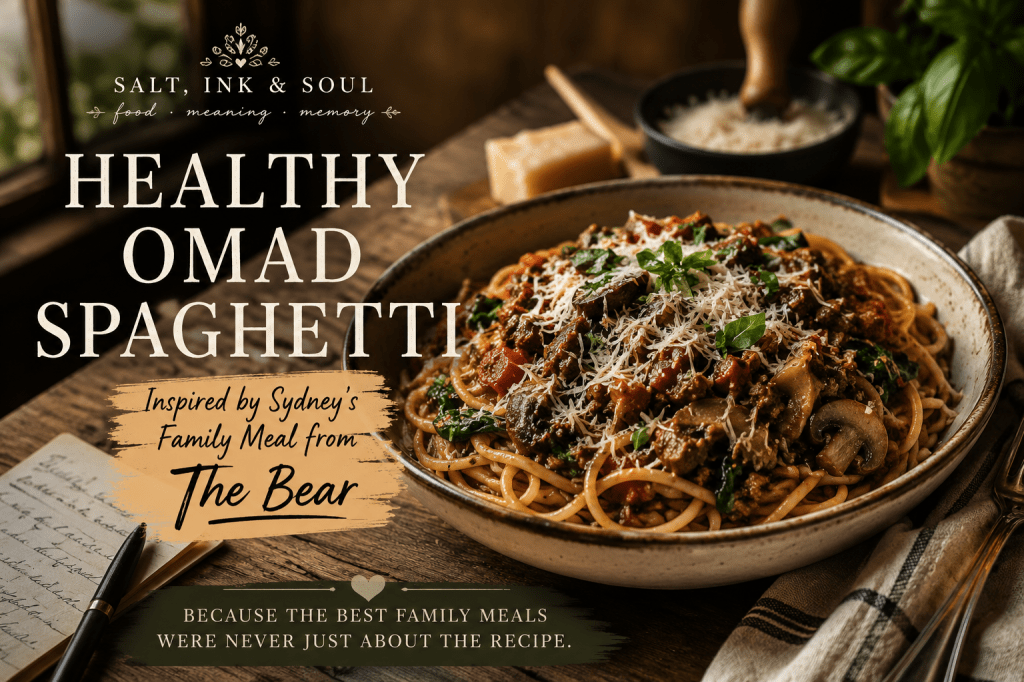
    Salt, Ink & Soul Healthy Spaghetti

    Inspired by Sydney’s Family Meal from “The Bear”

    I’ve been trying to watch as much of The Bear as I can. It’s not always easy. The show has a way of turning up the heat—not just in the kitchen, but in the people. There are moments when the intensity becomes a little too much for me, so I pause it, step away, and come back another day. But every time I do, I find myself thinking about the food. It isn’t just something to eat; it’s another way the characters care for one another, even when they don’t know how to say the words.

    One of my favorite parts of the show is the family meal. It reminded me that the meals we remember most are rarely about the recipe itself. Years later, we don’t always remember exactly what was seasoned with this or cooked for that long. We remember who was sitting around the table. The conversations that stretched a little longer than the meal. The laughter. The stories. The comfort of knowing that, for a little while, everyone belonged in the same place.

    That inspired me to try making some of the dishes from the show in my own kitchen. Not exact copies, and probably not all of them. Just the ones that feel within reach, with a few small changes to better fit the way I’m eating these days. My goal isn’t to recreate the restaurant. It’s to bring a little of that feeling home.

    So here’s my healthier take on Sydney’s family meal spaghetti—a version made for One Meal A Day (OMAD), with plenty of lean protein, vegetables, and just enough real pasta to remind me that eating well doesn’t have to mean giving up the foods that bring us comfort.

    Salt, Ink & Soul Healthy Spaghetti

    Servings

    4 meal-prep portions

    Ingredients

    Protein

    • 2 pounds (907 g) 93% lean ground beef
    • (Optional) Replace ½ pound with lean Italian turkey sausage for a little extra flavor.

    Pasta

    • 8 ounces (227 g) high-quality dried spaghetti
      • This works out to 2 ounces (56 g) dry pasta per serving.

    Sauce

    • 1 (24-ounce) jar no-sugar-added marinara sauce
    • 1 (15-ounce) can crushed tomatoes
    • 2 tablespoons tomato paste

    Vegetables

    • 8 ounces mushrooms, sliced
    • 1 medium onion, diced
    • 1 medium zucchini, diced small
    • 1 bell pepper, diced
    • 3 cups fresh spinach
    • 4 cloves garlic, minced

    Seasonings

    • 2 tablespoons olive oil
    • 2 teaspoons Italian seasoning
    • 1 teaspoon dried oregano
    • 1 teaspoon dried basil
    • 1 teaspoon garlic powder
    • 1 teaspoon onion powder
    • ½ teaspoon crushed red pepper flakes (optional)
    • 1 teaspoon kosher salt, or to taste
    • ½ teaspoon freshly ground black pepper

    To Finish

    • Fresh basil, chopped (optional)
    • Freshly grated Parmesan cheese

    Instructions

    1. Build the Flavor

    Heat the olive oil in a large Dutch oven or heavy-bottomed pot over medium-high heat.

    Add the onions and mushrooms and cook for 5–6 minutes until they begin to soften and develop color.

    Stir in the garlic and cook for another 30 seconds.

    Add the ground beef and cook until browned, breaking it into small pieces as it cooks. If necessary, drain any excess fat.

    2. Add the Vegetables

    Stir in the zucchini and bell pepper.

    Cook for about 5 minutes until they begin to soften.

    Fold in the spinach and cook just until wilted.

    3. Simmer the Sauce

    Add:

    • Marinara sauce
    • Crushed tomatoes
    • Tomato paste
    • Italian seasoning
    • Oregano
    • Basil
    • Garlic powder
    • Onion powder
    • Salt
    • Pepper
    • Red pepper flakes (if using)

    Stir well.

    Reduce the heat to low and let the sauce simmer for 30–40 minutes, stirring occasionally.

    The longer it simmers, the deeper and richer the flavors become.

    4. Cook the Pasta

    While the sauce simmers, cook the spaghetti according to the package directions until al dente.

    Before draining, reserve about ½ cup of the pasta water.

    If the sauce needs thinning, stir in a splash of the reserved pasta water.

    5. Assemble

    Place approximately 2 ounces (56 g dry, cooked) spaghetti into each bowl or meal-prep container.

    Top generously with the meat-and-vegetable sauce.

    Finish with freshly grated Parmesan and chopped basil.

    Garlic Green Beans

    Ingredients

    • 1 pound fresh green beans
    • 1 tablespoon olive oil
    • 2 cloves garlic, minced
    • Salt and pepper
    • Juice of ½ lemon

    Instructions

    Bring a pot of salted water to a boil.

    Cook the green beans for 4–5 minutes until tender-crisp.

    Drain well.

    Heat the olive oil in a skillet over medium heat.

    Add the garlic and cook for about 30 seconds until fragrant.

    Add the green beans and toss for 2–3 minutes.

    Season with salt, pepper, and a squeeze of fresh lemon juice.

    Meal Prep

    Divide everything into four containers:

    • 2 ounces dry (56 g) cooked spaghetti
    • Generous serving of meat and vegetable sauce
    • Garlic green beans

    Each meal is packed with lean protein, colorful vegetables, and just enough pasta to satisfy the craving without overwhelming the plate.

    Salt, Ink & Soul

    One thing I’ve learned is that eating healthier doesn’t have to mean giving up the meals you love. Sometimes it simply means making room for better ingredients, a little more balance, and a little more intention.

    Like the family meals that inspired this recipe, this isn’t about perfection.

    It’s about taking the time to feed yourself well.

    Because the people gathered around the table always mattered more than the recipe.

    Kyle J. Hayes

    kylehayesblog.com

    Please like, comment, and share

    Resources for Hard Times

    If you’re looking for practical help, food support, or community resources, you can visit the Salt, Ink & Soul Resources Page.
    👉 Resources for Hard Times