Sometimes a television show stops entertaining you and quietly begins asking questions about your own life.
Season 2 of The Bear did that for me.
The Second season of The Bear is filled with food.
Beautiful food. Precise food. Food arranged with tweezers and intention. Food that carries the weight of memory, ambition, grief, and expectation.
But the best thing the season serves is not a plate.
It is change.
Not the kind of change people announce loudly. The change in The Bear is quieter than that. It comes through repetition. Through discomfort. Through people being sent away from what they know so they can return with a clearer understanding of who they might become.
Marcus leaves the familiar kitchen and enters another world. He studies pastry with patience and humility. He learns that excellence is not magic. It is attention. It is noticing texture, temperature, timing. It is doing the same thing again, not because the first attempt was worthless, but because care asks us to try once more.
Tina goes to culinary school.
That may not sound revolutionary to some people. But there are moments in life when being offered the chance to learn becomes a form of recognition. Someone looks at you and says, perhaps without saying it directly, There is more in you.
And then there is Richie.
Richie may be the clearest example of what the season is trying to tell us.
He begins as a man who feels the world moving without him. He is loud because he is uncertain. Defensive because he is afraid. He mistakes familiarity for usefulness and anger for authority. He has spent so much time believing he does not belong anywhere that he has begun to behave as if belonging itself is a lie.
Then he is sent to another restaurant.
At first, he believes he is being punished.
That is often how growth feels when it begins.
We think we have been removed because we are unwanted. We do not always understand that distance can sometimes reveal what closeness has hidden. Away from the noise of his own kitchen, Richie begins to see the work differently.
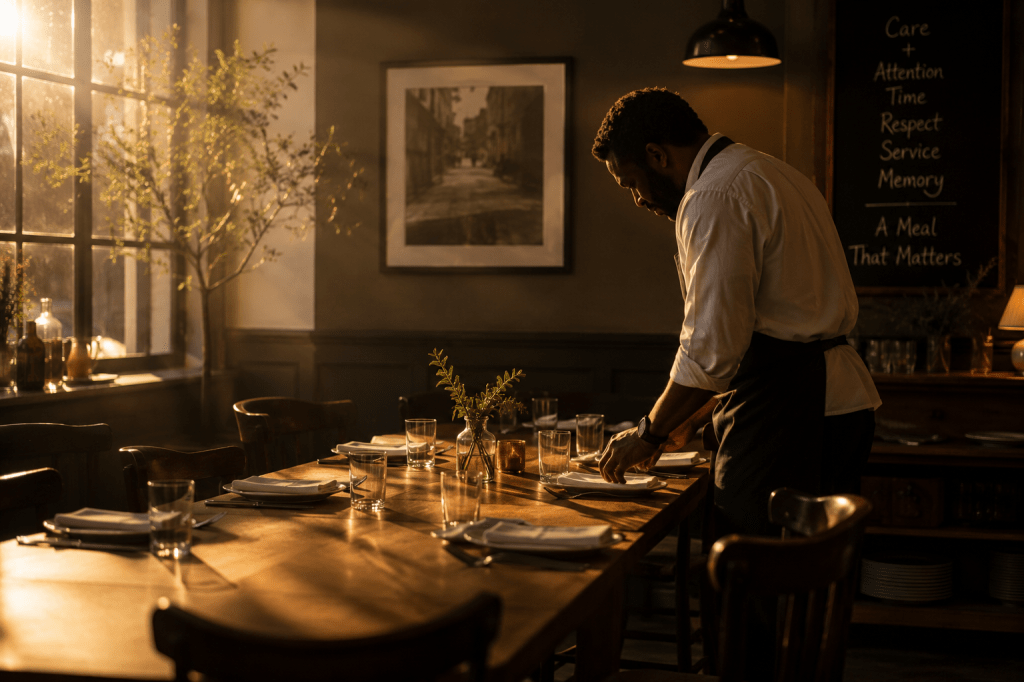
He polishes forks.
He observes.
He learns the names of dishes.
He watches how a dining room moves.
And slowly, he begins to understand that service is not submission. It is not weakness. It is not pretending that the customer is always right.
Service is attention.
It is knowing that someone has saved money for months to sit at a table. That a meal may be celebrating a birthday, a promotion, a marriage, a farewell. That what feels like another shift to the staff may become a memory someone carries for the rest of their life.
Richie begins to understand that his work affects people.
Not someday.
Now.
A glass placed carefully. A question answered with patience. A surprise offered because someone was paying attention. Small actions, perhaps. But lives are often shaped by small actions.
By the end of his training, Richie has not become a different person.
He has become more fully himself.
That distinction matters.
Growth is not always about becoming unrecognizable. Sometimes it is about clearing away the fear, resentment, and confusion that kept us from seeing our own usefulness. Richie discovers that he has a gift for people. For reading a room. For making someone feel welcomed. For understanding the emotional rhythm of a place.
He finds his place.
And once he finds it, something changes in him.
He no longer wants merely to be included.
He wants to improve.
That may be one of the most important transitions a person can make.
There is a difference between wanting recognition and wanting mastery. Recognition asks, Do you see me? Mastery asks, How can I become worthy of the responsibility I have been given?
I think about that when I write.
Every day I sit with words.
Some days they come easily. Other days they arrive slowly, dragging doubt behind them. There are sentences I admire in the moment and question the next morning. Some pieces feel finished until I read them again and see all the places where I stopped too soon.
But every time I write, I want the next thing to be better.
Not only for me.
For the person who takes the time to read it.
That reader may never know how long I sat with a paragraph. They may never see the sentences I removed or the endings I softened. They may never know how many times I wondered whether the piece was honest enough, clear enough, useful enough.
They should not have to know.
The effort is part of the service.
When someone gives you their attention, they are giving you something they cannot recover. Time. A few quiet minutes from a life already full of demands. They could have gone elsewhere. They could have closed the page.
But they stayed.
That matters to me.
So I want the words to meet them with care.
I want each essay to say, in its own way, I knew you were coming, so I prepared something.
That does not mean every piece will be perfect.
Perfection is often another form of fear. It can keep us polishing forever, afraid to place anything on the table. The better goal is honesty joined with discipline. To bring what we have learned. To respect the reader. To leave the work a little stronger than we found it.
That is what Marcus learns.
That is what Tina learns.
That is what Richie finally learns.
Skill is not only talent.
It is responsibility.
It is the willingness to be taught.
There is tenderness in that.
We often treat self-improvement as punishment. We speak to ourselves harshly, as if shame were the only tool capable of shaping a better life.
But shame rarely builds anything that can stand.
Growth needs honesty, yes.
It also needs patience.
A person must be able to look at who they have been without believing they are condemned to remain there. They must be able to say, I was wrong. I was careless. I did not understand.
And then, perhaps more importantly:
I can learn.
Season 2 of The Bear understands this.
It shows us that we are not finished.
That the person we have been is not the final draft.
That finding our place does not mean the work is over.
It means we finally know where to begin.
Please like, comment, and share
Resources for Hard Times
If you’re looking for practical help, food support, or community resources, you can visit the Salt, Ink & Soul Resources Page.


Leave a Reply