
Subscribe to continue reading
Subscribe to get access to the rest of this post and other subscriber-only content.

Subscribe to get access to the rest of this post and other subscriber-only content.
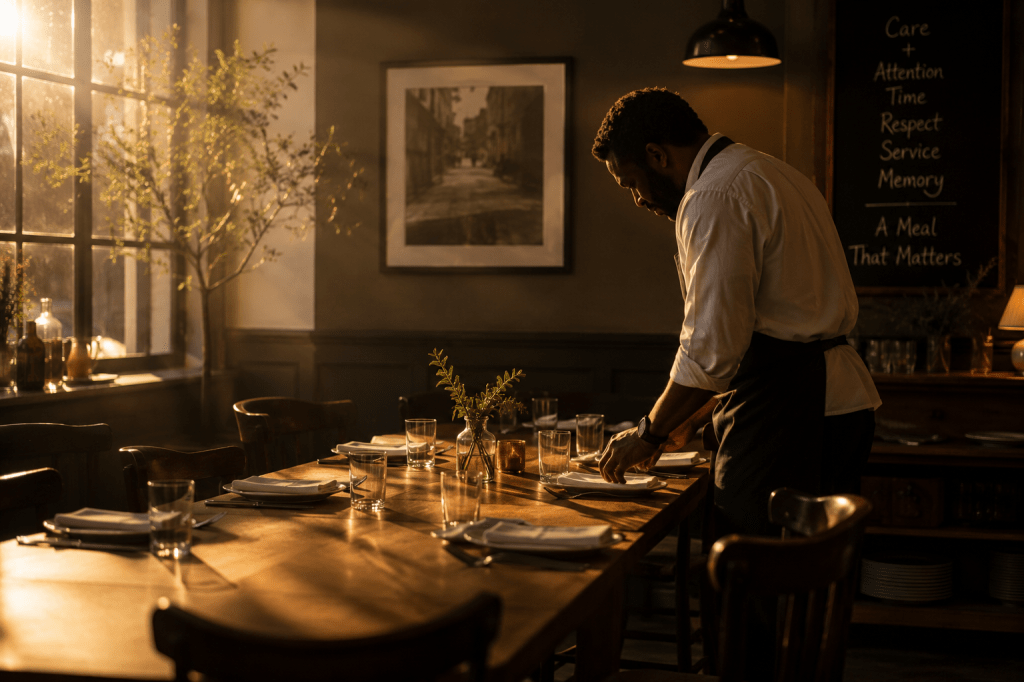
Sometimes a television show stops entertaining you and quietly begins asking questions about your own life.
Season 2 of The Bear did that for me.
The Second season of The Bear is filled with food.
Beautiful food. Precise food. Food arranged with tweezers and intention. Food that carries the weight of memory, ambition, grief, and expectation.
But the best thing the season serves is not a plate.
It is change.
Not the kind of change people announce loudly. The change in The Bear is quieter than that. It comes through repetition. Through discomfort. Through people being sent away from what they know so they can return with a clearer understanding of who they might become.
Marcus leaves the familiar kitchen and enters another world. He studies pastry with patience and humility. He learns that excellence is not magic. It is attention. It is noticing texture, temperature, timing. It is doing the same thing again, not because the first attempt was worthless, but because care asks us to try once more.
Tina goes to culinary school.
That may not sound revolutionary to some people. But there are moments in life when being offered the chance to learn becomes a form of recognition. Someone looks at you and says, perhaps without saying it directly, There is more in you.
And then there is Richie.
Richie may be the clearest example of what the season is trying to tell us.
He begins as a man who feels the world moving without him. He is loud because he is uncertain. Defensive because he is afraid. He mistakes familiarity for usefulness and anger for authority. He has spent so much time believing he does not belong anywhere that he has begun to behave as if belonging itself is a lie.
Then he is sent to another restaurant.
At first, he believes he is being punished.
That is often how growth feels when it begins.
We think we have been removed because we are unwanted. We do not always understand that distance can sometimes reveal what closeness has hidden. Away from the noise of his own kitchen, Richie begins to see the work differently.
He polishes forks.
He observes.
He learns the names of dishes.
He watches how a dining room moves.
And slowly, he begins to understand that service is not submission. It is not weakness. It is not pretending that the customer is always right.
Service is attention.
It is knowing that someone has saved money for months to sit at a table. That a meal may be celebrating a birthday, a promotion, a marriage, a farewell. That what feels like another shift to the staff may become a memory someone carries for the rest of their life.
Richie begins to understand that his work affects people.
Not someday.
Now.
A glass placed carefully. A question answered with patience. A surprise offered because someone was paying attention. Small actions, perhaps. But lives are often shaped by small actions.
By the end of his training, Richie has not become a different person.
He has become more fully himself.
That distinction matters.
Growth is not always about becoming unrecognizable. Sometimes it is about clearing away the fear, resentment, and confusion that kept us from seeing our own usefulness. Richie discovers that he has a gift for people. For reading a room. For making someone feel welcomed. For understanding the emotional rhythm of a place.
He finds his place.
And once he finds it, something changes in him.
He no longer wants merely to be included.
He wants to improve.
That may be one of the most important transitions a person can make.
There is a difference between wanting recognition and wanting mastery. Recognition asks, Do you see me? Mastery asks, How can I become worthy of the responsibility I have been given?
I think about that when I write.
Every day I sit with words.
Some days they come easily. Other days they arrive slowly, dragging doubt behind them. There are sentences I admire in the moment and question the next morning. Some pieces feel finished until I read them again and see all the places where I stopped too soon.
But every time I write, I want the next thing to be better.
Not only for me.
For the person who takes the time to read it.
That reader may never know how long I sat with a paragraph. They may never see the sentences I removed or the endings I softened. They may never know how many times I wondered whether the piece was honest enough, clear enough, useful enough.
They should not have to know.
The effort is part of the service.
When someone gives you their attention, they are giving you something they cannot recover. Time. A few quiet minutes from a life already full of demands. They could have gone elsewhere. They could have closed the page.
But they stayed.
That matters to me.
So I want the words to meet them with care.
I want each essay to say, in its own way, I knew you were coming, so I prepared something.
That does not mean every piece will be perfect.
Perfection is often another form of fear. It can keep us polishing forever, afraid to place anything on the table. The better goal is honesty joined with discipline. To bring what we have learned. To respect the reader. To leave the work a little stronger than we found it.
That is what Marcus learns.
That is what Tina learns.
That is what Richie finally learns.
Skill is not only talent.
It is responsibility.
It is the willingness to be taught.
There is tenderness in that.
We often treat self-improvement as punishment. We speak to ourselves harshly, as if shame were the only tool capable of shaping a better life.
But shame rarely builds anything that can stand.
Growth needs honesty, yes.
It also needs patience.
A person must be able to look at who they have been without believing they are condemned to remain there. They must be able to say, I was wrong. I was careless. I did not understand.
And then, perhaps more importantly:
I can learn.
Season 2 of The Bear understands this.
It shows us that we are not finished.
That the person we have been is not the final draft.
That finding our place does not mean the work is over.
It means we finally know where to begin.
Please like, comment, and share
If you’re looking for practical help, food support, or community resources, you can visit the Salt, Ink & Soul Resources Page.
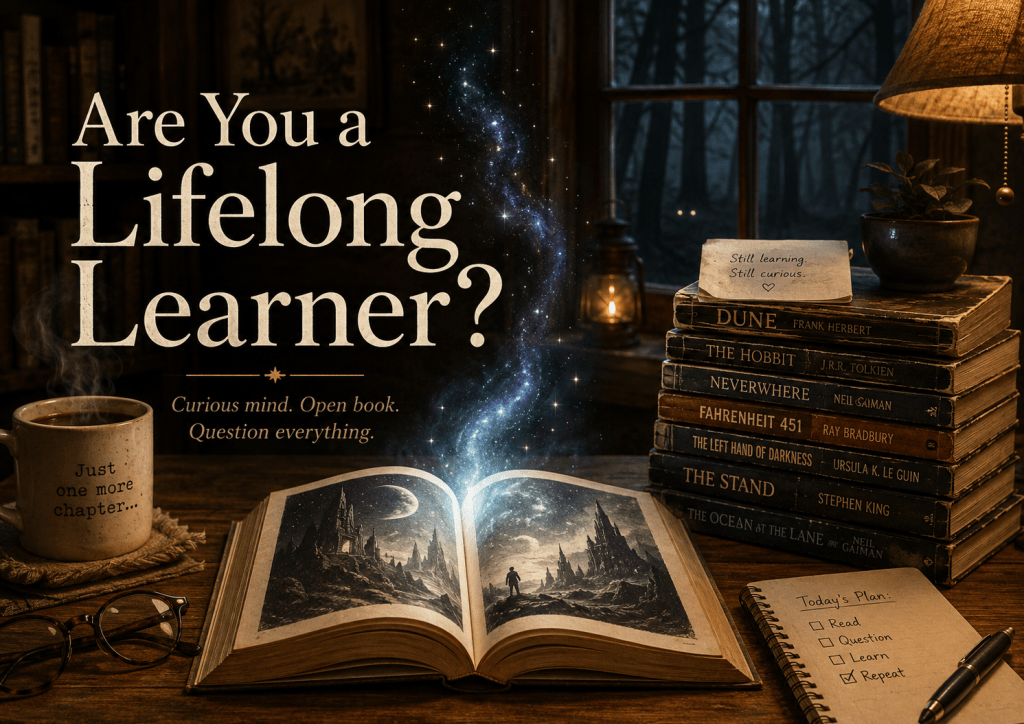
The answer is yes.
An easy yes.
I have been learning my entire life, although I am not entirely sure what the question means by “learning.”
Does it mean school?
Books?
Experience?
Mistakes?
Because if mistakes count, I may be one of the most educated people alive.
As a boy, I loved books.
I was always reading something. Anything I could get my hands on.
Most of it was science fiction and fantasy, which meant I knew a great deal about dragons, distant planets, magical weapons, alien civilizations, and saving the universe.
This knowledge has been surprisingly useless during tax season.
Still, I was learning.
Books taught me that there were worlds beyond the one I could see. They introduced me to strange places, impossible creatures, difficult choices, and people who were usually expected to save everyone despite having almost no adult supervision.
At the time, I did not think of reading as education.
I thought I was escaping.
But sometimes escaping into a book is how we return to the world with a better understanding of it.
Stories taught me about courage.
Friendship.
Power.
Fear.
Sacrifice.
They also taught me that accepting mysterious jewelry from strangers is usually a bad idea.
Then came my teenage years, when much of my education moved from books to horror movies.
I watched far too many of them.
Still, they taught me several practical lessons.
If you are camping and someone suddenly goes missing, leave.
If you hear strange noises in the woods, leave faster.
Do not investigate.
Do not split up.
Do not say, “I’ll be right back.”
And under no circumstances should you stop in the nearby town to explain what happened.
The townspeople already know.
They have always known.
They will stare at you silently from the diner while someone behind the counter slowly wipes the same glass.
Just get in your car and go.
If the car will not start, then unfortunately, the movie has already decided your future.
The most important thing I learned, however, was that the more you know, the more you realize how much you do not know.
This was unfortunate news for me.
I had a rather inflated opinion of myself when I was younger.
I was confident.
Very confident.
The kind of confident that can only exist when a person has not yet encountered enough information to become confused.
I thought I knew almost everything.
Not because I had learned everything, of course.
I simply had not yet discovered how much everything included.
Then I kept reading.
I kept watching.
I kept listening.
I kept living.
And slowly, the world became larger.
Every answer introduced another question.
Every subject revealed ten more subjects I had never considered.
Every person knew something I did not.
This was humbling.
Annoying, but humbling.
I look back at that cocky boy now and laugh.
Not because he was foolish.
At least not entirely.
He was simply standing at the edge of a very large ocean, holding a cup of water, convinced he had discovered the sea.
There is something beautiful about that kind of confidence.
There is also something dangerous about it.
The older I become, the more I understand that learning is not about reaching a place where no one can correct you.
It is about listening to people whose experiences are different from your own.
It is changing your mind when new information gives you a good reason to do so.
That last one can be difficult.
People become attached to their opinions.
Sometimes we carry an opinion for so long that it begins to feel like a family member.
Not necessarily a family member we like.
But one we feel obligated to defend at gatherings.
Lifelong learning requires us to let some of those old opinions go.
It requires curiosity.
Humility.
And the willingness to accept that the younger version of ourselves occasionally had no idea what he was talking about.
I still love books.
I still love discovering something new.
I still enjoy the feeling of reading a sentence that makes me stop and reconsider something I thought I understood.
But I no longer think learning is a journey toward knowing everything.
That sounds exhausting.
Learning is simply remaining teachable.
It is keeping the windows open.
It is allowing new ideas to enter, while occasionally asking the old ones to gather their things and leave.
The older I get, the less interested I am in being the smartest person in the room.
Mostly because the smartest person in the room usually knows enough not to announce it.
I would rather stay curious.
I would rather keep reading.
I would rather keep learning.
And somewhere inside me, that boy is still holding a science-fiction book, ready to travel to another world.
The teenager is probably still watching a horror movie and yelling at the screen, “Do not go into the woods.”
They are both still confident.
Still curious.
Still slightly convinced they can save the universe.
The difference is that now they understand two important things:
Read the instructions first.
And if the woods start making strange noises, leave.
Please like, comment, and share
If you’re looking for practical help, food support, or community resources, you can visit the Salt, Ink & Soul Resources Page.

I would tell him to come home to himself sooner.
Not home as a place.
Home as a knowing.
Home is that quiet room inside you where your own voice still lives before the world teaches you to mistrust it.
I would tell my 20-year-old self to stop spending so much of his life auditioning for people who were never going to choose him, honestly. Stop bending yourself into shapes that do not fit your spirit. Stop mistaking acceptance for love. Stop confusing attention with belonging.
Because there is a difference.
And learning that difference can cost you years.
At twenty, you think being liked will save you.
You think if you become easier, funnier, quieter, louder, more agreeable, more useful, more available, more whatever the room seems to require, then maybe people will keep you around. Maybe they will see you. Maybe they will decide you are worth knowing.
But some people do not dislike you for failing to become enough.
Some people were never interested in getting to know you at all.
They were interested in what you could provide.
Your time.
Your loyalty.
Your attention.
Your silence.
Your willingness to shrink yourself so they would not have to make room.
That is a hard lesson.
But it is a freeing one.
I would tell him this: do not waste your best years trying to become acceptable to people who benefit from you not knowing your worth.
Spend that time discovering who you are.
Not who you perform.
Not who you pretend to be when you are afraid of being left out.
Not who you become when loneliness starts negotiating against your dignity.
Who you are.
What you love.
What you believe.
What brings you peace?
What kind of man do you want to become when no one is clapping?
What kind of life feels honest when nobody is watching?
I would tell him that solitude is not always punishment. Sometimes it is protection. Sometimes being alone is the first place where you can finally hear yourself without all the borrowed voices talking over you.
There is grief in realizing how much time you gave away.
Time you could have used to grow.
To read.
To think.
To build.
To heal.
To understand your own mind.
To become comfortable in your own skin.
To stop asking strangers, friends, lovers, and crowds for permission to exist.
But I would not speak to him cruelly.
He was doing the best he could with what he knew.
He wanted a connection.
He wanted to matter.
He wanted to be loved in a world that often teaches people to earn what should have been given freely.
So I would not shame him for trying.
I recommend telling him to try differently.
Try choosing yourself.
Try telling the truth sooner.
Try leaving when the room keeps requiring your disappearance.
Try noticing who only loves you when you are convenient.
Try paying attention to the people who make you feel peaceful rather than desperate.
Try building a life that does not depend on approval from people who have not even learned to approve of themselves.
Because one day, you will understand something that a twenty-year-old could not yet know.
The goal was never to become the kind of person everyone liked.
The goal was to become someone you could live with.
Someone you could respect.
Someone whose reflection did not look like a stranger assembled from other people’s expectations.
I would tell him that self-discovery is not selfish.
It is necessary.
You cannot build a true life out of borrowed pieces. You cannot keep abandoning yourself and call it love. You cannot keep giving your time to people who leave you with less of yourself and expect peace to grow there.
So I would tell my 20-year-old self:
Come back to you.
Earlier.
Stay with you.
Longer.
Learn yourself before trying to be chosen.
Because the people meant for your life should not require you to disappear before they can accept you.
And the time you spend becoming yourself is never wasted.
Please like, comment, and share
If you’re looking for practical help, food support, or community resources, you can visit the Salt, Ink & Soul Resources Page.
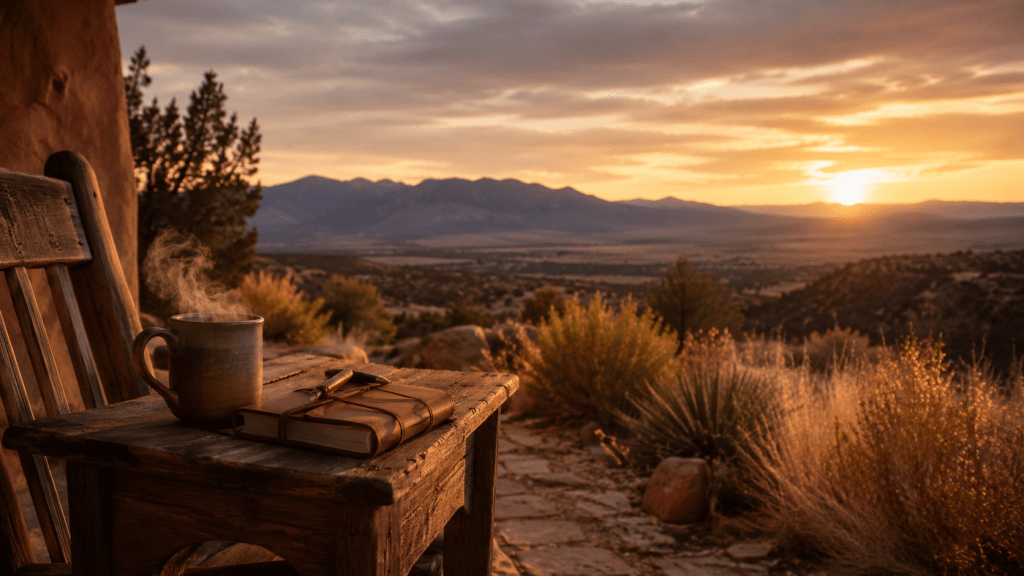
People still look at me strangely when I tell them I chose New Mexico.
Not passed through.
I didn’t end up here by accident.
Not got stranded by work, family, disaster, or one of those wrong turns life has a way of dressing up as destiny.
I chose it.
And I understand why that sounds strange to some people. New Mexico is not always the place people are taught to imagine when they are dreaming out loud. It does not shout for your attention the way other places do. It does not beg to be admired. It sits there beneath that impossible sky, all red earth and distance, all wind and silence, all mountains watching like old witnesses, and waits to see if you are the kind of person who can be still long enough to understand it.
I may not have understood it when I came here.
I only know that I came.
And the longer I stay, the more I wonder whether choosing is sometimes only the name we give to being led.
I know how that sounds.
I know how strange it can feel to speak of God in a world that has learned to explain everything, leaving nothing sacred. We want clean answers. We want maps, logic, strategy, relocation plans, job prospects, rental prices, and practical reasons that fit neatly in the mouth.
But some things do not fit.
Some things happen below language.
Some places do not just receive you.
They work on you.
New Mexico has worked on me.
I know there is another life I might have lived. A smaller one. Not evil. Not worthless. Just narrow enough to make me forget the sound of my own becoming. Maybe that is why I look at New Mexico with such wonder. It did not simply give me a place to live. It gave me distance from the life that might have closed around me.
Not loudly. Not all at once. Not with some grand cinematic gesture where the sky opens, and the old self falls away. It has been quieter than that. More patient. More humiliating, in the way healing can be humiliating when it shows you how long you mistook your wounds for your personality.
The anger I carried for most of my life did not disappear overnight. Anger rarely does. It had roots. It had memory. It had reasons. Some of them were honest. Some of them were old defenses that had outlived their usefulness. Anger had been my armor, my witness, my proof that what happened mattered. Resentment had been a bitter little fire I kept alive because I feared that if I let it go, the world would get away with what it had done.
But something about this place began to make the fire unnecessary.
Maybe it was the sky.
That sounds too simple, but the sky here is not simple. It is a thing with depth. It can make a man feel both small and held. It stretches over you like a question you cannot answer quickly. Morning light hits the Sandias and makes them look less like mountains than scripture written in stone. Evening comes down slow, blue and gold and purple, as if the day itself is reluctant to leave.
Some places crowd you.
New Mexico opened something.
It gave me room to hear myself without the old noise. Room to ask what I was carrying. Room to wonder if every burden deserved to be carried forever.
And in that room, my writing changed.
Or maybe I changed, and the writing followed.
Before New Mexico, I wrote from a harder place. A place of clenched teeth. A place where every sentence had to prove I had survived. There was power in that. I will not insult the old version of myself by pretending he had nothing to offer. He kept me alive. He carried me through years I still do not always know how to name. He wrote with blood because blood was what he had.
But here, something began to soften.
Not weaken.
Soften.
There is a difference.
Softening is not surrender. It is not becoming harmless. It is learning that tenderness can be a form of strength when it has survived the furnace and still chooses not to become cruel.
My writing blossomed here because I was finally allowed to become more than my pain.
That may be the deepest gratitude I have.
New Mexico did not ask me to stop telling the truth. It simply showed me that truth had more than one temperature. It could burn, yes. But it could also warm. It could feed. It could sit at a kitchen table beside green chile, coffee, bread, and silence, and still say what needed to be said.
I found people here who cared.
That sentence looks small on the page, but it isn’t to me.
I found people who did not treat art like foolishness. People who did not look at writing as some strange indulgence, some childish dream a grown man should outgrow. I found writers. Artists. Chefs. Jewelry designers. Makers of beautiful things. People who understood that creation is not always decoration. Sometimes creation is survival. Sometimes it is testimony. Sometimes it is the only way a person can turn the pieces of himself into something that may help somebody else breathe.
They let me know it was okay to write.
Okay to express.
Okay to find out who I truly was.
Okay to share it.
That kind of permission can change a life.
Not because a person should need permission to become himself, but because many of us come from places, families, histories, and wounds where the self was something we learned to hide. We learned to be useful before we learned to be honest. We learned to endure before we learned to speak. We learned to make ourselves smaller so the world would not notice how much we were carrying.
And then, somehow, I found myself here.
In a place where art is not hidden away.
It is on the walls. Around necks. In markets. In kitchens. In books. In the hands of people who shape silver, clay, chile, sentences, bread, paint, and memory. Here, beauty is not always polished. Sometimes it is rough-edged and sun-baked. Sometimes it smells like roasting chile and dust after rain. Sometimes it is turquoise against brown skin, a bowl of posole, a poem read in a room full of strangers, a balloon rising into the morning while I stand firmly on the ground, grateful to admire what I have no intention of riding.
I still look at those balloons with wonder.
A field full of color lifting into the sky like somebody decided joy needed a body.
And no, I doubt I will ever ride one.
There are still fears I have not conquered.
I can admit that now without shame.
Once, I might have seen every fear as evidence against me. As proof that I had not become enough. But I am learning that life is not conquered all at once. Some fears remain not to mock us, but to remind us that we are still human. I can stand beneath the balloons and marvel. I can watch them rise. I can honor the courage of those who climb into the basket and float into the open air.
And I can keep my feet on the earth.
That, too, is a kind of wisdom.
New Mexico has taught me that becoming does not always look dramatic. Sometimes becoming is waking up and realizing you are less angry than you used to be. Sometimes it is noticed that the old resentment does not answer as quickly when called. Sometimes it is writing a sentence and realizing it came from peace, not injury. Sometimes it is looking around your life and seeing, with a kind of stunned humility, that what once felt impossible has quietly become real.
I have changed here.
I do not say that lightly.
My problems did not vanish because I crossed a state line. Pain is not that simple. A man brings himself wherever he goes. His ghosts pack light. They know how to travel.
But here, many of mine began to lose their grip.
Some of that was time.
Some of that was work.
Some of that was people.
And some of it, I believe, was God.
I cannot prove that in the way the world likes proof. I cannot show a receipt for grace. I cannot chart mercy on a map. I only know that I came here carrying things I thought would always be mine, and now some of them no longer fit in my hands.
That feels like God to me.
Not always thunder.
Sometimes release.
Sometimes a door opens in a place you never expected to call home.
So this is my gratitude.
For the desert that did not ask me to explain myself.
For the mountains that stood there while I became quieter.
For the artists who made expression feel possible.
For the cooks who reminded me that food is memory and care.
For the writers who made the page feel less lonely.
For the people who showed me that community does not always announce itself with noise. Sometimes it comes gently, through encouragement, through conversation, through a simple belief that what you are making matters.
For the balloons, I will admire from below.
For the sky that keeps making me look up.
For the anger that is leaving.
For the words that came back changed.
For the man I was.
For the man I am becoming.
For New Mexico.
The land I chose.
Or maybe the land that was chosen for me.
Please like, comment, and share
If you’re looking for practical help, food support, or community resources, you can visit the Salt, Ink & Soul Resources Page.
I had written before about Pawn of Prophecy being the first grown-up book I truly remember finishing.
I called it grown-up because, to the boy I was then, grown-up meant weight. It meant no pictures waiting kindly on the page to tell me where to look. It meant more than two hundred pages. It meant holding a book in my hands and realizing that the story was not going to bend down to meet me. I would have to rise toward it.
That book pulled me into fantasy.
It showed me that reading could be more than an assignment, more than an obligation, more than something adults told children was good for them in the same dry voice they used for vegetables and bedtime. It showed me that a book could be a door. That worlds were waiting behind paper. That some maps were printed in ink, and some were built in the mind.
But years later, another book did something different.
It did not pull me in gently.
It made me work.
The author was Isaac Asimov.
The book was Foundation.
I had read his work before. I had read I, Robot. I knew, at least a little, the clean machinery of his imagination. I knew he could take a question and dress it in steel, logic, and circuitry until it became something larger than a question. But Foundation was different.
Foundation did not feel like a story at first.
It felt like being dropped into a room where every adult was already deep in conversation.
Empire. Decay. Mathematics. Religion. Trade. Politics. Psychology. Civilization. Collapse.
These were not the words of childhood.
Not really.
They were the words of men in quiet rooms deciding the shape of history. Words spoken over maps. Words carried inside institutions. Words sharpened by people who understood that power does not always arrive with a raised fist. Sometimes power arrives as a theory. Sometimes as a doctrine. Sometimes as a prediction. Sometimes, as a sentence, it is so cold and precise that it seems to have no human being behind it at all.
I remember reading it and feeling the pressure.
The book gave me a headache.
Not in the way a bad book gives you a headache. Not from boredom. Not from confusion alone. It was the headache of being stretched too thin. The ache that comes when the mind is trying to grow faster than comfort allows. The ache of climbing stairs two at a time because something above you is calling, and pride will not let you turn around.
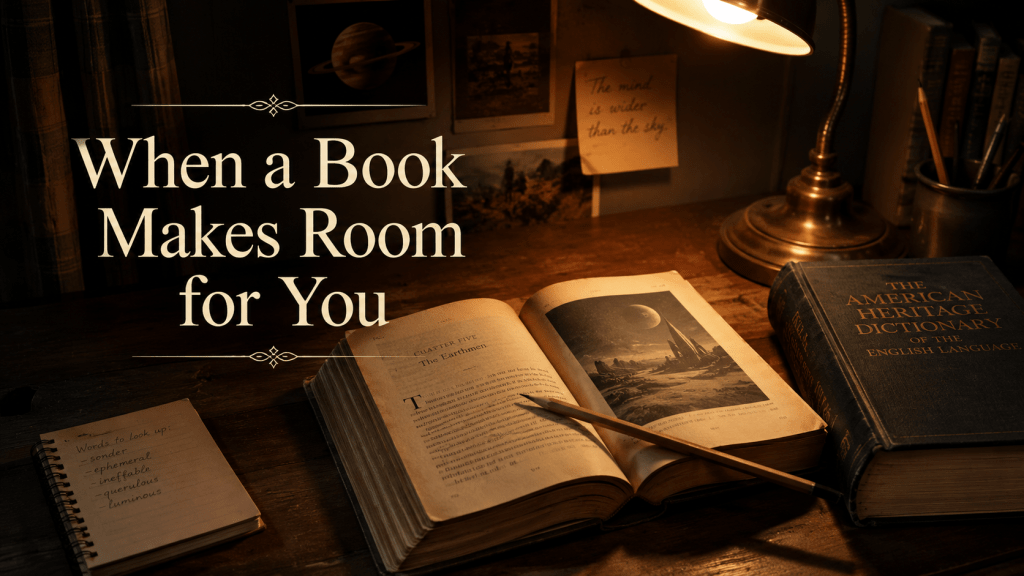
So I kept a dictionary nearby.
That detail matters to me now.
A dictionary beside a child reading science fiction is a small altar to hunger.
It says: I do not understand yet, but I want to.
It says: I will not let this word turn me away.
It says: there is something in here worth reaching for.
I would come across a word I did not know, and the sentence would stop. The whole machinery of the book would halt in front of me. I could have skipped over it. Children do that. Adults do it too. We learn to walk around what we do not understand and pretend the gap did not matter.
But I wanted to understand what I had gotten myself into.
That is the phrase that stays with me.
What had I gotten myself into?
Not just a book.
A different kind of thinking.
With fantasy, I had entered a world of quests, prophecies, chosen people, ancient evils, and hidden destinies. That world had its own difficulty, its own language, its own inheritance. But Foundation asked something else of me. It did not ask me to believe in magic. It asked me to consider history as a force. It asked me to imagine that civilizations could be studied the way storms are studied. That human beings, in great masses, might move with patterns they could not see from inside their own lives.
That is a heavy thing for a child to hold.
Because children already live inside systems they cannot name.
Family systems. School systems. Neighborhood systems. Money systems. Race systems. Silence systems. The strange laws of who gets listened to and who gets dismissed. Who is allowed to be brilliant and who is merely told to behave? Who gets called gifted? Who gets called difficult? Who is encouraged to dream, and who is warned early about the cost of dreaming too loudly.
A child may not know the vocabulary.
But he knows the feeling.
Maybe that was why Foundation troubled me so much.
The words were difficult, yes. But beneath the words was something I recognized before I could explain it. The book understood that people are not only people. They are also citizens, believers, workers, rulers, servants, merchants, cowards, visionaries, tools, threats, memories, and ghosts inside the body of history.
It understood that a person could be swallowed by a time.
And maybe some part of me already feared that.
Maybe some part of me knew that being lost was not always a matter of direction. Sometimes you are lost because the world around you has already decided where you belong, and you have not yet learned the language to argue back.
So I learned words.
Not all at once.
Slowly.
One page at a time.
I looked them up. I went back to the sentence. I read it again. Sometimes I understood. Sometimes I only understood enough to keep going. But enough is not nothing. Enough is how many of us survive the beginning of anything.
And then, something changed.
The book got easier.
Or maybe I did.
That is one of the quiet miracles of reading. You enter a book as one person and, if the book does its work and you do yours, you leave as someone slightly altered. Not healed. Not completed. But changed in some small interior way.
At first, the world of Foundation felt like a locked room.
Then the words began to open.
The unfamiliar became familiar. The machinery of empire began to hum in a language I could follow. The names no longer felt distant. The ideas no longer stood over me. I started to move inside the book instead of standing outside it, knocking.
And once I could understand the words, I began to feel something I did not expect.
I felt welcomed.
That sounds strange, maybe.
A book about the fall of a Galactic Empire is not warm in the usual sense. It is not a grandmother’s kitchen. It is not a pot on the stove with steam rising and somebody telling you to sit down before your plate gets cold. It is not soft light, clean linen, or a hand on the shoulder.
And yet I felt welcomed.
Not because the book made itself easy.
Because it allowed me in after I did the work.
There is a particular dignity in that.
Some doors open because somebody loves you enough to unlock them.
Some doors open because you learn how the lock works.
Both matter.
I think about that boy with the dictionary now, and I feel tenderness for him. I see him sitting there, probably more stubborn than confident, refusing to let the book defeat him. I see him reaching for meaning. I see him being humbled and strengthened at the same time.
He did not know then that he was doing more than reading.
He was training.
Training his patience.
Training his attention.
Training his ability to sit with difficulty without mistaking difficulty for rejection.
That is not a small lesson.
Too many people are taught that if something is hard, it must not be for them. They meet a closed door and assume the house was never meant to hold them. They meet a word they do not know and hear the old voices rise up: this is not your place, this is not your level, this is not your world.
But sometimes difficulty is not a warning.
Sometimes it is an invitation with teeth.
Sometimes the book is not saying ‘ leave.‘
Sometimes it says, “Come closer.“
Bring your dictionary.
Bring your confusion.
Bring your headache.
Bring the part of you that is tired of standing outside rooms where meaning is being made.
Come closer anyway.
I have spent much of my life trying to understand that difference. The difference between a thing that excludes you and a thing that challenges you. The difference between a gate built to keep you out and a mountain that asks whether you are willing to climb.
As a child, I did not have those words.
I only had the book.
I only had the dictionary.
I only had the ache behind my eyes and the strange hunger that kept me turning pages.
But I know now that something important happened there.
A boy who had once learned that fantasy could be fun began to learn that reading could also be demanding, serious, even disciplinary. Not punishment. Discipline. The kind that teaches you to stay. The kind that asks you to become worthy of your own curiosity.
And that, maybe, is one of the hidden gifts of difficult books.
They do not simply give us stories.
They give us evidence.
Evidence that we can grow.
Evidence that confusion is not the end.
Evidence that language, no matter how intimidating, can be approached. Studied. Broken open. Claimed.
There is power in learning a word.
There is power in refusing to be embarrassed by not knowing.
There is power in saying, quietly, even as a child: I am going to understand this.
That kind of hunger becomes part of you.
It follows you into adulthood.
It follows you into the books you later write, the essays you later shape, the memories you later return to with older hands and a more wounded heart. It follows you into all the rooms where you still sometimes feel like you do not belong. It reminds you that belonging is not always given at the beginning.
Sometimes, belonging is built.
Page by page.
Word by word.
Looked up.
Read again.
Carried forward.
I think that is why Foundation stayed with me. Not only because of its ideas, though the ideas were enormous. Not only because of its scope, though the scope was vast. It stayed with me because it made me participate in my own becoming.
It did not entertain me passively.
It required me.
And there is a strange love in being required by something worthy.
A book that is too easy may comfort you. There is nothing wrong with that. We need those books too. We need the ones that meet us when we are tired, when the world has scraped too much from us, when we need to be held instead of tested.
But some books arrive like a teacher who does not raise his voice.
They place the work in front of you.
They trust that you can do it.
They do not flatter you.
They do not simplify themselves to spare you discomfort.
They wait.
And if you stay long enough, they open.
That was Foundation for me.
A headache.
A dictionary.
A locked room.
A world.
And then, eventually, a welcome.
I did not know then how much of my life would be shaped by that pattern. How many times I would stand before something difficult and wonder whether it was beyond me. How many times I would have to decide whether to walk away or reach for the dictionary, whatever form the dictionary took.
A book.
A memory.
A conversation.
A silence.
A wound.
A history.
A self I did not yet understand.
Maybe all of us carry dictionaries of one kind or another.
Tools for translating the parts of life that first arrive unreadable.
We use them to understand grief. Love. Race. Family. Masculinity. Faith. Failure. Hunger. Loneliness. Hope. We use them to name what once only hurt. We use them to walk back into the sentence of our lives and read it again with more mercy.
That boy reading Foundation did not know he was practicing for all that.
He just wanted to understand the book.
But maybe that is how becoming often begins.
Not with a grand declaration.
Not with destiny.
Not with anyone telling you who you are.
Just a child, alone with a difficult page.
Please like, comment, and share
If you’re looking for practical help, food support, or community resources, you can visit the Salt, Ink & Soul Resources Page.

