
Subscribe to continue reading
Subscribe to get access to the rest of this post and other subscriber-only content.

Subscribe to get access to the rest of this post and other subscriber-only content.

Subscribe to get access to the rest of this post and other subscriber-only content.
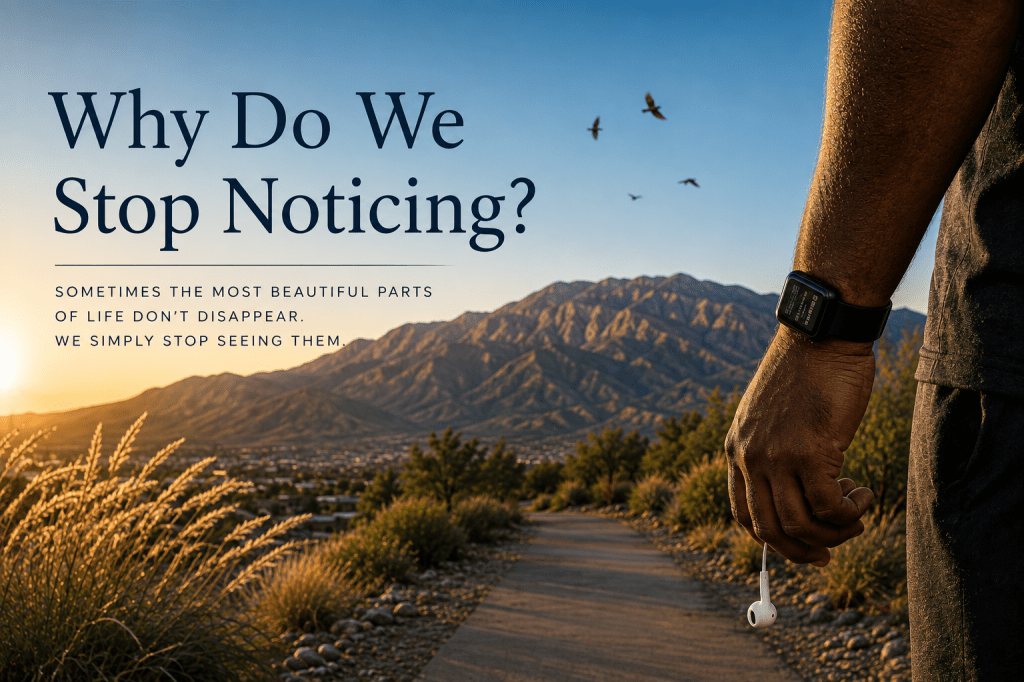
There is something I’ve been guilty of lately.
Not noticing.
If it were left up to me, I could happily spend most of my days at home. I’d write, cook, read, and if I needed my daily dose of sunshine, I’d probably just stand in the doorway for a few minutes and call it enough.
I know that’s part of who I am.
So every day I make myself go outside.
I go for a walk to get my steps in. To spend a little time in the sunshine. To breathe fresh air. It’s become part of my routine, and I genuinely enjoy it.
At least, I thought I did.
Before I leave the house, I do what I’ve done almost every day for months.
I start my Apple Watch.
I put in my earbuds.
I choose something to listen to.
Then I start walking.
There’s nothing wrong with any of those things.
But recently I realized something.
Almost all of my attention was somewhere other than where I was.
I was watching my pace.
Checking my distance.
Listening to music.
Thinking about how many steps I had left before I reached my goal.
My body had switched to autopilot.
I was aware of people around me, but mostly as objects to walk around.
I wasn’t really seeing my neighborhood.
I was simply moving through it.
One morning I caught myself looking down at my watch again.
I looked up.
The mountains were there.
They had been there every morning.
The sky was a deeper blue than I remembered.
A breeze moved through the trees.
Somewhere nearby, birds were carrying on a conversation I had apparently been missing for weeks.
None of those things had suddenly appeared.
I had.
Or maybe that’s not quite true.
My body had been showing up.
My attention hadn’t.
That made me wonder how often I was doing the same thing in the rest of my life.
How many meals had I eaten while thinking about what came next instead of tasting what was already on my plate?
How many conversations had I rushed through because my mind was already working on tomorrow?
How many mornings had I traded for another item on my to-do list?
I have spent so much of my life trying to be more efficient.
Looking for the best way to do something.
The quickest way.
The smartest way.
Anything to save a few minutes.
And to be fair, that mindset has helped me in a lot of ways.
My walks have improved my health.
My Apple Watch has encouraged me to keep moving.
The watch wasn’t the problem.
Somewhere along the way, I realized I had become more interested in finishing my walk than experiencing it.
I wasn’t only trying to reach a step goal.
I was trying to live a healthier life.
Part of living a healthier life is noticing the world you’re walking through.
The sunshine.
The mountains.
The changing seasons.
The maintenance man who always waves.
The ordinary things that quietly become the memories we miss one day.
Maybe beauty hasn’t become rare.
Maybe we’ve simply become busy.
Busy enough to walk through beautiful places without ever really seeing them.
Tomorrow I’ll probably still wear my Apple Watch.
I’ll probably still listen to music.
I’ll probably still count my steps.
But I think I’ll leave one earbud out for a little while.
Because it would be a shame to spend my whole life moving through beautiful places…
…without ever really noticing them.
Please like, comment, and share
If you’re looking for practical help, food support, or community resources, you can visit the Salt, Ink & Soul Resources Page.
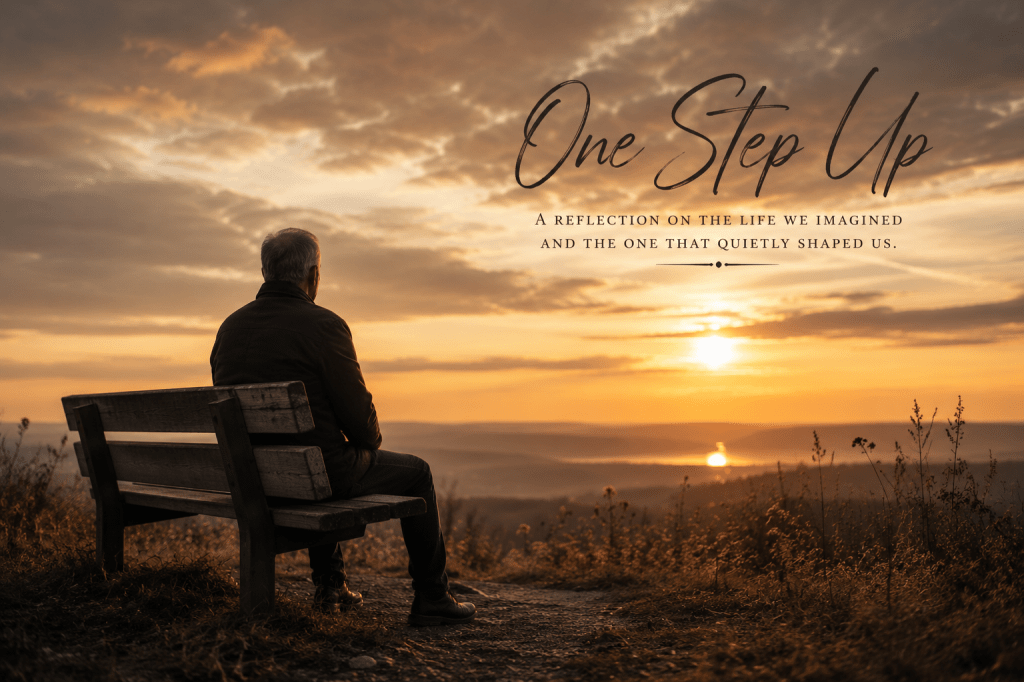
Sometimes a song stays with you because you realize it has been telling your story all along.
There are lyrics from Bruce Springsteen’s “One Step Up” that have followed me for years:
“When I look at myself I don’t see
The man I wanted to be.
Somewhere along the line I slipped off track.
I’m caught moving one Step up and two steps back.”
The first time I heard those words, I understood them.
The older I’ve become, the more they’ve come to understand me.
When I was young, I had a picture of the life I would live.
It wasn’t extravagant. I wasn’t dreaming of fame or fortune. What I wanted was much quieter than that.
I wanted to be married.
I wanted a home that always felt full. Children running through the hallway. Grandchildren years later. Birthdays that needed another chair pulled up to the table. Sunday dinners that lingered long after the plates were empty because no one was in a hurry to leave.
I thought I would grow into that man.
Life had different plans.
Some dreams end all at once.
Others fade so slowly that one day you realize you’ve been mourning them without ever knowing when they disappeared.
There isn’t always someone to blame.
Sometimes life simply unfolds differently than the version we carried inside ourselves.
For years, I measured my life against the man I expected to become. Every birthday became another quiet comparison. Another reminder of the distance between the future I imagined and the present I was living.
That can become a cruel way to measure a life.
Because the mirror only reflects what is.
It never shows what has been survived.
It doesn’t reveal the disappointments that taught you compassion. It doesn’t show the losses that made you gentler. It cannot measure the strength it took to keep moving after discovering life wasn’t interested in following your plans.
Somewhere along the way, I stopped asking where I had gone wrong.
Age has a way of changing the questions.
I no longer ask myself as often, Why didn’t my life become what I imagined?
Instead, I find myself asking something else.
What kind of man would I have been?
If I had married.
If the house had been filled with children.
If life had unfolded exactly as I had hoped.
Would I have learned empathy without loneliness?
Would I have become a writer if I had been busy living the life I thought I wanted?
Would I have paid such close attention to ordinary moments if everything had come easily?
I honestly don’t know.
We spend so much time grieving the lives we never lived that we forget those lives would have shaped us differently.
The husband I imagined.
The father I dreamed of becoming.
The grandfather sitting quietly at the end of a crowded table.
He would have been another version of me.
But not necessarily a better one.
Maybe he would have been happier.
Maybe he would have been wiser.
Or maybe he would have missed the lessons this life insisted on teaching.
Because while I didn’t become the man I expected, I became someone else.
Someone who learned that kindness often grows where certainty once lived.
Someone who discovered that stories matter because they remind us we aren’t walking alone.
Someone who writes in the hope that another person, somewhere, might recognize themselves and feel just a little less alone.
Maybe that writer could only have been born from this life.
Not the one I planned.
But the one I was given.
Please like, comment, and share
If you’re looking for practical help, food support, or community resources, you can visit the Salt, Ink & Soul Resources Page.
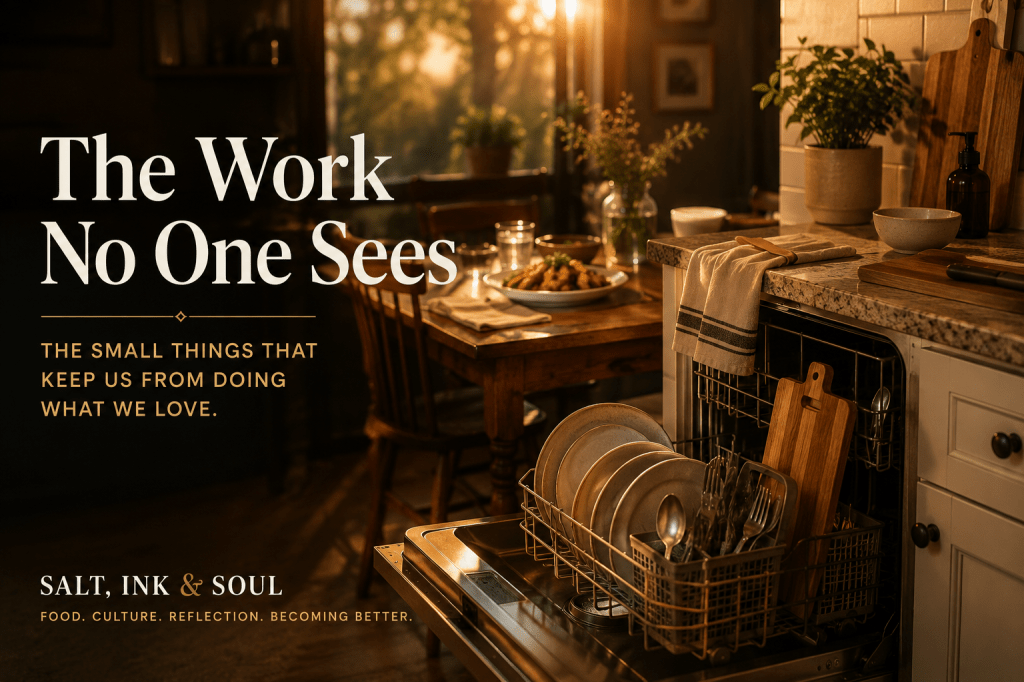
I write a lot about learning the metric system.
It probably seems like an odd thing to get excited about, but switching from cups and teaspoons to weighing ingredients changed the way I cook. Recipes became more consistent. Bread rose the way it was supposed to. Sauces tasted the way I imagined they would. The more I cooked, the more I realized that precision wasn’t taking the joy out of cooking.
It was giving me confidence.
I started cooking because I love food.
Good food.
Not expensive food.
Just food made with care.
For a long time, I thought learning to cook would be the hardest part.
I was wrong.
Believe it or not, what almost kept me from cooking wasn’t the recipes.
It was the dishes.
The pots and pans.
The cutting boards.
The greasy stove.
The food splattered across the counter.
The crumbs on the floor.
All the little reminders that every good meal leaves something behind.
I can’t tell you how many times I’ve made a meal that turned out exactly the way I hoped. I’d taste as I cooked, adjusting a little salt here, another pinch of pepper there, until everything felt right.
Then I’d sit down and realize something.
I wasn’t hungry anymore.
I’d spent so much time smelling the food and tasting the food that by the time dinner was finished, I was exhausted.
The kitchen looked like a disaster.
And now I had another job waiting for me.
That’s when I realized something.
Cooking isn’t just about cooking.
It’s about planning.
These days I rarely cook for just one meal.
If I’m already chopping vegetables, washing dishes, heating the oven, and dirtying a sink full of bowls, I might as well make enough for a few days. I try to keep a few meal-prepped meals in the refrigerator or freezer for the evenings when I don’t feel like cooking at all.
That one change made cooking easier.
But another lesson changed everything.
I learned something embarrassingly simple.
The dishwasher has to be empty before I start cooking.
Otherwise, everything backs up.
Dirty dishes stay in the sink because there’s nowhere for them to go.
Bowls pile up.
Utensils pile up.
Before long, one small task I skipped yesterday becomes today’s biggest obstacle.
It was such a simple lesson.
But I don’t think it’s only about dishwashers.
How often do we avoid doing something we love because of one small part we don’t enjoy?
Maybe it isn’t cooking.
Maybe it’s writing.
The writing isn’t the hard part.
Editing is.
Maybe it’s exercising.
The workout isn’t the hard part.
Putting on your shoes is.
Sometimes the thing standing between us and the life we want isn’t the dream.
It’s the cleanup.
And then there’s another lesson every cook eventually learns.
The food doesn’t always turn out the way you imagined.
Sometimes you follow the recipe exactly, and something still feels off.
Sometimes you try a new ingredient, and it simply doesn’t work.
Sometimes dinner is just… okay.
And that’s okay.
Not every meal has to become your signature dish.
Not every attempt has to be perfect.
Every meal teaches you something.
Every mistake teaches you something.
The next one is usually a little better.
I think writing works the same way.
Most people only see the finished essay.
They don’t see the sentences that were deleted.
The paragraphs rewritten five times.
The moments you stare at the screen wondering why the words won’t come.
They don’t see the work before the work.
The same is true of cooking.
People see the meal.
They don’t see the planning.
They don’t see the grocery list.
They don’t see the dishes.
They don’t see the quiet work that made any of it possible.
I’ve come to believe that’s true of almost everything worthwhile.
The parts people applaud are usually the parts everyone can see.
The parts that change us are usually the ones no one ever notices.
Maybe that’s why we should give ourselves a little more grace.
The work no one sees is still work.
Sometimes it’s the dishes.
Sometimes it’s the planning.
Sometimes it’s simply emptying yesterday’s dishwasher so today’s work has somewhere to begin.
And more often than not…
It’s the work that matters most.
Please like, comment, and share
If you’re looking for practical help, food support, or community resources, you can visit the Salt, Ink & Soul Resources Page.
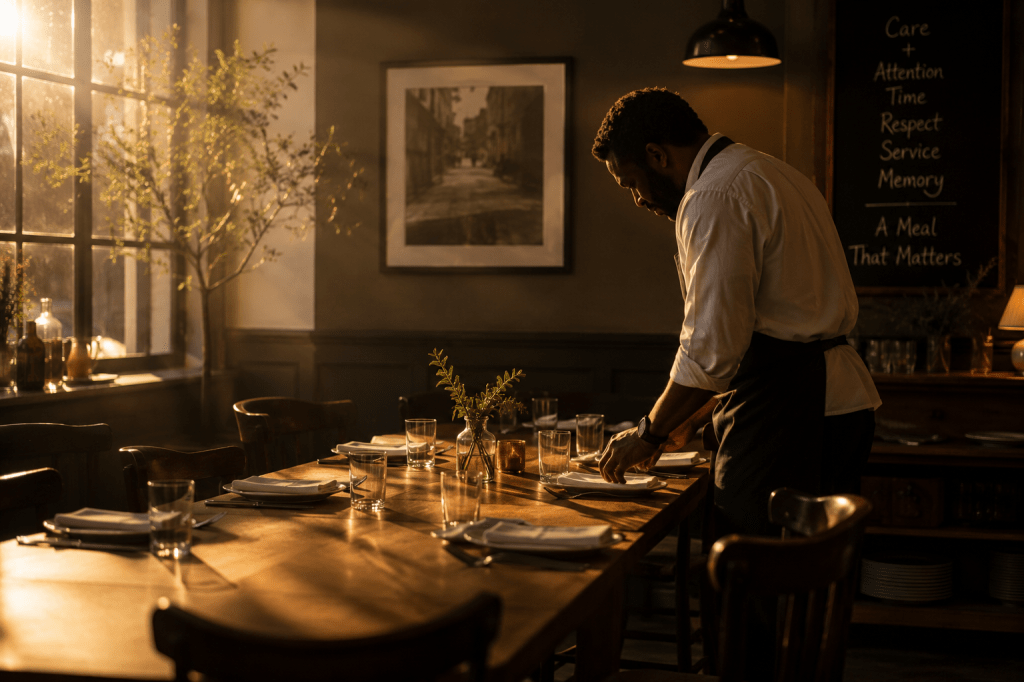
Sometimes a television show stops entertaining you and quietly begins asking questions about your own life.
Season 2 of The Bear did that for me.
The Second season of The Bear is filled with food.
Beautiful food. Precise food. Food arranged with tweezers and intention. Food that carries the weight of memory, ambition, grief, and expectation.
But the best thing the season serves is not a plate.
It is change.
Not the kind of change people announce loudly. The change in The Bear is quieter than that. It comes through repetition. Through discomfort. Through people being sent away from what they know so they can return with a clearer understanding of who they might become.
Marcus leaves the familiar kitchen and enters another world. He studies pastry with patience and humility. He learns that excellence is not magic. It is attention. It is noticing texture, temperature, timing. It is doing the same thing again, not because the first attempt was worthless, but because care asks us to try once more.
Tina goes to culinary school.
That may not sound revolutionary to some people. But there are moments in life when being offered the chance to learn becomes a form of recognition. Someone looks at you and says, perhaps without saying it directly, There is more in you.
And then there is Richie.
Richie may be the clearest example of what the season is trying to tell us.
He begins as a man who feels the world moving without him. He is loud because he is uncertain. Defensive because he is afraid. He mistakes familiarity for usefulness and anger for authority. He has spent so much time believing he does not belong anywhere that he has begun to behave as if belonging itself is a lie.
Then he is sent to another restaurant.
At first, he believes he is being punished.
That is often how growth feels when it begins.
We think we have been removed because we are unwanted. We do not always understand that distance can sometimes reveal what closeness has hidden. Away from the noise of his own kitchen, Richie begins to see the work differently.
He polishes forks.
He observes.
He learns the names of dishes.
He watches how a dining room moves.
And slowly, he begins to understand that service is not submission. It is not weakness. It is not pretending that the customer is always right.
Service is attention.
It is knowing that someone has saved money for months to sit at a table. That a meal may be celebrating a birthday, a promotion, a marriage, a farewell. That what feels like another shift to the staff may become a memory someone carries for the rest of their life.
Richie begins to understand that his work affects people.
Not someday.
Now.
A glass placed carefully. A question answered with patience. A surprise offered because someone was paying attention. Small actions, perhaps. But lives are often shaped by small actions.
By the end of his training, Richie has not become a different person.
He has become more fully himself.
That distinction matters.
Growth is not always about becoming unrecognizable. Sometimes it is about clearing away the fear, resentment, and confusion that kept us from seeing our own usefulness. Richie discovers that he has a gift for people. For reading a room. For making someone feel welcomed. For understanding the emotional rhythm of a place.
He finds his place.
And once he finds it, something changes in him.
He no longer wants merely to be included.
He wants to improve.
That may be one of the most important transitions a person can make.
There is a difference between wanting recognition and wanting mastery. Recognition asks, Do you see me? Mastery asks, How can I become worthy of the responsibility I have been given?
I think about that when I write.
Every day I sit with words.
Some days they come easily. Other days they arrive slowly, dragging doubt behind them. There are sentences I admire in the moment and question the next morning. Some pieces feel finished until I read them again and see all the places where I stopped too soon.
But every time I write, I want the next thing to be better.
Not only for me.
For the person who takes the time to read it.
That reader may never know how long I sat with a paragraph. They may never see the sentences I removed or the endings I softened. They may never know how many times I wondered whether the piece was honest enough, clear enough, useful enough.
They should not have to know.
The effort is part of the service.
When someone gives you their attention, they are giving you something they cannot recover. Time. A few quiet minutes from a life already full of demands. They could have gone elsewhere. They could have closed the page.
But they stayed.
That matters to me.
So I want the words to meet them with care.
I want each essay to say, in its own way, I knew you were coming, so I prepared something.
That does not mean every piece will be perfect.
Perfection is often another form of fear. It can keep us polishing forever, afraid to place anything on the table. The better goal is honesty joined with discipline. To bring what we have learned. To respect the reader. To leave the work a little stronger than we found it.
That is what Marcus learns.
That is what Tina learns.
That is what Richie finally learns.
Skill is not only talent.
It is responsibility.
It is the willingness to be taught.
There is tenderness in that.
We often treat self-improvement as punishment. We speak to ourselves harshly, as if shame were the only tool capable of shaping a better life.
But shame rarely builds anything that can stand.
Growth needs honesty, yes.
It also needs patience.
A person must be able to look at who they have been without believing they are condemned to remain there. They must be able to say, I was wrong. I was careless. I did not understand.
And then, perhaps more importantly:
I can learn.
Season 2 of The Bear understands this.
It shows us that we are not finished.
That the person we have been is not the final draft.
That finding our place does not mean the work is over.
It means we finally know where to begin.
Please like, comment, and share
If you’re looking for practical help, food support, or community resources, you can visit the Salt, Ink & Soul Resources Page.
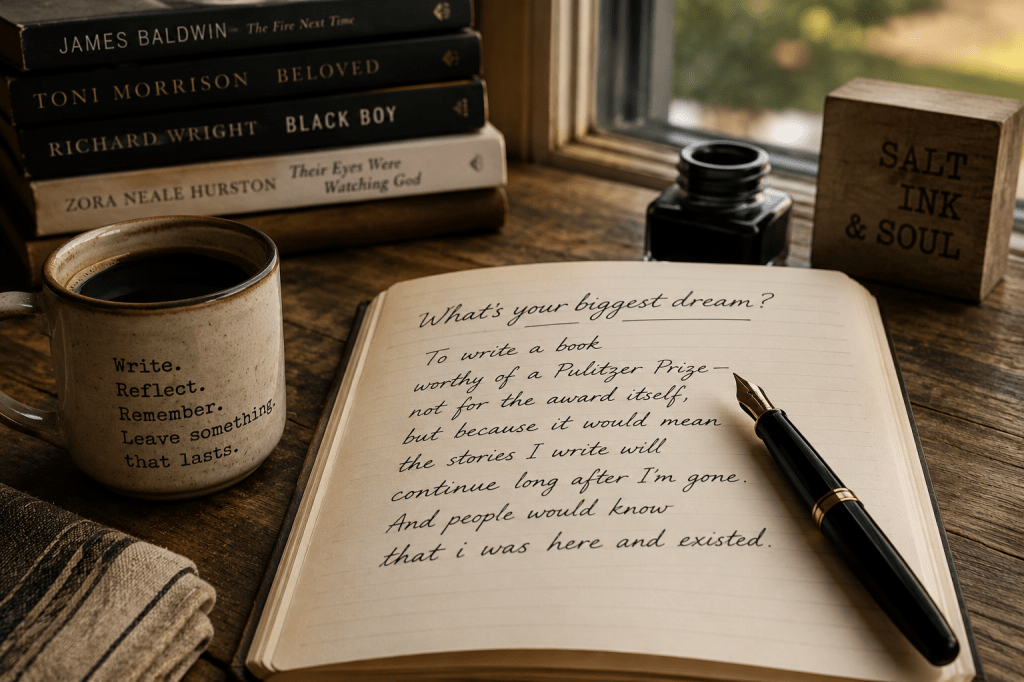
To write a book worthy of a Pulitzer Prize.
Not because I need an award. Awards gather dust. They eventually become another object on a shelf.
What I hope for is something quieter.
I hope to write something that outlives me. A book that someone opens years from now and still finds truth in. A book that reminds a stranger they are not alone, or helps someone understand a history they never knew they carried.
Most of all, I hope my words become proof that I was here.
That I lived. That I paid attention. That I loved enough to write it all down.
I hope that someday, someone I’ve never met will turn the final page, sit in the silence for a moment, and begin asking questions. Who was this man? What kind of life shaped him? Why did these stories matter so much to him? What was he trying to leave behind?
If they dig deeply enough into the words, I hope they’ll find the answers. Not because I ever wrote about myself directly, but because every honest sentence carries a little of its author within it.
Long after my voice has gone silent, I hope the stories remain. Not to make me unforgettable, but to leave behind a small piece of light for whoever comes next.
If that journey one day leads to a Pulitzer Prize, I would receive it with deep gratitude. But the prize has never been the dream.
The dream has always been to leave something behind that time cannot easily erase.
Please like, comment, and share
If you’re looking for practical help, food support, or community resources, you can visit the Salt, Ink & Soul Resources Page.
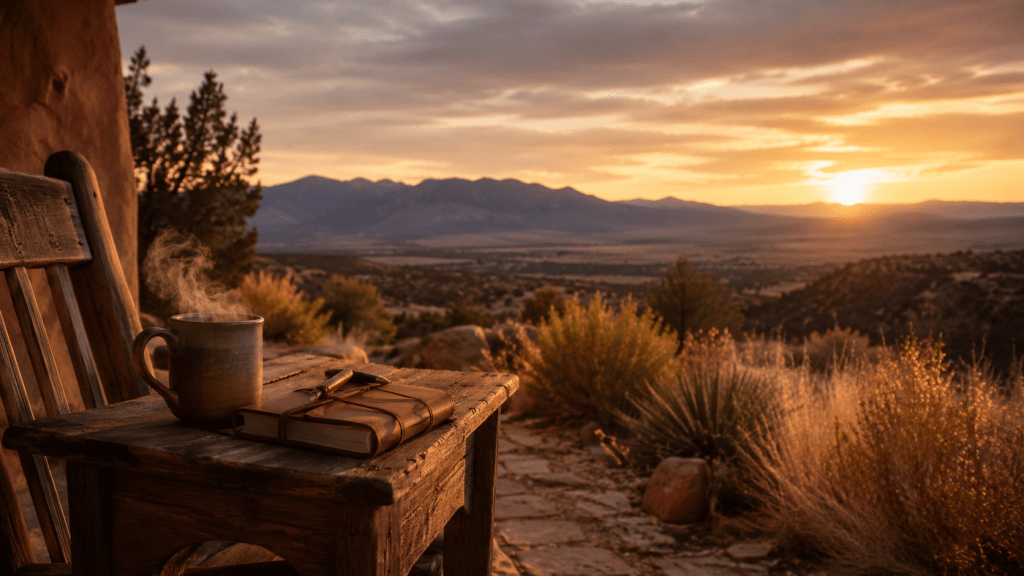
People still look at me strangely when I tell them I chose New Mexico.
Not passed through.
I didn’t end up here by accident.
Not got stranded by work, family, disaster, or one of those wrong turns life has a way of dressing up as destiny.
I chose it.
And I understand why that sounds strange to some people. New Mexico is not always the place people are taught to imagine when they are dreaming out loud. It does not shout for your attention the way other places do. It does not beg to be admired. It sits there beneath that impossible sky, all red earth and distance, all wind and silence, all mountains watching like old witnesses, and waits to see if you are the kind of person who can be still long enough to understand it.
I may not have understood it when I came here.
I only know that I came.
And the longer I stay, the more I wonder whether choosing is sometimes only the name we give to being led.
I know how that sounds.
I know how strange it can feel to speak of God in a world that has learned to explain everything, leaving nothing sacred. We want clean answers. We want maps, logic, strategy, relocation plans, job prospects, rental prices, and practical reasons that fit neatly in the mouth.
But some things do not fit.
Some things happen below language.
Some places do not just receive you.
They work on you.
New Mexico has worked on me.
I know there is another life I might have lived. A smaller one. Not evil. Not worthless. Just narrow enough to make me forget the sound of my own becoming. Maybe that is why I look at New Mexico with such wonder. It did not simply give me a place to live. It gave me distance from the life that might have closed around me.
Not loudly. Not all at once. Not with some grand cinematic gesture where the sky opens, and the old self falls away. It has been quieter than that. More patient. More humiliating, in the way healing can be humiliating when it shows you how long you mistook your wounds for your personality.
The anger I carried for most of my life did not disappear overnight. Anger rarely does. It had roots. It had memory. It had reasons. Some of them were honest. Some of them were old defenses that had outlived their usefulness. Anger had been my armor, my witness, my proof that what happened mattered. Resentment had been a bitter little fire I kept alive because I feared that if I let it go, the world would get away with what it had done.
But something about this place began to make the fire unnecessary.
Maybe it was the sky.
That sounds too simple, but the sky here is not simple. It is a thing with depth. It can make a man feel both small and held. It stretches over you like a question you cannot answer quickly. Morning light hits the Sandias and makes them look less like mountains than scripture written in stone. Evening comes down slow, blue and gold and purple, as if the day itself is reluctant to leave.
Some places crowd you.
New Mexico opened something.
It gave me room to hear myself without the old noise. Room to ask what I was carrying. Room to wonder if every burden deserved to be carried forever.
And in that room, my writing changed.
Or maybe I changed, and the writing followed.
Before New Mexico, I wrote from a harder place. A place of clenched teeth. A place where every sentence had to prove I had survived. There was power in that. I will not insult the old version of myself by pretending he had nothing to offer. He kept me alive. He carried me through years I still do not always know how to name. He wrote with blood because blood was what he had.
But here, something began to soften.
Not weaken.
Soften.
There is a difference.
Softening is not surrender. It is not becoming harmless. It is learning that tenderness can be a form of strength when it has survived the furnace and still chooses not to become cruel.
My writing blossomed here because I was finally allowed to become more than my pain.
That may be the deepest gratitude I have.
New Mexico did not ask me to stop telling the truth. It simply showed me that truth had more than one temperature. It could burn, yes. But it could also warm. It could feed. It could sit at a kitchen table beside green chile, coffee, bread, and silence, and still say what needed to be said.
I found people here who cared.
That sentence looks small on the page, but it isn’t to me.
I found people who did not treat art like foolishness. People who did not look at writing as some strange indulgence, some childish dream a grown man should outgrow. I found writers. Artists. Chefs. Jewelry designers. Makers of beautiful things. People who understood that creation is not always decoration. Sometimes creation is survival. Sometimes it is testimony. Sometimes it is the only way a person can turn the pieces of himself into something that may help somebody else breathe.
They let me know it was okay to write.
Okay to express.
Okay to find out who I truly was.
Okay to share it.
That kind of permission can change a life.
Not because a person should need permission to become himself, but because many of us come from places, families, histories, and wounds where the self was something we learned to hide. We learned to be useful before we learned to be honest. We learned to endure before we learned to speak. We learned to make ourselves smaller so the world would not notice how much we were carrying.
And then, somehow, I found myself here.
In a place where art is not hidden away.
It is on the walls. Around necks. In markets. In kitchens. In books. In the hands of people who shape silver, clay, chile, sentences, bread, paint, and memory. Here, beauty is not always polished. Sometimes it is rough-edged and sun-baked. Sometimes it smells like roasting chile and dust after rain. Sometimes it is turquoise against brown skin, a bowl of posole, a poem read in a room full of strangers, a balloon rising into the morning while I stand firmly on the ground, grateful to admire what I have no intention of riding.
I still look at those balloons with wonder.
A field full of color lifting into the sky like somebody decided joy needed a body.
And no, I doubt I will ever ride one.
There are still fears I have not conquered.
I can admit that now without shame.
Once, I might have seen every fear as evidence against me. As proof that I had not become enough. But I am learning that life is not conquered all at once. Some fears remain not to mock us, but to remind us that we are still human. I can stand beneath the balloons and marvel. I can watch them rise. I can honor the courage of those who climb into the basket and float into the open air.
And I can keep my feet on the earth.
That, too, is a kind of wisdom.
New Mexico has taught me that becoming does not always look dramatic. Sometimes becoming is waking up and realizing you are less angry than you used to be. Sometimes it is noticed that the old resentment does not answer as quickly when called. Sometimes it is writing a sentence and realizing it came from peace, not injury. Sometimes it is looking around your life and seeing, with a kind of stunned humility, that what once felt impossible has quietly become real.
I have changed here.
I do not say that lightly.
My problems did not vanish because I crossed a state line. Pain is not that simple. A man brings himself wherever he goes. His ghosts pack light. They know how to travel.
But here, many of mine began to lose their grip.
Some of that was time.
Some of that was work.
Some of that was people.
And some of it, I believe, was God.
I cannot prove that in the way the world likes proof. I cannot show a receipt for grace. I cannot chart mercy on a map. I only know that I came here carrying things I thought would always be mine, and now some of them no longer fit in my hands.
That feels like God to me.
Not always thunder.
Sometimes release.
Sometimes a door opens in a place you never expected to call home.
So this is my gratitude.
For the desert that did not ask me to explain myself.
For the mountains that stood there while I became quieter.
For the artists who made expression feel possible.
For the cooks who reminded me that food is memory and care.
For the writers who made the page feel less lonely.
For the people who showed me that community does not always announce itself with noise. Sometimes it comes gently, through encouragement, through conversation, through a simple belief that what you are making matters.
For the balloons, I will admire from below.
For the sky that keeps making me look up.
For the anger that is leaving.
For the words that came back changed.
For the man I was.
For the man I am becoming.
For New Mexico.
The land I chose.
Or maybe the land that was chosen for me.
Please like, comment, and share
If you’re looking for practical help, food support, or community resources, you can visit the Salt, Ink & Soul Resources Page.
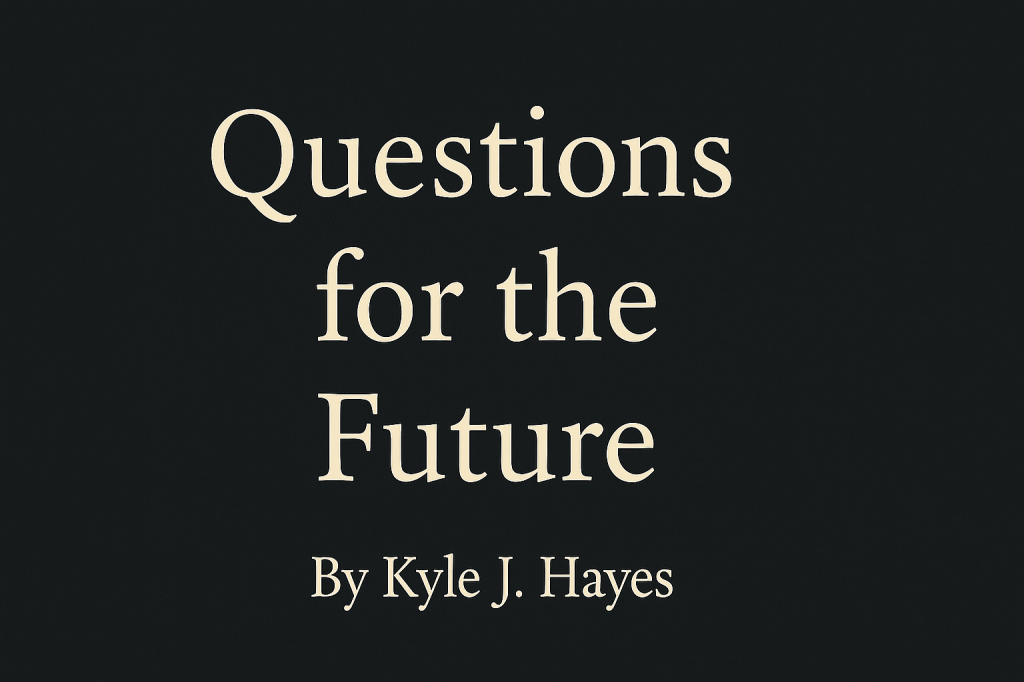
There’s a kind of fear that doesn’t arrive all at once. It doesn’t kick down the door. It seeps in, like humidity through cracked paint or smoke through the seams of a closed window. The kind that makes a home in your chest, building slowly and silently. That’s the kind of fear I’ve had about writing.
Because writing—real writing—isn’t just performance. It’s not what you show them. It’s what leaks out in the spaces you don’t control. In the metaphors you didn’t mean to use. The slip of a memory. The softness in a sentence when you swore you were being strong. That’s the terror. That somehow, on a blank page, people will see you—unasked, unfiltered, unprepared.
And I’ve been dodging that kind of exposure for a long time.
You grow up learning to hide parts of yourself. In some neighborhoods, vulnerability is just another way to get hit—emotionally, spiritually, or with something less metaphorical. So you learn. You get good at it. You make armor out of silence and humor out of pain. You laugh loud enough to drown out the parts of yourself you don’t want heard.
For me, it started early—ridiculed for being soft. For caring. For feeling things too deeply. Every time I let something slip, there was a consequence. Sometimes it was teasing. Sometimes it was loneliness. Over time, the message became clear: protect yourself.
So I did. I built walls with intention. Not just to keep people out, but to keep something in—me.
Lately, though, I’ve started letting people in. Not the whole crowd. Just a few. Just enough. You find someone you trust—maybe a friend who knows the shape of your silence—and you let them see a little more. A crack. A draft of warmth. Not a storm.
But still, I worry.
Because once the dam is broken, who controls the flood?
That’s the thing about pain: it’s obedient until it isn’t.
So I let it out in trickles. A sentence here. A sigh there. I’ve convinced myself that’s safer. That if the moment goes sideways, I can slam the valve shut and pretend like I never said anything at all.
I’m curious if that’s preservation or cowardice. Or both.
Sometimes, the isolation feels like a weighted blanket that won’t get off my chest. You carry the weight of your untold stories like overdue bills, knowing the interest is accumulating. You pretend you’re just private. But privacy, in excess, becomes starvation.
You tell yourself you’re protecting yourself—but at what cost?
When no one knows your whole name, who will mourn you properly?
That’s the mess of it. Writing—this act of storytelling—isn’t always about catharsis. Sometimes it’s confrontation. Sometimes it’s putting a mirror to your own face and realizing you’ve spent years looking away. The stories we don’t tell are often the ones we most need to understand.
I write now not because I want to be known, but because I’m starting to believe that parts of me are worth knowing.
And if someone out there reads this and recognizes their own mask, their own silence, their own slow-burning rage and resignation—maybe we’ve both done something that matters.
I don’t have answers. Just questions for the future.
What happens when you open too much?
What happens when you never open at all?
Maybe the trick isn’t to dam the flood or drown in it—maybe it’s to learn to wade.
Even if it means revealing that you bleed just like everyone else.
Kyle J. Hayes
kylehayesblog.com
Please like, comment, and share
If you’re looking for practical help, food support, or community resources, you can visit the Salt, Ink & Soul Resources Page.
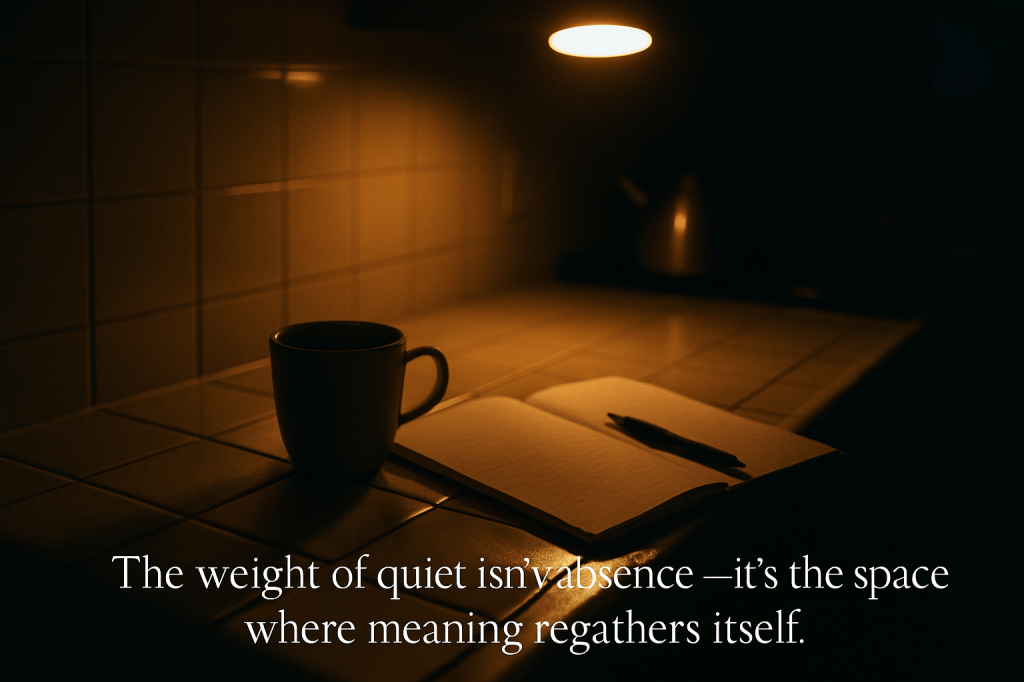
Salt, Ink & Soul — Albuquerque Notes
It’s not silence I’m afraid of.
It’s what it asks me to notice.
After the city winds down and the last porch light clicks off, a different gravity settles over Albuquerque. The air thins and sharpens. The clock doesn’t tick so much as announce—each second a footstep down an empty hall. Even the refrigerator hum sounds like a confession. Outside, the street goes soft: figures moving like ghosts, wind pushing fine dust into corners as if to whisper, look closer.
In the kitchen at night, I stand there, unsure. Wanting to make something, not knowing if I’m even hungry. Under one dim bulb, a small pool of gold forms on the counter. Tile throws the light back in fragments—little squares of moon you can touch. The sink holds its breath. Somewhere above the cabinets, the house settles into itself, wood remembering the day it was a tree. The room is stocked—spices, onions, bones for broth—but hunger doesn’t arrive on command. The emptiness isn’t in the pantry. It lives somewhere between the throat and the hands.
They say a writer’s greatest enemy is the blank page. They’re not wrong, but that’s not all. Emptiness has cousins: a cook’s dim kitchen when the body isn’t hungry; a road at midnight when the destination is gone and home hasn’t yet declared itself. The quiet asks for something you can’t measure—faith in a spark you cannot see.
What does it mean to keep creating when the world around you—and inside you—goes still? What do you do when the excitements of special events are gone?
There’s a restlessness inside the calm, like ducks on a pond—serene on the surface, paddling like hell beneath. After the community’s noise, the quiet feels heavier than the rest. It carries expectation without applause, work without witnesses. You can hold peace and pressure at once: the relief of not performing, the terror that maybe the next sentence, the next meal, won’t arrive.
So I walk the rooms, listen to the house breathe, look out at adobe walls silvered by the moon, at porch lights fluttering like low-altitude stars. In this desert city, quiet isn’t absence—it’s landscape. Wind hums in the eaves. A lone car slips past, tires whispering secrets to the asphalt. Somewhere, behind a thin wall, soft laughter breaks and fades—the way a match surrenders after doing its job.
If I cook, I begin with what listens back: onion, oil, salt, low flame. I don’t chase a masterpiece; I court a whisper. Heat slowly, until the room remembers its purpose. If I write, I let the hands move before the story arrives—detail by detail: the scrape of chair legs, the nick on the cutting board shaped like a small country, the clock insisting it is the only drummer left. I ask the night to tell me what it knows that daylight talks over.
Quiet becomes a compass if you let it. It points not north but inward. It wants fewer clever sentences and more honest ones. It returns me to the first question: Who taught you to make something from almost nothing? Who fed you when there wasn’t much to eat? What did their hands look like under this same small bulb?
I used to treat stillness like a problem to solve. I believed I should always be doing something—don’t waste time. Now I try to honor it as part of the work. The pause isn’t an intermission between lives; it’s the dark soil where the next season’s roots grow. It’s where endurance gathers; where healing grows legs.
So I keep the rituals small and faithful. I leave a clean spoon on the counter. I set a glass of water by the notebook. I promise myself ten minutes of heat—words or stove, I don’t care which—then I let the ember decide. Some nights it becomes soup for nobody but me. Some nights it becomes a paragraph that holds after morning. The work is quiet, and it is enough.
Outside, the Sandias keep their shape against deeper blue—mountain patience refusing to be hurried. Inside, the kitchen bulb halos the room like a blessing I didn’t think I’d earned. The page accepts a first line. The pan agrees with the first hiss. The world does not erupt in applause. It doesn’t need to.
The fire worth trusting now is the low one—the barely visible ring that keeps the pot honest; the internal pilot light that refuses extinction. Creation isn’t the thunder of a finale; it’s the stubborn heat that stays when the audience goes home.
The quiet isn’t asking me to fill it—only to listen long enough to remember why I speak.
Kyle J. Hayes
kylehayesblog.com
Please like, comment, and share

