
Subscribe to continue reading
Subscribe to get access to the rest of this post and other subscriber-only content.

Subscribe to get access to the rest of this post and other subscriber-only content.

Subscribe to get access to the rest of this post and other subscriber-only content.
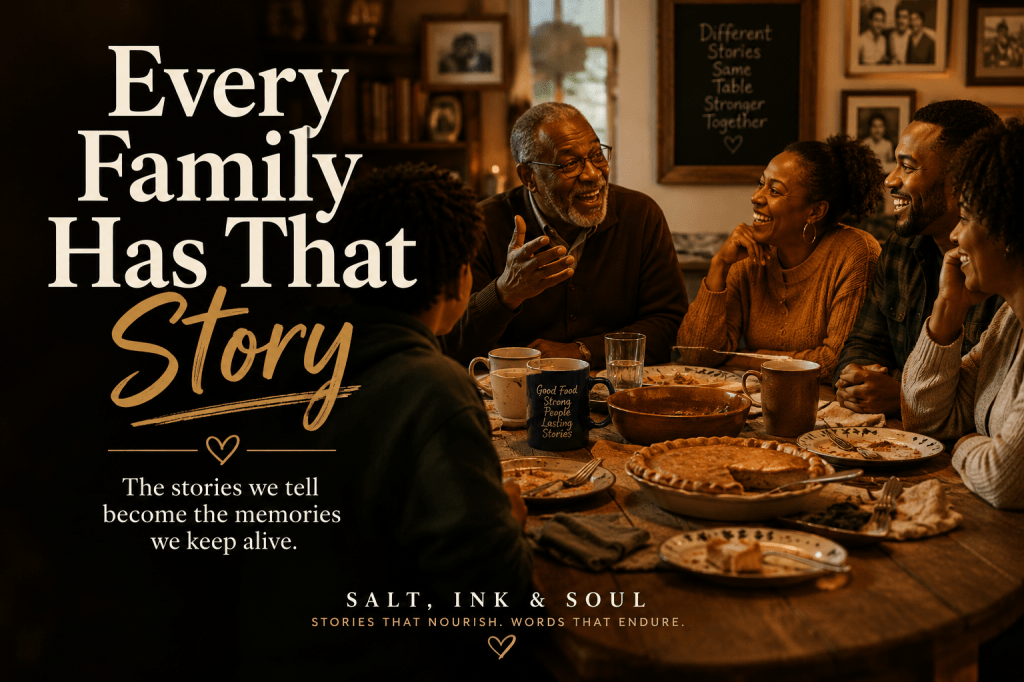
Some of the best conversations I’ve ever had didn’t begin with someone asking a question.
They began while pouring another cup of coffee.
While washing dishes after dinner.
While someone looked out the window and quietly said,
“You know what I’ve been thinking about lately…”
That’s all it takes.
Not an agenda.
Not an interview.
Not a carefully prepared topic.
Just a moment when life slows down enough for someone to open a door to a memory.
I’ve come to believe that families don’t stay together because everyone remembers every detail the same way.
They stay together because they keep telling the stories.
Every family has that story.
The one that somehow finds its way into the conversation whenever everyone is together.
The one everyone laughs about before it’s even finished.
The one each person remembers just a little differently.
For my family, there is one story that always seems to make its way back to the table.
I was too young to know all of the details.
Even today, I don’t know everything that happened.
What I do know is that it involved a corrupt landlord, my uncle getting out of his car without putting it in park, a dog, and somehow several members of my family ending up in jail.
Even writing that now makes me smile.
It sounds unbelievable.
Yet every person in my family who remembers it tells a slightly different version.
My older brother remembers one part.
My older sister remembers another.
Someone interrupts to correct a detail.
Someone else starts laughing before the funniest part has even been told.
Then another memory surfaces that no one had thought about in years.
The story changes a little every time it’s told.
Not because anyone is trying to rewrite history.
Because memory isn’t a recording.
It’s something we carry together.
Each of us holds a different piece.
When we gather around the table, those pieces somehow begin finding one another again.
Two of the people who were involved in that story—my uncle and my favorite aunt—have since passed away.
Every time someone begins telling that story, it’s as if they find their way back to the table.
For a little while, we aren’t just remembering what happened.
We’re remembering them.
Their voices.
Their laughter.
The way they told the story themselves.
What begins as a funny family memory quietly becomes something more.
It’s one of the ways we bring them back to the surface, if only for a little while.
I’ve started to think that’s one of the quiet purposes of sharing a meal.
The food brings us to the table.
The stories remind us why we came.
We spend a lot of time making sure family recipes don’t disappear.
We write them down.
We pass them from one generation to the next.
We treasure the handwritten recipe cards tucked inside old cookbooks.
Those things matter.
But stories matter too.
Maybe even more.
A recipe can tell you how to make dinner.
Only a story can tell you who was sitting around the table.
Only a story can make someone who has been gone for years suddenly feel close enough to hear them laugh again.
I’ve noticed something else over the years.
The stories we tell most often usually aren’t about our greatest accomplishments.
They’re about the unexpected moments.
The family disasters that somehow became family legends.
The misunderstandings.
The road trips.
The holidays that didn’t go according to plan.
The moments that seemed impossible at the time but somehow became the ones that make everyone laugh the hardest years later.
Time has a gentle way of sanding down some of life’s rough edges.
Not all of them.
Some memories deserve to remain exactly as serious as they were.
But others become reminders that we survived together.
That we laughed again.
That we kept going.
Maybe that’s why the best conversations don’t start with a question.
They start with a memory.
Someone quietly says,
“You know what I’ve been thinking about lately…”
And before long, one story becomes another.
Coffee gets poured again.
The dishes can wait.
Nobody is looking at the clock.
For a little while, the people we’ve lost pull up a chair beside us once more.
They live in the stories we continue to tell.
Maybe that’s one of the greatest gifts we can give the people we love.
Not perfect memories.
Not flawless stories.
Just the willingness to keep telling them.
Because as long as someone around the table can begin with,
“Do you remember when…”
they’re never really gone.
Every family has that story.
I hope we never stop telling ours.
Please like, comment, and share
If you’re looking for practical help, food support, or community resources, you can visit the Salt, Ink & Soul Resources Page.
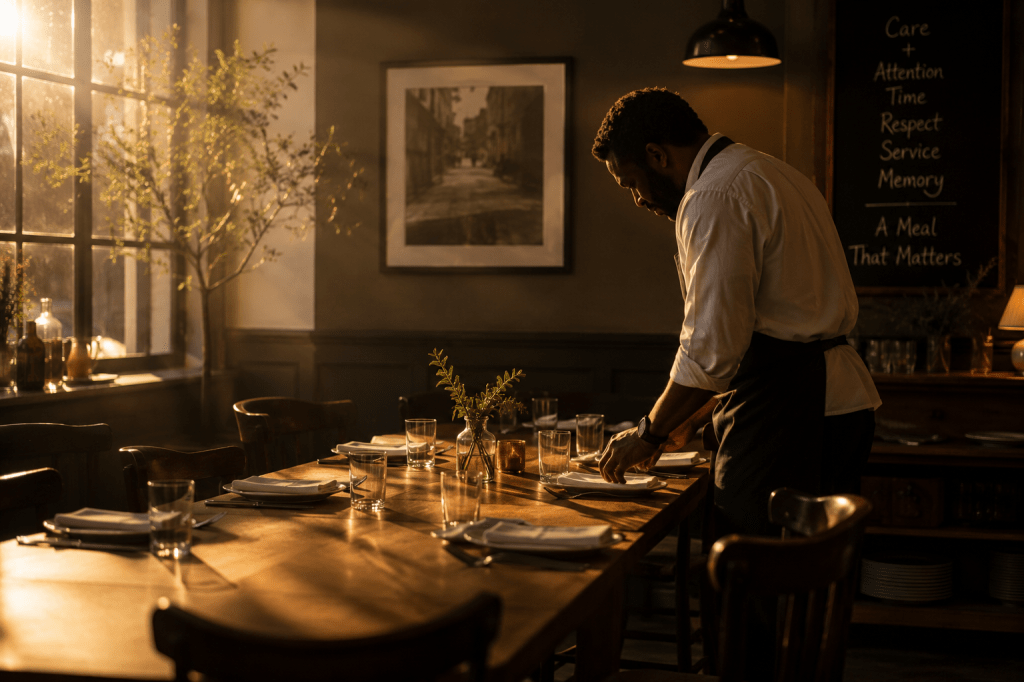
Sometimes a television show stops entertaining you and quietly begins asking questions about your own life.
Season 2 of The Bear did that for me.
The Second season of The Bear is filled with food.
Beautiful food. Precise food. Food arranged with tweezers and intention. Food that carries the weight of memory, ambition, grief, and expectation.
But the best thing the season serves is not a plate.
It is change.
Not the kind of change people announce loudly. The change in The Bear is quieter than that. It comes through repetition. Through discomfort. Through people being sent away from what they know so they can return with a clearer understanding of who they might become.
Marcus leaves the familiar kitchen and enters another world. He studies pastry with patience and humility. He learns that excellence is not magic. It is attention. It is noticing texture, temperature, timing. It is doing the same thing again, not because the first attempt was worthless, but because care asks us to try once more.
Tina goes to culinary school.
That may not sound revolutionary to some people. But there are moments in life when being offered the chance to learn becomes a form of recognition. Someone looks at you and says, perhaps without saying it directly, There is more in you.
And then there is Richie.
Richie may be the clearest example of what the season is trying to tell us.
He begins as a man who feels the world moving without him. He is loud because he is uncertain. Defensive because he is afraid. He mistakes familiarity for usefulness and anger for authority. He has spent so much time believing he does not belong anywhere that he has begun to behave as if belonging itself is a lie.
Then he is sent to another restaurant.
At first, he believes he is being punished.
That is often how growth feels when it begins.
We think we have been removed because we are unwanted. We do not always understand that distance can sometimes reveal what closeness has hidden. Away from the noise of his own kitchen, Richie begins to see the work differently.
He polishes forks.
He observes.
He learns the names of dishes.
He watches how a dining room moves.
And slowly, he begins to understand that service is not submission. It is not weakness. It is not pretending that the customer is always right.
Service is attention.
It is knowing that someone has saved money for months to sit at a table. That a meal may be celebrating a birthday, a promotion, a marriage, a farewell. That what feels like another shift to the staff may become a memory someone carries for the rest of their life.
Richie begins to understand that his work affects people.
Not someday.
Now.
A glass placed carefully. A question answered with patience. A surprise offered because someone was paying attention. Small actions, perhaps. But lives are often shaped by small actions.
By the end of his training, Richie has not become a different person.
He has become more fully himself.
That distinction matters.
Growth is not always about becoming unrecognizable. Sometimes it is about clearing away the fear, resentment, and confusion that kept us from seeing our own usefulness. Richie discovers that he has a gift for people. For reading a room. For making someone feel welcomed. For understanding the emotional rhythm of a place.
He finds his place.
And once he finds it, something changes in him.
He no longer wants merely to be included.
He wants to improve.
That may be one of the most important transitions a person can make.
There is a difference between wanting recognition and wanting mastery. Recognition asks, Do you see me? Mastery asks, How can I become worthy of the responsibility I have been given?
I think about that when I write.
Every day I sit with words.
Some days they come easily. Other days they arrive slowly, dragging doubt behind them. There are sentences I admire in the moment and question the next morning. Some pieces feel finished until I read them again and see all the places where I stopped too soon.
But every time I write, I want the next thing to be better.
Not only for me.
For the person who takes the time to read it.
That reader may never know how long I sat with a paragraph. They may never see the sentences I removed or the endings I softened. They may never know how many times I wondered whether the piece was honest enough, clear enough, useful enough.
They should not have to know.
The effort is part of the service.
When someone gives you their attention, they are giving you something they cannot recover. Time. A few quiet minutes from a life already full of demands. They could have gone elsewhere. They could have closed the page.
But they stayed.
That matters to me.
So I want the words to meet them with care.
I want each essay to say, in its own way, I knew you were coming, so I prepared something.
That does not mean every piece will be perfect.
Perfection is often another form of fear. It can keep us polishing forever, afraid to place anything on the table. The better goal is honesty joined with discipline. To bring what we have learned. To respect the reader. To leave the work a little stronger than we found it.
That is what Marcus learns.
That is what Tina learns.
That is what Richie finally learns.
Skill is not only talent.
It is responsibility.
It is the willingness to be taught.
There is tenderness in that.
We often treat self-improvement as punishment. We speak to ourselves harshly, as if shame were the only tool capable of shaping a better life.
But shame rarely builds anything that can stand.
Growth needs honesty, yes.
It also needs patience.
A person must be able to look at who they have been without believing they are condemned to remain there. They must be able to say, I was wrong. I was careless. I did not understand.
And then, perhaps more importantly:
I can learn.
Season 2 of The Bear understands this.
It shows us that we are not finished.
That the person we have been is not the final draft.
That finding our place does not mean the work is over.
It means we finally know where to begin.
Please like, comment, and share
If you’re looking for practical help, food support, or community resources, you can visit the Salt, Ink & Soul Resources Page.

There is something strange about anniversaries.
They do not ask permission before arriving.
A year ago, Malcolm-Jamal Warner left this world.
Like so many people, I first knew him as Theo, not as a character, exactly, but as someone who quietly occupied a corner of my life. Week after week, he reminded us that growing up was awkward, that mistakes did not have to define us, and that being a young Black man could include gentleness, humor, uncertainty, and love.
He became familiar.
And familiarity has a way of convincing us we know someone.
I have thought about that a great deal over this past year.
When he died, I did what many of us do now. I searched.
Not because I wanted headlines. I wanted something closer to the man than the memories television had given me.
That search led me somewhere I never expected.
Apple Music.
I typed his name.
That is where I found Miles Long.
At first I wondered if it could really be him. Then I pressed play.
What I discovered wasn’t simply another creative pursuit from an actor I admired.
It was another language.
The music carried the warmth of the records that raised many of us. Soul. Jazz. Hip-hop. Spoken word. Music that wasn’t trying to chase trends because it understood something more important.
Truth never goes out of style.
The grooves were patient.
The bass never hurried.
The lyrics trusted you enough to meet them halfway.
They sounded like conversations that begin after midnight, when people finally stop pretending they’re fine.
Listening to those songs felt less like discovering a new artist than discovering a room in a house I thought I already knew.
And that realization stayed with me.
How many people have I admired while never truly seeing them?
How many lives have I reduced to the role they played in my own story?
We often say we should give people their flowers while they’re here.
But flowers are not enough if we never walk through the garden.
Malcolm-Jamal Warner was never just the young man who helped redefine television. He was a poet. A musician. A thinker. A man still asking questions about love, identity, fatherhood, justice, and becoming.
His work was larger than the spotlight.
Maybe that is the lesson I have carried this past year.
Most of us are more than the thing the world applauds us for.
The teacher paints.
The mechanic writes poetry.
The grandmother who makes the best cornbread also carries stories no one has bothered to ask about.
The quiet man in the corner may have spent decades composing songs no one in the room has ever heard.
We spend our lives introducing ourselves through occupations.
But our souls rarely fit inside a job title.
A year later, I still return to Miles Long.
Not because grief demands it.
Because gratitude does.
Those songs remind me to slow down.
To look again.
Rest well, Malcolm.
Thank you for reminding us that the most beautiful parts of a person are often the ones waiting just beyond what everyone already knows.
Please like, comment, and share
If you’re looking for practical help, food support, or community resources, you can visit the Salt, Ink & Soul Resources Page.
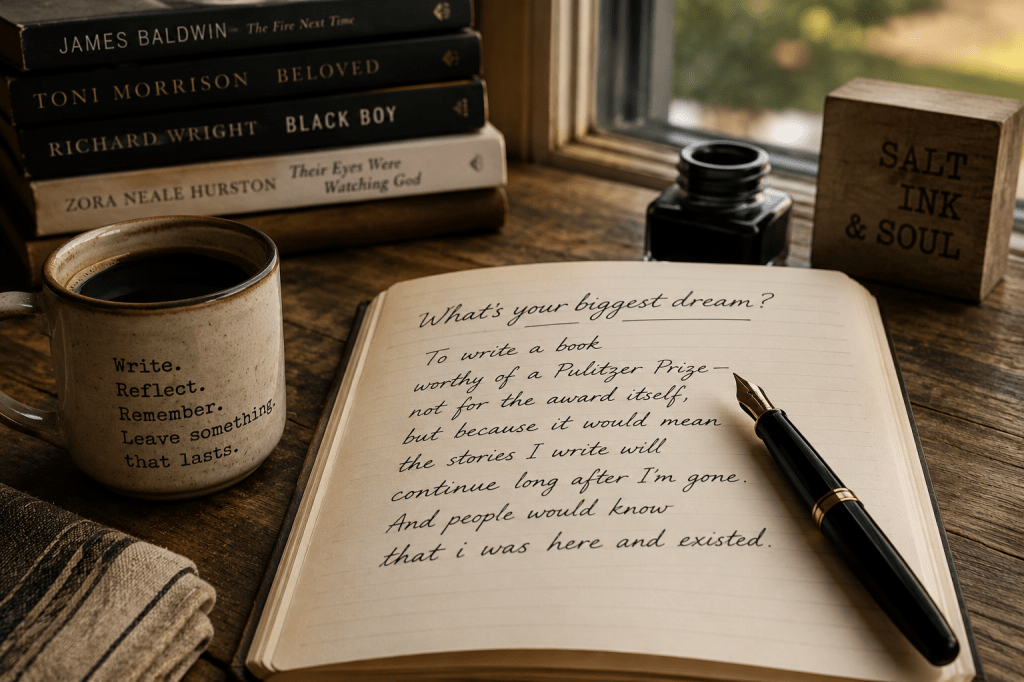
To write a book worthy of a Pulitzer Prize.
Not because I need an award. Awards gather dust. They eventually become another object on a shelf.
What I hope for is something quieter.
I hope to write something that outlives me. A book that someone opens years from now and still finds truth in. A book that reminds a stranger they are not alone, or helps someone understand a history they never knew they carried.
Most of all, I hope my words become proof that I was here.
That I lived. That I paid attention. That I loved enough to write it all down.
I hope that someday, someone I’ve never met will turn the final page, sit in the silence for a moment, and begin asking questions. Who was this man? What kind of life shaped him? Why did these stories matter so much to him? What was he trying to leave behind?
If they dig deeply enough into the words, I hope they’ll find the answers. Not because I ever wrote about myself directly, but because every honest sentence carries a little of its author within it.
Long after my voice has gone silent, I hope the stories remain. Not to make me unforgettable, but to leave behind a small piece of light for whoever comes next.
If that journey one day leads to a Pulitzer Prize, I would receive it with deep gratitude. But the prize has never been the dream.
The dream has always been to leave something behind that time cannot easily erase.
Please like, comment, and share
If you’re looking for practical help, food support, or community resources, you can visit the Salt, Ink & Soul Resources Page.
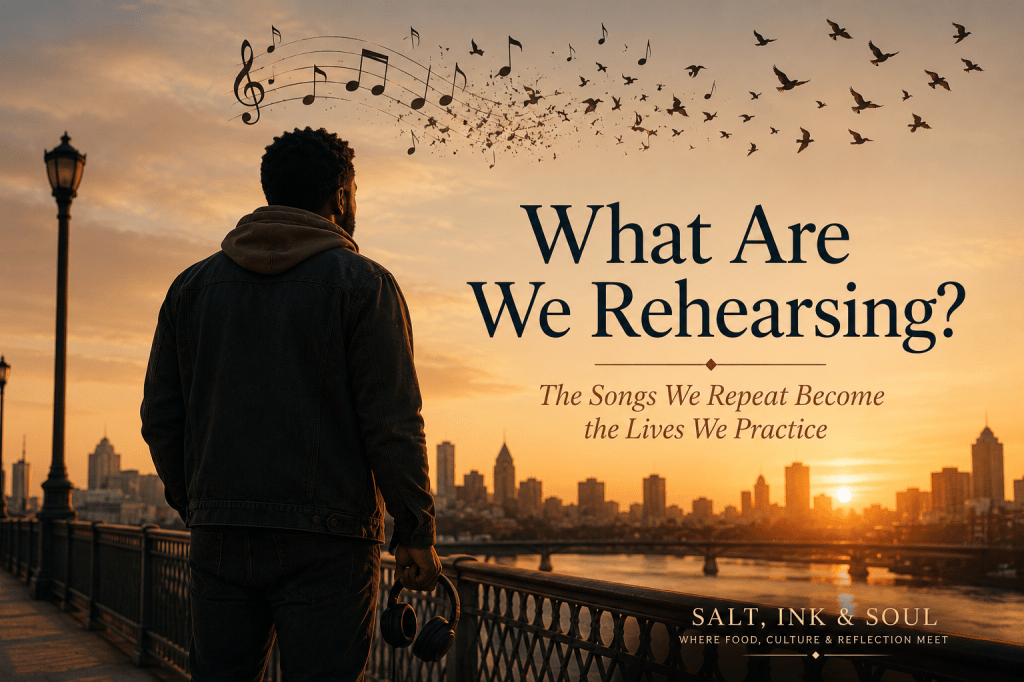
Sometimes another person’s question stays with you longer than their answer.
This week, I found myself thinking about a conversation sparked by singer India Arie. She wondered aloud what it means when the songs we celebrate become the stories we live by. She was not asking for censorship. She was not asking anyone to stop making music. She was asking whether what we repeatedly consume eventually begins to shape us.
That question has followed me around.
Maybe I’m seeing too much.
Or maybe I’m finally paying attention.
I have been thinking about repetition.
Not just in music, but in every part of life.
A basketball player takes thousands of jump shots until the movement becomes instinct.
A pianist practices scales until the fingers no longer ask permission from the mind.
A grandmother makes cornbread so many times that measuring cups become unnecessary.
We call it practice.
We call it discipline.
We call it muscle memory.
We already understand that repetition changes the body.
So why do we become uncomfortable when someone asks whether repetition might also shape the heart?
Long before neuroscience gave us language like neural pathways and habit formation, people understood that words carried power. Communities repeated prayers because they believed repetition strengthened faith. Parents repeated lessons because they hoped they would become character. Freedom songs were sung over and over because they reminded weary people that they were more than the conditions surrounding them.
Some people called those rituals sacred.
Others believed repeated words could become something darker.
They believed that speaking certain things over and over invited them into your life.
Whether we call it ritual, conditioning, or simply human psychology, perhaps they were all reaching toward the same truth.
What we practice eventually begins to feel natural.
That thought has stayed with me as I watch our culture.
Not just Black culture.
All culture.
We live in an age where algorithms have become our DJs.
They decide what rises.
They decide what repeats.
They decide what millions of people hear before breakfast.
I am not interested in arguing that music alone determines the future of a community.
It doesn’t.
No song can explain generations of segregation, economic inequality, underfunded schools, broken public policy, or the many burdens that Foundational Black Americans have carried across centuries. To pretend otherwise would ignore history.
But I also refuse to believe music is powerless.
If songs had no influence, companies would not spend millions of dollars making sure certain ones reach our ears.
Advertising exists because repetition works.
Political campaigns exist because repetition works.
Religious liturgy exists because repetition works.
Education itself depends on repetition.
Why would we imagine music is somehow exempt?
This is not about blaming any one artist.
Every generation has created music that unsettled the one before it.
Hip-hop, like jazz before it, has given voice to neighborhoods that were often ignored. It has documented struggle, celebrated creativity, challenged power, and preserved stories that might otherwise have disappeared.
Some of the greatest poetry I have ever heard arrived wrapped in a beat.
That deserves respect.
But every art form also contains choices.
Some songs call us toward dignity.
Others celebrate revenge.
Some remind us that love requires sacrifice.
Others convince us that commitment is weakness.
Some tell young people they are worth more than what the world has offered them.
Others invite them to build an identity around excess, exploitation, or self-destruction.
Those differences matter.
What troubles me even more is not that those songs exist.
Art has always reflected both light and shadow.
What troubles me is what gets amplified.
There are artists creating music about healing.
About fatherhood.
About faith.
About perseverance.
About accountability.
About joy that does not require someone else’s humiliation.
They exist.
Yet they rarely seem to receive the same machinery behind them.
That should make us curious.
Not angry.
Curious.
Why do stories that flatter our impulses often travel farther than stories that challenge us to grow?
Why does outrage outperform wisdom?
Why is self-control so difficult to market while excess is endlessly profitable?
Those are questions worth asking.
Especially for those of us who are descendants of people who once sang their way through unimaginable suffering.
Our ancestors understood something about repetition.
They sang hope until hope became endurance.
They repeated Scripture until it became courage.
They gathered around kitchen tables and church pews, telling the same family stories until children understood they belonged to something larger than themselves.
Those songs did not erase injustice.
But they strengthened people enough to survive it.
I wonder what songs we are teaching ourselves now.
Not because I believe every lyric becomes destiny.
But because I know that what surrounds us eventually begins to sound like home.
And what sounds like home eventually becomes normal.
The most dangerous ideas are rarely the loudest.
They become dangerous because they stop sounding unusual.
They become ordinary.
That is how repetition works.
It does not always convince.
Sometimes it simply familiarizes.
And familiarity is powerful.
I think about food often.
Anyone who has spent time reading Salt, Ink & Soul knows that.
A single meal will not make you healthy.
Neither will a single meal make you sick.
But years of eating eventually shape the body you live in.
Perhaps the soul works the same way.
Perhaps one song changes very little.
But thousands of repetitions…
Thousands of rehearsals…
Thousands of small invitations toward the same vision of success, love, relationships, wealth, and identity…
Perhaps those leave fingerprints we cannot always see.
This is not a call to fear music.
It is not a call to silence artists.
It is certainly not a call to stop creating.
It is a call to become more intentional listeners.
To ask ourselves a simple question before we press play.
What am I rehearsing?
Because every day we are practicing something.
Compassion or contempt.
Discipline or indulgence.
Hope or cynicism.
Dignity or degradation.
None of us escapes rehearsal.
The only choice we have is deciding what kind of life we want to become fluent in.
Maybe I’m seeing too much.
Or maybe I have simply reached an age where I understand that nothing enters the soul without leaving something behind.
If that is true, then perhaps one of the quietest acts of freedom is choosing carefully what we allow to echo there.
Please like, comment, and share
If you’re looking for practical help, food support, or community resources, you can visit the Salt, Ink & Soul Resources Page.
Two years ago, we didn’t yet understand what we were watching.
It looked small at first. Familiar. Another flare-up in a genre built on pressure and pride. Another moment where two men sharpened language into something meant to cut. We have seen that before. We have been taught to expect it. Hip-hop has always known how to turn conflict into rhythm, into spectacle, into something you can nod your head to even as it bruises.
But this felt different.
Not immediately. Not at the beginning.
It took time.
That is how earthquakes work. The ground does not announce itself all at once. It shifts quietly beneath you, rearranging things you thought were fixed, until one day you realize the landscape is not what it was.
And by then, it’s already happened.
I did not arrive at Kendrick Lamar through reverence.
I arrived the way many of us do now—through fragments. Through what was handed to me. Through what was already popular enough to reach me without effort. After the 2022 Super Bowl, I began listening, but not studying. Sampling, not sitting. I knew the songs people knew. The ones already flattened into familiarity.
But I did not yet understand the architecture.
I did not yet understand that some artists do not make songs. They are building rooms. And those rooms are not always comfortable places to stand.
By the time Mr. Morale & the Big Steppers arrived, I could feel something shifting, even if I didn’t yet have the language for it. That album did not ask to be liked. It asked to be endured. It asked you to sit with a contradiction. With confession. With the uncomfortable truth that growth does not always look like progress.
And maybe that was the beginning of it for me.
Not the battle.
But the preparation.
Because the truth is, what happened in 2024 did not begin in 2024.
It began in 2013, when Kendrick stepped onto “Control” and did something that, at the time, felt like sport. He named names. He made ambition sound like confrontation. It was framed as competition, but competition has a memory. And memory, when left long enough, becomes something else.
You could hear it if you went back.
In Drake’s “The Language.”
In Kendrick’s verses that refused to soften.
In “King Kunta,” where the accusations didn’t need to be named outright to be understood.
For years, it lived in that space hip-hop knows well—half-lit, half-spoken, never fully denied. A tension you could feel without being told.
Until someone said it plainly.
“Big three.”
And another voice answered:
No.
When “Like That” dropped, something old finally exhaled.
And what followed was not just music.
It was an escalation.
“Push Ups.”
“Taylor Made Freestyle.”
“Euphoria.”
“6:16 in LA.”
“Family Matters.”
“Meet the Grahams.”
“Not Like Us.”
“The Heart Part 6.”
A sequence that felt less like a back-and-forth and more like a dismantling. Not just of reputations, but of identity itself. Each record didn’t just respond. It reframed. It attempted to redefine the other man in public.
And that is where it stopped being entertainment.
Because when accusation enters the room—real accusation, heavy accusation, the kind that reaches beyond art and into life—you are no longer just listening. You are witnessing something that carries weight beyond rhythm.
The music no longer existed in isolation.
It spilled.
Into headlines.
Into conversations that had nothing to do with rap.
Into people who had never followed either artist, but suddenly had an opinion.
That is when you know something has changed.
When the audience is no longer just fans, but witnesses.
After it ended—or at least after it slowed—I went backward.
Because that is what moments like this demand of you. They send you into the archive. They make you reconsider what you thought you understood.
Lines sound different when you know where they were headed.
Verses carry a weight they didn’t have before.
“Control” becomes less of a spark and more of a blueprint.
“King Kunta” sharpens.
“First Person Shooter” stops sounding like a celebration and starts sounding like a miscalculation.
You begin to understand that some conflicts are not sudden.
They are patient.
They wait.
And then came what felt, to me, like the real shift.
Not the songs.
Not even the outcome.
But what came after.
The lawsuit.
Because something about that moment felt like crossing a line that had always been there, even if we didn’t acknowledge it. Hip-hop has always existed in tension with power—economic power, corporate power, the machinery that turns art into product.
But to see a rap battle move from the booth to the courtroom…
That changes the feeling of it.
It reminds you that this thing we love does not live outside of systems. It moves through them. It is shaped by them. And sometimes, it is constrained by them in ways we don’t fully see until moments like this pull the curtain back.
It is one thing to win a record.
It is another thing to contest what that record does once it leaves your hands.
And still, Kendrick kept moving.
The album.
The Grammys.
The Super Bowl.
The tour.
Each step is not just a continuation, but a widening.
Because winning a battle is one thing.
Turning that moment into something lasting—that is something else.
By the time he stood on that stage, in front of the largest audience possible, it no longer felt like we were watching a rapper.
It felt like we were watching a moment that had outgrown its origin.
And what stayed with me was not the victory.
It was the restraint.
The decision to center the story over spectacle.
To stand in the aftermath of noise and choose something deliberate.
That is harder than it looks.
Kendrick has said he is not our savior.
And I understand that.
Because we ask too much of people, we turn them into symbols. We expect them to carry our belongings. Our questions. Our contradictions. Our need to believe someone else has clarity we do not.
That is not fair.
But I find myself returning to that word anyway.
Not as worship.
Not as absolution.
But as recognition.
Because sometimes what saves you is not a person.
It is a reminder.
A reminder that language can still be sharp.
That art can still demand something of you.
That you are allowed—maybe even required—to think more deeply than what is handed to you at the surface.
That is what this did for me.
It pulled me out of passive listening.
It made me go back.
Made me sit longer.
Made me hear not just what was said, but what was built beneath it.
And in a time where so much is designed to be consumed quickly, forgotten easily…
That feels rare.
So when I look back now, I don’t just see a feud.
I see an education.
I see how something that started as competition has become more like an examination. Of artistry. Of ego. Of truth and performance and the space between them.
I see how I entered through familiarity and stayed because something deeper kept calling me back.
And I think about how often we miss that.
How often do we stand at the beginning of something, thinking it is small, not realizing we are already inside something that will change how we understand the thing itself?
Some moments are noise while they are happening.
And history once they pass.
This was both.
And what it left behind, at least for me, is simple:
I listen differently now.
And sometimes, that is enough.
Kyle J. Hayes
If this found you at the right time,
Feel free to like, comment, or share it with someone who might need it too.
If you’re looking for practical help, food support, or community resources, you can visit the Salt, Ink & Soul Resources Page.
There’s a certain kind of teaching that doesn’t happen at a chalkboard.
It happens later in the quiet. When you’re old enough to look back at the boy you were and realize he didn’t need tougher lessons—he needed better language for what he was already carrying. He needed someone to name the weight, not just tell him to lift it. He needed instructions that didn’t feel like shame.
I write children’s stories, and if you look closely, there’s a lesson tucked inside each one like a warm note in a pocket. People sometimes think that’s cute. Sometimes it is. But it’s also a confession.
Because the truth is: I’m not only writing for children.
I’m writing for the younger version of me.
I’m writing for the boy who kept hearing “you’ll learn the hard way” like it was a rite of passage. Like pain was a badge you earned. Like wasted time was the price of admission. Like you had to bleed to be considered real.
And maybe that’s the oldest lie we tell boys—that the only education that counts is the kind that bruises.
I grew up in a world that didn’t always teach feelings the way it taught survival. It taught stamina. It taught silence. It taught the art of looking fine. It taught you how to swallow your own questions whole so nobody would see you chewing.
And then, later—when you’re old enough to know you’ve been living with a hunger you couldn’t name—you realize what you were missing wasn’t toughness.
It was guidance.
The kind that says: Here’s how to be human without hardening into a weapon.
So I started writing the lessons I wish had been offered to me without the threat attached.
Not sermons. Not lectures. Just small stories.
A fox who checks on his friends.
A quiet day that gives permission to rest.
A soup that doesn’t look fancy but still warms the room.
A cloud that doesn’t stay forever but leaves growth behind.
These aren’t just plots.
They’re repairs.
They’re me trying to do something with what I’ve learned, instead of letting it sit inside me as regret.
Because I’ve learned the hard way. I’ve paid for the information for years. With missteps. With stubborn pride. With the kind of loneliness that doesn’t announce itself—it just rearranges your life until you forget what joy used to sound like.
There’s a particular kind of waste that hurts the most—not wasted money or missed chances, but wasted time becoming. The years you spend thinking you’re broken, or behind, or unworthy of gentleness. The years you spend trying to earn what should have been given freely: permission to grow.
That’s why the lessons keep showing up in my stories.
Not because I believe children are empty and need to be filled, but because children are already full—full of questions, full of fear, full of hope they don’t yet know how to protect. And too often they inherit a world that tells them their softness is a flaw.
So I write to tell them the opposite.
I write to tell them that kindness is not weakness. That asking for help is not failure. That being unseen isn’t proof you don’t matter. That the quiet parts of you deserve a home.
That you can be strong without being cruel.
That you can become a good man without becoming a hard one.
And I write to tell the adults reading over their shoulders something too: it’s not too late to offer yourself the lesson you never got. It’s not too late to sit beside the younger version of yourself and say, I see what you went through. You didn’t deserve to go through it alone.
People sometimes assume empathy is just a personality trait, like eye color. But I think empathy is often the leftover heat from a life that could have gone colder. It’s what happens when you’ve been hurt and decide—quietly, stubbornly—that you don’t want to hand that hurt forward.
That’s what my stories are.
My refusal to hand it forward.
I don’t write because I’m better than anyone. I write because I know what it costs when we don’t have maps. I know what it costs when boys are told that confusion is weakness and tenderness is something to outgrow.
I know how easy it is to turn “learned the hard way” into an identity instead of a warning.
I’m trying to offer a different inheritance.
Not perfection. Not a shortcut around life. Life will still be life—wild, unfair, beautiful, sometimes brutal. But maybe we can spare someone a few needless miles. Maybe we can keep a kid from mistaking pain for a teacher and loneliness for a personality.
We can help them spend less time surviving and more time becoming.
That’s the hope under every story I write: that someone—somewhere—will feel seen sooner than I did. That they’ll recognize themselves in a gentle fox or a patient cloud and understand, without being told too bluntly, that they’re allowed to be human.
And if that happens, even once, then none of this is wasted.
Not the stories.
Not the lessons.
Not even the hard way.
Maybe that’s what these stories really are — small lanterns placed along the path I once had to walk in the dark.
If someone younger finds one of them sooner than I did, then the years it took me to learn those lessons won’t have been wasted.
Kyle J. Hayes
Please like, comment, and share
If you’re looking for practical help, food support, or community resources, you can visit the Salt, Ink & Soul Resources Page.
There are twenty of you here—readers who chose to subscribe, to return, and to spend time with this blog over the past year. That number may look small from the outside, but it doesn’t feel small to me. It means that twenty people, in a world that’s moving faster every day, chose to slow down and read words without being in a hurry.
This year, Salt, Ink & Soul became a place I didn’t fully understand until I was already inside it. A place where food could carry memory without needing to justify itself. Where children’s stories could sit beside reflections on grief, resilience, and the quiet weight of being human. Where the idea of “enough” could be asked gently, without demanding an answer right away.
Some of you read every post.
Some of you arrive when a title catches something familiar.
Some of you read quietly, without ever commenting or leaving a trace.
All of that is welcome here.
What I’ve learned this year is that writing doesn’t have to shout to be heard. It only has to be honest. Showing up—again and again—even when the words come slowly, even when the questions remain unfinished, has felt like its own kind of discipline. And knowing readers are willing to sit with that uncertainty has meant more than I can adequately say.
If you’re reading this as a subscriber, thank you for choosing to stay. Thank you for trusting this space enough to let it arrive in your inbox. Your presence—steady, patient, unassuming—has helped shape what this place is becoming.
And if you’re reading this for the first time, know this: this is a quiet corner. A place for stories about food, memory, children, and the small moments that often get overlooked. You’re welcome here, whether you pass through once or decide to stay awhile.
As the year turns, I don’t have grand promises. What I do have is intention. I’ll keep writing. I’ll keep paying attention. I’ll keep trying to make this space feel warm, thoughtful, and human—a place where reflection can breathe.
Thank you for being here at the beginning. Thank you for reading slowly. Thank you for taking the time to read words written with care.
If there’s a story you’re still waiting for, or a question you carry quietly, I hope you’ll continue to walk through this space with me. There will be more stories ahead, more moments to sit with, more chances to pause together—and I’m grateful for every reader who chooses to return.
With gratitude and hope
Kyle Hayes
Salt, Ink & Soul
If you’d like to spend more time with these themes, my books explore food, memory, resilience, and emotional truth in greater depth.
Explore the books here → Felix collections or on Amazon

