Tag: community

  • The Family Table Is Still Waiting

    The Family Table Is Still Waiting

    There is a particular kind of loneliness that doesn’t arrive when you’re by yourself.

    It arrives when the room is full.

    The plates are set. Glasses gather little rings of water on the table. Someone reaches for the salt without asking. Someone else laughs at a story you’ve all heard before, yet somehow it still earns another smile.

    And still…

    Something feels absent.

    Not because the chairs are empty.

    Because our attention is.

    I’ve watched it happen more times than I care to admit. Friends. Family. Holidays. Birthdays. A table filled with people I genuinely wanted to see.

    Then the food arrives.

    Almost instinctively, hands reach for phones before forks. Plates are turned toward the light. Someone asks everyone to wait while they find the right angle. Steam rises, curls into the air, and quietly disappears while filters are chosen and captions are written.

    “I’ll be just a second.”

    “Don’t eat yet.”

    “I haven’t posted it.”

    It’s become so ordinary that we rarely question it anymore.

    The meal is here.

    The people are here.

    Yet we’re busy proving it to everyone who isn’t.

    I’m not writing this as a complaint about technology. Some of my favorite conversations have happened because of it. I’ve stayed close to people who live hundreds of miles away. I’ve shared recipes with strangers who now feel like neighbors. This very blog exists because of a screen.

    Technology isn’t the enemy.

    Forgetfulness is.

    Somewhere along the way, we began forgetting what the table was for.

    Growing up, our table wasn’t remarkable. It wasn’t made from expensive wood, and nobody would’ve mistaken our dinners for something from a magazine.

    But that table had a way of telling the truth.

    You could tell who’d had a hard day before anyone said a word. You noticed who was quieter than usual. If someone pushed food around their plate instead of eating, someone would eventually ask, “You alright?”

    Not because they had studied body language.

    Because they were paying attention.

    That’s what the table did.

    It slowed us down just enough to notice one another.

    It was never really about the food.

    The fried chicken, the greens, the spaghetti, the macaroni—they were invitations. Reasons to gather. The meal gave everyone something to do with their hands while their hearts slowly caught up.

    Looking back, I couldn’t tell you exactly what every Sunday dinner tasted like.

    But I remember who sat beside me.

    I remember the laughter that made sweet tea come out somebody’s nose.

    I remember conversations that started over cornbread and somehow became lessons about life.

    I remember discovering that people rarely tell you the most important things right away. They tell you after the plates have been cleared. After dessert. After everyone has settled into the comfort of simply being together.

    Those moments didn’t happen because someone planned them.

    They happened because nobody was trying to be somewhere else.

    Today, we carry with us everywhere.

    A notification from work.

    A headline from across the world.

    A video someone says we have to watch.

    A message that feels urgent until tomorrow reminds us it wasn’t.

    Little by little, our attention leaves the room before we ever do.

    We call it staying connected.

    Sometimes I wonder if we’ve confused being connected with being present.

    They’re not the same thing.

    Presence asks something more of us.

    It asks us to look into someone’s eyes long enough to notice what they aren’t saying.

    To hear the hesitation before the words.

    To recognize that a quiet “I’m fine” can carry the weight of an entire year.

    No photograph captures that.

    No caption can.

    I’ve been thinking lately about a small act of rebellion.

    Nothing dramatic.

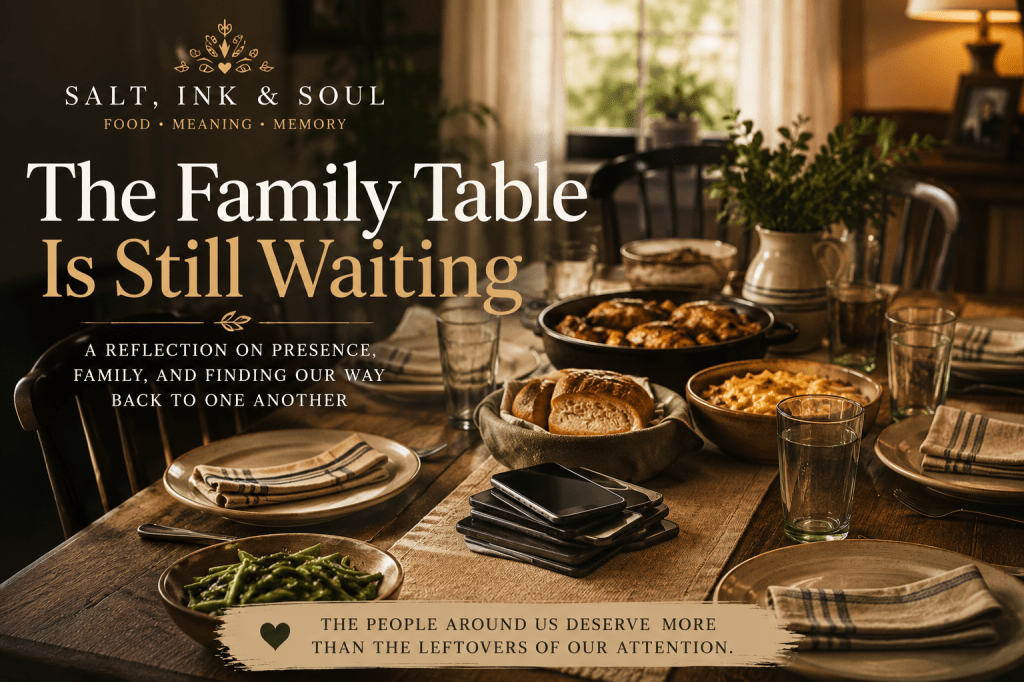
    Just a stack of phones in the middle of the table.

    Face down.

    Not because the phones are bad.

    Because the people around the table deserve our undivided attention, if only for the length of a meal.

    That stack becomes its own centerpiece.

    A quiet promise.

    For the next hour, no one outside this room needs more of us than the people inside it.

    Without the glow of our screens, we begin to notice things again.

    The way your father pauses before mentioning an old friend.

    The way your sister laughs a little harder than usual because she’s trying not to cry.

    The way your grandmother reaches for your hand without saying why.

    Those moments don’t trend.

    They don’t go viral.

    Most of them will never be photographed.

    But they are the moments that become our lives.

    The digital world will always ask us for another picture, another opinion, another performance of ourselves.

    The family table asks for something much simpler.

    It asks us to arrive.

    Not polished.

    Not interesting.

    Not curated.

    Just present.

    Maybe that’s enough.

    Maybe it always was.

    The family table is still waiting.

    The chairs are still there.

    The empty seat still knows your name.

    All it has ever wanted is the one thing no screen can offer.

    You.

    Kyle J. Hayes

    kylehayesblog.com

    Please like, comment, and share

    Resources for Hard Times

    If you’re looking for practical help, food support, or community resources, you can visit the Salt, Ink & Soul Resources Page.

    👉 Resources for Hard Times

  • They’ll Remember More Than the Score

    They’ll Remember More Than the Score

    Well…

    We didn’t get them this time.

    As someone very new to soccer, I have to admit I was disappointed to see the USMNT’s World Cup journey come to an end. Like so many Americans, I had started believing. Every match pulled me in a little deeper. Every victory made me think, “Maybe this is our year.”

    It wasn’t.

    But if there is one phrase Americans know almost by heart, it’s:

    We’ll get them next time.

    There is hope tucked inside those words.

    Not denial.

    Not pretending we didn’t lose.

    Just the belief that another opportunity is coming.

    Another chance.

    For me, something unexpected happened during this World Cup.

    I didn’t just discover a tournament.

    I discovered a sport.

    A few months ago, I couldn’t have told you much about formations or tactics. Today, I find myself checking match schedules, watching highlights, learning the game’s rhythm, and already looking forward to the next World Cup.

    That feels like a gift.

    One I didn’t know I was missing until someone handed it to me.

    Even though Team USA is no longer playing, something beautiful is still happening.

    The World Cup is still here.

    The matches continue.

    And so do the people who traveled thousands of miles to experience them.

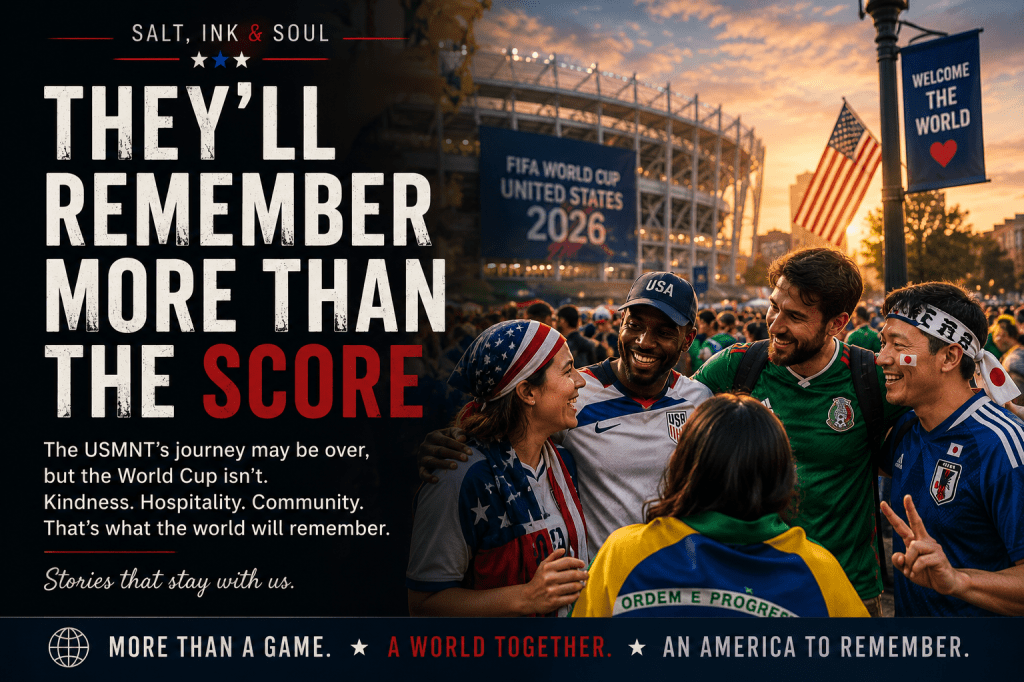
    Over the past few weeks, I’ve watched countless videos of supporters from Europe, South America, Africa, Asia, and beyond sharing their experiences here in the United States. What struck me wasn’t just their excitement over the matches.

    It was how often they talked about the people.

    The conversations with strangers.

    The restaurant recommendations.

    The unexpected hospitality.

    For all the stories people hear about America before they arrive, many leave talking about something entirely different.

    They leave talking about us.

    Not politicians.

    But People.

    Ordinary Americans.

    The cashier who wished them luck before the match.

    The server who recommended the best local barbecue.

    The family who invited them into a conversation.

    The stranger who pointed them toward the right train.

    The fan who celebrated beside them even though they spoke different languages.

    That is an America I know.

    The America where neighbors wave.

    Where someone stops to help you change a tire.

    Where a plate of food somehow finds its way into your hands if you’ve been around long enough.

    Where we may argue among ourselves, but we still know how to welcome a guest.

    No, we don’t have to go out of our way.

    No one is requiring it.

    But I hope we do anyway.

    Not because we are trying to prove something.

    Because hospitality has always been one of the quiet strengths of ordinary people.

    Governments introduce nations.

    People define them.

    Long after the final trophy is lifted, many of these visitors won’t remember every score.

    But they will remember how they were treated.

    They’ll remember the conversations that made them laugh.

    The meals they shared.

    The cities they explored.

    The strangers who became friends for an afternoon.

    Those memories travel farther than any goal ever could.

    I’m disappointed that Team USA’s run has ended.

    I wanted to see them go farther.

    I wanted to keep cheering.

    But I’m grateful all the same.

    Grateful that this tournament introduced me to a sport I never expected to love.

    Grateful that one conversation opened the door to something new.

    And grateful that the rest of the world still has a chance to experience something that has always existed beyond the headlines.

    The America we know.

    The America we build every day with kindness, generosity, and simple conversations between strangers.

    The world is still watching.

    Let’s give them something beautiful to remember.

    Kyle J. Hayes

    kylehayesblog.com

    Please like, comment, and share

    Resources for Hard Times

    If you’re looking for practical help, food support, or community resources, you can visit the Salt, Ink & Soul Resources Page.
    👉 Resources for Hard Times

  • Fireworks, Smoke, and the Light We Share on July 4th

    Fireworks, Smoke, and the Light We Share on July 4th

    I remember the Fourth of July first through the body.

    Not through history books.

    Not through speeches.

    Not through the careful language of founding documents.

    I remember it through smoke.

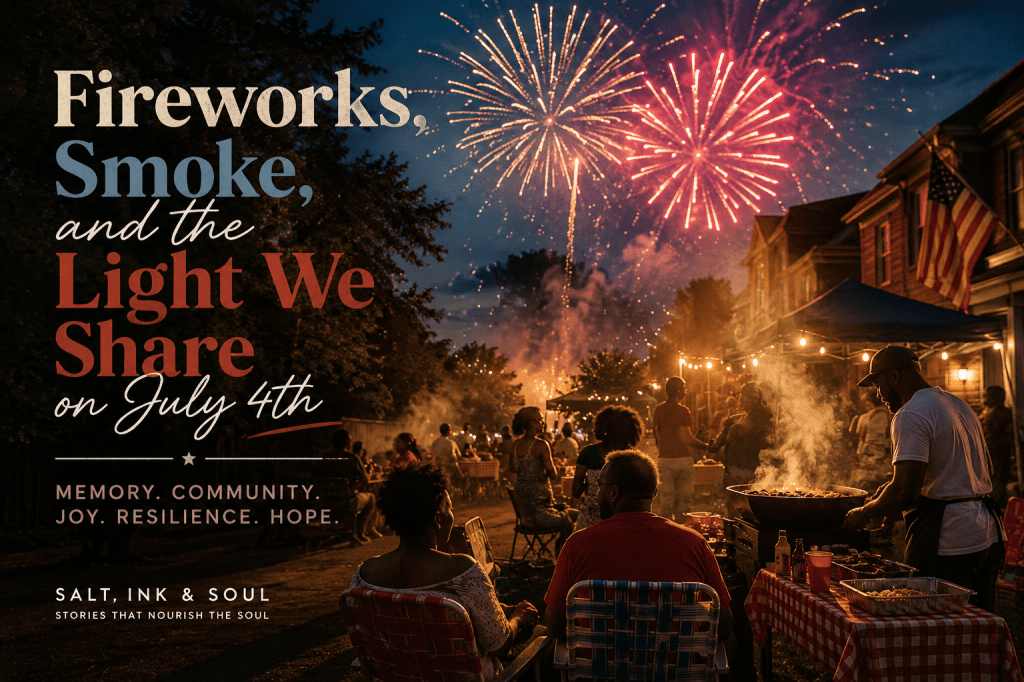
    Smoke rising from grills in backyards. Smoke drifting over alleyways. Smoke clinging to shirts and hair and folding itself into the memory of summer. I remember children running with sparklers, paper plates bending under ribs, baked beans, deviled eggs, and potato salad that everybody quietly judged but still ate.

    I remember laughter louder than the cheap fireworks we lit off in the alley.

    We did not talk much about the Declaration of Independence. We did not sit around quoting Jefferson. We talked about who cooked what. Who brought the good ice. Who made the punch too sweet. Who showed up with store-bought chicken and tried to pass it off like they had been standing over grease all morning.

    But we were celebrating something.

    Maybe not the country in the way textbooks wanted us to.

    Maybe not independence in its cleanest form.

    Maybe what we celebrated was presence.

    The gift of still being here.

    The gift of people gathered close enough to call your name across a yard.

    The gift of neighbors who knew your mother, your children, your business, and sometimes your middle name.

    As I grew older, the smoke stayed the same, but the fire changed.

    Sparklers became firecrackers. Firecrackers became bottle rockets. Bottle rockets became whole nights spent standing outside, daring the sky to answer us. Later, it became more organized. City festivals. Parades. Firework shows over rivers, stadiums, parks, and fairgrounds.

    You would drive somewhere with a blanket, a cooler, and just enough patience to sit in traffic afterward. Then the first burst would open above you, and for a moment, everybody stopped pretending to be separate.

    We all looked up.

    Together.

    That was always the part that mattered most to me.

    Not just the color.

    Not just the sound.

    But the shared looking.

    The brief agreement that something beautiful was happening above us, and we were willing to be quiet long enough to receive it.

    Now, I often watch the fireworks on television.

    I sit in the quiet of a home I work hard to keep. The sound comes through speakers. The colors fill the screen. There is no smoke in the room. No uncle yelling, “Don’t blow your fingers off.” No cousin running too close to the grill. No auntie guarding the good aluminum foil pans like national treasure.

    And some years, I have wondered what the Fourth of July is supposed to mean.

    I have wondered how to celebrate a nation that has so often complicated celebration.

    I have wondered how to hold joy in one hand and history in the other without dropping either one.

    Because for Black folks, America has always asked a strange thing of us.

    It has asked us to love a house we helped build while reminding us which rooms were never meant for us.

    It has asked us to sing while carrying memory.

    It has asked us to wave flags that did not always wave for us.

    And yet, somehow, we kept making room for joy.

    We made room around tables.

    We made room in church basements.

    We made room on porches, in parks, on folding chairs, beside grills, under trees, and in the middle of neighborhoods the world too often misunderstood.

    That is no small thing.

    To still find laughter, cook, dance, gather, and still look up.

    Kyle J. Hayes

    kylehayesblog.com

    Please like, comment, and share

    Resources for Hard Times

    If you’re looking for practical help, food support, or community resources, you can visit the Salt, Ink & Soul Resources Page.
    👉 Resources for Hard Times

  • What Are We Rehearsing?

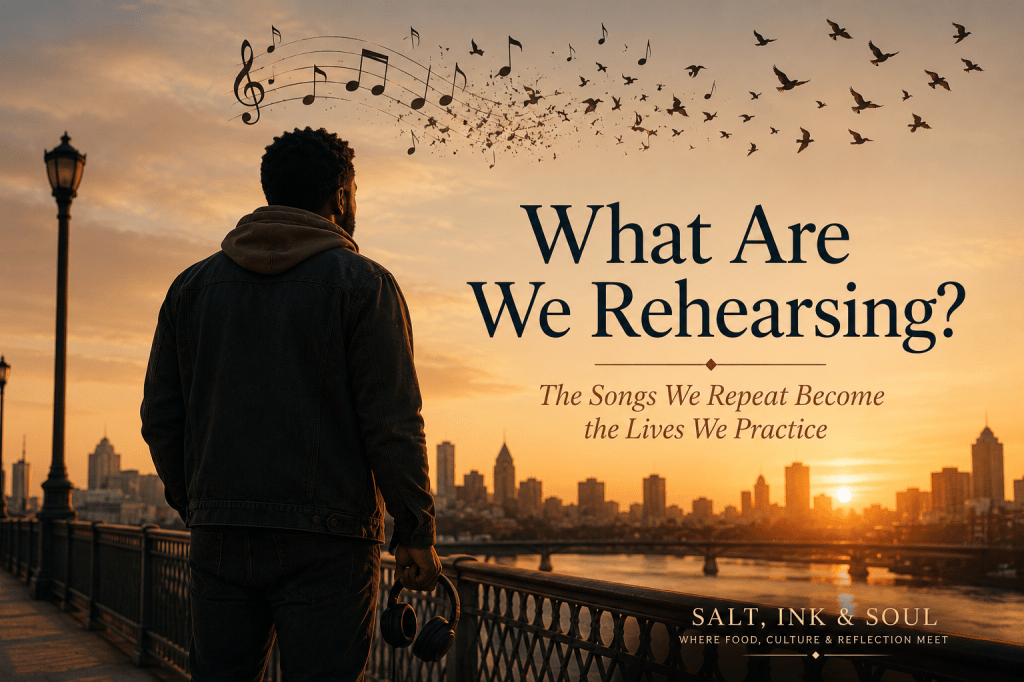
    What Are We Rehearsing?

    Sometimes another person’s question stays with you longer than their answer.

    This week, I found myself thinking about a conversation sparked by singer India Arie. She wondered aloud what it means when the songs we celebrate become the stories we live by. She was not asking for censorship. She was not asking anyone to stop making music. She was asking whether what we repeatedly consume eventually begins to shape us.

    That question has followed me around.

    Maybe I’m seeing too much.

    Or maybe I’m finally paying attention.

    I have been thinking about repetition.

    Not just in music, but in every part of life.

    A basketball player takes thousands of jump shots until the movement becomes instinct.

    A pianist practices scales until the fingers no longer ask permission from the mind.

    A grandmother makes cornbread so many times that measuring cups become unnecessary.

    We call it practice.

    We call it discipline.

    We call it muscle memory.

    We already understand that repetition changes the body.

    So why do we become uncomfortable when someone asks whether repetition might also shape the heart?

    Long before neuroscience gave us language like neural pathways and habit formation, people understood that words carried power. Communities repeated prayers because they believed repetition strengthened faith. Parents repeated lessons because they hoped they would become character. Freedom songs were sung over and over because they reminded weary people that they were more than the conditions surrounding them.

    Some people called those rituals sacred.

    Others believed repeated words could become something darker.

    They believed that speaking certain things over and over invited them into your life.

    Whether we call it ritual, conditioning, or simply human psychology, perhaps they were all reaching toward the same truth.

    What we practice eventually begins to feel natural.

    That thought has stayed with me as I watch our culture.

    Not just Black culture.

    All culture.

    We live in an age where algorithms have become our DJs.

    They decide what rises.

    They decide what repeats.

    They decide what millions of people hear before breakfast.

    I am not interested in arguing that music alone determines the future of a community.

    It doesn’t.

    No song can explain generations of segregation, economic inequality, underfunded schools, broken public policy, or the many burdens that Foundational Black Americans have carried across centuries. To pretend otherwise would ignore history.

    But I also refuse to believe music is powerless.

    If songs had no influence, companies would not spend millions of dollars making sure certain ones reach our ears.

    Advertising exists because repetition works.

    Political campaigns exist because repetition works.

    Religious liturgy exists because repetition works.

    Education itself depends on repetition.

    Why would we imagine music is somehow exempt?

    This is not about blaming any one artist.

    Every generation has created music that unsettled the one before it.

    Hip-hop, like jazz before it, has given voice to neighborhoods that were often ignored. It has documented struggle, celebrated creativity, challenged power, and preserved stories that might otherwise have disappeared.

    Some of the greatest poetry I have ever heard arrived wrapped in a beat.

    That deserves respect.

    But every art form also contains choices.

    Some songs call us toward dignity.

    Others celebrate revenge.

    Some remind us that love requires sacrifice.

    Others convince us that commitment is weakness.

    Some tell young people they are worth more than what the world has offered them.

    Others invite them to build an identity around excess, exploitation, or self-destruction.

    Those differences matter.

    What troubles me even more is not that those songs exist.

    Art has always reflected both light and shadow.

    What troubles me is what gets amplified.

    There are artists creating music about healing.

    About fatherhood.

    About faith.

    About perseverance.

    About accountability.

    About joy that does not require someone else’s humiliation.

    They exist.

    Yet they rarely seem to receive the same machinery behind them.

    That should make us curious.

    Not angry.

    Curious.

    Why do stories that flatter our impulses often travel farther than stories that challenge us to grow?

    Why does outrage outperform wisdom?

    Why is self-control so difficult to market while excess is endlessly profitable?

    Those are questions worth asking.

    Especially for those of us who are descendants of people who once sang their way through unimaginable suffering.

    Our ancestors understood something about repetition.

    They sang hope until hope became endurance.

    They repeated Scripture until it became courage.

    They gathered around kitchen tables and church pews, telling the same family stories until children understood they belonged to something larger than themselves.

    Those songs did not erase injustice.

    But they strengthened people enough to survive it.

    I wonder what songs we are teaching ourselves now.

    Not because I believe every lyric becomes destiny.

    But because I know that what surrounds us eventually begins to sound like home.

    And what sounds like home eventually becomes normal.

    The most dangerous ideas are rarely the loudest.

    They become dangerous because they stop sounding unusual.

    They become ordinary.

    That is how repetition works.

    It does not always convince.

    Sometimes it simply familiarizes.

    And familiarity is powerful.

    I think about food often.

    Anyone who has spent time reading Salt, Ink & Soul knows that.

    A single meal will not make you healthy.

    Neither will a single meal make you sick.

    But years of eating eventually shape the body you live in.

    Perhaps the soul works the same way.

    Perhaps one song changes very little.

    But thousands of repetitions…

    Thousands of rehearsals…

    Thousands of small invitations toward the same vision of success, love, relationships, wealth, and identity…

    Perhaps those leave fingerprints we cannot always see.

    This is not a call to fear music.

    It is not a call to silence artists.

    It is certainly not a call to stop creating.

    It is a call to become more intentional listeners.

    To ask ourselves a simple question before we press play.

    What am I rehearsing?

    Because every day we are practicing something.

    Compassion or contempt.

    Discipline or indulgence.

    Hope or cynicism.

    Dignity or degradation.

    None of us escapes rehearsal.

    The only choice we have is deciding what kind of life we want to become fluent in.

    Maybe I’m seeing too much.

    Or maybe I have simply reached an age where I understand that nothing enters the soul without leaving something behind.

    If that is true, then perhaps one of the quietest acts of freedom is choosing carefully what we allow to echo there.

    Kyle J. Hayes

    kylehayesblog.com

    Please like, comment, and share

    Resources for Hard Times

    If you’re looking for practical help, food support, or community resources, you can visit the Salt, Ink & Soul Resources Page.
    👉 Resources for Hard Times

  • The Table Still Matters

    The Table Still Matters

    I try not to say much on Sundays.

    But this has been sitting with me.

    Food costs more now.

    You feel it at the store.

    You feel it before you even decide what to cook.

    But the part that stays with me isn’t just the price.

    It’s what we’re slowly letting go of.

    Sunday used to mean something.

    Not because everything was easier.

    But because people made time anyway.

    Now we go out.

    We wait.

    We pay.

    We leave.

    And somewhere in that, something quieter disappears.

    So maybe… stay home.

    Cook what you can.

    Nothing complicated.

    Nothing perfect.

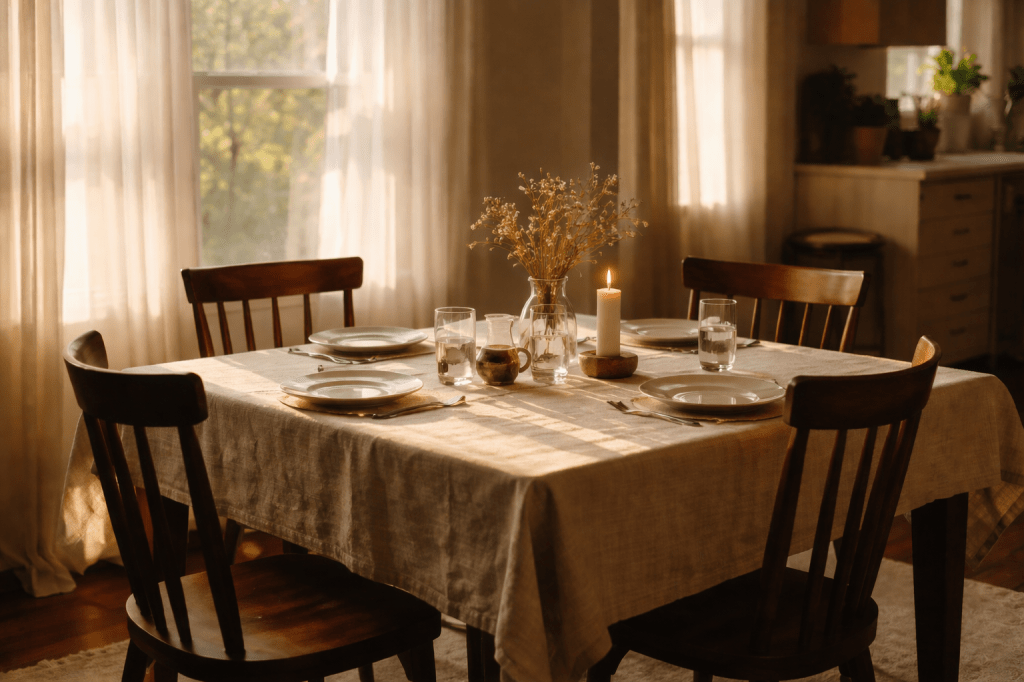
    Sit down with people who know you.

    People who don’t need a menu to understand you.

    The table doesn’t need much.

    Just a place.

    A little time.

    Someone willing to share it.

    That might still be enough.

    Kyle J. Hayes

    kylehayesblog.com

    If this found you at the right time,

    Feel free to like, comment, or share it with someone who might need it too.

    Resources for Hard Times

    If you’re looking for practical help, food support, or community resources, you can visit the Salt, Ink & Soul Resources Page.
    👉 Resources for Hard Times

  • “Questions for the Future”

    “Questions for the Future”

    There’s a kind of fear that doesn’t arrive all at once. It doesn’t kick down the door. It seeps in, like humidity through cracked paint or smoke through the seams of a closed window. The kind that makes a home in your chest, building slowly and silently. That’s the kind of fear I’ve had about writing.

    Because writing—real writing—isn’t just performance. It’s not what you show them. It’s what leaks out in the spaces you don’t control. In the metaphors you didn’t mean to use. The slip of a memory. The softness in a sentence when you swore you were being strong. That’s the terror. That somehow, on a blank page, people will see you—unasked, unfiltered, unprepared.

    And I’ve been dodging that kind of exposure for a long time.

      You grow up learning to hide parts of yourself. In some neighborhoods, vulnerability is just another way to get hit—emotionally, spiritually, or with something less metaphorical. So you learn. You get good at it. You make armor out of silence and humor out of pain. You laugh loud enough to drown out the parts of yourself you don’t want heard.

      For me, it started early—ridiculed for being soft. For caring. For feeling things too deeply. Every time I let something slip, there was a consequence. Sometimes it was teasing. Sometimes it was loneliness. Over time, the message became clear: protect yourself.

    So I did. I built walls with intention. Not just to keep people out, but to keep something in—me.

      Lately, though, I’ve started letting people in. Not the whole crowd. Just a few. Just enough. You find someone you trust—maybe a friend who knows the shape of your silence—and you let them see a little more. A crack. A draft of warmth. Not a storm.

    But still, I worry.

      Because once the dam is broken, who controls the flood?

    That’s the thing about pain: it’s obedient until it isn’t.

    So I let it out in trickles. A sentence here. A sigh there. I’ve convinced myself that’s safer. That if the moment goes sideways, I can slam the valve shut and pretend like I never said anything at all.

    I’m curious if that’s preservation or cowardice. Or both.

      Sometimes, the isolation feels like a weighted blanket that won’t get off my chest. You carry the weight of your untold stories like overdue bills, knowing the interest is accumulating. You pretend you’re just private. But privacy, in excess, becomes starvation.

    You tell yourself you’re protecting yourself—but at what cost?

    When no one knows your whole name, who will mourn you properly?

      That’s the mess of it. Writing—this act of storytelling—isn’t always about catharsis. Sometimes it’s confrontation. Sometimes it’s putting a mirror to your own face and realizing you’ve spent years looking away. The stories we don’t tell are often the ones we most need to understand.

    I write now not because I want to be known, but because I’m starting to believe that parts of me are worth knowing.

    And if someone out there reads this and recognizes their own mask, their own silence, their own slow-burning rage and resignation—maybe we’ve both done something that matters.

      I don’t have answers. Just questions for the future.

    What happens when you open too much?

    What happens when you never open at all?

    Maybe the trick isn’t to dam the flood or drown in it—maybe it’s to learn to wade.

    Even if it means revealing that you bleed just like everyone else.

    Kyle J. Hayes

    kylehayesblog.com

    Please like, comment, and share

    Resources for Hard Times

    If you’re looking for practical help, food support, or community resources, you can visit the Salt, Ink & Soul Resources Page.
    👉 Resources for Hard Times

  • A Love Letter to Potlucks, Church Basements, and Aluminum Trays

    A Love Letter to Potlucks, Church Basements, and Aluminum Trays

    Salt, Ink & Soul — Humanity Through Food Series

    There’s a special kind of magic that happens when a community decides—quietly, without fuss—that everyone needs to be fed.

    Not in some grand, official sense.

    Not with grants or committees or agendas.

    Just fed.

    Fed the old-fashioned way:

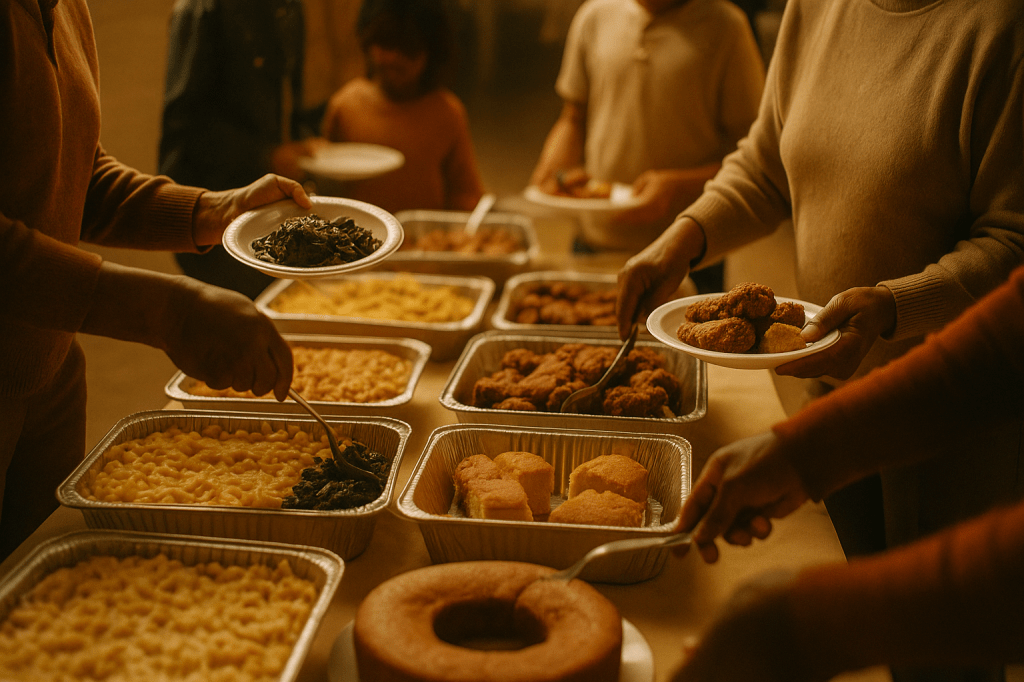
    On a folding table in a warm room that smells like memory, grief, pride, and somebody’s auntie’s best Fried Chicken.

    I’ve always had a soft spot for potlucks. Maybe it’s because people bring their best selves to those tables—literally. Every dish arrives covered in foil and hope, carried by someone who has spent the whole morning stirring and tasting and adjusting because they wanted to show what they could do. Not to brag. But to share.

    A potluck is a quiet confession:

    This is the dish I trust to speak for me.

    And there’s something beautiful about the way people place their food on the table and then pretend not to watch. They hover from a distance—not out of ego, but out of longing. Waiting for that smile. That small nod. That moment when someone tastes their dish and closes their eyes, just for a heartbeat, because something familiar touched them.

    You can’t buy that moment.

    You can only feed it.

    Church basements have their own flavor of truth.

    The ceilings are low. The chairs wobble. The lighting flickers. But none of that matters, because the food—the real food—is honest. Greens cooked down until they surrendered. Cakes that lean to the left but taste like heaven. Macaroni and cheese that could heal almost anything.

    People don’t come to impress in those spaces.

    They come to belong.

    They come to be held by the warmth of a room that has seen everything: baptisms, funerals, heartbreak, and survival. And in every season of life, the table stays set.

    Long before the world used terms like mutual aid, this was it.

    This was the safety net.

    This was how communities kept each other alive.

    No one asked, “What can I bring?”

    They asked, “Who needs to eat?”

    And somehow the table always balanced itself—one person bringing meat, another bringing bread, someone else bringing something sweet, and a few saints making sure the greens showed up so the ancestors wouldn’t fuss.

    It wasn’t organized.

    It was instinctual.

    Care doesn’t need a sign-up sheet.

    It just needs a kitchen.

    I think about those aluminum trays—the ones that bend if you hold them wrong. They don’t look like much, but they’ve carried entire histories. Weddings. Funerals. Reunions. Wednesday nights where people just needed a reason not to be alone.

    Aluminum trays are our generation’s scarred cast-iron skillets: humble, overlooked, essential.

    And they remind me of something I fear we’re losing in our digital, curated world:

    We were feeding each other long before we were performing for each other.

    A potluck isn’t content.

    It’s a community.

    It’s generosity without ceremony.

    It’s survival disguised as Sunday comfort.

    That’s probably why I love them so much.

    Because in a culture obsessed with individualism, a potluck is a rebellion.

    It says: We do this together.

    It says: Come as you are, and bring whatever you can.

    It says: There is room for you at this table, even if life hasn’t been kind, even if you feel small, even if all you could manage today was paper plates.

    Food has always been the language that makes room for the parts of us we don’t know how to name.

    So here’s my love letter—

    to the potlucks, the church basements, the community centers, the too-small living rooms, the aluminum trays carried in trembling hands.

    To the people who show up with their best dishes and their quiet hopes.

    To those who feed others before feeding themselves.

    To the tables that held us long before we had the words for what we were carrying.

    May we never forget how to gather like this.

    May we always remember that survival was never meant to be a solo act.

    And may we keep spreading these tables—wherever we can, with whatever we have—so no one has to face the world hungry, unseen, or alone.

    Kyle J. Hayes

    kylehayesblog.com

    Please like, comment, and share

    Resources for Hard Times

    If you’re looking for practical help, food support, or community resources, you can visit the Salt, Ink & Soul Resources Page.
    👉 Resources for Hard Times

  • Where the Fire Lives Now

    Where the Fire Lives Now

    Salt, Ink, & Soul — Albuquerque Notes

    So what now?

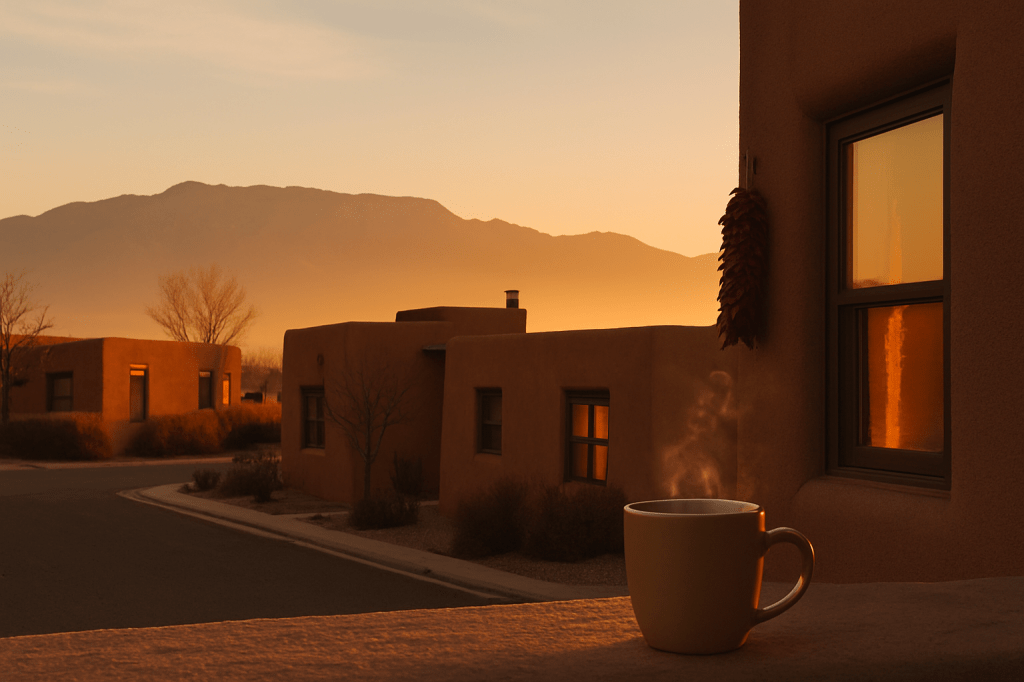
    The mornings feel sharper. The kind of air that bites before it kisses. The city exhales from weeks of color and noise, and what’s left is us — the ones who stay when the cameras leave. The ones who know the rhythm of this place when it’s quiet, when the wind has room to think again. Albuquerque becomes smaller in these weeks, but in a way that feels true. The traffic slows. The conversations drift toward what’s next: the cold, the holidays, the bills that never rest.

    It’s a different kind of work now.

    We pull coats from closets and test the heater before sunrise. We sweep the porch, watch the last leaves blow down Central, and start talking about green chile stew the way other cities talk about snow. The vendors pack away their tents. The small diners on Lomas fill again with regulars who know the servers by name. It’s quieter — but not empty. Just changed.

    Everywhere you look, people are preparing. For the cold. For the gatherings. For the weight of the months that close a year. The woman at the laundromat folds blankets that smell faintly of cedar. A man in line at Albertsons mutters about the cost of food. Someone carries a bag of tamales wrapped in a towel to keep them warm. In this city, even small talk turns to survival — not in the desperate sense, but the sacred one. How to endure. How to soften the edges of a hard season.

    That may be where the fire lives now, not in the spectacle or the season’s headline, but in the quiet gestures that keep life lit. The pan was warming on the stove before dawn. The neighbor is checking on an elder before the cold snap. The smell of roasted chile still lingering in backyards is proof that something good happened here and will again. The city glows from within, not above.

    Albuquerque people are built for this. For the ebb between celebration and solitude. For the ordinary days that still ask for presence. The heat of chile, the hum of space heaters, the scratch of ristras hanging against stucco walls — these are our small flames. We feed them daily, without thinking, and call it living.

    Outside, the Sandias sit there, massive yet intimate, like an old friend you’re used to ignoring until the seasons remind you she’s still here. The river runs thin but steady. Somewhere, a child’s jacket zipper sticks, and a parent sighs with the patience of love. It’s all so ordinary — and maybe that’s the point. The fire doesn’t need to be loud to mean something.

    The city keeps moving, slower now, softer. We return to work, to families, to whatever version of hope we can hold through December. The light fades earlier, but it carries a particular mercy with it — the permission to rest, to reflect, to begin again quietly.

    Where the fire lives now is in us — in every New Mexican who stays when the noise dies down. In the ones who keep the coffee warm, who open the shop before dawn, who find beauty in a simple meal shared under a cold sky. The spectacle was never the point. The people were.

    Kyle J. Hayes

    kylehayesblog.com

    Please like, comment, and share

  • When the Sky Empties: Remembering the Ground We Stand On

    When the Sky Empties: Remembering the Ground We Stand On

    When the last balloon disappears beyond the Sandias and the roar of burners fades into quiet, the city feels different. The sky, so alive just yesterday, now stretches bare and endless — as if catching its breath after carrying so much wonder. The fields that once pulsed with color and laughter have returned to stillness, the smell of dust and fried dough lingering in the cool morning air. Vendors pack their tents, families drive home, and the wind takes its time moving through what’s left — paper cups, flattened grass, and the memory of joy.

    I live here in Albuquerque, where Native American culture isn’t a festival you visit — it’s a pulse that moves through every day. You see it in the food — fry bread sizzling beside green chile stew — in the jewelry stands where turquoise catches sunlight like captured sky, and in the murals where ancestors watch from painted adobe walls. You hear it in languages that exist nowhere else, carried in song and conversation. This is the place where the Gathering of Nations fills the air each spring, where drums thunder and dancers move like prayers made visible — a spotlight on cultures that never stopped burning, even when the world looked away.

    So when Indigenous Peoples’ Day arrives, it doesn’t feel like an isolated moment — it feels like recognition of what’s always been. It’s a day that reminds us this land isn’t borrowed or bought; it’s lived in, sung to, and remembered. It honors those who first called these mesas home, who understood the sacredness of the earth beneath their feet long before any balloon lifted toward the sky.

    The irony isn’t lost on me — how one day we fill the heavens with color, and the next we honor those who’ve always found meaning in the ground. Maybe that’s the lesson of this timing: that flight and foundation were never intended to be separate things. The balloons rise because the land allows them to. The beauty of the sky depends on the reverence of the soil.

    Standing in the empty field, I feel both awe and humility. The footprints, the dust, the faint hum of the Rio Grande nearby — it all feels alive, like the land is reminding us that celebration doesn’t end when the sky clears. It just changes form.

    Maybe the trick isn’t to choose between the two — not flight or foundation — but to remember that we rise best when we know what we’re rising from.

    As the sun warms the quiet city, I watch one last balloon drifting alone, far to the east — small, defiant, and free. And I think of next year, when the sky will once again bloom with color, and the land will hold us steady beneath it all.

    Because here, in Albuquerque, both sky and soil have stories. And we honor them best when we remember we belong to both.

    Kyle J. Hayes

    kylehayesblog.com

    Please like, comment, and share

  • The People Who Make the Sky Possible

    The People Who Make the Sky Possible

      We always start with the balloons. It’s hard not to; those floating colors command the horizon, pulling the eye upward until you forget your neck is sore. We discuss the chase trucks, their history, and the roots of flight in France and its rebirth in the soil of New Mexico. We speak of mass ascensions and Dawn Patrol, of Darth Vader and cows and hearts suspended against the dawn. But beneath all of it—the fabric, the burners, the photographs—is something more ordinary, and maybe more sacred: the people.

    Not just the pilots, not just the crews. The others.

    The volunteers, for instance, who rise earlier than even the birds, long before the sun thinks of climbing over the Sandias. They are there in the half-dark, directing traffic, holding ropes, keeping the rhythm of a ritual that looks effortless only because someone else made it so. They do this not for glory or paychecks, but because something within them decided that one week in October was worth sacrificing their sleep and time to help thousands of strangers feel wonder. They are the kind of people who disappear into the background, allowing the balloons to dominate the frame. And yet without them, there is no frame at all.

    Then there are the vendors. Their labor is not spectacle—it is fuel. They stand in lines of steam and scent, ladling out hot coffee, burritos, and sweet pastries to crews, balloonists, and wide-eyed tourists who arrive before dawn. They are there in the cold, their hands working the heat of the griddle while we marvel at the heat of the burners. They remind us that even awe requires calories. That memory is easier to hold when your fingers are warm against a paper cup.

    But the Fiesta isn’t confined to the field. For nine days, Albuquerque becomes a host. Visitors don’t only look up; they wander sideways. They move through Old Town’s adobe walls, tracing steps along Route 66, ducking into shops where turquoise glints under fluorescent light. They pause to listen to a drumbeat in a plaza, to hear the echoes of Native voices that remind them this land has been witness to centuries before balloons ever grazed its skies. They sit in diners and brewpubs, ask about “red or green,” and learn the shorthand of a state where chile is not just food but language, not just spice but identity.

    That’s what we forget when we reduce the Fiesta to balloons alone: it is not just a celebration of flight. It is a celebration of place. A city, a state, a culture flinging its doors wide and saying Come see us, come taste us, come know us. For nine days, New Mexico is not an afterthought on a map but the center of the world’s gaze. People arrive from Japan, Brazil, Wisconsin, Bristol, China, and Kenya. They stand shoulder to shoulder with locals, their accents colliding over green chile stew. And when they return home, they carry with them more than pictures of balloons—they carry New Mexico itself: the food, the hospitality, the community that rose as surely as the balloons did.

    I think about this often: balloons drift. They rise, they scatter, they vanish into the horizon. Their beauty is in their impermanence. But the people—the ones who cook, who sell, who welcome—are the tether. They keep the Fiesta from being only about what escapes into the sky. They anchor it in the soil, in red earth and chile smoke, in the hands that hand you coffee at dawn.

    Nine days in October. That’s what it is. Nine days when the world’s compass needle swings toward New Mexico, and all those who live here become part of something larger than themselves. Not by flying, but by feeding, guiding, welcoming, and reminding. The sky may belong to the balloons. But the heart of the Fiesta—always, inevitably—belongs to the people.

    By Kyle J. Hayes

    kylehayesblog.com

    Please like, comment, and share