Author: Kyle Hayes

  • The Quiet Battle: On Becoming Better Than I Was Yesterday

    The Quiet Battle: On Becoming Better Than I Was Yesterday

    There’s a war I’ve been waging for as long as I can remember. It’s not loud. It doesn’t wear camouflage or march in boots. It’s fought in quiet rooms, in the space between my reflection and my own gaze, in the long corridors of thought I walk every day. The battle is simple to name but hard to win: to be better than I was yesterday.

    For a long time, I fought it alone. There were no comrades beside me, no voices urging me forward when I stumbled, no hands to lift me when I fell. My victories were small and private, my defeats heavy and unshared. The silence was both armor and prison.

    But something shifted. Somewhere between the sunburnt mesas and the high desert air, between the way the light bends differently over these mountains and the way the nights here are cut by the howl of wind, I found people. They don’t know they’re helping me in this fight, but they are. In their words, in their presence, in the way they remember to ask how I’m doing and care enough to listen to the answer.

    It’s strange, almost unsettling, to feel cared for as an adult — especially when you’ve lived most of your life believing that kind of thing was for other people. There’s a vulnerability in accepting it, a quiet fear that it could disappear as suddenly as it came. But there’s also gratitude. Deep, marrow-deep gratitude.

    Why here? Why Albuquerque, of all places? I can’t say for sure. It could be the geography, or maybe it’s luck, or perhaps it’s something bigger than me. I know there’s crime here — but there’s crime everywhere. Here, no earthquakes are shaking the foundation beneath your feet, no hurricanes tearing the sky open, no floods swallowing the streets whole. Tornadoes don’t come to claim the horizon. Fires, yes — but distant, mostly. The air is dry, free of the heavy hand of humidity. The summers don’t melt you into the pavement, the winters don’t turn you into stone. It’s a place that feels like a compromise between danger and peace, a delicate balance between extremes.

    However, the real reason may be more difficult to pinpoint. It could be because here, in this city cut into the desert, I’ve been able to fight my battle differently. Not alone. With quiet allies I never knew I’d have. With a sense — still fragile, still new — that maybe being better than I was yesterday isn’t just about survival. Maybe it’s also about connection.

    And that’s worth staying for.

    By Kyle J. Hayes

    kylehayesblog.com

    Please like, comment, and share

  • The Erosion of Empathy: How Modern Culture Profits from Our Disconnection

    The Erosion of Empathy: How Modern Culture Profits from Our Disconnection

    There was a time when the measure of a man — or a woman — was found not in the size of their following or the polish of their online image, but in the quiet and consistent act of showing up. I wrote about this recently, about the sacred obligation of standing beside a friend or loved one when the air is heavy and the road is hard. I thought it was simple and uncontroversial. But the responses — some of them sharp and cynical — told me otherwise.

    Somewhere along the line, “showing up” became suspect. An intrusion. A threat to the self-sufficient myths we’ve been sold. Our culture now thrives on the idea that we don’t need each other. That independence is the highest virtue, and connection is optional. This isn’t by accident. There’s money to be made in our isolation.

    Once, the things we needed most — counsel, comfort, the passing down of wisdom — were woven into the fabric of family, neighbors, and community. Now, those things are outsourced. We buy courses instead of seeking out elders. We pay for subscription boxes to send meals rather than cooking together at home. We hire therapists — valuable as they are — because we no longer know how to lean on a friend’s kitchen table at midnight, coffee going cold, until the words finally spill. We have apps to tell us when to breathe because no one close enough is there to notice when we’ve been holding our breath for days.

    The machine prefers it this way. The less we depend on one another, the more we can be sold.

    And the machine has its willing prophets — reality TV, dressed up as truth, but built on humiliation and betrayal. Shows that turn infidelity, family fractures, and public shaming into plotlines. We applaud contestants for cutting each other down because we’ve been told that winning matters more than being whole. Our entertainments train us to cheer for isolation, to accept the destruction of trust as inevitable.

    Even violence — the kind that once would have driven people into each other’s arms — is now another currency. We scroll past death in high definition, processed into algorithm-friendly clips, sandwiched between memes and ads for things we don’t need. It echoes the old coliseum, except now the arena is digital, and the crowd doesn’t even have to leave the couch.

    And then there’s AI. It promises efficiency, companionship, and even creativity. But beneath the marvel, there’s a subtle and dangerous bargain: if we can outsource our conversations, our art, our thought, we can also outsource the messy, difficult work of being human together. What happens to empathy when we can simulate its language without its labor? When our words are polished but our hearts stay untouched?

    This erosion of empathy is not just a cultural inconvenience — it is a slow unspooling of the threads that hold us together. Without them, mental health frays. Communities collapse. The moral muscle that once made us rush to the side of a grieving friend weakens from lack of use.

    Showing up — in person, in spirit, with presence — has never been about convenience. It’s about resistance. Against a culture that profits when we stay alone. Against the idea that our worth can be measured in clicks and comments. Against the creeping belief that we can do without one another.

    Showing up still matters. Maybe more than ever. And I am still stunned that anyone would argue otherwise. But I also know that, in a world where connection is commodified, showing up is an act of quiet rebellion.

    The question is whether we are willing to rebel. Whether we are willing to remember that no app, no feed, no AI can replace the feel of someone’s hand on yours when you can’t speak. Whether we are willing to reclaim what we’ve lost before the last of it slips away, sold back to us at a premium.

    Because if we’re not — if we continue to mistake isolation for strength — the erosion of empathy won’t just be complete; it will be irreversible. It will be irreversible.

    By Kyle J. Hayes

    kylehayesblog.com

    Please like, comment, and share

  • The Weight of Showing Up

    The Weight of Showing Up

    In Two Birds, One Road, I wrote about the quiet importance of simply being there—about how showing up can matter more than any polished speech or perfect gesture. Lately, that truth has pressed heavier against my chest.

    It started with something I saw on television. An airman, just graduated from basic training, stood alone in formation. Families swarmed around others—hugs, laughter, the chaotic joy of reunion. But he stayed rooted in place, scanning the crowd for a face that never appeared. Until a stranger, seeing what should not have been, stepped forward to tap him out. It was an act of kindness, yes, but one born of a glaring absence.

    I know that absence too well.

    When I graduated from high school early, I went straight into the military. On the day of my departure, I sat in an empty house waiting for my recruiter to pick me up. No one hugged me goodbye. No one told me they were proud. I carried my own bags to the bus station, the silence trailing me like a shadow. That kind of loneliness doesn’t leave quickly—it carves out a space in you.

    It’s part of why I try so hard to show up now. To be the kind of presence I once needed. But showing up isn’t always easy for me. Crowds set my nerves on edge. The press of bodies, the overlapping voices, the restless energy—they fray something in me. My instincts tell me to avoid it, to stay in the quiet where I can breathe. And yet, when someone I care about has a moment worth witnessing, I make myself go.

    Sometimes that means gripping the steering wheel tighter than I should, rehearsing what I’ll say when I walk in. It means steadying my breath as I step into a room where the noise swells and my pulse quickens. It means feeling my throat tighten but staying anyway—standing in that space because my discomfort is not more important than their moment.

    I’ve driven to ceremonies, funerals, celebrations—times when joy or grief filled the air so thick it felt almost physical. I’ve stood in crowds with my heart racing, willing my hands not to shake, because I refuse to let the people I care for stand alone.

    Showing up doesn’t erase the mornings I sat by myself, waiting for someone who never came. But it’s how I keep that emptiness from spilling into someone else’s story. It’s how I say: You matter. I am here. 

    Because I know, better than most, that sometimes the greatest gift you can give is your presence—uncomfortable, nervous, imperfect, but real.

    By Kyle J. Hayes

    kylehayesblog.com

    Please like, comment, and share

  • Two Birds, One Road

    Two Birds, One Road

    Hello.

    If you’ve read my words before, you already know—I don’t go out often. Not in the way people mean when they talk about “getting out” as a lifestyle. I don’t float from brunch tables to crowded patios, nor do I glide through farmers’ markets with tote bags heavy with fresh basil and conversation. I have to make myself go out. Sometimes I have to bargain with myself, like a parent coaxing a child out from behind a locked bathroom door. I’ll say: It’s just for an hour. You might even enjoy it. But most of the time, the weight of silence wins.

    Earlier this week, I had a plan. A road trip. Nothing grand—just the promise of motion, listening to some good Road Trip music, and visions of a horizon pulling me forward. But sickness found me first. It crept in the way it always does: slow enough to ignore at first, fast enough to take the whole day hostage. So the trip was shelved, another pin in the corkboard of things I’ll get to eventually.

    But today was different. Today, I found myself behind the wheel again, heading north to Rio Rancho for a Pinning ceremony—a milestone for my friend Ralph. Not just any milestone, but the culmination of years of work that most people wouldn’t survive, let alone endure. He put in hours that stretched into the small, skeletal hours of morning when most of us are asleep and dreaming. He worked shifts that bled into each other until time stopped feeling linear—just a long, unbroken stretch of effort. Weekends vanished, holidays blurred, and what little rest he got came with the weight of what still needed to be done. He trained, studied, and pushed through exhaustion that could crush a lesser will.

    And now, here he was—standing in front of a room filled with people, receiving a pin that meant he made it. That every bleary-eyed morning, every missed gathering, every hour spent grinding when others would have quit, had led to this moment.

    Rio Rancho isn’t far, not really. It’s no cross-state odyssey. But somewhere between the last stretch of I-25 and the city’s wide, sun-bleached streets, I started thinking: distance isn’t the measure of a road trip. It could be the leaving. It could be the act of turning the key, of trusting the road to change you, even in ways you won’t notice until later.

    The ceremony itself was a tide of voices, pressed uniforms, and the scent of starch in the air. Ralph stood at the center, that pin catching the light. Pride radiated from him—not the loud, brash kind, but the deep, quiet pride of someone who knows exactly what it cost to get here.

    I thought about the bargain I made with myself: Go see your friend. Stand in that room. Then you can retreat. But standing there, I realized I’d already doubled the wager. I wasn’t just showing up for him; I was showing up for me. I was in motion again—out of the house, into the mess and warmth of other people. Two birds with one stone.

    Driving back, the city falling away in my rearview, I felt lighter. Not in the euphoric way people talk about “getting out of your comfort zone.” This was quieter, less photogenic. A reminder that life doesn’t just happen in the grand gestures or the far-flung miles. Sometimes it’s in the short drives, the small rooms, the simple act of showing up for someone who has fought their way to a moment worth celebrating.

    Maybe Rio Rancho counts as a road trip. Perhaps it doesn’t. But for today, it was far enough to leave myself behind for a while—and close enough to witness a friend’s hard-earned triumph, one that made the journey worth every mile.

    By Kyle J. Hayes

    kylehayesblog.com

    Please like, comment, and share

  • “The Taste of Absence”

    “The Taste of Absence”

    I’ve never had the kind of kitchen childhood you read about in cookbooks or see in those nostalgic food documentaries. There was no grandmother with her sleeves rolled up, coaxing flavor from a pot as if she were bargaining with the ancestors. No father at the grill, the smell of charred meat mixing with family stories. No kitchen table where lessons were passed down between sips of coffee and the hum of a Sunday morning.

    Mostly, I was told to move.

    To get out of the way.

    To stop interrupting the real work.

    So the kitchen, for me, wasn’t an inheritance—it was a place I learned to enter only later, uninvited, and only by figuring it out for myself.

    What I know now, I built from trial and error: burnt onions, overcooked rice, chicken so dry it could survive a desert. I took classes under the buzzing fluorescent lights of community kitchens, where the instructors spoke in ratios and knife techniques, not the language of memory or home. I learned the steps, memorized the recipes, but there’s no ghost of a past meal in my hands. No lineage guiding my fingers. No taste of childhood in the sauce.

    I have a friend—let’s call her Maestra. She is Filipino, and in her kitchen, the air bends around her as if it has known her all her life. Watching her cook is like watching an orchestra conductor who also happens to be a storyteller, a diplomat, and the beating heart of a gathering.

    On her stove, several pots and pans move toward perfection in unison—adobo simmering slow, pancit tossed with just the proper tension, coconut milk thickening in a ginataan, a pot of sinigang steaming the windows. She weaves in and out between them, stirring, seasoning, and tasting without missing a beat in the conversation about Food, family, or some memories from the philipines. She doesn’t measure—she knows.

    When she plates her Food, it’s never just a dish—it’s a table alive with history. Her flavors speak of islands, migration, resistance, and celebration. The dishes arrive all at once like a chorus in perfect harmony.

    Me? I sweat over one plate at a time, reading the recipe as if it’s a bomb-disposal manual. Every step feels like another chance to fail. When I’m done, I have something edible, sometimes even good—but it’s a solo note, trembling in the air next to her symphony.

    I ask myself: Can you become great without the memories? Without the childhood smells and tastes baked into your bones?

    We’re told that the greats carry the kitchens of their past inside them—that every dish is just a retelling of something they’ve tasted a thousand times before. And maybe that’s true. Perhaps the secret ingredient is memory itself —a thing you can’t teach, can’t buy, and can’t fake.

    But I know this: technique can be learned. The hand can be trained to cut more finely, and the palate can be trained to notice balance. Timing can become muscle memory. Recipes can be mastered and perfected.

    What’s harder is closing the gap between cooking Food and cooking yourself into the Food.

    Maestra doesn’t think about her cooking—it’s an extension of her body, her mind, her history. I have to construct mine, brick by brick. She inhabits her kitchen; I visit mine like a tourist with a guidebook in hand.

    So the question isn’t whether I can be as good as her.

    Perhaps it’s whether I can make cooking something I belong to, rather than something I rent for the night.

    If I have to work twice as hard, does that mean I will always achieve less? Or does it mean my dishes, though born without heritage, might one day carry a different kind of truth—one built not from tradition, but from grit?

    Because there is a strange kind of beauty in building a craft from nothing. In learning to stand in a space you were once told wasn’t yours. In finding your own voice in a language you had to teach yourself.

    The greats will always have their inherited symphonies. I may never match them in that. But maybe—if I keep showing up to the stove, keep burning, failing, and trying again—I can compose my own kind of music.

    It won’t taste like hers.

    It won’t sound like hers.

    But it will be mine.

    And maybe, one day, someone will watch me cook and think it looks like music, too.

    By Kyle J. Hayes

    kylehayesblog.com

    Please like, comment, and share
  • Beneath the Steam: On Illness and the Old Ways

    Beneath the Steam: On Illness and the Old Ways

    It began like a thief who knew my schedule better than I did—slow, deliberate, testing every door before finding the one left unlocked. A scratch in the throat. A heaviness in the limbs. The faint suspicion that breathing had become less casual, less thoughtless, than it had been yesterday. I told myself I’d push through. I said to myself that sickness is for other people, those who have the time for it. But sickness does not bargain. By midweek, it had settled in fully, an uninvited tenant pressing down on my lungs, hijacking one of the things I hold dearest—my taste.

    Something is humbling about losing your sense of taste. I have crossed oceans for flavor. I have eaten in alleys and palaces alike, chasing the elusive truth of a dish. Food, to me, is not just sustenance—it is memory, culture, love made tangible. And now it was gone. My morning coffee could’ve been hot water from a radiator. My favorite bowl of ramen tasted like broth poured through gauze. Even the memory of taste felt muted, as though my brain were looking for a file that had been deleted.

    We live in an age where you can treat almost anything with a credit card and a ten-minute visit to the pharmacy. Pills for the fever, sprays for the throat, syrups that coat the lungs in menthol haze. Convenience at the ready. But the best cures—the ones that live in the marrow of memory—require no prescription. For me, it begins with green tea, lemon, and honey. My mother’s go-to remedy. The scent alone brings her into the room: the citrus brightness cutting through the air, the floral sweetness of honey sinking into the steam, the earthiness of green tea grounding it all. She swore by it. I still do.

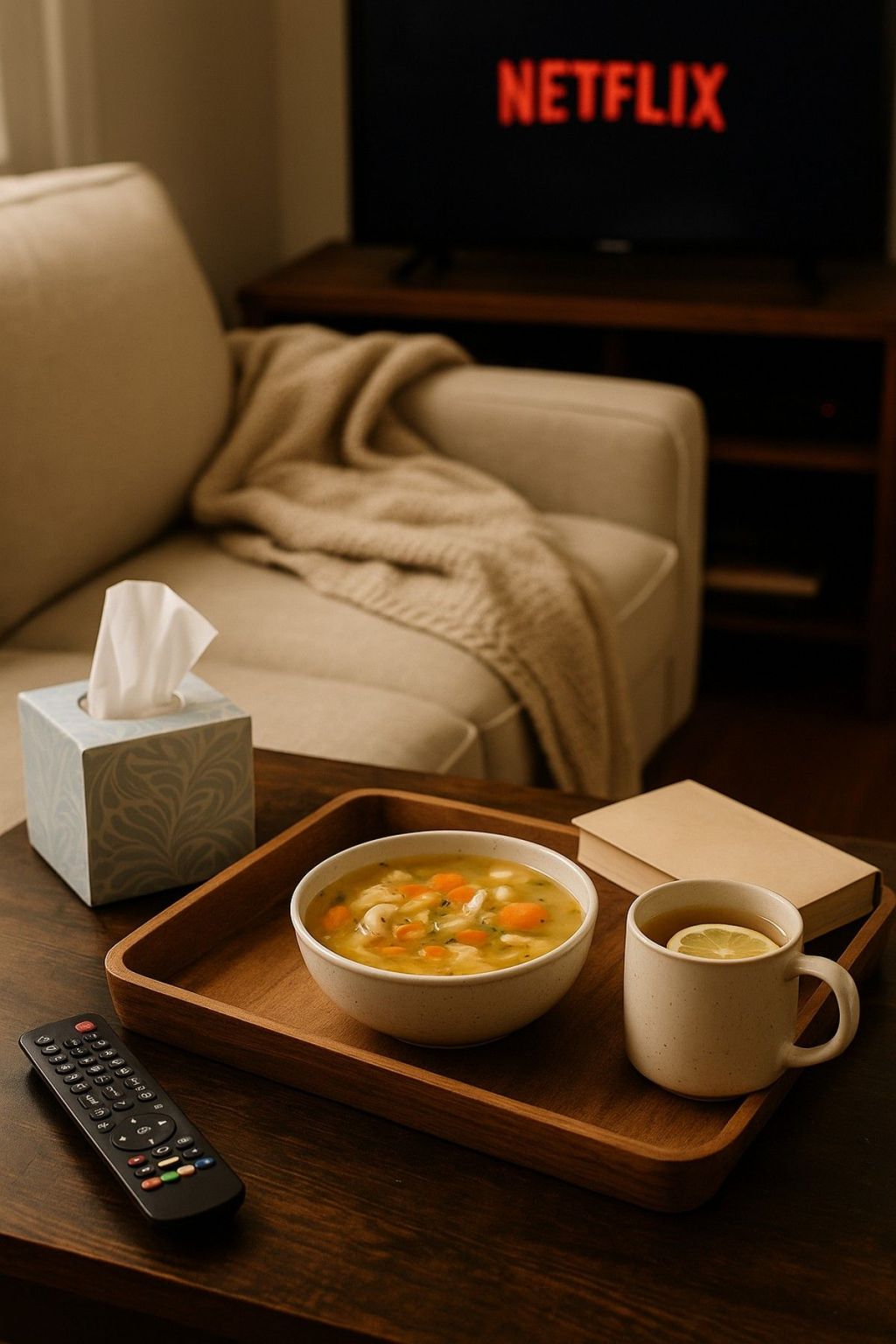
    And then, there is chicken soup. I’ve traveled the country, eaten at the tables of strangers, but if America has a single unifying folk remedy, it is this. In Southern kitchens, Italian kitchens, and even kitchens in California, it’s the same idea, different dialects. Chicken, water, vegetables, salt. Sometimes noodles, sometimes rice. Always the intention to heal. And it works. I don’t know if it’s the steam easing the lungs, the broth coaxing warmth back into your bones, or the simple fact that someone cared enough to make it. But it works.

    There’s a ritual to it. Once the soup is simmering, you find your spot. For me, it’s the sofa, where the sun pools in late afternoon. Pillows arranged just so, blanket at the ready. A remote within arm’s reach, Netflix queue prepared to swallow the next several hours. This is not indulgence; this is convalescence. You let the warmth from the bowl linger in your hands before each spoonful, breathing in the scent as if it were a prayer. You sip slowly, allowing the broth to seep into the cracks that sickness has made in you.

    Recovery isn’t just about medicine. It’s about surrender—admitting that you are, in fact, mortal, and in need of care. It’s about allowing yourself to slow down, to be still, to let the old ways work their magic while the world spins on without you. Green tea and lemon. Honey. Chicken soup. These are not just cures for the body—they are acts of remembrance, of connection to the people and places that shaped you. They remind you that before we had walk-in clinics and urgent cares, we had each other. And sometimes, that was enough.

    By the time my taste returns, I know the sickness will already be loosening its grip. But the tea and the soup will remain, as they always have, waiting for the next time life reminds me that I am breakable—and that the cure is as much about being fed as it is about being healed.

    Click here for the full chicken soup recipe

    https://kylehayesblog.com/simple-garlic-chicken-soup/

    By Kyle J. Hayes

    kylehayesblog.com

    Please like, comment, and share
  • The Roads of NewMexico

    The Roads of NewMexico

    I do not go out as much as I should. I have learned to live with the quiet corners of my home, to accept the stillness as both refuge and weight. The city’s hum, with its restless people and anonymous noise, is sometimes too much—like standing in a crowded room where the air feels claimed before I can breathe it in. Out there, in the public world, I sometimes feel like I am trespassing on a story that was not written with me in mind.

    And yet, some roads call to me.

    I am from farm country, where the land stretches wide enough to hold every thought you’ve been avoiding. Out here, beauty is not a spectacle but a constant, a birthright of the horizon. The sky spills itself in all directions, unapologetic, while fields—golden in some seasons, green in others—move gently under the wind’s persuasion. You learn, if you grow up here, that beauty is not always something you chase. Sometimes it is something you stand still for.

    But when the itch for movement comes, when the air in my lungs feels stale from sameness, I take to the road, not for the chatter of tourist shops or the curated charm of main streets, but for the wide‑open arteries that connect this land’s beating heart.

    Once, the road took me to Santa Fe. The church stood there in quiet defiance of time, its walls holding centuries the way the land holds roots. I didn’t linger. I didn’t wander through galleries or sip coffee in some sunlit corner café. I came for the church, and once I had seen it—once I had my proof in the form of photographs—I left. It wasn’t a snub to the city. It was more like an instinct: I had come for one truth, and once it was in my hands, I needed the road again.

    The next pull was Taos, where I saw the earthship homes—structures like prayers whispered into clay. They are born of the land and return to it, designed for self‑sufficiency, for a way of living that doesn’t ask the earth for more than it can give. I toured them, let my hands trace the walls, and wondered how many of us truly know how to live with the earth instead of on it.

    On my way back, I stopped at the gorge. They call it breathtaking, but “breath‑stealing” is closer to the truth. One moment you are on solid ground, and the next the earth has opened its jaws before you, deep and indifferent. I felt my stomach fall, my body pull back. It was too much—too wide, too high, too close to the idea that we are small and fragile. That was the end of my trip. I let the road fold back into itself and carry me home.

    There are other routes in New Mexico, I’m told. Places where the land tells its own version of scripture—mountains that seem older than time, desert plains that remember the tread of people who came long before us. I want to see them. Not for the itinerary or the postcard moment, but for the quiet it might stir in me. For the way the road, with all its curves and stretches, might teach me something about moving forward even when the destination is unclear.

    The truth is, I am not searching for new places as much as I am searching for new ways to inhabit myself. Each mile is less about escape than about arrival—the slow unfolding of who I am when I am far from the rooms that have learned my silence too well.

    So if you know the roads in New Mexico—roads that are not just scenic but soulful, roads where the wind speaks and the earth listens—I am listening too. Because the journey is never just the land you cross. It is the terrain you carry inside you, waiting to be mapped.

    By Kyle J. Hayes

    kylehayesblog.com

    Please like, comment, and share
  • “Hunger Without End: On Gluttony, Illusion, and the Ache Beneath Our Shine”

    “Hunger Without End: On Gluttony, Illusion, and the Ache Beneath Our Shine”

    We were taught to consume.

    Not just food, but image.

    Not just goods, but symbols.

    And when the goods were kept from us, when the symbols were gated behind color lines and zip codes and unspoken rules, we carved our hunger into a religion.

    We baptized our children in a name-brand.

    We anointed ourselves in oil and gold—some real, some not.

    And somewhere in the soft blur between lack and longing, between what we were told we could never have and what we dreamed we could hold, we lost the ability to tell the difference between wealth and its costume.

    This is gluttony—not of appetite, but of aching.

    A consuming of things to quiet the absence.

    And the Black body, especially the Foundational one, has been trained to perform this pageant of possession for survival and pride alike.

    I’ve seen the gleam of a gold chain reflect the face of a boy who hasn’t eaten.

    I’ve watched a girl unzip a thousand-dollar purse in a home where the lights flicker.

    I’ve heard engines roar from cars bought with back-breaking hours, only to idle outside crumbling apartments owned by people who never stepped foot on the block.

    This is not mockery. This is mourning.

    Because none of it is accidental.

    They built us a hunger.

    They stole land, language, family, and future, leaving behind hunger.

    They gutted neighborhoods through redlining, zoning, and predatory loans.

    They made it illegal for us to buy homes in the same cities we built.

    They passed down violence through policy and called it economics.

    And when we looked around at what little we had, we did what any scarred people do: we reached for shine.

    If they wouldn’t let us live in their luxury, we’d bring the illusion of it into our closets.

    We’d wear it like armor.

    We’d measure ourselves not by equity or ownership, but by how much we could afford to spend in a weekend.

    The bag on the table became the dream deferred.

    The belt buckle became the new birthright.

    The car became the crown.

    Even if the lease costs more than the rent.

    Even if the address was still subsidized.

    Even if the neighborhood fell apart as we sped through it.

    But it’s not just economics. It’s spiritual.

    Gluttony—absolute gluttony—isn’t about food or fashion.

    It’s about a soul that no longer believes in enough.

    It’s a bottomless wanting.

    A kind of despair that arises because it cannot be built.

    That consumes because it cannot heal.

    That hoard because it cannot rest.

    In our community, this manifests in patterns that appear to be pride but are actually rooted in pain.

    We spend on the visible because the invisible feels like failure.

    We reject home ownership because we’ve been evicted from history itself.

    We distrust banks, land, and institutions because they’ve burned us for centuries.

    So we trust what we can carry.

    What we can wear?

    What they can see.

    And yet, the question remains:

    Who are we feeding with all this performance?

    What hunger are we really trying to satisfy?

    Is it the hunger for love we never got?

    For dignity we were denied?

    For recognition, power, presence?

    Gluttony, unchecked, eats through the village.

    It turns neighbors into competitors.

    It replaces mutual aid with envy.

    It leaves no room for wisdom, only impulse.

    And when the high wears off—when the car note’s late and the purse is out of season—we are left again with that same ache. That same emptiness. That same stillness where self-worth should have been planted.

    But this isn’t where the story ends.

    We are still the descendants of builders.

    Still, the children of people who knew how to sew dignity into rags.

    Still, the bloodline of men and women who understood that legacy is not found in what you wear, but in who you lift.

    The solution is not shame.

    It’s not judgment.

    It’s remembering.

    Remembering that wealth is not a symbol—it is a tool.

    That a home passed down is worth more than a car driven alone.

    That the quiet power of ownership outlives every designer label.

    A neighborhood invested in is worth more than a vacation post.

    And that healing will never be sold in stores.

    Healing is slow. It is communal. It is spiritual.

    We do not lack style. We lack the space to grieve.

    And so we dress up the grief.

    We perform it with leather seats and champagne flutes.

    But beneath it all—beneath the chrome and the chain and the tag—there is still a child, still a people, still a history asking:

    What if enough was never what they told us it was?

    What if enough of us remember who we really are?

    By Kyle J. Hayes

    kylehayesblog.com

    Please like, comment, and share

  • Should We Forget, Remember, or Just Move Forward? On Grief, Ozzy Osbourne, and the Ghosts We Keep

    Should We Forget, Remember, or Just Move Forward? On Grief, Ozzy Osbourne, and the Ghosts We Keep

    Some weeks feel heavier than others. Not because the calendar says so. Not because tragedy itself is rare—death moves through every week like fog. But because sometimes loss has a shape, a face, a voice you didn’t realize had been echoing in the corners of your life until the silence arrives.

    This week, we lost two.

    One was known more for music. The other, for acting.

    Both architects of something bigger than entertainment culture.

    And one of them was Ozzy.

    Ozzy Osbourne.

    Lead singer of Black Sabbath.

    Rock god.

    Sabbath’s frontman.

    The man who growled verses that sounded like scripture torn from a post-apocalyptic Bible.

    The soft-speaking Brit whose singing voice sounded clearer than his speech.

    The one who turned chaos into chorus.

    I wasn’t a disciple. I didn’t wear the T-shirts or memorize the track lists.

    But I knew Ozzy.

    That’s the thing about culture—you don’t have to invite it in for it to sit down in your house.

    You could’ve never bought an album and still know the riffs of “Iron Man.”

    You could’ve avoided MTV and still felt the Osbournes crawling across the pop landscape.

    You didn’t have to watch the show to be caught in the blast radius of what it pioneered: celebrity confession as spectacle. The camera lens as altar.

    Ozzy was always there, somewhere between myth and meme.

    Slurred sentences, eyeliner, doves, bats, and blurred subtitles.

    A walking contradiction—strange, chaotic, fragile, funny, wild, legendary.

    And now he’s gone.

    And I find myself asking the question that grief always drags behind it:

    What do we do now?

    Do we forget?

    Do we remember?

    Or do we simply move forward?

    The Gen X in me tends to lean toward forgetting. We were built to press forward, to walk away from burning buildings and collapsing ideas.

    We buried our childhoods in cassette tapes and camcorder memories.

    We watched the world grow louder, faster, and messier, and we learned to keep moving.

    Because that’s what survival looked like.

    But forgetting has a cost.

    And sometimes that cost is ourselves.

    So I try to remember.

    Not just the famous bits—the hair, the stage presence, the controversy.

    But what did his existence mean to a culture that was always looking for an edge?

    Ozzy didn’t just perform chaos.

    He was the chaos.

    And somehow, he turned that chaos into art.

    That, to me, is the lesson.

    He didn’t tidy up his pain for mass consumption.

    He screamed it.

    He played it at maximum volume.

    He lived it—and maybe stumbled through it—but he offered it to us without polish or apology.

    And that makes me think about grief in a different way.

    The point isn’t to forget, or even to remember perfectly.

    Maybe it’s simply to hold space—however messy, however incomplete.

    We remember not because it makes us better archivists, but because remembrance is resistance to the idea that people disappear completely when they die.

    We carry them forward—not in perfection, but in pieces.

    A lyric.

    A laugh.

    A guitar riff that rides the back of your throat when the room goes too quiet.

    A moment in the car when the radio plays something old and loud and reckless and suddenly you’re sixteen again, unsure of everything but the volume.

    So what now?

    Now, we grieve.

    Now, we say Rest in Power to the legends and the lost.

    Now, we play the songs we half-remember and let them soundtrack the ache.

    And then, yes—we move forward.

    But we move forward with ghosts.

    We let them walk beside us.

    We let them interrupt the silence with memory.

    We let them whisper in the spaces where culture once gave them a stage.

    Because in the end, grief is not a detour.

    It’s not the opposite of progress.

    It’s part of the road.

    And we don’t heal by forgetting.

    We heal by carrying well.

    Rest in peace, Ozzy.

    You howled your way into the marrow of a generation.

    We heard you.

    And in our own way—we won’t forget.

    By Kyle J. Hayes

    kylehayesblog.com

    Please Like, comment, and share

  • The Notes Between the Lines:   Malcolm-Jamal Warner, Miles Long, and Never Knowing

    The Notes Between the Lines: Malcolm-Jamal Warner, Miles Long, and Never Knowing

    I found out he passed the way we find out everything now—fast, impersonal,

    And I froze.

    Not because I was surprised that death comes—it always comes. Not even because of what I remembered of him as Theo—the boyish laugh, the missteps, the way he made failing seem soft enough to try again.

    I froze because I didn’t know I would miss him.

    I knew the actor. The icon. The cultural marker that helped redefine what it meant to be young, Black, and trying to find your place in a home that wasn’t perfect, but at least pretended to be.

    But I didn’t know the man.

    Not really.

    After the shock wore off, I did what so many of us do now when we grieve—I searched. Not through photo albums or eulogies, but online.

    That led me to Apple Music.

    I typed his name.

    And that’s when I found it.

    Miles Long.

    I didn’t know what to think at first. But no—it was him. His name. His band. His voice.

    Miles Long. A play on his full name. A double entendre wrapped in legacy and intention.

    I started at the beginning: The Miles Long Mixtape. Pressed play.

    And something strange happened.

    It wasn’t like discovering a new artist. It was like recovering a part of myself I didn’t know I had lost.

    The music pulled me into the 90s, yes—but not the polished nostalgia of playlist rewinds or streaming service suggestions. This was a lived-in sound. The kind of R&B and early Neo Soul that knew about heartbreak and healing in the same breath. You could hear the weight of lessons that never made it into scripts. You could feel the poetry of someone who had been quietly documenting what wasn’t televised.

    Basslines that whispered.

    Grooves that curled like smoke around memory.

    Lyrics that didn’t beg for attention—they just stayed.

    Like grief.

    Like wisdom.

    And I couldn’t help but ask: How did I not know this?

    How did I live under the illusion that he stopped at Acting?

    What does it mean that even in my admiration, I had still reduced him?

    We talk so much about giving people their flowers, but we rarely ask if we ever truly saw the full garden they were planting—quietly, consistently, in the cracks where cameras don’t go.

    Malcolm wasn’t chasing fame. He was chasing truth.

    And the music proves it.

    He wasn’t sampling culture. He was documenting it.

    In bass. In breath. In bars of spoken word so raw they sound like prayers.

    I listen now not as a fan, but as a student.

    As someone ashamed that it took death to open the album.

    As someone mourning not just the man, but the years I could’ve been learning from him and didn’t.

    There is a unique ache in discovering the depths of a person after they’re gone.

    It feels like theft.

    Not by them, but by time.

    By distraction.

    By the illusion that we know people just because we remember who they were on our screens.

    I didn’t know him.

    But I know something now.

    I know that he created art without seeking applause.

    I know that he raised a generation onscreen and then tried to heal that same generation with poems, melodies, and grooves that felt like balm.

    I know that Miles Long was more than a name—it was a statement.

    About the journey. About pace. About the distance between how we’re seen and who we really are.

    Tonight, I’ll play the mixtape again.

    Not because I’m trying to hold onto something, but because I finally showed up.

    And it is the most devastating beauty—to arrive late and still be welcomed by the work.

    I don’t know how to explain this grief.

    It’s not celebrity worship. It’s not nostalgia.

    It’s the sorrow of realizing you almost missed someone you should’ve known intimately.

    It’s the ache of belated recognition.

    It’s love, delayed—but no less real.

    Rest well, Malcolm.

    By Kyle J. Hayes

    kylehayesblog.com

    Please Like, comment, and share