
Tag: BlackHistoryMonth

  • Sweet Potato Buttermilk Pancakes with Bourbon Maple Syrup

    Sweet Potato Buttermilk Pancakes with Bourbon Maple Syrup

    There’s a reason certain combinations survive long enough to become myth.

    Chicken and waffles did not rise because it was clever. It rose because it was honest.

    In Harlem, long after midnight, musicians stepped off stages with their shirts still damp and their bones still humming. They wanted fried chicken. They wanted waffles. They wanted both. At places like Wells Supper Club, someone understood that hunger does not neatly divide itself into categories. Dinner or breakfast. Savory or sweet. Survival or joy.

    So they were given both.

    That instinct — to refuse narrowing — runs deep in our kitchens.

    It lives in the sweet potato.

    A root carried across water it did not choose. Pressed into unfamiliar soil. It grew anyway. Fed families anyway. Quietly. Steadily. Without demanding recognition.

    Roast it long enough, and it deepens. The sugars darken. The flesh softens. What seemed simple reveals complexity.

    I love sweet potato pie.

    I love pancakes.

    And the older I get, the less patience I have for pretending I must choose one love over another.

    So, for the final recipe of Black History Month, I did what those musicians did, in my own way.

    I said yes to both.

    Sweet Potato Buttermilk Pancakes with Bourbon Maple Syrup.

    Not as a gimmick.

    As a continuation.

    The pancakes are tender but grounded. The sweet potato gives them weight without heaviness. The buttermilk brings tang. Cinnamon and nutmeg whisper rather than shout. The syrup carries a faint burn at the edge — just enough to remind you that sweetness has always required something.

    This is not performance food.

    It is an inherited food.

    Black history is often spoken loudly in February. Speeches. Panels. Timelines. Names we should never forget.

    But history also lives in smaller places.

    In cast iron, warming slowly.

    In flour dusted across a wooden counter.

    In a root mashed by hand.

    Sometimes remembrance is not a declaration.

    Sometimes it is breakfast.

    Made with both hands.

    Served warm.

    Eaten without apology.

    🥞 Sweet Potato Buttermilk Pancakes with Bourbon Maple Syrup

    Ingredients

    Pancakes

    • 1 cup mashed roasted sweet potato (cooled)
    • 1 ¼ cups all-purpose flour
    • 1 tablespoon brown sugar
    • 1 teaspoon baking powder
    • ½ teaspoon baking soda
    • ½ teaspoon salt
    • ½ teaspoon cinnamon
    • ¼ teaspoon nutmeg
    • 1 cup buttermilk
    • 1 large egg
    • 2 tablespoons melted butter
    • ½ teaspoon vanilla extract

    Bourbon Maple Syrup

    • ½ cup pure maple syrup
    • 1 tablespoon unsalted butter
    • 1–2 teaspoons bourbon (optional)
    • Pinch of sea salt

    Method

    1. Roast the Sweet Potato

    Roast at 400°F until fork-tender and caramelized at the edges. Mash until smooth. Let cool fully before mixing.

    Depth matters.

    2. Combine the Dry Ingredients

    Whisk flour, brown sugar, baking powder, baking soda, salt, cinnamon, and nutmeg in a bowl.

    Keep it simple.

    3. Combine the Wet Ingredients

    In another bowl, mix sweet potato, buttermilk, egg, melted butter, and vanilla.

    Stir gently. No rushing.

    4. Bring Them Together

    Fold wet into dry. Do not overmix. Small lumps are welcome.

    Tenderness lives there.

    5. Cook

    Heat a lightly buttered skillet over medium heat.

    Pour ¼ cup batter per pancake.

    Cook until bubbles rise and edges set. Flip once. Finish until golden brown.

    Low heat rewards patience.

    6. Make the Syrup

    Warm the maple syrup and butter in a small saucepan. Remove from heat. Stir in bourbon and sea salt.

    The scent should rise before the steam fades.

    Serve With

    Toasted pecans.

    Soft butter.

    Strong coffee.

    Unhurried conversation.

    Kyle J. Hayes

    kylehayesblog.com

    Please like, comment, and share

    Resources for Hard Times

    If you’re looking for practical help, food support, or community resources, you can visit the Salt, Ink & Soul Resources Page.

    👉 Resources for Hard Times

  • The Neighborhood Mom

    The Neighborhood Mom

    For T.S. — my sister, and the Neighborhood Mom to so many.

    Every neighborhood had her.

    Not appointed.

    Not elected.

    Not funded.

    But known.

    She didn’t live in the biggest house. Most of the time, it was the opposite. Paint tired. Couch worn thin. The kitchen light was buzzing like it had something to say. The kind of home that didn’t look like much from the sidewalk — but felt like oxygen once you stepped inside.

    We didn’t call her a social worker.

    We didn’t call her a guardian.

    We didn’t call her a saint.

    We just knew: if things got bad, you could go there.

    I remember walking into a house like that once and being startled — not by silence, but by the opposite. Children everywhere. Some on the floor. Some on couches. Some are half-asleep with homework still open. Shoes by the door that didn’t all belong to the same family. A pot on the stove that seemed to stretch itself every night to feed one more mouth than it should have been able to handle.

    It looked chaotic if you didn’t understand it.

    But if you stayed long enough, you saw the pattern.

    You saw the safety.

    She wasn’t rich. Sometimes she was barely holding her own household together. Bills late. Refrigerator thinner than she would admit. You could tell by the way she portioned things that she knew how to stretch. How to make a little feel like enough. How to season scarcity until it didn’t taste like embarrassment.

    How she fed so many on so little is still a mystery to me.

    But she did.

    Plates appeared. Clean shirts appeared. Towels were shared. Soap was rationed but never withheld. And at night — no matter how crowded it was — there was always a space cleared for someone who didn’t have one.

    Some of those children came because home was loud in the wrong way.

    Some came because home was silent in the wrong way.

    Some came because there was no home at all.

    She didn’t interrogate the reason.

    She made space.

    In neighborhoods where systems were underfunded and futures were over-policed, women like her were infrastructure. They were the unofficial institutions. The gap-fillers. The quiet counterweights to chaos.

    You could write a thousand policy papers about community stabilization and still miss the fact that sometimes it was one woman’s kitchen table doing the heavy lifting.

    She didn’t have a nonprofit.

    She had a heart that wouldn’t let her turn children away.

    And that kind of heart is not soft.

    It is disciplined.

    Because compassion without discipline collapses under pressure. But she kept showing up. Every day. Every week. Every time a new pair of eyes looked at her from the doorway with that question in them:

    Can I stay?

    And she almost always said yes.

    What we didn’t understand as children was the cost.

    We didn’t see the arithmetic she was doing in her head.

    We didn’t hear the sighs she swallowed.

    We didn’t know how tired she was.

    We only saw the outcome:

    We were clean.

    We were fed.

    We were safe.

    And in neighborhoods where safety was not guaranteed, that was no small thing.

    It’s easy to celebrate the visible heroes — the ones with microphones, the ones whose names are etched in textbooks. But communities are often held together by people whose names never leave the block.

    The neighborhood mom.

    She was not perfect. She had her rules. Her voice could rise when it needed to. She knew who was lying before the lie finished forming. She demanded respect not because she craved control, but because order was the only way love could function in a crowded house.

    That house was not just a shelter.

    It was a rehearsal.

    It taught children what stability felt like, even if only for a season. It modeled what adulthood could look like when responsibility wasn’t optional. It showed that care is not about abundance. It’s about commitment.

    I think about her sometimes when conversations turn to “community breakdown” or “youth crisis.” People talk about statistics. Funding gaps. Cultural decline.

    And you can measure many things.

    But you can’t easily measure the woman who refuses to let children sleep outside.

    You can’t quantify the moral gravity of a person who says, “You can stay here,” when she barely has enough for herself.

    That is not charity.

    That is architecture.

    She built invisible scaffolding around young lives until they were strong enough to stand on their own.

    And maybe the most powerful part is this:

    She did not do it for applause.

    She did not do it for legacy.

    She did it because her heart would not let her do otherwise.

    There are people whose goodness is not strategic.

    It is instinctive.

    The neighborhood mom was one of them.

    As adults, we sometimes look back and realize something uncomfortable:

    We survived partly because of someone else’s quiet sacrifice.

    Because somewhere along the way, a woman with too little decided to stretch herself further.

    And now the question isn’t just about honoring her.

    It’s about becoming her in whatever way we can.

    Not necessarily by opening our homes to a dozen children — though some still do.

    But by asking:

    Where is the open space in my life?

    What safety do I need to provide?

    How can I make “a little” feel like enough for someone else?

    In a world obsessed with visibility, the neighborhood mom practiced invisible greatness.

    She did not trend.

    She endured.

    Kyle J. Hayes

    kylehayesblog.com

    Please like, comment, and share

    Resources for Hard Times

    If you’re looking for practical help, food support, or community resources, you can visit the Salt, Ink & Soul Resources Page.
    👉 Resources for Hard Times

  • The Weight of Staying

    The Weight of Staying

    Kofi lived in the low, breathing cradle of a Southern town where the sun didn’t just rise—it pressed.

    It leaned into the red dirt and the wooden porches, into the backs of people who worked outside because that’s what their lives required.

    The town wasn’t large. It didn’t need to be.

    Every face carried history.

    Every house leaned a little with age, like it had listened to too many stories and decided to rest into them.

    The land itself felt watched over, not owned—held carefully, as something fragile and sacred is.

    Kofi spent his days moving through open fields and fence lines, helping his family tend what little they had: a few animals, a garden, the kind of labor that teaches a boy where his strength ends and his patience must begin.

    He learned the rhythm of the place—the slow insistence of heat, the way time stretched instead of rushed.

    His father was a quiet man.

    Not the kind who filled rooms with speeches, but the kind whose words stayed with you because they were never wasted.

    “To live right,” his father told him once, leaning against a fence post worn smooth by generations of hands, “is to stand straight even when nobody’s watching.

    Especially then.”

    One afternoon, a stranger came into town.

    He arrived in a clean truck that looked too new for the road it traveled, carrying papers instead of tools. He spoke of opportunity. Of development. Of progress.

    He pointed at maps and lines drawn where lives already existed.

    He talked about money the way some people talk about salvation.

    The town gathered.

    Some listened closely.

    Some crossed their arms.

    Everyone felt the weight of the moment, even if they didn’t yet know how to name it.

    The land he wanted wasn’t empty. It was layered—with memories, with loss, with people who had already been moved once before in stories their grandparents told quietly.

    Kofi stood at the edge of the crowd, absorbing more than anyone realized.

    The stranger noticed him.

    Later, away from the others, the man crouched down and handed Kofi something small and shining.

    A token.

    A promise wrapped in metal.

    “Just tell them it’s good,” the man said softly. “They’ll listen to you.”

    Kofi felt the pull of it—the way temptation doesn’t shout but suggests.

    The way it pretends to be harmless.

    He remembered his father’s voice.

    Calm.

    Certain.

    Unbending.

    When the moment came, Kofi stepped forward.

    His hands trembled, but his feet held.

    “This land,” he said, his voice carrying farther than he expected, “isn’t just dirt. It’s where our people learned how to stay. It’s where they buried what they lost and planted what they hoped for.

    You can’t sell something that’s still holding us up.”

    The town grew quiet.

    Not shocked.

    Not dramatic.

    Just still—like something important had been named out loud.

    The stranger gathered his papers.

    He left the same way he came, promises evaporating in the heat.

    Kofi didn’t feel proud the way stories sometimes pretend you should.

    He felt steady.

    Anchored.

    As if he had chosen to belong rather than to escape.

    That evening, his father sat beside him without speaking for a long while.

    Then he nodded once.

    Integrity, Kofi learned, wasn’t loud.

    It didn’t glitter.

    It didn’t offer shortcuts.

    It was the decision to stay rooted when leaving looked easier.

    To speak truth even when silence offered comfort.

    And as Kofi grew, the town grew with him—not richer, not shinier—but intact.

    Still standing.

    Kyle J. Hayes

    kylehayesblog.com

    Please like, comment, and share

    Resources for Hard Times

    If you’re looking for practical help, food support, or community resources, you can visit the Salt, Ink & Soul Resources Page.
    👉 Resources for Hard Times

  • What We Mean When We Say “Our Culture”

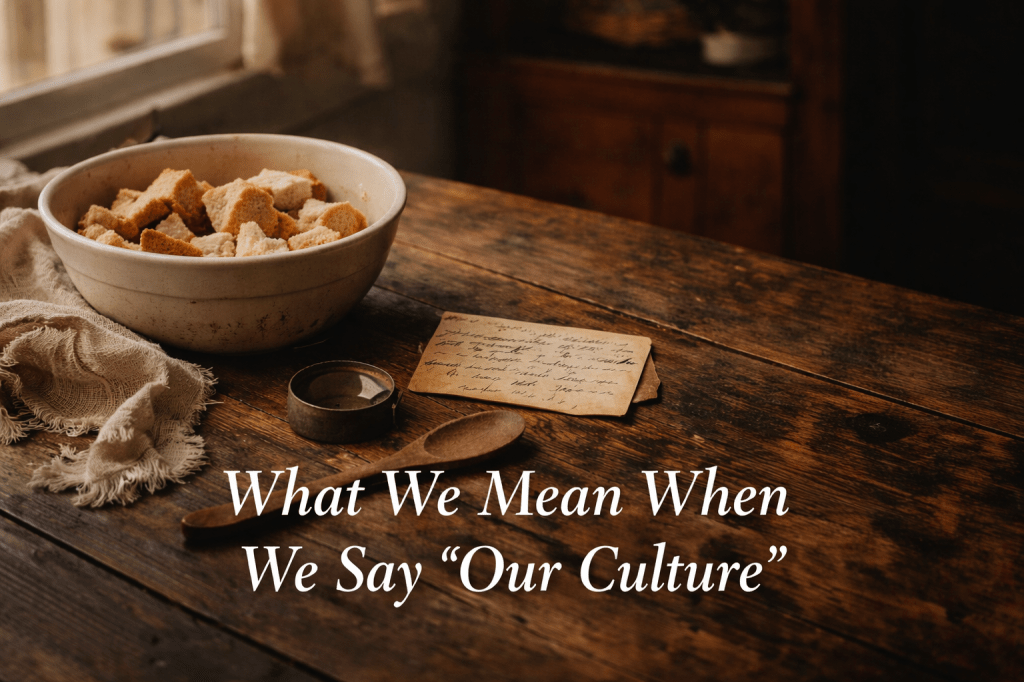
    What We Mean When We Say “Our Culture”

    The word culture gets used carelessly now.

    It gets flattened into playlists and palettes. Into slang that travels faster than its meaning. Into food that’s photographed better than it’s remembered. People say culture when they mean style. Or vibe. Or whatever is popular long enough to be profitable.

    But that’s not what we mean.

    When we say “our culture,” we’re not talking about trends.

    We’re talking about what stayed.

    Our culture is not defined by how visible it is, but by how much pressure it survived. It is the set of practices that held when everything else was designed to break. The habits that outlived laws. The knowledge that didn’t need permission to be passed down.

    I learned that before I could explain it.

    I learned it in kitchens where nobody measured anything, but nothing was wasted. In the way elders cooked like they were remembering something with their hands, in the discipline of knowing when enough was enough—when to add heat, when to lower it, when to let something rest.

    That restraint is culture.

    It’s the same restraint you hear in certain sentences. The kind that don’t rush to impress. That leaves space on purpose. You hear it in Baldwin’s insistence that language must tell the truth even when it makes people uncomfortable.

    Before history was written, it traveled by sound.

    It moved through voices that carried grief without explanation and joy without apology. Through spirituals that mapped escape. Through blues that name loss, without begging for sympathy. Through singers like Billie Holiday, who could hold an entire history in a pause.

    Nina Simone understood this: that art wasn’t decoration.

    It was testimony.

    That wasn’t entertainment.

    That was record-keeping.

    And the cooks were doing it too.

    Our food was never just about flavor. It was about continuity. About making sure people ate, yes—but also about making sure they remembered who they were while doing it. Recipes weren’t written down because they didn’t need to be. They lived in repetition. In watching. In correction offered gently. In knowing when something tasted right without explaining why.

    That’s why recipes function as records.

    A dish tells you where a people were. What they had access to. What they were denied. What they salvaged anyway. It tells you how they thought about care—who was fed first, how far food was expected to stretch, how sweetness showed up even when conditions said it shouldn’t.

    Bread pudding exists because waste was not an option.

    Lemon sauce exists because joy was still necessary.

    Neither of those things happened by accident.

    This is what makes our culture specific.

    Not borrowed.

    Not interchangeable.

    Not a costume someone can put on without carrying the weight.

    Our culture was shaped by constraint and refined by care. It learned to be precise because excess wasn’t available. It learned to be expressive because silence was dangerous. It learned to be communal because survival required it.

    That’s why defining it matters.

    Not to build gates.

    But to keep the record straight.

    Because erasure rarely announces itself. It arrives as minimization. As everybody struggled. As to why keep bringing it up? As we’re all the same now. It arrives by disconnecting culture from origin and selling the leftovers as novelty.

    But culture isn’t a vibe.

    It’s a system.

    A system of survival practices passed hand to hand. Voice to ear. Pan to plate. Sentence to sentence.

    And when we say our culture, what we mean is this:

    We kept something alive when it wasn’t supposed to survive.

    We carried memory without archives.

    We built beauty without resources.

    We made care look ordinary so it wouldn’t be taken from us.

    Writers did it with language.

    Musicians did it with sound.

    Artists did it with vision.

    Cooks did it with repetition.

    All of them answered the same question:

    How do you tell the truth without disappearing?

    So when I write about food, I’m not being nostalgic. I’m being precise. I’m pointing to one of the most reliable records we have. An archive you can eat. A history that still feeds people.

    That’s our culture.

    Not because it’s popular.

    But because it held.

    Kyle J. Hayes

    kylehayesblog.com

    Please like, comment, and share

    Resources for Hard Times

    If you’re looking for practical help, food support, or community resources, you can visit the Salt, Ink & Soul Resources Page.
    👉 Resources for Hard Times

  • The Weight of What You Carry

    The Weight of What You Carry

    In the American South, where heat teaches patience whether you want the lesson or not, there lived a small boy named Amari.

    Adults called him full of energy. What they meant was that his body often moved faster than his judgment. His feet were quick. His mouth was quicker. He laughed before asking and burned hot when he felt small.

    He lived near a road that once mattered more than it did now. Trucks still passed. Church folk still waved. Old men still sat in folding chairs like they were guarding something no one had named aloud. His mother worked long days. His Uncle Michael cooked.

    Not fancy food.

    Not restaurant food.

    The kind that fed tired hands. The kind that smelled like onions in cast iron and meant you’re safe here. Salt mattered in that kitchen—not just for taste, but for balance. For knowing when something was right.

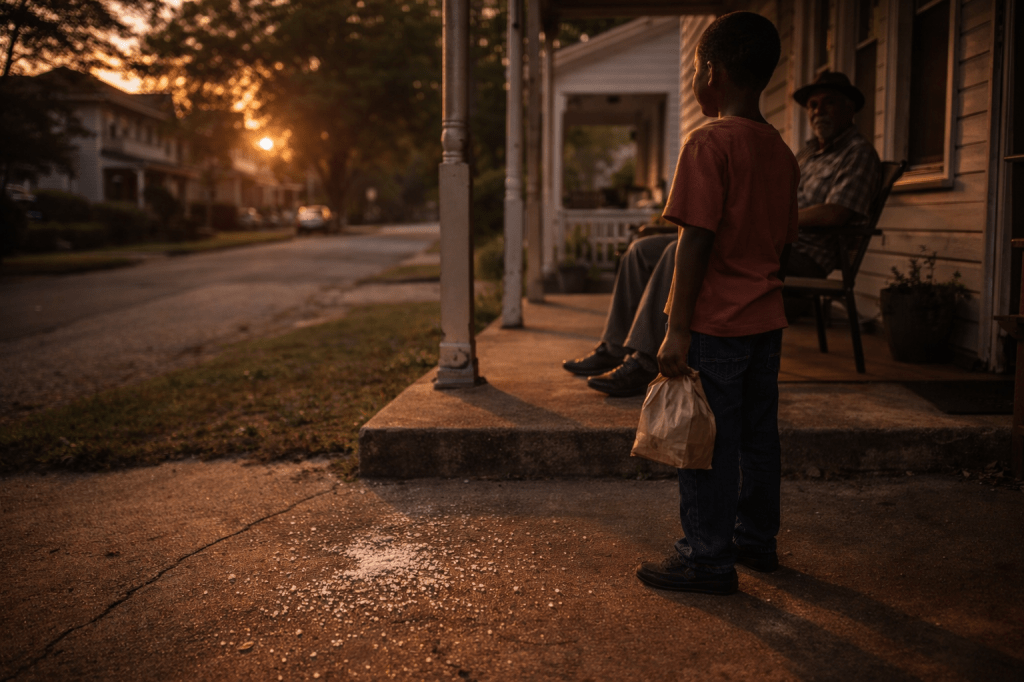
    One morning, his Uncle Michael handed Him a small paper sack.

    “Take this next door,” he said. “And don’t spill it.”

    Amari nodded. Serious. Focused. For a moment.

    Outside, the block was alive—boys throwing rocks at a rusted can, a radio too loud, laughter ricocheting between houses. Amari wanted to be seen.

    So he set the sack down for just a second.

    The wind came without asking. It tipped the bag. Salt scattered across the concrete, bright and unforgiving.

    Amari froze.

    Salt doesn’t come back once it’s rushed. It only tells the truth about what happened.

    Someone laughed. Not cruel. Just careless.

    That’s when Mr. Lewis, who sat on his porch every morning like time had placed him there on purpose, spoke up.

    “You know what that is?” he asked, nodding at the ground.

    “Just salt,” Amari said.

    Mr. Lewis shook his head. “Salt is what’s left after everything else burns away. You don’t rush it.”

    Then he asked, gently, “What were you really trying to do, son?”

    Amari swallowed. “I wanted to look strong.”

    Mr. Lewis nodded. “Strength ain’t speed. It’s control.”

    Amari carried the empty bag back and told his Uncle the truth before fear could dress it up. He didn’t yell.

    “Today,” he said, “you cook with me.”

    All day, Amari learned to wait. To stir without splashing. To listen to the heat, to the timing, to himself. By evening, his Uncle Michael handed him another sack.

    “This time,” he said, “carry it slow.”

    And Amari did.

    Not out of fear.

    Out of understanding.

    That night, with cicadas humming and the wind still moving through the trees, Amari learned what no one had rushed to teach him:

    Resilience isn’t never spilling.

    Self-discipline isn’t punishment.

    Self-awareness is knowing when you’re rushing—

    and choosing to hold what matters steady.

    The wind kept blowing.

    But Amari knew how to carry now.

    Kyle J. Hayes

    kylehayesblog.com

    Please like, comment, and share

    Resources for Hard Times

    If you’re looking for practical help, food support, or community resources, you can visit the Salt, Ink & Soul Resources Page.

    👉 Resources for Hard Times

  • For Now, February

    For Now, February

    A Salt, Ink & Soul opening to a month of food, memory, and refusal

    For now, the calendar still gives us February.

    For now, it still calls it Black History Month—like history is something you can contain inside thirty-one little squares. Like the story fits neatly between a Valentine’s aisle and a President’s Day sale. Like you can honor a people with a banner and then go right back to pretending you don’t owe them anything.

    But I keep saying for now because I can feel the drag of erasure in the air.

    Not the dramatic kind.

    Not the kind that arrives with sirens.

    The quiet kind.

    The administrative kind.

    The kind that wears a clean shirt and says, We’re just updating the curriculum.

    The kind that edits a paragraph, removes a name, deletes a program, and calls it “neutral.”

    The kind that pretends it isn’t doing violence because it isn’t shouting while it does it.

    It is a strange thing to watch a country try to forget the very hands that helped hold it together.

    Stranger still to watch it happen while the evidence is everywhere—under glass in museums, in the bones of cities, in the laws written to contain us, and in the culture that gets celebrated only after it’s been drained of its origin.

    Because that’s the trick, isn’t it?

    America loves Blackness the way it loves seasoning.

    It wants the flavor without the farm.

    The rhythm without the bruises.

    The sweetness without the sweat.

    So yes—for now.

    And since forgetting seems to be trending, I’m going to do what Black folks have always done in the face of people trying to erase us.

    I’m going to make something undeniable.

    I’m going to cook.

    Not the kind of cooking meant to impress strangers.

    Not the kind that performs.

    Not the kind that comes with tweezers and a lecture.

    I mean the real kind.

    The kind that stains the wooden spoon.

    The kind that fogs the windows.

    The kind you smell in your clothes the next morning and don’t even mind—because it reminds you that you fed somebody. That you survived another week. That you made a house feel like a home.

    This month, I’m focusing on one part of our contribution that no one can remove from me because it’s been in me since birth:

    Food.

    Not as a trend.

    Not as content.

    As inheritance.

    Because even if they remove our names from the walls, they can’t remove the way we seasoned what we were given. They can’t remove the improvisation—how we learned to make a feast out of “not much.” They can’t remove the genius of turning what was dismissed into something worth gathering around.

    They can’t remove the way our people built entire philosophies of care from pots and pans and whatever showed up in the week’s hands.

    Food is history you can taste.

    And the beautiful, complicated truth is this: our food is not one thing.

    It is regional the way our lives have always been regional—shaped by migration, soil, water, weather, what was available, what was stolen, what was traded, what was shared, what was guarded.

    A dish can have the same name and still be a different story depending on where you’re standing when you make it.

    Someone in Louisiana will tell you the right way and mean it.

    Someone in Georgia will tell you the right way and mean it, too.

    Someone in Mississippi will roll their eyes at both of them and start cooking anyway.

    All three are telling the truth.

    Because food isn’t just ingredients. It’s teaching. It’s what your auntie did when you were sick. It’s how your granddad ate when money was tight. It’s the way your family made the ordinary feel sacred without ever using the word sacred.

    So what I’m offering this month won’t claim to be universal. It won’t pretend to be the official version of anything.

    These dishes will be mine—shaped by what I was taught, what I learned the hard way, and what I had to make work when there wasn’t time, money, or energy for anything fancy.

    That’s what makes them honest.

    And if you come from your own line of recipes, your own set of we don’t do it like that, understand this:

    You belong here, too.

    This isn’t about declaring a winner.

    It’s about keeping the record alive.

    It’s about refusing the lie that our culture is just a vibe anyone can borrow without context.

    It’s about saying:

    We were here.

    We are here.

    And we fed this country in more ways than it can admit.

    Because food is one of the most intimate ways people leave fingerprints on the world.

    Laws can be rewritten.

    Statues can be removed.

    Books can be banned.

    But try taking a taste memory from somebody.

    Try telling someone to forget greens cooked right.

    Try telling them to forget cornbread that actually means something.

    Try telling them to forget a kitchen that felt like safety.

    You can’t. Not fully.

    That’s why they try to package it.

    Rebrand it.

    Sell it back.

    Make it “comfort food” without ever naming the discomfort it came from.

    But we know.

    And this month, I want to honor what we know—not with speeches, but with a plate.

    So yes, please enjoy.

    And yes, you will probably have to walk a few extra steps.

    Not because this is indulgence for indulgence’s sake, but because our food was never meant to be eaten with shame. It was meant to be eaten with gratitude. In the community. Without apology.

    Walk your steps.

    Drink your water.

    Take your time.

    Then come back to the table.

    Because this month—for now—I’m choosing to tell Black history the way I learned it first:

    Not from a textbook.

    From a kitchen.

    From a hand that loved me enough to season what little we had.

    From a people who refused to disappear.

    Welcome to February.

    Kyle J. Hayes

    kylehayesblog.com

    Please like, comment, and share

    Resources for Hard Times

    If you’re looking for practical help, food support, or community resources, you can visit the Salt, Ink & Soul Resources Page.

    👉 Resources for Hard Times