It has been hot here in New Mexico.
Not simply summer hot, where you expect the afternoon to be uncomfortable and learn to live with it. This has been the kind of heat that makes you reconsider ordinary decisions.
Like cooking dinner.
There is something almost absurd about standing in a kitchen on a hundred-degree day and deciding that what the house really needs is a 400-degree oven.
You walk into the kitchen.
You look at the stove.
You think about what you planned to cook.
And suddenly, a sandwich sounds pretty good.
There is nothing wrong with that.
A good sandwich, some chips, maybe a salad or some cold fruit can feel almost perfect when the heat outside seems determined to follow you into the house.
But you can only eat that way for so many days.
Eventually, you want something cooked.
Something hot.
Something that feels like dinner.
And hunger, unlike the rest of us, has never been particularly impressed by the weather.
We still have to eat.
So after thinking about it for a while, I finally bought an air fryer.
I had resisted getting one.
I’ve lived long enough to watch plenty of kitchen appliances arrive with promises that they were about to revolutionize the way we eat. Some of them eventually found permanent homes in cabinets, sitting beside other machines that had once promised to change breakfast forever.
But this time, the heat made a better argument than any commercial could.
An air fryer is small. It cooks quickly. Most importantly right now, I can make dinner without turning the kitchen—and eventually the rest of the house—into an extension of the desert outside.
So I’ve been using it.
And I like it.
I know not everyone has one.
That is worth saying.
Because conversations about food have a way of becoming conversations about privilege without anyone noticing.
We assume everybody has the same kitchen.
The same appliances.
The same grocery budget.
The same amount of time.
The same energy when the day is over.
They don’t.
Food writing sometimes forgets that.
Cooking can become theater.
Beautiful kitchens. Expensive cookware. Perfect ingredients arranged across countertops. Recipes requiring twenty ingredients, three pans, and an afternoon nobody seems to have to work through.
There is nothing inherently wrong with any of that.
Cooking can be art.
It can be recreation.
It can be something we do simply because creating something beautiful with our hands gives us pleasure.
I understand that.
I love cooking.
But cooking has another purpose that existed long before anybody photographed a dinner plate.
Somebody has to eat.
And somewhere tonight, somebody will come home tired from work, stand in front of a refrigerator, and try to figure out what can be made with what is inside.
Somebody else will look at a grocery bill and quietly put something back.
Someone will be feeding children who do not care that the person making dinner has had a difficult day.
And somebody will be standing in a hot kitchen wondering what they can cook without making an already uncomfortable home even hotter.
They are cooking too.
Maybe that is cooking in its most honest form.
It doesn’t matter that you worked late.
It doesn’t matter that you’re tired.
It doesn’t matter that groceries cost more than you expected.
And it certainly doesn’t matter that it is a hundred degrees outside.
Eventually, someone still has to answer one of the most ordinary questions in family life:
What are we going to eat?
It is such a simple question.
But those words can conceal an extraordinary amount of labor.
Because somebody has usually been thinking about the answer long before anyone asks.
They checked the refrigerator.
They know what is left.
They remember what everybody ate yesterday.
They know what needs to be used before it spoils.
They know what the family likes and what somebody will complain about.
They have considered the weather.
They have considered the money.
And perhaps most importantly, they have considered how tired they are.
Then, somehow, food appears.
We rarely call this extraordinary.
Maybe because it happens too often.
Care has a way of becoming invisible when it becomes dependable.
Dinner appears.
People eat.
The dishes are washed.
Tomorrow comes.
And eventually the question returns.
What are we going to eat?
Families have been answering that question under conditions far more difficult than mine for generations.
Before air conditioning cooled our kitchens, people still cooked through the summer.
Before refrigerators kept everything safely cold, people found ways to preserve food.
Before supermarkets offered strawberries in winter and nearly anything else we wanted regardless of season, people learned to make meals from what grew nearby, what could be preserved, what could be stretched, and what could be shared.
Somewhere inside that history are countless people whose names will never appear in a cookbook.
Mothers.
Fathers.
Grandmothers.
Grandfathers.
Aunts.
Uncles.
Older brothers and sisters.
Neighbors.
People who stood in kitchens while everyone else waited somewhere cooler.
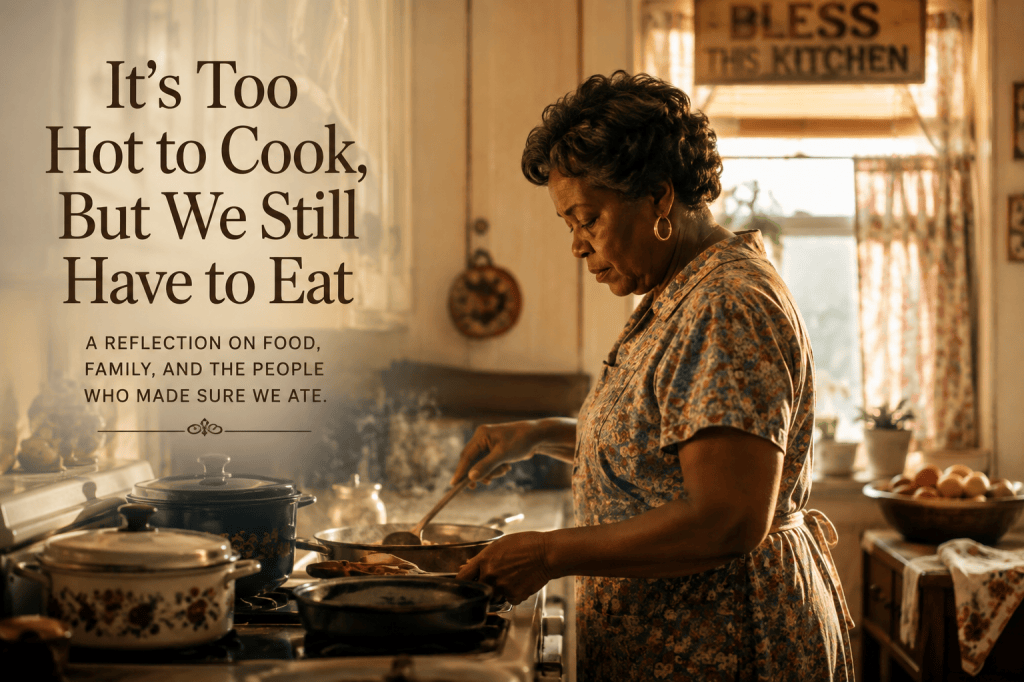
I remember some of this from my own childhood.
When food was being prepared, we children were often chased out of the kitchen.
We didn’t belong in there underfoot while somebody was trying to cook. There were hot pans, sharp knives, grease popping on the stove, cabinet doors opening and closing, and grown folks trying to finish a meal.
So we were sent somewhere else.
Go play.
Go sit down.
Get out of this kitchen.
At the time, I don’t remember thinking very deeply about it.
I was a child.
The kitchen was simply where the food came from.
Only later do you begin to understand what was happening in the room after you were chased out.
Someone kept track of what was cooking, what needed stirring, what was almost done, and what still needed another few minutes.
Then, when everything was ready, the rest of us came back.
I remember something else too.
My grandmother would bring my grandfather his food before she sat down and joined the rest of us.
That was simply how things were in her kitchen.
And in so many other kitchens.
As a child, I didn’t question it.
Children inherit rituals long before they understand them. We watch how the adults move around one another and assume this is simply how the world works.
Grandpa sat.
Grandma brought his plate.
Then eventually she sat down too.
I know people may look at that differently now.
Some may see an old expectation placed upon women. Others may recognize a particular language of marriage, family, and care from another generation.
Maybe both things can be true.
I don’t need to turn my grandmother’s kitchen into an argument.
I only need to remember what I saw.
Because what stays with me now isn’t simply that she brought my grandfather his food.
It is that she brought his food before she sat down herself.
There is a difference.
As children, we tend to remember the meal from the chair.
Someone else remembers that same meal from their feet.
We remember what was on the plate.
We remember whether we liked it.
We remember asking for seconds.
We remember the conversations around the table.
The grown folks talking about things we weren’t supposed to understand while we quietly listened anyway.
Maybe that is one of the strange things about getting older.
You begin revisiting childhood memories from the perspective of the adults who were standing just outside the frame.
You finally notice what their hands were doing while yours were empty.
We remember the food.
Sometimes I wonder whether we remember the heat.
We remember fried chicken.
Greens.
Beans that seemed to cook all afternoon.
Cornbread pulled hot from an oven.
We remember smells that could travel through an entire house and tell us what was coming before we ever saw the plate.
We remember sitting down.
We remember eating.
We remember asking for seconds.
Memory is generous to the person being fed.
It can erase the sweat from the person doing the feeding.
There was labor inside those meals.
There was time.
There was planning.
Sometimes there was sacrifice.
And sometimes there was simply someone who would have preferred to sit down but remained standing a little longer because the people they loved needed to eat.
I didn’t understand any of that when I was a child.
I only knew that eventually we would be called back into the kitchen. There would be food on the table, my grandfather would have his plate, and my grandmother would finally take her seat.
Back then, I thought that was simply dinner.
Please like, comment, and share
Resources for Hard Times
If you’re looking for practical help, food support, or community resources, you can visit the Salt, Ink & Soul Resources Page.