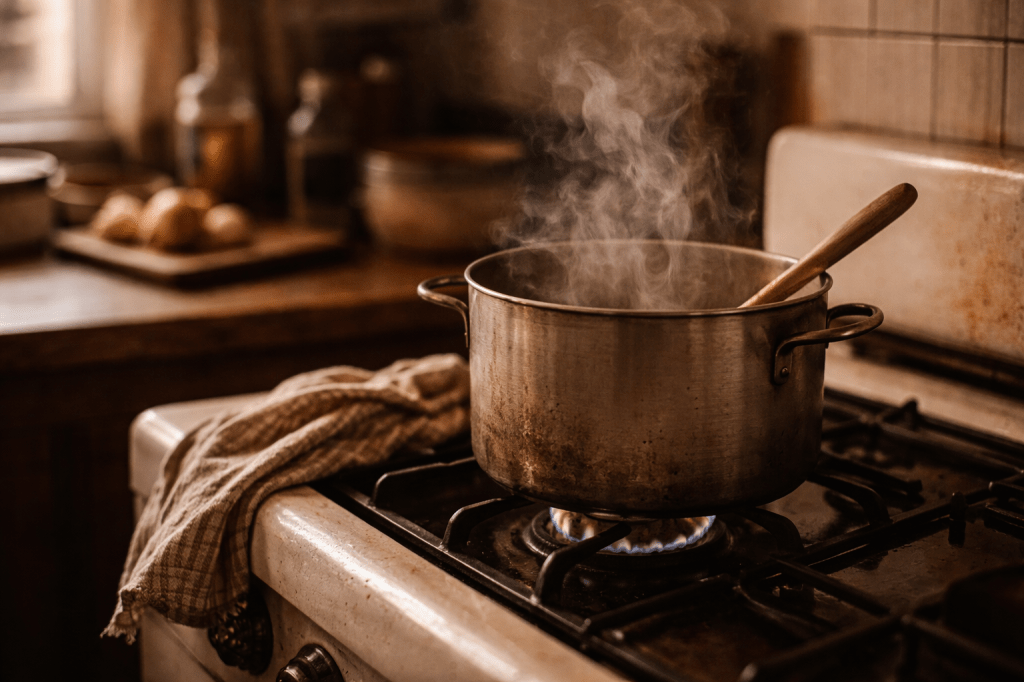
I Cook.
I say that carefully, almost defensively, the way someone says I write but refuses the title that would make it sound like a performance. I cook, but I am not a chef. Not because I lack skill, but because I reject what that word has come to mean—at least in the way it’s been packaged, televised, plated, and praised.
Turn on a screen or scroll long enough and you’ll find yourself staring at a meal made by someone with a coat, a pedigree, and an accent—something arranged with tweezers, built from ingredients you have to Google, let alone locate. The lighting is perfect. The language around it is reverent. The price is astronomical.
And somewhere in the middle of all that spectacle, a quiet question tries to form:
Does this feed anyone?
Not the ego. That’s already been fed.
Not the reputation. That’s the point.
I mean the body. The soul. The tired person who’s been chewed up by the world and needs something warm, steady, and honest to bring them back to themselves.
What Food Is Supposed to Do
Food is meant to do two things at once.
It should send you out into the world strong, grounded, nourished, capable of standing upright in whatever waits for you. And it should welcome you home, comforting you after the world has taken its cut.
A good meal says, Sit down. You made it. You’re safe here for a moment.
Too much of what passes for “great food” today does neither.
Some of these five-star, white-tablecloth experiences leave you not with fullness, but with confusion. You spend the first five minutes asking how you’re supposed to eat it. The next five are asking what it even is. And the last few wondering, was that it?
A smear.
A foam.
A reduction of something that once had a spine.
You leave with a taste and a question mark. No warmth. No grounding. No sense that your body was actually consulted in the process.
When Difficulty Gets Mistaken for Care
Then come the reviews.
Long, florid essays written by people who seem less interested in being fed than in proving they understood the meal. As if complexity itself were nourishment. As if difficulty were virtue. As if decoding were the same thing as being cared for.
Sometimes I suspect those reviews exist not to describe the food, but to inflate it—to stretch a small experience into something larger than it was. To reassure the diner, the chef, and the culture that the emperor’s plate is, in fact, wearing clothes.
About That Word “Chef”
Maybe the problem starts with the word chef itself.
At its root, a chef is a person trained in traditional French cooking. That’s not an insult. It’s a definition. But definitions matter—especially when they quietly turn into hierarchies.
And here’s where I say the thing that makes people uncomfortable:
I do not believe the French know how to cook.
Not in the way that matters to me.
They drown everything in sauce, then congratulate themselves for having learned how to drown properly. Technique over instinct. Presentation on nutrition. Control over generosity. The dish becomes a demonstration rather than an offering.
The sauce isn’t always there to enhance. Sometimes it’s there to hide—to obscure the fact that without it, the food has nothing to say.
What troubles me more is how that tradition looks down on everything that didn’t come from Europe—especially the cuisines built without academies, without written rules, without approval. The foods made by people who cooked because they had to. People who turned scraps into sustenance. Who learned flavor not from textbooks, but from hunger, memory, and survival.
The Truth Told by Bread
Ironically, the best thing to come out of France isn’t a sauce at all.
It’s bread.
The baguette.
The food of the poor.
Flour. Water. Yeast. Time. Crisp crust. Soft interior. No performance. No confusion. No question about what it is or what it’s for.
You tear it.
You eat it.
You’re fed.
Perfect in its simplicity.
And that tells the truth the rest of the cuisine tries to avoid.
The Lineage I Claim
The true food of any people comes from those who make something out of nothing. From those who cook not to impress, but to sustain. From kitchens where the question isn’t Is this innovative? But will this carry us through the night?
That’s the lineage I claim.
I cook food meant to hold you together. Food that understands fatigue. Food that doesn’t need a narrator. Food that respects the eater enough not to turn them into an audience.
When I cook, I’m not trying to challenge you.
I’m trying to care for you.
I want the meal to say, You don’t have to think so hard right now. I want it to meet you where you are—hungry, worn down, hopeful, human.
Good food doesn’t leave you with questions.
It leaves you with strength.
It leaves you with comfort.
It leaves you ready to go back out into the world—or prepared to rest from it.
So no, I’m not a chef.
Cooking is an act of hospitality, not hierarchy. An offering, not a performance. A quiet declaration that survival deserves pleasure—and pleasure doesn’t need permission.
And if that means my food will never be plated with tweezers or praised in paragraphs, so be it.
The people I cook for don’t need convincing.
They just need to be fed.
Kyle J. Hayes
Please like, comment, and share
Resources for Hard Times
If you’re looking for practical help, food support, or community resources, you can visit the Salt, Ink & Soul Resources Page.
 Salt,Ink, & Soul