Tag: FoodAsCare

  • Who Gets to Be an Expert?

    Who Gets to Be an Expert?

    Somewhere along the way, the word expert got dressed up.

    It put on a clean apron and started speaking in polished sentences. It learned how to name every acid, every cut, and every technique, the way some people learn scripture—precise, rehearsed, confident. It started arriving with credentials. With ratings. With a camera angle. With a voice that sounds like it already knows it’s right.

    And I’m not here to mock skill. Skill is real. Craft matters. Discipline matters. There’s beauty in someone who has spent years learning a thing until their hands don’t have to think about it anymore.

    But I’ve been watching how authority gets handed out.

    Who gets to hold it?

    Who gets ignored?

    Because I know cooks whose food will stop you mid-bite—not because you’re analyzing anything, not because you’re performing appreciation the way you were taught to, but because something inside you goes quiet for a second.

    Not silence like politeness.

    Silence like recognition.

    That’s the kind of moment I trust.

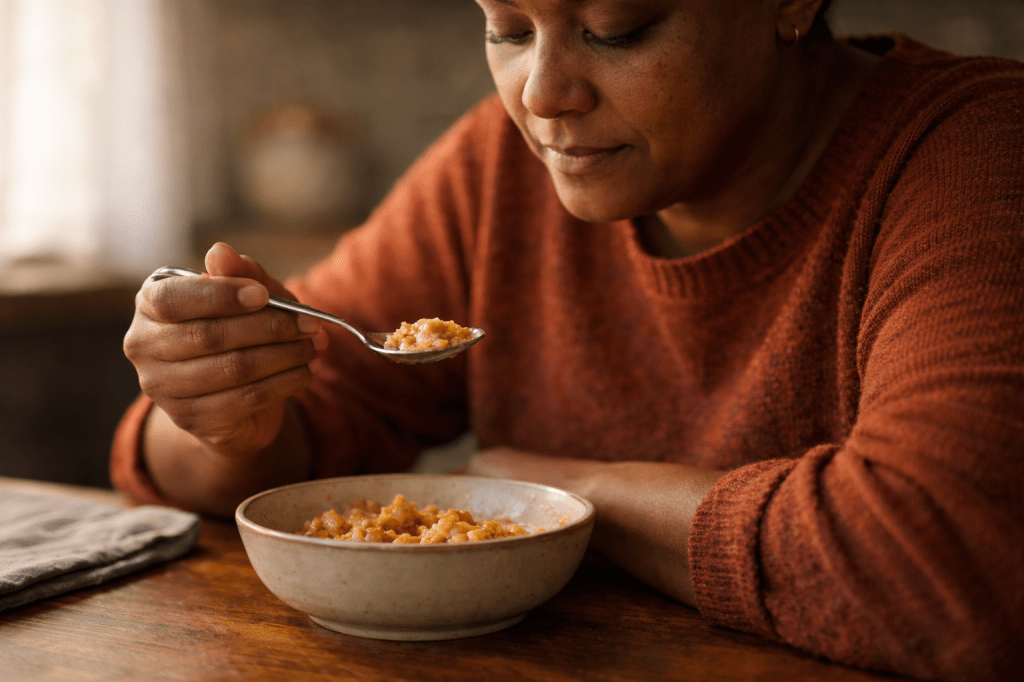
    My own belief is simple, even if it’s heavy: the people who get to determine who is an expert are the ones who eat and feel that all-encompassing satisfaction and gratitude. The ones who take a spoonful or a bite, and it stops them—not because they’re dissecting ingredients, but because it has touched their soul. Their spirit. Those parts that make us truly us.

    It satisfied their hunger.

    And it blessed their spirit.

    To me, those are the ones who get to decide.

    Not the loudest voice in the room.

    Not the person with the best lighting.

    Not the one who can turn dinner into a performance review.

    The ones at the table.

    Because food, at its honest center, is not a debate. It’s a communion. It’s a small, daily miracle that too many people are forced to negotiate with—money, time, fatigue, scarcity, stress—all of it pressing down like weather. And then someone makes something anyway. Something warm. Something that holds.

    If a meal can do that—if it can steady a person, if it can return them to themselves, if it can make their shoulders drop in relief—what are we really supposed to call the one who made it?

    An amateur?

    A “home cook,” said the way people say less than?

    We live in a world that mistakes visibility for validity. If you can describe what you did in the right vocabulary, you’re treated like an expert. If you can plate it like a magazine cover, you’re treated like an expert. If you can turn the meal into content, into a brand, into a series—then the world hands you the title and nods as if that settles the matter.

    But plenty of the best food I’ve ever encountered wouldn’t survive that kind of spotlight.

    It wasn’t made to impress strangers.

    It was made to take care of somebody.

    And that kind of care has its own standards.

    The best cooks I know aren’t always chasing innovation. Sometimes they’re chasing enough. Sometimes they’re chasing right. Sometimes they’re trying to make sure the child who didn’t eat at school gets something in their belly before bedtime. Sometimes they’re trying to make Sunday feel like Sunday, even when the week has been cruel.

    That’s not romantic. That’s real.

    And if you want to talk about expertise, you have to talk about repetition. The kind that doesn’t look glamorous but builds a person into someone you can trust.

    There is expertise in making the same dish fifty times until you understand its moods.

    Until you know the difference between heat and impatience.

    Until you can tell, by smell alone, when something is about to cross the line.

    There is expertise in cooking with what you have and still making it taste like dignity.

    There is expertise in a kitchen where nobody measures, but nothing is careless.

    And for us—especially in Black kitchens—this is not new.

    Our culture has always carried genius in ordinary containers. We didn’t always have the luxury of experimentation for fun. We had to make the function taste like joy. We had to turn “not much” into “enough” and sometimes into a feast, not because we were trying to impress, but because we were trying to remain human under conditions that kept insisting we were disposable.

    That’s expertise.

    Not the kind that needs to announce itself.

    The kind that survives.

    So when I ask who gets to be an expert, I’m not asking for a title to hand out. I’m asking a quieter question:

    Who do we trust?

    Do we trust the person with the cleanest story, the best branding, the most followers?

    Or do we trust the one whose food has carried people through real life?

    I think about the moment a person tastes something, and their eyes shift—not wide for show, not performative, just… softened. Like the body recognizes safety. Like the spirit exhales. Like something inside them says, I remember this. Even if they’ve never had this exact dish before.

    That’s the moment I mean.

    That moment is a kind of witness.

    And witnesses matter.

    Because food is not only fuel. It’s memory. It’s mood. It’s belonging. It’s how we tell people, in the simplest language we have, I see you.

    If the world wants to measure expertise by technique alone, it will keep missing the point.

    Technique can be learned.

    But the ability to feed someone in a way that makes them feel held?

    That takes attention.

    That takes empathy.

    That takes a kind of spiritual accuracy that can’t be faked.

    And yes, I know—people will say this is sentimental. Too soft. Too unscientific.

    But I don’t trust a world that treats satisfaction like something shallow. I don’t trust a world that turns eating into analysis and forgets that the body is not a machine. The body is a living story, carrying stress and grief and history. Sometimes the most skilled thing you can do is make a meal that lets somebody come home to themselves for a moment.

    So here’s where I land:

    The expert is not always the one who explains the food best.

    The expert is the one who makes you stop mid-bite—not to evaluate, but to feel grateful. The one who satisfies hunger and blesses the spirit. The one whose food doesn’t just taste good, but makes you feel less alone inside your own life.

    And the people who know that—the people who have felt that—those are the ones who get to decide.

    Not because they’re critics.

    Because they’re human.

    Because they are the reason cooking matters at all.

    And if the world never hands that cook a title, the table still will.

    Quietly.

    In the only way that counts.

    Kyle J. Hayes

    kylehayesblog.com

    Please like, comment, and share

    Resources for Hard Times

    If you’re looking for practical help, food support, or community resources, you can visit the Salt, Ink & Soul Resources Page.
    👉 Resources for Hard Times

  • What We Mean When We Say “Our Culture”

    What We Mean When We Say “Our Culture”

    The word culture gets used carelessly now.

    It gets flattened into playlists and palettes. Into slang that travels faster than its meaning. Into food that’s photographed better than it’s remembered. People say culture when they mean style. Or vibe. Or whatever is popular long enough to be profitable.

    But that’s not what we mean.

    When we say “our culture,” we’re not talking about trends.

    We’re talking about what stayed.

    Our culture is not defined by how visible it is, but by how much pressure it survived. It is the set of practices that held when everything else was designed to break. The habits that outlived laws. The knowledge that didn’t need permission to be passed down.

    I learned that before I could explain it.

    I learned it in kitchens where nobody measured anything, but nothing was wasted. In the way elders cooked like they were remembering something with their hands, in the discipline of knowing when enough was enough—when to add heat, when to lower it, when to let something rest.

    That restraint is culture.

    It’s the same restraint you hear in certain sentences. The kind that don’t rush to impress. That leaves space on purpose. You hear it in Baldwin’s insistence that language must tell the truth even when it makes people uncomfortable.

    Before history was written, it traveled by sound.

    It moved through voices that carried grief without explanation and joy without apology. Through spirituals that mapped escape. Through blues that name loss, without begging for sympathy. Through singers like Billie Holiday, who could hold an entire history in a pause.

    Nina Simone understood this: that art wasn’t decoration.

    It was testimony.

    That wasn’t entertainment.

    That was record-keeping.

    And the cooks were doing it too.

    Our food was never just about flavor. It was about continuity. About making sure people ate, yes—but also about making sure they remembered who they were while doing it. Recipes weren’t written down because they didn’t need to be. They lived in repetition. In watching. In correction offered gently. In knowing when something tasted right without explaining why.

    That’s why recipes function as records.

    A dish tells you where a people were. What they had access to. What they were denied. What they salvaged anyway. It tells you how they thought about care—who was fed first, how far food was expected to stretch, how sweetness showed up even when conditions said it shouldn’t.

    Bread pudding exists because waste was not an option.

    Lemon sauce exists because joy was still necessary.

    Neither of those things happened by accident.

    This is what makes our culture specific.

    Not borrowed.

    Not interchangeable.

    Not a costume someone can put on without carrying the weight.

    Our culture was shaped by constraint and refined by care. It learned to be precise because excess wasn’t available. It learned to be expressive because silence was dangerous. It learned to be communal because survival required it.

    That’s why defining it matters.

    Not to build gates.

    But to keep the record straight.

    Because erasure rarely announces itself. It arrives as minimization. As everybody struggled. As to why keep bringing it up? As we’re all the same now. It arrives by disconnecting culture from origin and selling the leftovers as novelty.

    But culture isn’t a vibe.

    It’s a system.

    A system of survival practices passed hand to hand. Voice to ear. Pan to plate. Sentence to sentence.

    And when we say our culture, what we mean is this:

    We kept something alive when it wasn’t supposed to survive.

    We carried memory without archives.

    We built beauty without resources.

    We made care look ordinary so it wouldn’t be taken from us.

    Writers did it with language.

    Musicians did it with sound.

    Artists did it with vision.

    Cooks did it with repetition.

    All of them answered the same question:

    How do you tell the truth without disappearing?

    So when I write about food, I’m not being nostalgic. I’m being precise. I’m pointing to one of the most reliable records we have. An archive you can eat. A history that still feeds people.

    That’s our culture.

    Not because it’s popular.

    But because it held.

    Kyle J. Hayes

    kylehayesblog.com

    Please like, comment, and share

    Resources for Hard Times

    If you’re looking for practical help, food support, or community resources, you can visit the Salt, Ink & Soul Resources Page.
    👉 Resources for Hard Times

  • Smothered Pork Chops

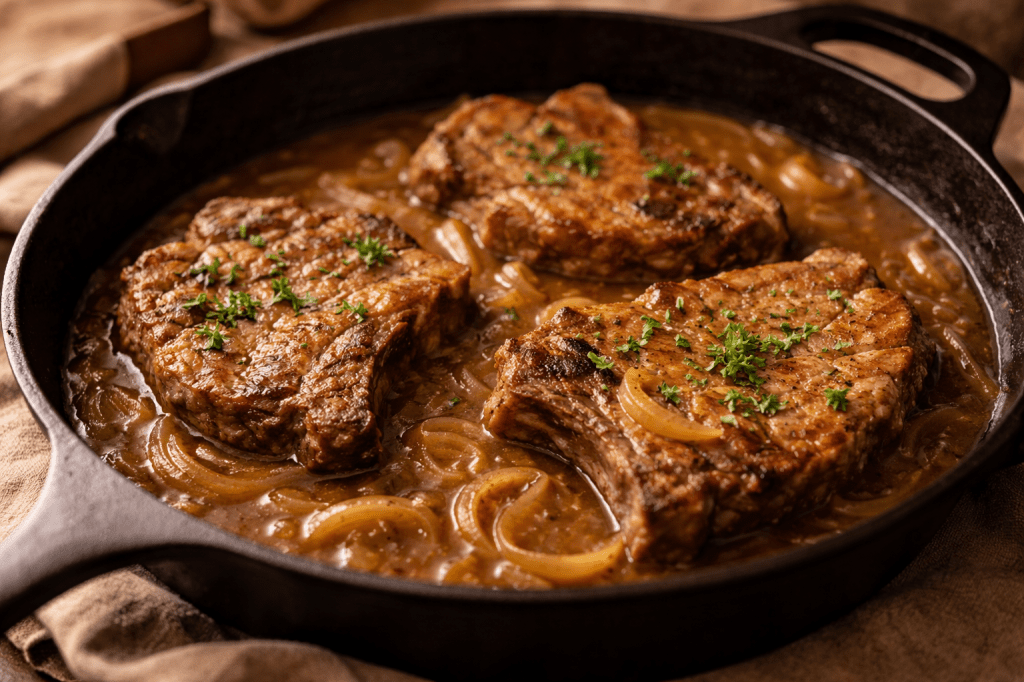
    Smothered Pork Chops

    Some meals announce themselves.

    And some meals wait.

    Smothered pork chops belong to the second kind. They don’t arrive crispy or loud. They don’t crackle for attention. They lower the heat and take their time. They understand that tenderness isn’t something you rush—it’s something you protect.

    This is the kind of food you make when you’re tired but still want to eat well. When the day took more than it gave back. When you need something steady. Something that doesn’t argue with you.

    Smothering is an act of care.

    You cover the meat to keep it from drying out. You keep it close to the gravy so it can soften without falling apart. You let it go slow enough to become what it’s supposed to be.

    That’s the point.

    This isn’t restaurant food. It isn’t meant to impress. It doesn’t photograph clean. It shows up in a pan and asks you to sit down.

    Smothered Pork Chops

    Serves 2–3. Scales easily.

    Ingredients

    • 4 pork chops
    • (bone-in if you can—flavor and patience live there)
    • Salt and black pepper
    • Garlic powder (optional, but familiar)
    • Onion powder (same)
    • ½ cup all-purpose flour
    • 2–3 tbsp neutral oil or bacon fat
    • 1 large onion, sliced
    • 2 cups chicken broth (or water, if that’s what you have)
    • Optional additions:
      • a splash of milk or cream
      • a pinch of cayenne
      • a little butter at the end

    How to Make Them

    Pat the pork chops dry. Season both sides generously with salt, pepper, and whatever else you think is right. Not measured. Just enough that you’d miss it if it wasn’t there.

    Dredge lightly in flour. Shake off the excess. You’re not breading. You’re giving the gravy something to hold onto later.

    Heat the oil in a wide skillet over medium heat. Brown the chops on both sides until they pick up color. Not cooked through. Just enough to look like they’ve lived a little.

    Remove the chops and set them aside.

    Lower the heat. Add the onions to the same pan. Stir them through the leftover flour and oil. Let them soften. Let them take their time. Scrape up the brown bits. Those matters.

    Slowly pour in the broth, stirring as you go. The gravy will thicken on its own if you let it. If it gets too thick, add a little more liquid. If it’s thin, give it time. Gravy knows what it’s doing.

    Taste. Adjust. This is where you decide what kind of night it’s been.

    Nestle the pork chops back into the gravy. Spoon some over the top. Cover the pan. Lower the heat.

    Let them simmer gently for 30–45 minutes, until tender. Not falling apart. Just easy.

    Finish with a little butter or milk for softness. Or don’t.

    How to Eat Them

    With rice.

    With mashed potatoes.

    With whatever helps you get the gravy where it needs to go.

    Eat them while they’re hot. Save what’s left.

    They’ll be better tomorrow.

    Some meals don’t need applause.

    They just need a fork, a chair, and a little quiet.

    Kyle J. Hayes

    kylehayesblog.com

    Please like, comment, and share

    Resources for Hard Times

    If you’re looking for practical help, food support, or community resources, you can visit the Salt, Ink & Soul Resources Page.

    👉 Resources for Hard Times

  • For Now, February

    For Now, February

    A Salt, Ink & Soul opening to a month of food, memory, and refusal

    For now, the calendar still gives us February.

    For now, it still calls it Black History Month—like history is something you can contain inside thirty-one little squares. Like the story fits neatly between a Valentine’s aisle and a President’s Day sale. Like you can honor a people with a banner and then go right back to pretending you don’t owe them anything.

    But I keep saying for now because I can feel the drag of erasure in the air.

    Not the dramatic kind.

    Not the kind that arrives with sirens.

    The quiet kind.

    The administrative kind.

    The kind that wears a clean shirt and says, We’re just updating the curriculum.

    The kind that edits a paragraph, removes a name, deletes a program, and calls it “neutral.”

    The kind that pretends it isn’t doing violence because it isn’t shouting while it does it.

    It is a strange thing to watch a country try to forget the very hands that helped hold it together.

    Stranger still to watch it happen while the evidence is everywhere—under glass in museums, in the bones of cities, in the laws written to contain us, and in the culture that gets celebrated only after it’s been drained of its origin.

    Because that’s the trick, isn’t it?

    America loves Blackness the way it loves seasoning.

    It wants the flavor without the farm.

    The rhythm without the bruises.

    The sweetness without the sweat.

    So yes—for now.

    And since forgetting seems to be trending, I’m going to do what Black folks have always done in the face of people trying to erase us.

    I’m going to make something undeniable.

    I’m going to cook.

    Not the kind of cooking meant to impress strangers.

    Not the kind that performs.

    Not the kind that comes with tweezers and a lecture.

    I mean the real kind.

    The kind that stains the wooden spoon.

    The kind that fogs the windows.

    The kind you smell in your clothes the next morning and don’t even mind—because it reminds you that you fed somebody. That you survived another week. That you made a house feel like a home.

    This month, I’m focusing on one part of our contribution that no one can remove from me because it’s been in me since birth:

    Food.

    Not as a trend.

    Not as content.

    As inheritance.

    Because even if they remove our names from the walls, they can’t remove the way we seasoned what we were given. They can’t remove the improvisation—how we learned to make a feast out of “not much.” They can’t remove the genius of turning what was dismissed into something worth gathering around.

    They can’t remove the way our people built entire philosophies of care from pots and pans and whatever showed up in the week’s hands.

    Food is history you can taste.

    And the beautiful, complicated truth is this: our food is not one thing.

    It is regional the way our lives have always been regional—shaped by migration, soil, water, weather, what was available, what was stolen, what was traded, what was shared, what was guarded.

    A dish can have the same name and still be a different story depending on where you’re standing when you make it.

    Someone in Louisiana will tell you the right way and mean it.

    Someone in Georgia will tell you the right way and mean it, too.

    Someone in Mississippi will roll their eyes at both of them and start cooking anyway.

    All three are telling the truth.

    Because food isn’t just ingredients. It’s teaching. It’s what your auntie did when you were sick. It’s how your granddad ate when money was tight. It’s the way your family made the ordinary feel sacred without ever using the word sacred.

    So what I’m offering this month won’t claim to be universal. It won’t pretend to be the official version of anything.

    These dishes will be mine—shaped by what I was taught, what I learned the hard way, and what I had to make work when there wasn’t time, money, or energy for anything fancy.

    That’s what makes them honest.

    And if you come from your own line of recipes, your own set of we don’t do it like that, understand this:

    You belong here, too.

    This isn’t about declaring a winner.

    It’s about keeping the record alive.

    It’s about refusing the lie that our culture is just a vibe anyone can borrow without context.

    It’s about saying:

    We were here.

    We are here.

    And we fed this country in more ways than it can admit.

    Because food is one of the most intimate ways people leave fingerprints on the world.

    Laws can be rewritten.

    Statues can be removed.

    Books can be banned.

    But try taking a taste memory from somebody.

    Try telling someone to forget greens cooked right.

    Try telling them to forget cornbread that actually means something.

    Try telling them to forget a kitchen that felt like safety.

    You can’t. Not fully.

    That’s why they try to package it.

    Rebrand it.

    Sell it back.

    Make it “comfort food” without ever naming the discomfort it came from.

    But we know.

    And this month, I want to honor what we know—not with speeches, but with a plate.

    So yes, please enjoy.

    And yes, you will probably have to walk a few extra steps.

    Not because this is indulgence for indulgence’s sake, but because our food was never meant to be eaten with shame. It was meant to be eaten with gratitude. In the community. Without apology.

    Walk your steps.

    Drink your water.

    Take your time.

    Then come back to the table.

    Because this month—for now—I’m choosing to tell Black history the way I learned it first:

    Not from a textbook.

    From a kitchen.

    From a hand that loved me enough to season what little we had.

    From a people who refused to disappear.

    Welcome to February.

    Kyle J. Hayes

    kylehayesblog.com

    Please like, comment, and share

    Resources for Hard Times

    If you’re looking for practical help, food support, or community resources, you can visit the Salt, Ink & Soul Resources Page.

    👉 Resources for Hard Times

  • One-Pan Chicken Thighs with Cabbage & Onion

    One-Pan Chicken Thighs with Cabbage & Onion

    Some meals don’t need improvement.

    They just need time, heat, and a little trust.

    This one-pan dinner is built from ingredients that have fed people quietly for generations—chicken thighs, cabbage, and onions. Nothing fancy. Nothing rushed. Everything is doing the work it knows how to do.

    It’s the kind of meal you make when you stop chasing what’s supposed to be better and start listening to what actually sustains you.

    🕰️ Time & Yield

    • Prep Time: 10 minutes
    • Cook Time: 40–45 minutes
    • Total Time: About 55 minutes
    • Serves: 2–3

    🧂 Ingredients

    • 4 bone-in, skin-on chicken thighs
    • ½ medium green cabbage, sliced into thick ribbons
    • 1 large yellow onion, sliced
    • 2 tablespoons olive oil
    • 1 teaspoon kosher salt (plus more to taste)
    • ½ teaspoon black pepper
    • 1 teaspoon paprika (optional, for warmth)
    • 2 cloves garlic, smashed (optional)

    🔥 Instructions

    1. Preheat the oven
    2. Set your oven to 400°F (205°C).
    3. Prepare the vegetables
    4. In a large roasting pan or rimmed baking sheet, toss the sliced cabbage and onion with olive oil, salt, pepper, and paprika if using. Spread into an even layer.
    5. Season the chicken
    6. Pat the chicken thighs dry. Season both sides generously with salt and pepper.
    7. Assemble the pan
    8. Nestle the chicken thighs skin-side up on top of the cabbage and onions. Tuck the garlic cloves around the pan if using.
    9. Roast
    10. Place the pan uncovered in the oven. Roast for 40–45 minutes, until the chicken skin is deeply golden and crisp, and the cabbage is soft and lightly caramelized.
    11. Rest and serve
    12. Let the pan rest for 5 minutes before serving. Spoon the cabbage and onions onto plates and top with a chicken thigh.

    🍽️ Serving Notes

    This meal doesn’t ask for much on the side.

    It’s enough on its own.

    If you want something extra, a simple piece of bread or a spoonful of mustard on the plate is more than sufficient.

    📝 Kitchen Notes

    • Chicken thighs stay tender even if you leave them in a few extra minutes—this is forgiving food.
    • The cabbage sweetens as it cooks; resist the urge to stir too much.
    • This reheats well and tastes even better the next day.

    🌱 A Quiet Thought

    There’s confidence in cooking food you don’t have to explain.

    Ingredients that know their job.

    A pan that does most of the work.

    This is nourishment without performance—food you can trust to carry you through the evening.

  • Learning to Trust What Feeds You

    Learning to Trust What Feeds You

    The new year barely clears its throat, and already the world is handing you a clipboard.

    New body. New habits. New mindset. New you.

    It’s a familiar ritual—bright, loud, and strangely impatient. As if the calendar turning over means you’re supposed to turn over, too. As if January is a starting gun, and anyone who isn’t sprinting is already behind.

    But a lot of us don’t enter January refreshed.

    We enter it used up.

    The holidays don’t just end—they leave residue. The social obligations, the family history that shows up like an uninvited guest, the spending, the traveling, the remembering. Even the good moments can be exhausting in a way nobody warns you about. By the time the lights come down, you can feel your body asking for something simple: quiet, steadiness, a little less demand.

    And then—here comes the new year, leaning in close, insisting you should want more.

    Maybe you do.

    But before you chase the next big thing, it’s worth asking a gentler question.

    What actually sustains you—when no one is watching?

    Not what looks impressive.

    Not what sells.

    Not what earns applause.

    What keeps you whole?

    Discernment, Not Discipline

    Discipline gets talked about like it’s salvation. Like if you just tighten your grip hard enough, you can force your life into the shape you think it should be.

    But discernment is different.

    Discernment isn’t about forcing. It’s about noticing. It’s about remembering what your body already knows, but your brain keeps ignoring. It’s about telling the truth—not the motivational-poster truth, but the quiet truth that shows up on an ordinary Tuesday when the house is still, and nobody is clapping for you.

    Because here’s what I’ve learned, and it took me longer than it should have:

    A lot of us don’t abandon what works because it stopped working.

    We abandoned it because it stopped being exciting.

    Or because it stopped being new.

    Or because someone on a screen told us there’s a better way—cleaner, faster, more optimized, more expensive.

    We forget the old phrase that has kept more people alive than any wellness trend ever has:

    If it’s not broke, don’t fix it.

    The Temptation of the “Better”

    We live in a culture that treats contentment like a lack of ambition.

    If you find something that steadies you—one routine, one meal, one quiet practice—there’s always a voice hovering nearby saying, Yes, but have you tried this instead?

    It’s a strange form of disrespect, really. Not just to your body, but also to your memory. To the part of you that already did the hard work of learning what helps.

    The best example I can give is food.

    Some meals don’t photograph well. They aren’t built for attention. They’re built for survival and softness. They show up like a hand on your back.

    A pot of beans.

    A bowl of soup.

    Greens cooked low and slow.

    Rice that knows how to hold up for a whole day.

    They don’t announce themselves.

    They just do their job.

    They feed you.

    And there’s wisdom in that. A quiet kind of intelligence. The kind that doesn’t need a new label every January.

    What Feeds You Might Not Impress Anyone

    This is the part people forget: nourishment isn’t always glamorous.

    Sometimes what feeds you is repetitive.

    It might even look “small” from the outside.

    A nightly walk.

    A glass of water before coffee.

    A morning that starts without your phone.

    A playlist you return to like a familiar porch light.

    A person who doesn’t demand a version of you that’s louder than you feel.

    These things don’t earn trophies.

    But they keep you from unraveling.

    And maybe—just maybe—that is the point.

    Because what’s the use of the “better” version of you if it costs you the steadiness you already had?

    Stop Outsourcing the Answer

    Early January is full of experts.

    Everybody is selling a method. A blueprint. A plan. Some of it is useful. Some of it is noise dressed up as concern. But almost all of it carries the same quiet assumption:

    You don’t know what you need.

    So they’ll tell you.

    But your body is older than your calendar.

    It remembers what worked in the hard seasons. It remembers which routines kept you from breaking. It remembers the difference between being “motivated” and being well.

    The question is whether you’ll honor that memory—or override it again because you think you’re supposed to be someone new by now.

    This post isn’t an argument against growth.

    It’s a recalibration.

    A reminder that growth doesn’t have to be loud, and it doesn’t have to start with punishment.

    Sometimes growth begins with respect.

    Respect for what’s already working.

    Respect for the rhythms that steady you.

    Respect for the plain, honest things that keep you fed.

    Stimulation vs. Sustenance

    There’s a difference between what stimulates you and what sustains you.

    Stimulation is quick. Loud. Addictive. It feels like progress because it spikes your attention and gives you the illusion of motion.

    Sustenance is slower.

    It settles. It grounds. It doesn’t demand that you become someone else to deserve it.

    And in a world that rewards constant reinvention, choosing sustenance can feel almost rebellious.

    To keep what works.

    To return to what’s familiar.

    To say, gently but firmly: I’m not abandoning myself this year.

    A Softer New Year Promise

    If you want a new year promise, let it be this:

    Not that you’ll become perfect.

    Not that you’ll grind harder.

    Not that you’ll reinvent yourself on a schedule.

    Let it be that you’ll pay attention.

    That you’ll notice what actually feeds you.

    That you’ll trust what has carried you.

    That you’ll stop treating steadiness like a failure of imagination.

    Because there is nothing wrong with returning to what works.

    There is nothing weak about choosing the thing that makes your shoulders drop, and your breath deepen.

    There is a kind of wisdom in repetition. A holiness in the familiar.

    And if you can learn to trust what feeds you—really trust it—this year won’t need to be dramatic to be different.

    It will be different because you will be listening.

    And for the first time in a long time, you won’t be chasing “better” at the expense of being well.

    Kyle J. Hayes

    kylehayesblog.com

    Please like, comment, and share

    Resources for Hard Times

    If you’re looking for practical help, food support, or community resources, you can visit the Salt, Ink & Soul Resources Page.

    👉 Resources for Hard Times