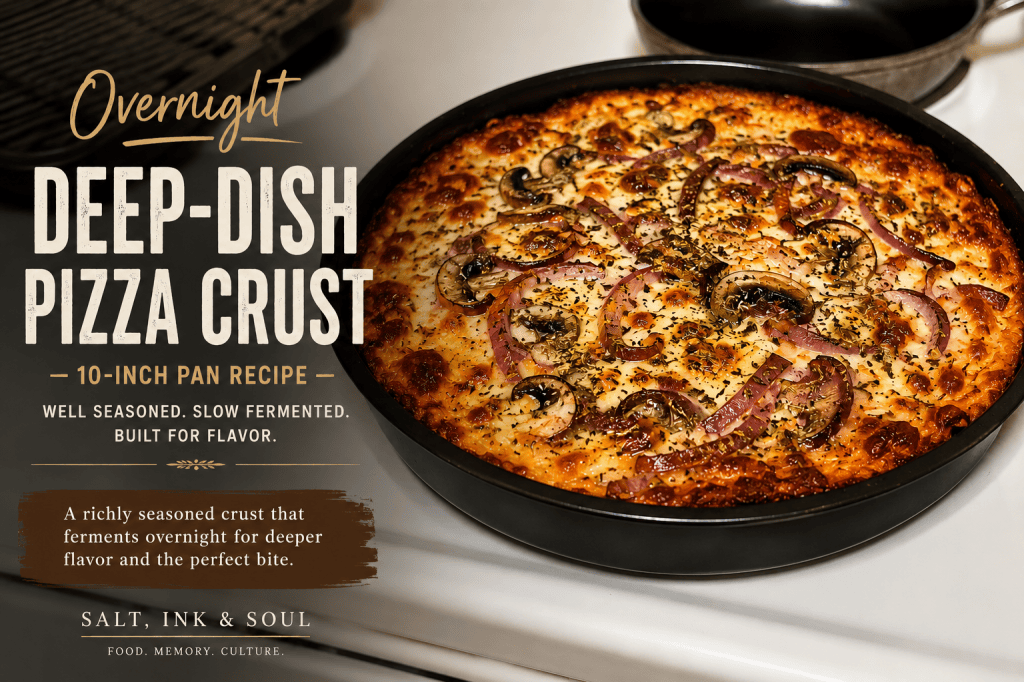
There is something satisfying about making pizza from the beginning.
Not opening a box.
Not waiting for someone to knock on the door.
Flour. Water. Yeast. A little patience.
And perhaps patience is the ingredient we have become most reluctant to use.
This dough spends the night in the refrigerator. Nothing dramatic happens. It simply rests while the yeast does its quiet work, turning a handful of ordinary ingredients into something that tastes as though considerably more effort went into it.
The next day, onions and mushrooms go into a hot skillet. The onions soften and sweeten. The mushrooms lose their water and begin to brown. Shred a pound of mozzarella by hand.
And yes, shred the cheese yourself.
The bagged stuff is convenient, but convenience sometimes comes with a small tax on quality. Pre-shredded cheese is coated to keep the pieces separate, which also keeps them from melting quite as beautifully. For this pizza, buy the block.
Then build the thing.
No shortcuts necessary.
10-Inch Overnight Deep-Dish Pizza
Makes: One 10-inch deep-dish pizza
Serves: 4 generously
Dough fermentation: 12–24 hours
Bake: approximately 25–30 minutes at 475°F / 246°C
For the Seasoned Overnight Dough
- 265 g bread flour
- 158 g warm water, about 95–100°F / 35–38°C
- 35 g extra-virgin olive oil
- 6 g kosher salt
- 2 g sugar
- 1.5 g instant yeast
- 1.5 g garlic powder
- 1.5 g onion powder
- 0.5 g dried oregano
- 0.5 g dried basil
- 0.5 g freshly ground black pepper
Optional, but very good:
- 3 g finely grated Parmesan
- 0.5 g smoked paprika
- 0.25 g dried thyme
For the Pan
- 14 g extra-virgin olive oil
- 4 g cornmeal
For the Pizza
- 1 lb / 454 g low-moisture whole-milk mozzarella, freshly shredded from a block
- 8 oz / 225 g fresh mushrooms, sliced
- 1 medium red or yellow onion, about 170–200 g, sliced into approximately ¼-inch strips
- 1 tablespoon / 14 g olive oil, for grilling the vegetables
- ¼ teaspoon kosher salt
- Freshly ground black pepper
- 1¼ cups / about 300 g thick pizza sauce
- 20–25 g freshly grated Parmesan or Pecorino Romano
- ½ teaspoon dried oregano
- Optional red-pepper flakes
I like red onion here, especially with mushrooms. It retains a little character after cooking and gives the finished pizza some sweetness without disappearing into the sauce.
The Night Before
Put the flour, salt, sugar, yeast, garlic powder, onion powder, oregano, basil, and black pepper into a large bowl.
If you’re using the Parmesan, smoked paprika, and thyme, add those too.
Pour in the warm water and olive oil.
Mix until the ingredients come together into a rough dough.
Knead by hand for about 8 minutes, or about 5 minutes in a stand mixer.
You’re not looking for perfection. You’re looking for a dough that has changed beneath your hands—smooth, elastic, soft, and just slightly tacky.
Lightly oil a bowl and put the dough inside.
Cover it and leave it on the counter for 30 minutes.
Then put it in the refrigerator.
Leave it there for 12–24 hours.
Eighteen to twenty-four is even better.
Time is doing some of the cooking before we’ve ever turned on the oven.
The Next Day
Take the dough from the refrigerator about 1½–2 hours before you want to make the pizza.
Cold dough remembers where it has been. Give it time to loosen up.
While it does, make the toppings.
Grill the Onions and Mushrooms
Heat a large skillet—cast iron is excellent here—over medium-high heat.
Add the tablespoon of olive oil.
Add the mushrooms first and spread them into a relatively even layer. Let them cook for 3–4 minutes before moving them much.
Mushrooms contain a remarkable amount of water. We want that water in the skillet, not trapped beneath our cheese.
Once they’ve begun releasing their moisture, add the sliced onion.
Season lightly with salt and black pepper.
Continue cooking for another 5–7 minutes, stirring occasionally, until the mushrooms have browned and the onions are tender with some caramelized edges.
Don’t cook the onions all the way down into jam. They still have another half hour in a hot oven.
Transfer everything to a plate and allow it to cool.
This step matters.
Raw mushrooms placed directly onto a deep-dish pizza can release enough water to make the center soggy. Cooking them first concentrates their flavor while protecting the crust.
Shred the Cheese
While the vegetables cool, shred the mozzarella.
All of it.
One pound.
It sounds excessive until you remember what we’re making.
This isn’t a thin pizza where cheese is scattered politely across the surface. Deep dish requires structure. That mozzarella forms a rich layer between the crust and everything wet that comes afterward.
Use low-moisture whole-milk mozzarella, preferably sold as a block.
Avoid fresh mozzarella packed in water for this particular pizza. It carries too much moisture.
And skip the pre-shredded bag if you can.
Freshly grated mozzarella melts into long, uninterrupted pools of cheese that remind you why pizza became beloved in the first place.
Prepare the Pan
Preheat the oven to 475°F / 246°C. Give it a good 30–45 minutes to heat through.
Coat the bottom and sides of a 10-inch / 25-cm deep-dish pan with 14 g olive oil.
Don’t be timid with it.
That oil is partly responsible for the wonderful thing that happens to the bottom and edges of this crust. It doesn’t merely bake.
It almost fries.
Sprinkle the bottom with the cornmeal.
Place the dough in the center and begin pressing outward with your fingertips.
Work it across the bottom and approximately 1½ inches / 4 cm up the sides.
If the dough keeps shrinking back, stop.
Give it ten minutes.
Then try again.
Sometimes dough, like people, becomes considerably more cooperative when you stop fighting with it.
Cover the pan and let the shaped dough rest for 45–60 minutes.
Build the Pizza
Deep dish asks us to forget some of what we know about pizza.
The sauce does not go down first.
Layer it like this:
- Freshly shredded mozzarella
- Grilled mushrooms and onions
- Pizza sauce
- Parmesan or Pecorino
- Oregano
Spread most of the mozzarella directly over the dough, taking it nearly to the edges.
Reserve roughly 75 g if you’d like some browned cheese visible on top, as in your pizza.
Scatter the grilled mushrooms and onions evenly over the mozzarella.
Spoon approximately 300 g pizza sauce over everything. Don’t mash it down. Spoon it across the surface and gently spread it.
Finish with Parmesan or Pecorino, oregano, and the reserved mozzarella.
A little crushed red pepper is welcome if that’s your way.
Bake
Place the pizza on the lower third of the oven.
Bake at 475°F / 246°C for 25–30 minutes.
Start watching carefully around 22 minutes.
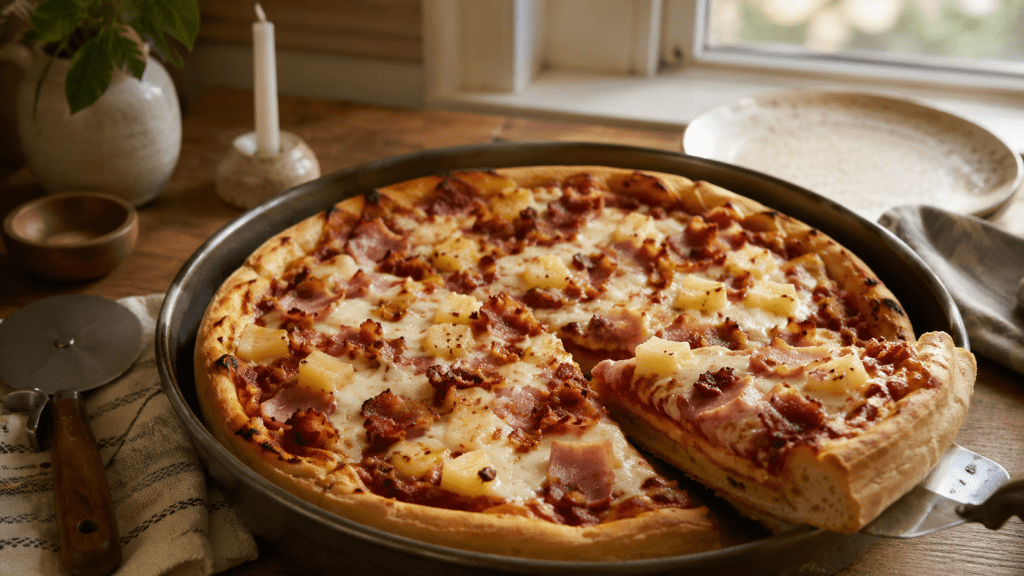
The cheese should be bubbling and beautifully browned in places. More importantly, the outer crust should be a deep golden brown.
If the cheese is getting too dark before the crust is ready, loosely tent the top with aluminum foil.
When it’s finished, take the pan from the oven and do something surprisingly difficult:
Leave it alone.
Give it 10–15 minutes before cutting.
That rest lets the cheese, sauce, and vegetables settle. Cut immediately, and all that beautiful filling is much more likely to run onto the plate.
Run a thin spatula around the edge, slice it into wedges, and serve.
A Note From the Kitchen
There are easier ways to make pizza.
That’s worth admitting.
You can buy dough. Buy shredded cheese. Open a jar. Throw raw vegetables over everything and have dinner on the table considerably sooner.
And sometimes that is exactly what dinner needs to be.
But this is something different.
You make the dough tonight for something you won’t eat until tomorrow. You grate a pound of cheese. You stand over a skillet long enough for mushrooms to brown and onions to soften.
None of these things is particularly difficult.
They simply ask you to care.
And maybe that’s one of the quiet pleasures of cooking at home.
Every once in a while, we make something slowly, not because we have to, but because we can.
Please like, comment, and share
Resources for Hard Times
If you’re looking for practical help, food support, or community resources, you can visit the Salt, Ink & Soul Resources Page.