There comes a moment in late November when the air shifts not just in temperature but in expectation. The world begins rehearsing its yearly performance — the food, the family, the football, the familiar script repeated so often it feels carved into the country’s memory.
And if you fit neatly into that script, it can feel warm, grounding, like returning to a language you somehow still remember fluently.
But for others, the holiday arrives like an old story they no longer belong to.
Most people don’t talk about those who feel the season coming like a weight. The people who look at the calendar and feel their chests tighten. The ones who know that the hardest holidays aren’t always the ones filled with chaos, but the ones filled with quiet.
The kind of quiet that makes you hear yourself.
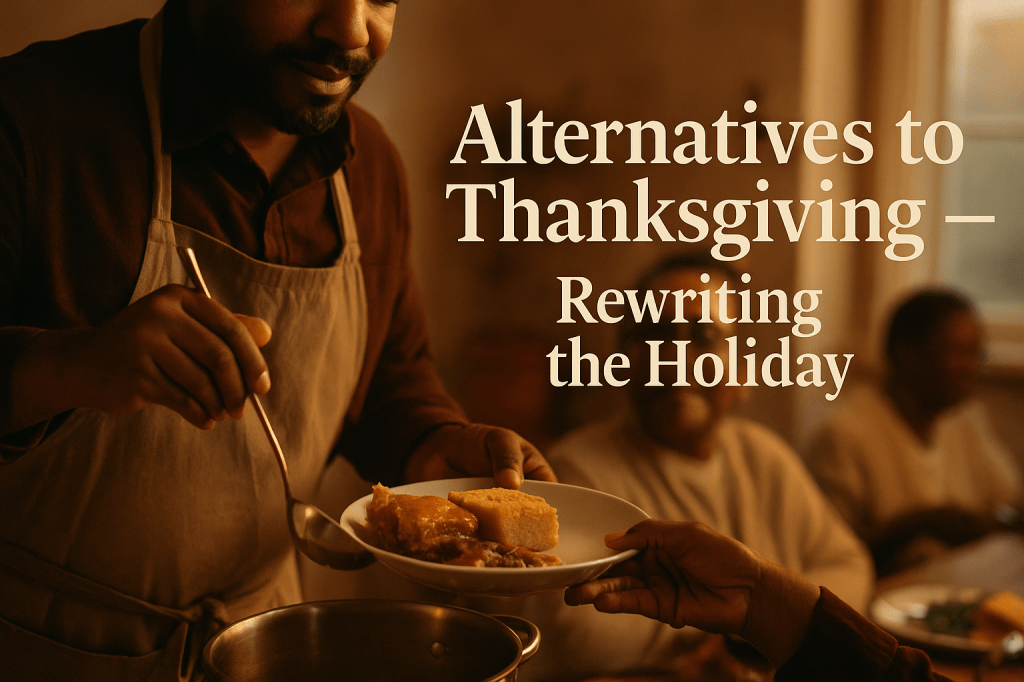
Some people try to rewrite the holiday in small, quiet ways — making it about something more than the expected trinity of food, family, and football. They find their gratitude not at a crowded table, but standing in the fluorescent light of a food pantry, handing out turkeys and canned goods with a soft smile, hoping no one sees the ache behind it.
For them, volunteering isn’t charity. It’s survival.
A way of turning their loneliness into something useful, something human, something that means they didn’t spend the day hiding from the world.
Because expecting yourself to shoulder a season of loneliness — to sit through a holiday full of painful memories — isn’t strength. It’s a self-inflicted exile.
And exile is not a tradition worth keeping.
The truth is this:
The holiday season is one of the hardest times of year to be single, estranged, rebuilding, recovering, or simply alone.
The world keeps offering images of togetherness, and it’s easy to forget that they’re curated, staged, and performed. That countless people sitting at those big tables are hurting too, just more quietly.
But being alone does not mean you must be lonely.
Humans are built for community. For congregating. For creating small pockets of belonging wherever we can find them. We weren’t designed for isolation — the world simply taught us how to perform it.
So some people start the slow, brave work of rewriting the holiday.
Not erasing it — rewriting it.
It may mean opening your home to friends who don’t have anywhere else to be.
It could mean joining a community meal where the only rule is kindness.
It may mean spending the morning volunteering, feeding people who understand hunger in more ways than one.
Maybe it means choosing a different ritual altogether — a long walk, a favorite movie, a personal tradition unburdened by expectation.
It could look like sitting with a small plate you prepared for yourself, not out of sadness, but out of intention — honoring your own company instead of apologizing for it.
It could look like surrounding yourself with people who understand the quiet parts of you.
It could look like helping someone else survive the holiday so you don’t have to face your own reflection all day long.
It might take courage.
Let go of the script you were handed as a child.
It might take admitting that the table you grew up sitting at wasn’t always a place of warmth but a place of wounds.
Traditions are beautiful until they become burdens.
Holidays are comforting until they become cages.
And sometimes the bravest thing you can do is step outside of both.
Rewriting the holiday doesn’t mean you’re rejecting the past.
It means you’re learning to honor the present — your present — even if it looks nothing like what you were taught to expect.
This year, if your table is empty, build another.
If the memories are heavy, reshape them.
If the day threatens to swallow you whole, step outside of it.
Make something new.
Make something honest.
Make something that doesn’t hurt to hold.
Because you don’t have to feel lonely just because you are alone.
And you don’t have to disappear just because the world expects you to stay quiet.
You can choose connection — even in small doses.
You can choose a community — even if you have to build it from scratch.
You can choose gratitude — even if it isn’t wrapped in tradition.
Rewriting the holiday is not an act of rebellion.
It’s an act of survival.
An act of self-respect.
An act of saying:
I deserve a holiday that makes room for me.
Sometimes that means sitting at a new table.
Sometimes it means opening a door for someone else.
Sometimes it means starting over.
But always — always — it means choosing yourself.
And that kind of choice?
That is something to be grateful for.
Kyle J. Hayes
kylehayesblog.com
Please like, comment, and share
Resources for Hard Times
If you’re looking for practical help, food support, or community resources, you can visit the Salt, Ink & Soul Resources Page.
 Salt,Ink, & Soul
Leave a comment