Salt, Ink & Soul — Humanity Through Food Series
I live now in New Mexico — a place where beans are more than food.
They’re a landscape.
A rhythm.
A quiet religion built into the daily life of the people who’ve been here long before asphalt and subdivisions.
Out here, beans carry the weight of generations. They simmer slowly on back burners, folded into stews, stretched across cold evenings, made sacred by repetition and memory. People speak of them with a kind of reverence I’m still learning to understand — the way you might talk about a story your grandmother told you a hundred times, knowing the hundred-and-first will still matter.
But that wasn’t my experience growing up.
Where I came from, the sight of beans didn’t bring comfort.
It filled my stomach with dread.
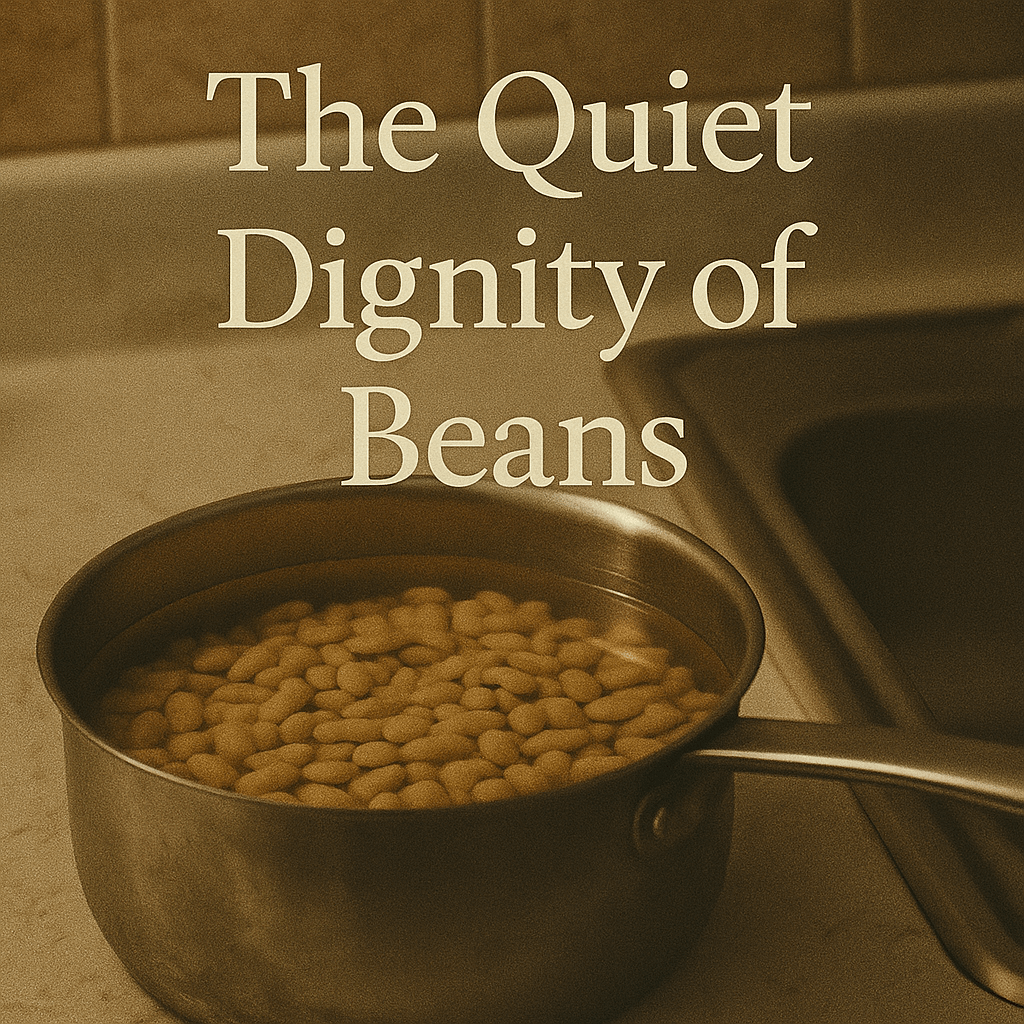
I’ve written before about the sinking feeling that washed over me when I saw a pot of beans soaking in the sink. It was a kind of childhood math — unspoken but understood. Beans meant money was tight. Beans meant there were no extra groceries to choose from. Beans meant stretching, rationing, surviving.
As kids, we formed a silent pact around it — not one spoken in words but in looks exchanged across the kitchen. We all felt it. That quiet disappointment disguised as appetite. Beans were never the meal we hoped for. They were the meal we needed.
And the way we carried that memory into adulthood…
That’s its own complicated story.
One of my sisters swears she’s “allergic” to beans.
A medical impossibility, the rest of us laugh at —
not out of cruelty, but out of recognition.
We know the truth.
It’s not her body reacting — it’s the past.
Invisible scars are funny that way —
they flare up without warning,
dictate tastes and habits,
and live under the skin long after the hard years have passed.
For each of us, beans became something to avoid —
a symbol of the lean seasons we survived together.
But here’s the truth buried under all that resistance:
We didn’t like them…
But they kept us alive.
And we knew it.
When I talk to others about this — about beans, scarcity, survival food — I’m surprised by how familiar the story feels.
Almost everyone has a version of the same confession:
“We didn’t like it. But we didn’t starve.”
Peanut butter sandwiches.
Canned soup.
Government cheese.
Rice dishes stretched thin.
Leftovers reinvented until they became something else entirely.
And, of course, beans.
It’s strange how something so simple can carry so much emotional weight.
A pot of beans meant another day we’d make it.
Another day, we wouldn’t go to bed hungry.
Another day, we’d stretch what we had until something better came along.
Beans were the food that stood between us and the cliff.
And now, all these years later, we still feel the echo of that grind.
Moving to New Mexico forced me to reconsider everything I thought I knew about beans.
Here, they aren’t a symbol of lack.
They’re a symbol of identity.
Of pride.
Of cultural endurance.
Of flavors perfected not out of necessity but out of intention.
I’ve watched families here talk about beans the way some people talk about heirlooms — with respect, with memory, with joy. They’re part of feasts, gatherings, rituals. They hold meaning.
It’s made me rethink what I grew up believing.
Made me wonder if healing sometimes looks like learning to see an old wound through a new lens.
Someone recently told me to try Navajo tacos.
And maybe I will — perhaps that’s my first step into rewriting a relationship shaped by childhood scarcity.
Maybe the world has been trying to teach me that beans are more than the fear I attached to them.
I don’t know if my siblings feel that shift.
I don’t know if they ever will.
But I’m starting to.
The Quiet Dignity of What Sustains Us
The older I get, the more I realize this:
There is a quiet dignity in the foods that kept us alive.
Even the ones we claimed to resent.
Even the ones that came with silent embarrassment.
Even the ones we push away now, out of habit or history.
Because survival has its own kind of grace —
a soft, steady grace that doesn’t ask to be admired.
It just asks to be acknowledged.
Beans taught me that.
They taught me resilience long before I had the language for it.
They taught me how families stretch together.
How siblings develop the same scars in different shapes.
How a kitchen can hold both struggle and salvation at once.
Beans may not have been our first choice. They may have carried more memories than flavor back then. But they fed us. They kept us standing. And in their own quiet way, they taught us how to survive when survival felt like the only thing we could afford.
I wish I could end this with a great bean recipe—some treasured family dish or perfected method—but the truth is, I don’t have one. If you do, or if there’s a recipe that carried you through your own seasons of scraping by and making do, please share the link. I’d be grateful to learn from you.
Kyle J. Hayes
kylehayesblog.com
Please like, comment, and share
Resources for Hard Times
If you’re looking for practical help, food support, or community resources, you can visit the Salt, Ink & Soul Resources Page.
 Salt,Ink, & Soul
Leave a comment