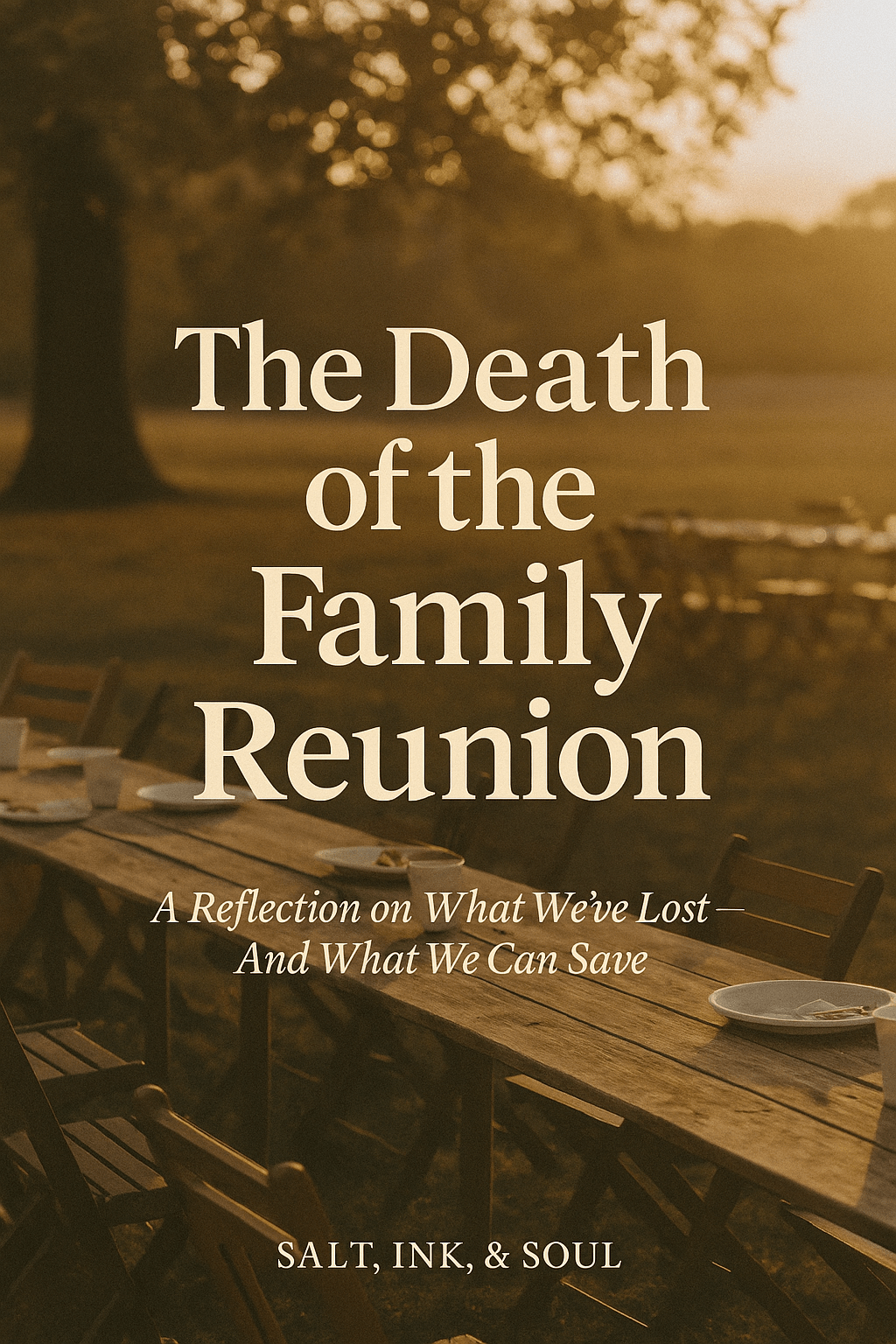
There was a time when the family reunion was a sovereign nation. It was its own country—borderless, sprawling, stitched together by folding chairs and potato salad, the language of inside jokes and side-eyes, the music of Stevie Wonder & Michael Jackson playing under the shade of Pine trees. A time when cousins you hadn’t seen in three summers ran up to you like the years hadn’t passed at all. When your great-aunt sat in the middle of the picnic like a tribal elder, commanding respect simply by being.
But those days are dying.
Today, we still have the cookout, but it’s smaller—more intimate. Just mama and them, maybe a stray cousin or two, whoever was close enough to text the night before. The sprawling tree has been pruned down to a sapling. Third and fourth cousins have become strangers. The great-aunts and uncles who used to hold court, the ones who could make feuding relatives hug just long enough for the picture—they are passing on. And no one has stepped up to replace them.
The family reunion wasn’t just a party. It was a performance of survival. It was where the family came to bear witness to itself. You’ve got to see the uncles who hadn’t spoken in years sitting at the same table, grunting through peace for a few hours because Big Mama asked them to. You saw your cousins—those living testaments to the places your blood had wandered—The Quad-Cities, St. Louis, Albuquerque—all gathered in one place. You saw what your people had endured. The reunion was a history lesson with Kool-Aid and pound cake.
And then there were the secrets. Every family has them—the ones you whisper about in the kitchen when you think the kids aren’t listening. The reunion was where those secrets were kept, not because they were shameful, but because they were binding. The elders held them like scrolls, as if they were holy texts. They knew which stories to tell and which to carry to their graves, and somehow that discipline kept the family whole.
Now, the elders are gone. The scrolls are scattered. The secrets have slipped into the wind, sometimes aired out in group chats, other times left to die in silence. And without the keepers of the covenant, we are drifting.
We live in an era of curated distance. We say “family” but mean it like a password, not a promise. The younger ones, the ones raised on social media and soft boundaries, have little appetite for gathering with people who once judged them, who might still hold the memory of their worst mistakes. The old guard could make you come anyway—make you show up, make you sit in the heat, make you pass the potato salad to the cousin you swore you’d never speak to again. They could force you to remember that family is not optional.
And yet, here we are—choosing.
There is grief in this. Grief not just for the elders who are gone, but for the version of ourselves that was possible when we stood together. Grief for the messy, complicated love that once kept us tethered.
But there may also be a call. We may have to decide whether the reunion dies with them or is reborn through us. It’s our turn to be the ones who hold the secrets, who call the roll, who get the feuding cousins to show up just long enough to remember that they still share a name.
The family reunion is not gone. It is waiting—like a pot on the back burner, simmering slow, hoping someone remembers to stir it.
The question is whether we will.
By Kyle J. Hayes
kylehayesblog.com
Please like, comment, and share
Thinking of Family Reunions makes me wonder, what’s your favorite dish to eat or to bring? Please leave a comment.
 Salt,Ink, & Soul
Leave a comment