Tag: personal growth

  • Who Are You Most Inspired By?

    Who Are You Most Inspired By?

    The person who inspires me most is Fred Rogers.

    Not because he was famous.

    Not because generations of children grew up watching him.

    And not because he seemed to have all the answers.

    He inspires me because he knew exactly who he was and never seemed interested in becoming someone else.

    In a world that often rewards loud voices, he spoke softly.

    In a world that celebrates outrage, he chose kindness.

    In a culture that often mistakes cynicism for wisdom, he believed people were worth caring about.

    What strikes me most is that he did what he truly loved. He found a way to use his gifts in the service of others and then spent decades doing exactly that. He did not seem to chase trends, popularity, or approval. He held fast to his convictions, whether the crowd agreed or not.

    That kind of consistency is rare.

    Many of us spend years trying to figure out who we are. Others know who they are but are afraid to live it. The pressure to fit in, to be accepted, or to be successful on someone else’s terms can be overwhelming.

    Yet he seemed content to walk a different path.

    A path built on the belief that every person has value.

    As I’ve gotten older, I’ve come to admire that more than talent, wealth, or fame. The people who leave the deepest mark on the world are often the ones who make others feel seen. They remind us that kindness is not weakness, that compassion requires courage, and that treating people with dignity is a worthy life’s work.

    When I think about the kind of person I hope to become, I don’t think about being the smartest person in the room or the most successful.

    I think about being useful.

    I think about leaving people better than I found them.

    That is why he inspires me.

    Not because he changed the world through power.

    But because he changed it through service, one person at a time.

    Kyle J. Hayes

    kylehayesblog.com

    Please like, comment, and share

    Resources for Hard Times

    If you’re looking for practical help, food support, or community resources, you can visit the Salt, Ink & Soul Resources Page.
    👉 Resources for Hard Times

  • What is something you wish you could tell your 20-year-old self?

    What is something you wish you could tell your 20-year-old self?

    I would tell him to come home to himself sooner.

    Not home as a place.

    Home as a knowing.

    Home is that quiet room inside you where your own voice still lives before the world teaches you to mistrust it.

    I would tell my 20-year-old self to stop spending so much of his life auditioning for people who were never going to choose him, honestly. Stop bending yourself into shapes that do not fit your spirit. Stop mistaking acceptance for love. Stop confusing attention with belonging.

    Because there is a difference.

    And learning that difference can cost you years.

    At twenty, you think being liked will save you.

    You think if you become easier, funnier, quieter, louder, more agreeable, more useful, more available, more whatever the room seems to require, then maybe people will keep you around. Maybe they will see you. Maybe they will decide you are worth knowing.

    But some people do not dislike you for failing to become enough.

    Some people were never interested in getting to know you at all.

    They were interested in what you could provide.

    Your time.

    Your loyalty.

    Your attention.

    Your silence.

    Your willingness to shrink yourself so they would not have to make room.

    That is a hard lesson.

    But it is a freeing one.

    I would tell him this: do not waste your best years trying to become acceptable to people who benefit from you not knowing your worth.

    Spend that time discovering who you are.

    Not who you perform.

    Not who you pretend to be when you are afraid of being left out.

    Not who you become when loneliness starts negotiating against your dignity.

    Who you are.

    What you love.

    What you believe.

    What brings you peace?

    What kind of man do you want to become when no one is clapping?

    What kind of life feels honest when nobody is watching?

    I would tell him that solitude is not always punishment. Sometimes it is protection. Sometimes being alone is the first place where you can finally hear yourself without all the borrowed voices talking over you.

    There is grief in realizing how much time you gave away.

    Time you could have used to grow.

    To read.

    To think.

    To build.

    To heal.

    To understand your own mind.

    To become comfortable in your own skin.

    To stop asking strangers, friends, lovers, and crowds for permission to exist.

    But I would not speak to him cruelly.

    He was doing the best he could with what he knew.

    He wanted a connection.

    He wanted to matter.

    He wanted to be loved in a world that often teaches people to earn what should have been given freely.

    So I would not shame him for trying.

    I recommend telling him to try differently.

    Try choosing yourself.

    Try telling the truth sooner.

    Try leaving when the room keeps requiring your disappearance.

    Try noticing who only loves you when you are convenient.

    Try paying attention to the people who make you feel peaceful rather than desperate.

    Try building a life that does not depend on approval from people who have not even learned to approve of themselves.

    Because one day, you will understand something that a twenty-year-old could not yet know.

    The goal was never to become the kind of person everyone liked.

    The goal was to become someone you could live with.

    Someone you could respect.

    Someone whose reflection did not look like a stranger assembled from other people’s expectations.

    I would tell him that self-discovery is not selfish.

    It is necessary.

    You cannot build a true life out of borrowed pieces. You cannot keep abandoning yourself and call it love. You cannot keep giving your time to people who leave you with less of yourself and expect peace to grow there.

    So I would tell my 20-year-old self:

    Come back to you.

    Earlier.

    Stay with you.

    Longer.

    Learn yourself before trying to be chosen.

    Because the people meant for your life should not require you to disappear before they can accept you.

    And the time you spend becoming yourself is never wasted.

    Kyle J. Hayes

    kylehayesblog.com

    Please like, comment, and share

    Resources for Hard Times

    If you’re looking for practical help, food support, or community resources, you can visit the Salt, Ink & Soul Resources Page.
    👉 Resources for Hard Times

  • What’s a fear you’ve overcome — and how did you do it?

    What’s a fear you’ve overcome — and how did you do it?

    Daily writing prompt
    What’s a fear you’ve overcome — and how did you do it?

    The fear I had to overcome was the fear of truly expressing myself.

    Not writing.

    I could write.

    I had always known there were words somewhere inside me, moving around in the dark, waiting for a place to go. But expression is different from writing. Expression asks more of you. Expression does not let you hide behind cleverness or distance. It asks you to bring the real thing forward.

    The feeling.

    The thought.

    The wound.

    The part of yourself you learned to protect because the world had already shown you what it could do with anything soft.

    I grew up being teased for anything and everything. That kind of thing does not leave you all at once. People like to pretend childhood cruelty is small because children are small, but that is not true. Small hands can still leave fingerprints. Small voices can still become the echoes a person carries into adulthood.

    After a while, you learn to hold yourself back.

    You learn to measure every word before it leaves your mouth. You learn to hide enthusiasm. You learn to make yourself less visible. You learn that being seen can feel dangerous.

    So the idea of putting myself on paper, my feelings, my thoughts, my pain, my emotions, and then placing it online where anyone could read it, was terrifying.

    It felt almost unnatural.

    Like standing in the middle of a room and taking off the armor I had spent years building.

    And yet, I did it.

    Not all at once.

    Not bravely in the way people imagine bravery.

    I did it one piece at a time.

    A sentence.

    A paragraph.

    A post.

    A confession softened by craft.

    A truth placed carefully enough that I could survive seeing it outside my body.

    The more I wrote, the more something inside me began to loosen. Not disappear. Not healed completely. But loosen. Writing became a way to take what had been trapped inside me and give it shape. Once it had shape, it was no longer just pain. It was testimony. It was a memory. It was language. It was something I could hold, examine, revise, and understand.

    And the more I did it, the better I felt.

    The better I got.

    That matters too.

    Because fear wants you to believe that expression will destroy you. It tells you that if people see the real thing, they will laugh. They will turn away. They will misunderstand. They will prove every old voice right.

    And sometimes people may not understand.

    But sometimes they do.

    Sometimes someone leaves a comment that lets you know your words reached a place in them they had not been able to name. Sometimes someone tells you that what you wrote helped them. Sometimes they do not say it loudly, but you can feel it. They saw themselves in your story. They realized they were not the only ones who had carried that kind of ache.

    That changes something.

    Because then the writing is not only about me.

    It becomes a bridge.

    A small one, maybe.

    But still a bridge.

    One person telling the truth from one side of loneliness, and another person hearing it from the other.

    That is how I overcame the fear.

    Not by becoming fearless.

    I do not think that is how fear works.

    I overcame it by learning that the fear did not get the final vote. I overcame it by writing anyway. By sharing anyway. By letting the work prove to me that vulnerability does not always lead to humiliation. Sometimes it leads to a connection. Sometimes it leads to healing. Sometimes it becomes the very thing that helps someone else survive their own silence.

    And in helping them, I help myself.

    That may be the part I did not expect.

    Every time someone responds and says, in some way, I know this feeling too, I am reminded that I am not alone either. The pain I thought was only mine was never only mine. The fear I thought made me strange was part of being human. The loneliness I carried had echoes in other people.

    Writing taught me that.

    Or maybe sharing did.

    Private writing can save you in one way. But public honesty can save you in the long run. It can turn the locked room into a doorway.

    I still feel the fear sometimes.

    I still know what it costs to tell the truth.

    But I also know what silence costs.

    And I have paid enough for that.

    So I keep writing.

    I keep placing pieces of myself on the page.

    Not because it is easy.

    Because somewhere, someone may need the words.

    And maybe I need them too.

    Kyle J. Hayes

    kylehayesblog.com

    Please like, comment, and share

    Resources for Hard Times

    If you’re looking for practical help, food support, or community resources, you can visit the Salt, Ink & Soul Resources Page.
    👉 Resources for Hard Times

  • The Land That Let Me Become 

    The Land That Let Me Become 

    People still look at me strangely when I tell them I chose New Mexico.

    Not passed through.

    I didn’t end up here by accident.

    Not got stranded by work, family, disaster, or one of those wrong turns life has a way of dressing up as destiny.

    I chose it.

    And I understand why that sounds strange to some people. New Mexico is not always the place people are taught to imagine when they are dreaming out loud. It does not shout for your attention the way other places do. It does not beg to be admired. It sits there beneath that impossible sky, all red earth and distance, all wind and silence, all mountains watching like old witnesses, and waits to see if you are the kind of person who can be still long enough to understand it.

    I may not have understood it when I came here.

    I only know that I came.

    And the longer I stay, the more I wonder whether choosing is sometimes only the name we give to being led.

    I know how that sounds.

    I know how strange it can feel to speak of God in a world that has learned to explain everything, leaving nothing sacred. We want clean answers. We want maps, logic, strategy, relocation plans, job prospects, rental prices, and practical reasons that fit neatly in the mouth.

    But some things do not fit.

    Some things happen below language.

    Some places do not just receive you.

    They work on you.

    New Mexico has worked on me.

    I know there is another life I might have lived. A smaller one. Not evil. Not worthless. Just narrow enough to make me forget the sound of my own becoming. Maybe that is why I look at New Mexico with such wonder. It did not simply give me a place to live. It gave me distance from the life that might have closed around me.

    Not loudly. Not all at once. Not with some grand cinematic gesture where the sky opens, and the old self falls away. It has been quieter than that. More patient. More humiliating, in the way healing can be humiliating when it shows you how long you mistook your wounds for your personality.

    The anger I carried for most of my life did not disappear overnight. Anger rarely does. It had roots. It had memory. It had reasons. Some of them were honest. Some of them were old defenses that had outlived their usefulness. Anger had been my armor, my witness, my proof that what happened mattered. Resentment had been a bitter little fire I kept alive because I feared that if I let it go, the world would get away with what it had done.

    But something about this place began to make the fire unnecessary.

    Maybe it was the sky.

    That sounds too simple, but the sky here is not simple. It is a thing with depth. It can make a man feel both small and held. It stretches over you like a question you cannot answer quickly. Morning light hits the Sandias and makes them look less like mountains than scripture written in stone. Evening comes down slow, blue and gold and purple, as if the day itself is reluctant to leave.

    Some places crowd you.

    New Mexico opened something.

    It gave me room to hear myself without the old noise. Room to ask what I was carrying. Room to wonder if every burden deserved to be carried forever.

    And in that room, my writing changed.

    Or maybe I changed, and the writing followed.

    Before New Mexico, I wrote from a harder place. A place of clenched teeth. A place where every sentence had to prove I had survived. There was power in that. I will not insult the old version of myself by pretending he had nothing to offer. He kept me alive. He carried me through years I still do not always know how to name. He wrote with blood because blood was what he had.

    But here, something began to soften.

    Not weaken.

    Soften.

    There is a difference.

    Softening is not surrender. It is not becoming harmless. It is learning that tenderness can be a form of strength when it has survived the furnace and still chooses not to become cruel.

    My writing blossomed here because I was finally allowed to become more than my pain.

    That may be the deepest gratitude I have.

    New Mexico did not ask me to stop telling the truth. It simply showed me that truth had more than one temperature. It could burn, yes. But it could also warm. It could feed. It could sit at a kitchen table beside green chile, coffee, bread, and silence, and still say what needed to be said.

    I found people here who cared.

    That sentence looks small on the page, but it isn’t to me.

    I found people who did not treat art like foolishness. People who did not look at writing as some strange indulgence, some childish dream a grown man should outgrow. I found writers. Artists. Chefs. Jewelry designers. Makers of beautiful things. People who understood that creation is not always decoration. Sometimes creation is survival. Sometimes it is testimony. Sometimes it is the only way a person can turn the pieces of himself into something that may help somebody else breathe.

    They let me know it was okay to write.

    Okay to express.

    Okay to find out who I truly was.

    Okay to share it.

    That kind of permission can change a life.

    Not because a person should need permission to become himself, but because many of us come from places, families, histories, and wounds where the self was something we learned to hide. We learned to be useful before we learned to be honest. We learned to endure before we learned to speak. We learned to make ourselves smaller so the world would not notice how much we were carrying.

    And then, somehow, I found myself here.

    In a place where art is not hidden away.

    It is on the walls. Around necks. In markets. In kitchens. In books. In the hands of people who shape silver, clay, chile, sentences, bread, paint, and memory. Here, beauty is not always polished. Sometimes it is rough-edged and sun-baked. Sometimes it smells like roasting chile and dust after rain. Sometimes it is turquoise against brown skin, a bowl of posole, a poem read in a room full of strangers, a balloon rising into the morning while I stand firmly on the ground, grateful to admire what I have no intention of riding.

    I still look at those balloons with wonder.

    A field full of color lifting into the sky like somebody decided joy needed a body.

    And no, I doubt I will ever ride one.

    There are still fears I have not conquered.

    I can admit that now without shame.

    Once, I might have seen every fear as evidence against me. As proof that I had not become enough. But I am learning that life is not conquered all at once. Some fears remain not to mock us, but to remind us that we are still human. I can stand beneath the balloons and marvel. I can watch them rise. I can honor the courage of those who climb into the basket and float into the open air.

    And I can keep my feet on the earth.

    That, too, is a kind of wisdom.

    New Mexico has taught me that becoming does not always look dramatic. Sometimes becoming is waking up and realizing you are less angry than you used to be. Sometimes it is noticed that the old resentment does not answer as quickly when called. Sometimes it is writing a sentence and realizing it came from peace, not injury. Sometimes it is looking around your life and seeing, with a kind of stunned humility, that what once felt impossible has quietly become real.

    I have changed here.

    I do not say that lightly.

    My problems did not vanish because I crossed a state line. Pain is not that simple. A man brings himself wherever he goes. His ghosts pack light. They know how to travel.

    But here, many of mine began to lose their grip.

    Some of that was time.

    Some of that was work.

    Some of that was people.

    And some of it, I believe, was God.

    I cannot prove that in the way the world likes proof. I cannot show a receipt for grace. I cannot chart mercy on a map. I only know that I came here carrying things I thought would always be mine, and now some of them no longer fit in my hands.

    That feels like God to me.

    Not always thunder.

    Sometimes release.

    Sometimes a door opens in a place you never expected to call home.

    So this is my gratitude.

    For the desert that did not ask me to explain myself.

    For the mountains that stood there while I became quieter.

    For the artists who made expression feel possible.

    For the cooks who reminded me that food is memory and care.

    For the writers who made the page feel less lonely.

    For the people who showed me that community does not always announce itself with noise. Sometimes it comes gently, through encouragement, through conversation, through a simple belief that what you are making matters.

    For the balloons, I will admire from below.

    For the sky that keeps making me look up.

    For the anger that is leaving.

    For the words that came back changed.

    For the man I was.

    For the man I am becoming.

    For New Mexico.

    The land I chose.

    Or maybe the land that was chosen for me.

    Kyle J. Hayes

    kylehayesblog.com

    Please like, comment, and share

    Resources for Hard Times

    If you’re looking for practical help, food support, or community resources, you can visit the Salt, Ink & Soul Resources Page.

    👉 Resources for Hard Times

  • What Could Have Been

    What Could Have Been

    Thoughts on the life I escaped.

    Maybe escaped is too much. There was no dramatic chase. No single door kicked open. No heroic music swelling in the background while a man heads to the southwest with all his wounds packed neatly in the trunk.

    It was quieter than that.

    It was the kind of escape that happens after years of feeling the walls move closer and closer until one day you realize the room has been shrinking around you. Not because anyone touched the walls. Not because anyone admitted what was happening. But because the life around you had already decided its limits for you, and if you were not careful, you would mistake those limits for destiny.

    I come from the Quad Cities.

    I say that with no hatred.

    A place can wound you and still feed you. A place can raise you and still not have room for you to become. A place can know your name and still never know what lives inside you.

    That is the complicated truth of home.

    People from the outside sometimes imagine the Midwest as simple. Quiet. Polite. Decent. Hardworking. Neighborly. They imagine front porches, snow shovels, church fish fries, factory shifts, Friday night bars, and grocery stores where everybody knows somebody’s cousin.

    And some of that is true.

    But truth is rarely clean.

    The Midwest has a way of hiding its knives in soft cloth.

    The racism was not always loud.

    That was part of the trouble.

    It did not always come wearing a hood or shouting from the street. It came smiling. It came with a handshake. It came with a joke you were supposed to laugh at if you wanted to keep the peace. It came in the silence after you spoke too well. It came in the promotion you were never quite right for. It came in the form of people making you feel grateful for being tolerated.

    Polite racism is a special kind of poison.

    It asks you to pretend you have not been poisoned.

    It asks you to be reasonable. Professional. Mature. Understanding. It asks you to bow your head and call it patience. It asks you to keep working, keep smiling, keep proving, keep swallowing. And because jobs are few and far between, because opportunity is treated like a chair in a crowded room, once you get a seat, you are expected to sit there and be thankful, no matter how hard the wood cuts into you.

    That is how a life gets built smaller than the soul.

    One concession at a time.

    You get a job and keep it.

    Good or not.

    Fair or not.

    Respectful or not.

    You keep it because there may not be another one waiting. You keep it because rent does not care about dignity. Groceries do not care about dreams. The light bill does not lower itself because your spirit is tired. So you learn the mathematics of survival. You calculate the insult against the paycheck. You measure humiliation against health insurance. You teach yourself to be quiet because quiet pays on Friday.

    And then one day, the quiet becomes you.

    That is the thing I fear most when I think about what might have been.

    Not poverty.

    Not struggle.

    Not even failure.

    I fear becoming quiet.

    I fear being a man who learned to live without asking what living was supposed to mean.

    There is a version of me who stayed.

    I can see him sometimes.

    He is not a bad man. That may be the saddest part. He is not foolish. He is not weak. He is not lazy. He is smart. Maybe too smart for the room and too tired to do anything about it.

    He works because work is what men are told to do. He buys the house he can afford because that is what responsibility looks like from the outside. He keeps his head down. He takes the jokes. He lets certain comments pass through him like winter air through an old window.

    He tells himself this is adulthood.

    He tells himself everybody compromises.

    He tells himself dreams are for people with softer lives.

    And every evening, maybe he ends up in some corner bar where the same songs from the eighties keep playing like time got drunk and forgot to leave.

    Maybe Springsteen comes through the speakers, singing about glory days, and everybody smiles because they know the words. They know the rhythm. They know the ache, even if they would never call it grief.

    But I never wanted to become that man.

    The man sitting under the dim light, nursing a drink, telling the same stories about who he used to be because the present has become too small to speak of. The man who once had promise, once had fire, once had some bright and dangerous thing inside him, but somewhere along the way learned to trade becoming for remembering.

    That was the life I feared.

    Not the bar itself.

    Not the music.

    Not even nostalgia, because memory can be holy when handled with care.

    What I feared was getting trapped there. Becoming fluent in the language of almost.

    Almost left.

    Almost wrote.

    Almost tried.

    Almost became.

    A man with intelligence enough to know the cage had a lock, but not enough courage left to reach for the door.

    Which is to say, a man dying of recognition in a room too small for his questions.

    That is no life.

    Not because bars are bad.

    Not because familiar music is bad.

    Not because staying in your hometown is a failure.

    Some people stay and build beautiful lives. Some people remain and become pillars. There are people whose roots run deep enough to turn the soil around them into fertile ground.

    But for me, staying would have been a kind of burial.

    I know that now.

    The Quad Cities are not ignorant. That is one of the lies people tell about places like that. People are educated there. People read. People think. People work hard. People earn degrees. But a degree is not the key if every door in the city is already full of people waiting for the same narrow opening.

    I have seen baggers at local stores with college degrees.

    That image stays with me.

    Not because honest work is shameful. There is dignity in all work done with care. But there is something brutal about a place where education does not always become movement. Where intelligence gets folded into survival. Where ambition learns to speak softly because there is nowhere for it to go. The local economy can make a person feel ridiculous for wanting more than what is available.

    You learn to lower your voice around your own dreams.

    You stop saying certain things out loud.

    Writing would have been one of those things.

    Writing, in that life, would have sounded absurd. Not because writing is absurd, but because harsh places train people to distrust anything that does not immediately pay the bills. Art becomes suspicious. Expression becomes indulgence. A man saying he wants to write sounds like a man saying he wants to starve beautifully.

    So the dream would have been crushed.

    Not all at once.

    Crushed slowly.

    Under overtime.

    Under politeness.

    Under fatigue.

    Under the need to be practical.

    Under the look people give you when you reveal some secret part of yourself, and they do not know whether to laugh or feel sorry for you.

    I might have stopped writing before I ever truly began.

    That thought troubles me.

    Because now I know what writing has become for me.

    It is not a hobby.

    It is not decoration.

    It is not some charming little side project meant to make me feel interesting.

    Writing is the place where I tell the truth before the world edits it. It is where I gather the broken pieces and make them speak. It is where I take what hurt me and refuse to let it die without meaning.

    But in the life I escaped, meaning might have had to wait.

    And wait.

    And wait.

    Until one day, it forgot my name.

    That is what small lives can do when they are not chosen freely. They do not always destroy you by violence. Sometimes they destroy you by routine. You wake up. You work. You endure. You pay. You sleep. You repeat. You become reliable. You become respected in the acceptable ways. You become the kind of man people point to and say, “He’s doing all right,” while something sacred inside you sits in the dark, starving.

    I could have become that man.

    That is why I do not speak of leaving lightly.

    Leaving was not only about geography.

    Leaving was disobedience.

    It was a refusal to let the place that shaped me become the place that sealed me shut. It was me saying, perhaps before I even had the language, that survival was not enough if survival required the death of everything tender, strange, creative, and true inside me.

    New Mexico did not make me from nothing.

    I brought myself here.

    I brought the scars, the questions, the intelligence, the anger, the hunger, the ache. I brought the boy who read because books were doors. I brought the man who wanted more but did not always believe more was allowed. I brought the Midwestern discipline, the working-class suspicion of easy promises, the memory of what it means to keep going when nothing romantic is happening.

    But New Mexico gave me room.

    And room can feel like grace when you come from a place where every dream had to crouch.

    Here, the sky does not crouch.

    The land stretches out like it is daring you to unclench. The mountains do not ask you to justify your existence. The light falls on everything with a kind of ancient indifference that somehow feels merciful. You can be small here without being erased. You can be quiet without disappearing. You can be alone without being trapped.

    And somehow, in that space, the writing came.

    The life that might have been still visits me sometimes.

    I see the house I could have bought because it was affordable, not because it held my future. I see the job I would have kept because leaving felt too dangerous. I see the polite insults swallowed whole. I see the younger men at the bar becoming older men at the same bar, telling the same stories under the same neon signs while the same songs play and the years pass without asking permission.

    I see myself there.

    And I feel grief.

    Not superiority.

    Grief.

    Because there are many brilliant people trapped in lives too narrow for them. Many gifted people never leave because leaving requires money, courage, timing, madness, or some combination of all four. There are many dreams buried under good sense. Many books have never been written. Many songs have never been sung. Many meals were never made. Many paintings were never painted. Many selves never met.

    The world calls that reality.

    Sometimes it is.

    But sometimes, reality is just a cage everybody’s gotten used to.

    I do not want to romanticize leaving. It costs. It takes things from you. It makes you a stranger. It removes the comfort of being easily understood. It teaches you that reinvention is not clean. There are lonely nights in new places. There are moments when the old life, for all its limits, looks warm simply because it is known.

    But I would rather be lonely in the direction of becoming than comfortable in the direction of disappearance.

    That is the truth I keep returning to.

    If I had stayed, maybe I would have been fine.

    That is the haunting part.

    Fine is a dangerous word.

    Fine can hide a thousand funerals.

    Fine can mean the bills are paid, but the soul has gone quiet. Fine can mean nobody worries about you because you have learned to maintain stability. Fine can mean the dream died so politely that even you forgot to mourn it.

    I did not want to be fine.

    I wanted to be alive.

    Not loud.

    Not famous.

    Not untouched by pain.

    Alive.

    Aware of my own mind. Responsible for my own becoming. Free enough to write badly until I wrote honestly. Free enough to tell the truth. Free enough to sit with the anger and ask whether it was protecting me or imprisoning me. Free enough to discover that I was more than the smartest man in a room I had outgrown.

    That is what New Mexico gave me.

    Or helped me claim.

    A life where writing became possible.

    A life where the old bitterness began to lose its authority.

    A life where the boy who once dreamed in silence could finally put words on the page and let them breathe.

    And maybe that is why New Mexico feels less like a place I moved to and more like the land that let me become. Because I know the life I might have stayed long enough to inherit. I know the man I might have become. And I know, with a gratitude I still cannot fully explain, that I was given room before the dream went quiet.

    I do not hate the place I came from.

    I carry it.

    The Quad Cities are in me. The Midwest is in me. The gray winters. The modest houses. The factory logic. The polite cruelty. The educated frustration. The bars with old songs playing. The people are doing their best with what the place allows. The aching knowledge that intelligence does not always become freedom.

    All of it is in me.

    But it is not over me.

    Not anymore.

    And maybe that is what escape really means.

    Not that you outrun the past.

    But that you live long enough, and choose bravely enough, to stop letting the past decide the size of your future.

    There is a life I did not stay long enough to become.

    I mourn him sometimes.

    I honor him, too.

    Because he reminds me of what was at stake.

    He reminds me that every page I write is not merely a page. It is evidence.

    Evidence that the dream survived the harshness.

    Evidence that the man did not bow his head forever.

    Evidence that the corner bar did not become the whole world.

    Evidence that I left.

    Kyle J. Hayes

    kylehayesblog.com

    Please like, comment, and share

    Resources for Hard Times

    If you’re looking for practical help, food support, or community resources, you can visit the Salt, Ink & Soul Resources Page.
    👉 Resources for Hard Times

  • The Quiet Work of Returning to Yourself

    The Quiet Work of Returning to Yourself

    Last week was my birthday.

    Some people say that sentence like an opening bell. Like a reason for noise. Like an invitation to be celebrated loudly and without complication. They wear the day easily. They let themselves be loved in public. They accept the cake, the song, the attention, the little rituals that come with being reminded that you are still here.

    I have never been one of those people.

    Birthdays have always been difficult for me. Not because I do not understand their meaning, but because I understand it too well. A birthday can be a celebration, yes. But it can also be a mirror. It can ask questions you were not ready to answer. It can bring old rooms back into view. Old disappointments. Old silences. Old versions of yourself standing in the corner, wondering why a day meant for joy feels so heavy in the body.

    And still, I was determined to make it through this birthday season.

    That may not sound like much to someone who has never had to survive their own calendar. But some of us know some dates carry weight. Dates that arrive with ghosts. Dates that ask us to be cheerful while a deeper part of us braces for impact. So making it through becomes its own kind of victory. Not dramatic. Not cinematic. Just real.

    I maintained my workout schedule. Not perfectly. Not with the clean discipline of a man untouched by fatigue. But enough to remind myself that I had not abandoned the work completely. Enough to say, “I am still here. I am still trying.”

    There was pizza. My birthday Hawaiian pizza. A little sweet, a little salty, a little defiant in the way all pineapple pizza is defiant. There was more food than that, too. Ice cream. Cake.

    A cake I did not buy.

    And if you know my history with cakes, you understand that was probably for the best.

    There are some things a man should not be trusted to negotiate with alone. Not because he is weak, but because he has learned himself well enough to know where the trapdoors are. There is wisdom in knowing your limits. There is wisdom in letting somebody else carry the cake into the room.

    I tried to relax. I really did.

    I let myself eat more than usual. I let the kitchen stay quiet more than usual. I did not cook as much. I told myself I was due for rest, and maybe I was. The body had been tired. The mind even more so. There is a kind of exhaustion that does not announce itself with collapse. It just makes every ordinary thing feel heavier. The pan. The laundry. The workout clothes. The blank page. The routine you once built with care suddenly looks like a staircase you are expected to climb with sandbags tied to your ankles.

    So I rested.

    Or I tried to.

    Rest is not always peaceful when you are used to surviving through motion. Sometimes stopping feels like failure. Sometimes sitting still lets the old noise catch up. Sometimes the body lies down, but the mind keeps pacing the room, counting what remains undone.

    But I gave myself what I could.

    Then the birthday passed.

    The cake was eaten. The pizza was posted. The day became a memory. And there I was again, standing at the edge of the ordinary life I had been trying to build.

    The schedule was still there.

    The workouts were still there.

    The cooking was still there.

    The writing was still there.

    The work was waiting.

    And this is the part people do not always talk about. Coming back.

    Not starting over. Not reinventing yourself. Not making some grand speech about discipline while the soundtrack swells behind you. Just coming back. Quietly. Awkwardly. Maybe with a little shame. Maybe with a little heaviness. Maybe with crumbs still on the plate and the body still asking for one more day.

    There is violence in the way we sometimes speak to ourselves after rest.

    We call ourselves lazy. Undisciplined. Weak. We look at a few days of softness and act as if all our progress has been burned to the ground. We forget that life is not a straight road. We forget that healing does not happen on a perfect schedule. We forget that even the strongest people sometimes need to sit down.

    But the return still matters.

    The return may be the real discipline.

    Anybody can begin when the feeling is fresh. When the plan is new. When the shoes are clean, and the refrigerator is stocked, and the mind is full of promises. Beginning has its own electricity. But returning is different. Returning happens after interruption. After cake. After stress. After old sadness. After a week when you did not quite live the way you wanted to.

    Returning asks for something deeper than motivation.

    It asks for mercy.

    It asks you to look at yourself honestly without becoming cruel.

    It asks you to say, “Yes, I drifted. Yes, I am tired. Yes, I ate more than planned. Yes, I stepped away from the rhythm. But I am not gone.”

    That is the sentence I am trying to hold onto.

    I am not gone.

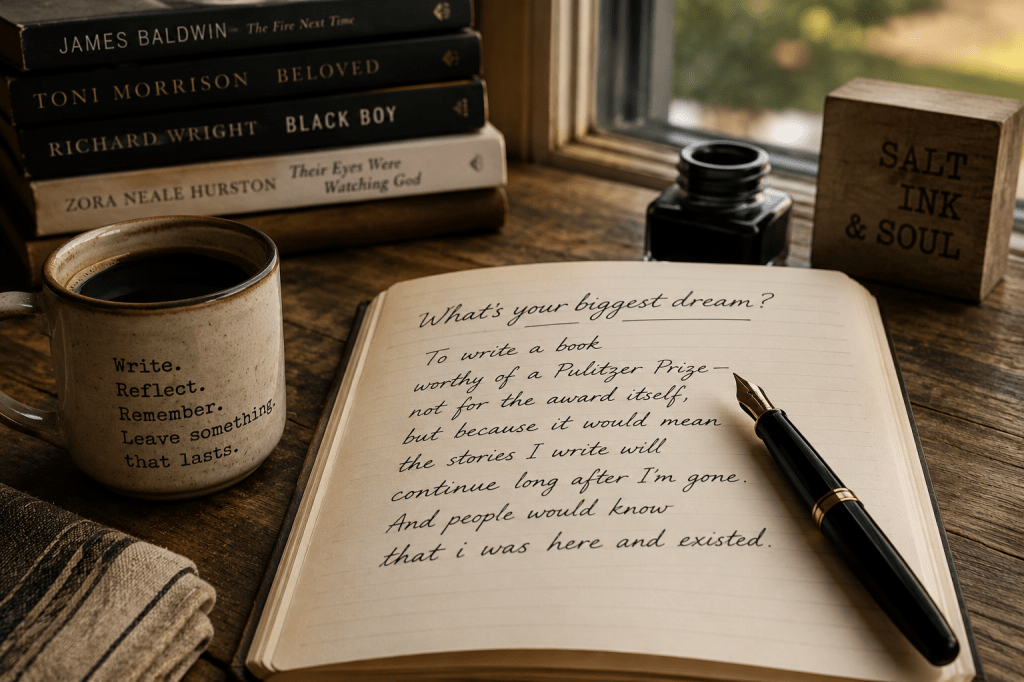
    Salt, Ink & Soul is not just about food. It is about the life around the food. The discipline. The memory. The survival. The return. It is about the meals we make when we are steady, and the ones we order when we are not. It is about the cake we did not buy for ourselves because we knew better. It is about the pizza we made because some small part of us still wanted to mark the day with care.

    It is about understanding that ordinary life is not separate from the sacred. Sometimes the sacred is the ordinary thing done again.

    The workout resumed.

    The kitchen is cleaned.

    The post is written.

    The water poured.

    The next honest meal is planned.

    The body is forgiven.

    The mind steadied.

    The day is taken one piece at a time.

    That is where I am now. Not fully reset. Not all the way back. Not pretending the stress disappeared just because the birthday passed. I am in the middle place. The space between falling out of rhythm and finding it again.

    And maybe that is where many of us live more often than we admit.

    Not broken.

    Not finished.

    Not transformed overnight.

    Just returning.

    There is dignity in that.

    There is dignity in the man who does not feel ready but begins again anyway. There is dignity in the woman who has carried too much and still folds the laundry. There is dignity in the parent who makes dinner tired. There is dignity in the person who walks back into the gym after missing days and does not make a speech about it. There is dignity in the writer who opens the page again, even when the words arrive slowly.

    We are taught to admire the comeback only when it is dramatic. But most comebacks are quiet. They happen in kitchens. In notebooks. On walking paths. In grocery aisles. In the private decision not to let a hard week become a lost month.

    So I am not rushing the reset.

    I am not punishing myself back into shape.

    I am not pretending rest was a failure.

    I am returning one day at a time.

    One meal.

    One workout.

    One page.

    One small act of keeping faith with myself.

    And maybe that is enough for now.

    Maybe that is how we survive the difficult seasons. Not by becoming untouched by them, but by learning how to come back after they have touched us. Not by denying the stress, the history, the exhaustion, or the old ache wrapped around certain dates. But by refusing to let those things have the final word.

    Last week was my birthday.

    I made it through.

    Kyle J. Hayes

    kylehayesblog.com

    Please like, comment, and share

    Resources for Hard Times

    If you’re looking for practical help, food support, or community resources, you can visit the Salt, Ink & Soul Resources Page.

    👉 Resources for Hard Times

  • What’s a moment that made you realize you were stronger than you thought?

    What’s a moment that made you realize you were stronger than you thought?

    Daily writing prompt
    What’s a moment that made you realize you were stronger than you thought?

    I do not think strength always announces itself.

    Sometimes it does not come roaring into the room, chest out and hands raised. Sometimes strength is quieter than that. Sometimes it is only a man standing in the wreckage of a moment, looking around, realizing he is still breathing.

    Still here.

    Still capable of taking one more step.

    When I began my self-improvement journey, someone told me to write down the things that proved my toughness. Not the things I wished were true. Not the things I wanted other people to see. The real things. The evidence. The life that the receipts had already given me.

    So I wrote them down.

    And I still read them sometimes.

    Not because I live in the past.

    Because sometimes the present tries to make you forget what you have already survived.

    In high school, I learned to ride a three-wheeler with friends. I was young then, still learning the shape of courage and embarrassment, still trying to figure out what kind of boy I was becoming. At some point, I rolled it off the side into a ditch.

    I could have let that be the story.

    The fall.

    The mistake.

    The proof that I did not belong on it.

    But I was fine.

    And more than that, I learned how to ride.

    That may sound small to someone else. But a lot of life is hidden inside moments like that. You fall into the ditch. You find out you are not broken. You climb out. You learn.

    Later, I joined the military.

    That was not a small thing.

    Basic training has a way of stripping a person down. It removes comfort. It removes softness. It removes the illusion that you can always negotiate your way out of difficulty. You learn what your body can do when your mind is tired. You learn what your mind can do when your body is begging for mercy. You learn that discipline is not a feeling. It is a decision repeated until it becomes part of you.

    I survived basic training.

    Then I graduated from A.I.T.

    There are pieces of me that still stand at attention because of that. Pieces of me that know how to endure discomfort without calling it the end. Pieces of me that understand that tired is not the same as finished.

    Then there was the city.

    A new city.

    No job.

    No friends.

    No place to live.

    There are few silences louder than arriving somewhere with nothing certain beneath your feet. No familiar face waiting. No soft landing. No guarantee that the decision you made was brave instead of foolish.

    But I came anyway.

    And now I have the best job.

    The best friends.

    A great apartment.

    That did not happen by magic. That happened because I stayed. Because I figured things out one problem at a time. Because the life I have now was built by a version of me who had every reason to be afraid and kept moving anyway.

    And then there was my back.

    Surgery has a way of making the body feel like a question mark. It reminds you that flesh is fragile. The spine is not just anatomy. It is architecture. It is permission. It is the quiet structure that lets a person stand, walk, work, and live.

    I was told I might not walk.

    A sentence can change the temperature of a room.

    I might not walk.

    That kind of possibility does something to you. It turns every ordinary movement into a prayer you did not know you were praying. It makes you aware of your legs, your feet, your balance, and your body’s willingness to answer when called.

    And now I am on my exercise bike.

    Not because everything was easy.

    Because it was not.

    Not because fear disappeared.

    Because it did not.

    But because strength, real strength, is not always the absence of fear. Sometimes it is pedaling after being told you might not walk. Sometimes it is building a life in a city where you arrived with almost nothing. Sometimes it is finishing training when quitting would have been easier. Sometimes it is climbing out of a ditch and learning how to ride.

    I used to think strength was something you had to prove to the world.

    Now I think it is something you sometimes have to prove to yourself.

    Again and again.

    That is why I keep the list.

    Because on the hard days, when doubt comes dressed in logic, when fear tries to sound like wisdom, when the old voices return and ask who I think I am, I can look back at what I have already conquered.

    I can remember.

    I have fallen.

    I have started over.

    I have endured.

    I have healed.

    I have rebuilt.

    And I am still here.

    Kyle J. Hayes

    kylehayesblog.com

    Please like, comment, and share

    Resources for Hard Times

    If you’re looking for practical help, food support, or community resources, you can visit the Salt, Ink & Soul Resources Page.
    👉 Resources for Hard Times

  • Another Year, Still Becoming

    Another Year, Still Becoming

    There is something strange about a birthday when you are no longer young enough to believe that time is endless, but not yet old enough to stop asking what can still be made from what remains.

    Another year has gone by.

    Usually, those words pass through me with a familiar feeling. A small accounting. A quiet glance backward. A brief pause before returning to the ordinary rhythm of the days. But this year feels different. Not louder. Not grander. Not wrapped in some sudden revelation or clean transformation.

    Just different.

    Quieter.

    Closer to the truth.

    I have been slowly becoming the person I once hoped I might be. Not in the polished way people talk about change when they want it to sound easy. Not in the clean language of motivation, where every wound becomes a lesson, and every loss becomes fuel. Real becoming is messier than that. It does not always arrive with applause. Sometimes it looks like sitting alone with a thought you used to run from. Sometimes it looks like writing one honest sentence and feeling your chest tighten because the page now knows something you were trying not to admit.

    For a long time, I carried things instead of naming them.

    Pain. Sorrow. Anger. Disappointment. The old ache of being misunderstood. The quiet exhaustion of trying to explain yourself to people who had already decided who you were.

    I kept too much inside.

    That is a dangerous kind of storage. The body becomes a basement. The mind becomes a locked room. The heart becomes a pantry full of old things nobody has touched, but everybody can smell. You think you are protecting yourself by not opening the door. But silence does not preserve pain. It ferments it.

    People say writing helps.

    I had heard that for years.

    Write it down. Get it out. Put it on the page.

    It sounded too simple to be true. Too soft. Too neat. The kind of advice people offer when they do not know what else to say. But this year, I learned there is a difference between hearing something and finally understanding it in your bones.

    Writing does help.

    Not because the page fixes everything. It does not. The page is not a miracle worker. It will not reach backward and undo what happened. It will not make childhood kinder, grief lighter, or disappointment less sharp. But the page gives the pain a place to stand outside of you.

    That matters.

    There are things I have written that no one will ever see. Things too private for public life. Things that belong only to me and the silence that held me while I wrote them. And maybe that is the point. Not everything has to be published to be powerful. Not every wound has to become content. Not every confession needs an audience.

    Some writing is not for the world.

    Some writing is how you survive yourself.

    This year, I learned how to write without holding back. Or at least, I began to learn. I started putting down the things I had been carrying in secret. The thoughts that came in the dark. The old sorrows with familiar faces. The questions that do not have clean answers.

    And somehow, in putting them down, I left some of them behind.

    Not all.

    I know better than that now.

    Healing is not a dramatic exit. It is not the door slamming shut behind pain while you walk into the sunlight reborn. Sometimes healing is smaller than that. Sometimes it is realizing that a memory no longer controls the whole room. Sometimes it is noticing you can speak of something that once broke you without breaking again. Sometimes it is simply waking up and discovering that yesterday’s sorrow did not take all of today.

    There are pains I have left behind.

    There are sorrows I no longer feed.

    I can now look at old versions of myself with compassion instead of shame.

    That is no small thing.

    We live in a world that loves measurement. Numbers. Milestones. Income. Followers. Weight lost. Books sold. Goals achieved. Proof, proof, proof. We are told to become better, but usually in ways that can be photographed, posted, monetized, or turned into a lesson for strangers.

    But some of the most important growth is invisible.

    No one claps when you stop hating yourself in one small area.

    No one sends flowers when you choose patience instead of anger.

    No one gives you a certificate for writing the truth in a private notebook and choosing not to drown in it.

    Still, these things count.

    They may be the only things that truly count.

    I still have goals. I still want to write better. I still want my work to reach people. I still want the sentences to carry more truth, more weight, more tenderness. I still want to build something that lasts beyond me, something my descendants might one day hold and say, He was here. He tried to tell the truth. He tried to leave a light on.

    But my goals feel different now.

    Less like a punishment.

    Less like a whip.

    Less like a scoreboard I use against myself.

    My current goal is simple.

    To be better.

    A better writer.

    A better person.

    That sounds plain, almost too plain. But there is depth in plain things. A pot of beans. A clean table. A quiet morning. A sentence that does not lie. The older I get, the more I trust what does not need decoration.

    To be better does not mean to become perfect.

    I am not interested in that kind of performance.

    Perfect people are usually hiding something. Or selling something. Or both.

    To be better means to be more honest than I was. More patient. More disciplined. More willing to listen. More willing to admit when I am wrong. More willing to soften without becoming weak. More willing to stand firm without becoming cruel.

    It means learning that strength is not always volume.

    It means understanding that manhood is not the absence of tenderness.

    It means knowing that pain may have shaped me, but it does not have to govern me.

    And it means accepting that none of this happens overnight.

    There is a kindness in that realization. A mercy. We are not finished products. We are not machines waiting for the correct program. We are living things. We grow unevenly. We bend toward light when we can. We carry damage in our rings like old trees. Some seasons produce fruit. Some seasons only teach the roots to hold.

    This year, I think I learned something about roots.

    I learned that private work matters.

    The unseen work matters.

    The quiet effort made when no one is watching matters.

    The sentence was written and deleted. The memory faced and survived. The apology is considered. The old anger questioned. The small promise kept. The day endured without giving up on yourself.

    These are not small things.

    They are the architecture of becoming.

    So this birthday does not feel like a celebration in the usual sense. I do not need noise. I do not need spectacles. I do not need the day to prove my worth through attention.

    What I want is quieter.

    A good meal.

    A little music.

    A clean room.

    A page.

    A moment to look at the man I was, the man I am, and the man I am still trying to become.

    And maybe that is enough.

    Maybe another year is not just a reminder that time is passing.

    Maybe it is also evidence.

    Evidence that I stayed.

    Evidence that I changed.

    Evidence that some part of me, even in the worst seasons, kept reaching toward the life I had not yet learned how to live.

    I am still becoming.

    Not quickly.

    Not perfectly.

    But honestly.

    And this year, that feels like a gift.

    Kyle J. Hayes

    kylehayesblog.com

    Please like, comment, and share

    Resources for Hard Times

    If you’re looking for practical help, food support, or community resources, you can visit the Salt, Ink & Soul Resources Page.

    👉 Resources for Hard Times

  • When the Neighborhood Song Finds You Again

    When the Neighborhood Song Finds You Again

    There are nights when adulthood feels heavier than it should.

    No catastrophe.

    No crisis that would make the evening news.

    Just the quiet pressure that settles in your chest after years of carrying things you rarely speak about. Bills. Expectations. The slow arithmetic of responsibility. The strange loneliness that can exist even when you’re surrounded by people.

    People like to say, ” Just talk to someone.

    And sometimes that’s good advice.

    But the truth adults rarely admit is that it isn’t always that simple.

    Sometimes you don’t know how to explain what you’re feeling. Sometimes the words are tangled. Sometimes the weight is vague—more like weather than injury. A fog rolling in without asking permission.

    Tonight was one of those nights for me.

    The kind where the mind circles the same questions again and again. Where the quiet in the house feels louder than usual. Where you sit with yourself and realize that being an adult often means being the one expected to have answers—even when you feel like the smallest person in the room.

    So I did something simple.

    I opened YouTube.

    Not looking for wisdom. Not looking for motivation or productivity advice or someone promising to unlock the secret to success in ten easy steps.

    Just something gentle.

    And somehow I landed on a channel filled with old episodes of Mr. Rogers’ Neighborhood.

    The moment the music started, something happened that I didn’t expect.

    That piano.

    That calm rhythm.

    That familiar invitation into a living room that somehow always felt safe.

    “It’s a beautiful day in the neighborhood…”

    Before I knew it, I was smiling.

    Not the polite smile adults wear in public. The real kind. The one that sneaks up on you when a memory taps you on the shoulder.

    I started singing along.

    And somewhere between the first line and the moment he changed his shoes, something inside me loosened. The stress that had been sitting in my chest all evening dissolved like sugar in warm coffee.

    Just like that.

    No lecture.

    No complicated explanation.

    No grand philosophy.

    Just a man speaking calmly about learning to ride a bicycle.

    About the moment when a child moves from three wheels to two.

    About wobbling.

    About trying again.

    About how growing up sometimes means doing things that feel a little scary at first.

    And there I was.

    A grown man sitting in his living room, smiling like a kid again.

    It made me wonder about something.

    How is it that someone who passed away in 2003 can still reach through time and calm the nervous system of a stranger sitting alone decades later?

    How can a quiet voice, a soft sweater, and a steady presence still quiet the storms adulthood sometimes builds inside us?

    The answer may be simpler than we think.

    He wasn’t trying to impress anyone.

    He wasn’t trying to dominate the room or prove how intelligent he was or convince the world he had all the answers.

    He was doing something far rarer.

    He was making space.

    Space for children to feel understood.

    Space for feelings to exist without being rushed away.

    Space for gentleness in a world that often rewards noise.

    And maybe—though we rarely admit it—adults need that space just as much as children do.

    Maybe the part of us that once sat cross-legged in front of a television, listening carefully to a man who spoke slowly and kindly, never actually disappears.

    It just gets buried.

    Under bills.

    Under expectations.

    Under the quiet belief that growing up means we should already know how to carry the weight.

    But every once in a while, something reminds us.

    A song.

    A memory.

    A familiar voice from another time.

    And suddenly the armor loosens.

    You remember what it felt like to be small, curious, and hopeful about the world. You remember that kindness isn’t weakness. That patience isn’t outdated. That gentleness—real gentleness—is one of the strongest things a human being can offer another.

    Watching that episode tonight made me think of something simple.

    Maybe the world needs more people like him.

    People who slow things down rather than speed them up.

    People who speak softly instead of shouting.

    People who remind us that it’s okay to feel what we feel.

    Especially when the world gets heavy.

    I could write more about this tonight.

    About kindness.

    About childhood.

    About how strange and beautiful it is that a simple television show can still calm an adult heart decades later.

    But the truth is…

    There’s another episode waiting.

    And for a little while longer, I’d like to sit here and watch the show.

    Kyle J. Hayes

    kylehayesblog.com

    Please like, comment, and share

    Resources for Hard Times

    If you’re looking for practical help, food support, or community resources, you can visit the Salt, Ink & Soul Resources Page.

    👉 Resources for Hard Times

  • The Lessons I Wish Someone Had Taught Me Sooner

    The Lessons I Wish Someone Had Taught Me Sooner

    There’s a certain kind of teaching that doesn’t happen at a chalkboard.

    It happens later in the quiet. When you’re old enough to look back at the boy you were and realize he didn’t need tougher lessons—he needed better language for what he was already carrying. He needed someone to name the weight, not just tell him to lift it. He needed instructions that didn’t feel like shame.

    I write children’s stories, and if you look closely, there’s a lesson tucked inside each one like a warm note in a pocket. People sometimes think that’s cute. Sometimes it is. But it’s also a confession.

    Because the truth is: I’m not only writing for children.

    I’m writing for the younger version of me.

    I’m writing for the boy who kept hearing “you’ll learn the hard way” like it was a rite of passage. Like pain was a badge you earned. Like wasted time was the price of admission. Like you had to bleed to be considered real.

    And maybe that’s the oldest lie we tell boys—that the only education that counts is the kind that bruises.

    I grew up in a world that didn’t always teach feelings the way it taught survival. It taught stamina. It taught silence. It taught the art of looking fine. It taught you how to swallow your own questions whole so nobody would see you chewing.

    And then, later—when you’re old enough to know you’ve been living with a hunger you couldn’t name—you realize what you were missing wasn’t toughness.

    It was guidance.

    The kind that says: Here’s how to be human without hardening into a weapon.

    So I started writing the lessons I wish had been offered to me without the threat attached.

    Not sermons. Not lectures. Just small stories.

    A fox who checks on his friends.

    A quiet day that gives permission to rest.

    A soup that doesn’t look fancy but still warms the room.

    A cloud that doesn’t stay forever but leaves growth behind.

    These aren’t just plots.

    They’re repairs.

    They’re me trying to do something with what I’ve learned, instead of letting it sit inside me as regret.

    Because I’ve learned the hard way. I’ve paid for the information for years. With missteps. With stubborn pride. With the kind of loneliness that doesn’t announce itself—it just rearranges your life until you forget what joy used to sound like.

    There’s a particular kind of waste that hurts the most—not wasted money or missed chances, but wasted time becoming. The years you spend thinking you’re broken, or behind, or unworthy of gentleness. The years you spend trying to earn what should have been given freely: permission to grow.

    That’s why the lessons keep showing up in my stories.

    Not because I believe children are empty and need to be filled, but because children are already full—full of questions, full of fear, full of hope they don’t yet know how to protect. And too often they inherit a world that tells them their softness is a flaw.

    So I write to tell them the opposite.

    I write to tell them that kindness is not weakness. That asking for help is not failure. That being unseen isn’t proof you don’t matter. That the quiet parts of you deserve a home.

    That you can be strong without being cruel.

    That you can become a good man without becoming a hard one.

    And I write to tell the adults reading over their shoulders something too: it’s not too late to offer yourself the lesson you never got. It’s not too late to sit beside the younger version of yourself and say, I see what you went through. You didn’t deserve to go through it alone.

    People sometimes assume empathy is just a personality trait, like eye color. But I think empathy is often the leftover heat from a life that could have gone colder. It’s what happens when you’ve been hurt and decide—quietly, stubbornly—that you don’t want to hand that hurt forward.

    That’s what my stories are.

    My refusal to hand it forward.

    I don’t write because I’m better than anyone. I write because I know what it costs when we don’t have maps. I know what it costs when boys are told that confusion is weakness and tenderness is something to outgrow.

    I know how easy it is to turn “learned the hard way” into an identity instead of a warning.

    I’m trying to offer a different inheritance.

    Not perfection. Not a shortcut around life. Life will still be life—wild, unfair, beautiful, sometimes brutal. But maybe we can spare someone a few needless miles. Maybe we can keep a kid from mistaking pain for a teacher and loneliness for a personality.

    We can help them spend less time surviving and more time becoming.

    That’s the hope under every story I write: that someone—somewhere—will feel seen sooner than I did. That they’ll recognize themselves in a gentle fox or a patient cloud and understand, without being told too bluntly, that they’re allowed to be human.

    And if that happens, even once, then none of this is wasted.

    Not the stories.

    Not the lessons.

    Not even the hard way.

    Maybe that’s what these stories really are — small lanterns placed along the path I once had to walk in the dark.

    If someone younger finds one of them sooner than I did, then the years it took me to learn those lessons won’t have been wasted.

    Kyle J. Hayes

    kylehayesblog.com

    Please like, comment, and share

    Resources for Hard Times

    If you’re looking for practical help, food support, or community resources, you can visit the Salt, Ink & Soul Resources Page.

    👉 Resources for Hard Times

    Links