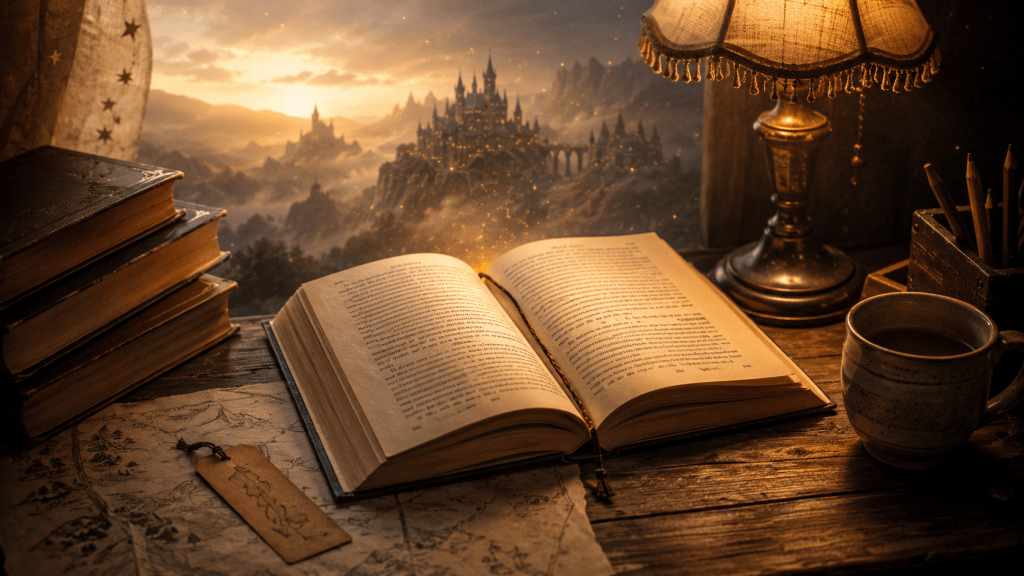


The first grown-up book I remember finishing was Pawn of Prophecy by David Eddings.
I call it grown-up because, to the boy I was then, grown-up did not mean taxes, sorrow, responsibility, or learning how to carry silence in your chest without letting it spill everywhere.
Grown-up meant no pictures.
Grown-up meant more than two hundred pages.
Grown-up meant opening a book and realizing nobody was going to help you with images anymore. The world was not going to be handed to you in color and ink. You had to build it yourself. You had to listen to the words, trust them, and let your own mind do part of the work.
That was new to me.
Before that, reading had often come with pictures. Comic books had taught me movement. They had taught me color, conflict, rhythm, and myth. They had taught me that pain could wear a cape, that responsibility could arrive before a person was ready, that the world was always asking somebody to stand up.
But Pawn of Prophecy did something different.
It slowed me down.
It invited me into a world that did not appear all at once. It unfolded. A little here. A little there. A name. A road. A secret. A strange feeling that the ordinary life of one boy might not be ordinary at all.
That is one of the great promises of fantasy.
The idea that you may be more than you have been told.
That the small place you begin is not the full measure of your life.
That somewhere beyond the familiar road, there may be danger, yes, but also meaning.
I did not know then that I was being drawn into a tradition. I did not have the language for genre, worldbuilding, archetype, quest, prophecy, or inheritance. I just knew that I wanted to keep going.
Page after page.
Chapter after chapter.
Not because someone made me.
Because I wanted to know.
That mattered.
Many children are taught to read as a duty. As homework. As proof. As something adults measure, grade, and turn into performance. But this book helped me learn that reading could be a pleasure. Reading could be hunger. Reading could be a private door opening inside an ordinary day.
I read the rest of the series.
Then I read the second series that came later.
That is how obsession begins sometimes. Not with thunder. Not with some grand declaration. Just one book that works its way into you and leaves the door open behind it.
And once that door is open, you become dangerous in the best possible way.
You become a child who knows there are other worlds.
You become someone who understands that paper can hold kingdoms.
You become someone who can sit in a room, turn a page, and be gone.
Gone, but not lost.
Elsewhere, but still becoming.
I think back on that book now not only because of the story itself, but because of what it gave me permission to feel. It told me that long books did not have to be intimidating. That imagination was not childish. That fantasy was not an escape, as people sometimes say, with judgment in their mouths.
Fantasy was training.
It was a rehearsal for wonder.
It was a way of learning that the visible world is not the only world.
And maybe that is why I remember it so clearly. Because that book did not just lead me into science fiction and fantasy. It taught me that stories could be lived inside. It taught me that a book without pictures could still fill the mind with images. It taught me that reading was not only something you did.
It was somewhere you went.
These days, I do not spend as much time reading what other people have created. I have been trying to build my own. Trying to take the lessons those old books left behind and shape them into something that carries my own breath, my own questions, my own ache.
But I remember where it started.
With more than two hundred pages and no pictures.
Please like, comment, and share
Resources for Hard Times
If you’re looking for practical help, food support, or community resources, you can visit the Salt, Ink & Soul Resources Page.


Leave a comment