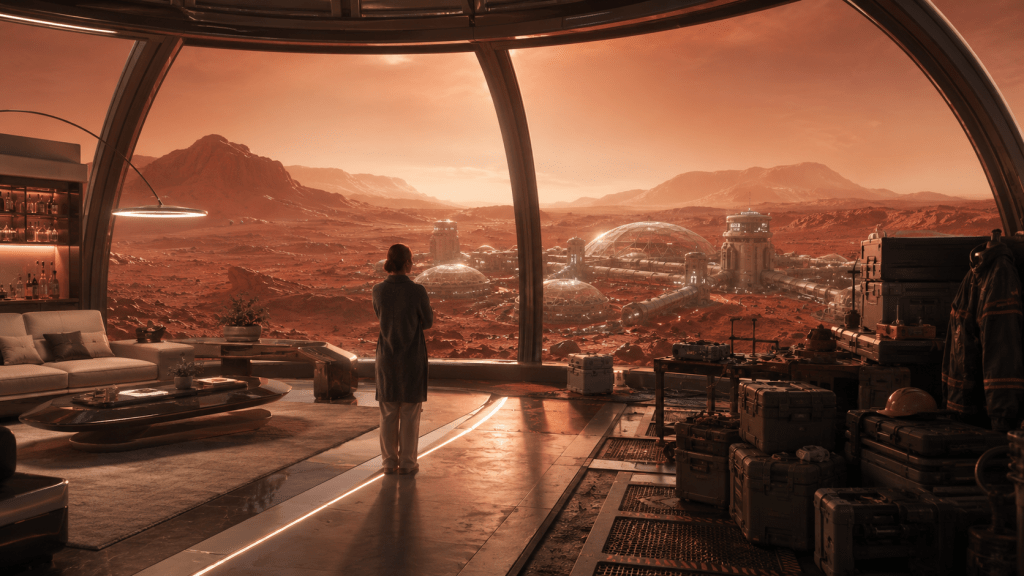
Yes, I do
But I do not believe we will go there because we suddenly became wiser.
I do not believe we will go because humanity looked up at the night sky, humbled by the smallness of our place in the universe, and decided to become better stewards of existence.
That would be a beautiful story.
I don’t think it is the true one.
I think we will go because Earth is becoming harder to live on.
Or because something valuable is found there.
Or because the wealthy decide the future should have a private entrance.
That sounds harsh, maybe. But history has taught me to be careful with any dream sold as progress when profit is standing somewhere in the room, quiet and smiling.
Mars will not simply be a new world.
It will be a mirror.
And what it reflects may not flatter us.
We like to imagine colonizing Mars as some grand human achievement. A flag planted in red dust. A bright dome under a strange sky. A child born beneath another planet’s sun. We imagine clean machines, brave scientists, heroic explorers, and the swelling music of destiny.
But I wonder what life there would actually look like after the cameras are gone.
Who gets to breathe the cleanest air?
Who gets the safest shelter?
Who owns the water?
Who owns the land beneath a dome they did not build with their own hands?
Who works outside when the suits fail?
Who cleans the filters?
Who repairs the machines?
Who risks the radiation?
Who serves the meals?
Who digs, carries, installs, maintains, and disappears from the official story?
Because that is the part we often skip.
Every empire has loved the language of discovery.
But somebody always does the labor.
Somebody always pays the cost.
If we build a world on Mars, I fear it will not be a world of equals. I fear it will become what so much of Earth already is: a place divided between those who own the future and those who are hired to survive inside it.
The extremely wealthy above.
The workers below.
Different planet.
Same old arrangement.
Maybe the rich will live in beautiful enclosed cities with artificial gardens, private schools, controlled weather, and windows facing the stars. Maybe they will speak of bravery and innovation while sipping water recycled by systems they did not design, repair, or understand.
And maybe the poor will live in tighter quarters, in service corridors, in work units, in maintenance bays, in the parts of the colony no brochure ever shows.
Maybe their bodies will be used as proof that the settlement is possible.
Maybe their sacrifice will be called an opportunity.
That is usually how these things go.
And still, the saddest part to me is this: much of the technology required to make Mars livable could probably teach us how to better care for Earth.
Closed-loop systems.
Clean energy.
Water conservation.
Food grown in difficult conditions.
Air filtration.
Waste reduction.
Efficient housing.
All this genius is aimed at surviving in a hostile world. In contrast, the world that has already given us oceans, forests, rain, soil, breath, and morning keeps being treated like something disposable.
There is something almost tragic in that.
The human imagination is powerful enough to dream of living on Mars, but not disciplined enough to stop poisoning the place where we already live.
We can imagine domes on another planet before we can imagine justice on this one.
We can imagine terraforming Mars before we can imagine repairing Flint, cooling overheated cities, feeding hungry people, or protecting the only atmosphere that has ever held us without a machine.
That bothers me.
Because Mars is not home.
Not yet.
Maybe not ever in the way Earth is home.
Mars has no ancestral memory for us. No childhood streets. No grandmother’s kitchen. No rain against the window. No trees bending in summer wind. No soil holds the bones of our people. No rivers that know our names.
Earth has carried us.
And we have treated her like a thing to be conquered.
So what makes us think Mars would be spared?
That is the question I cannot shake.
If the same hunger goes with us, the same greed, the same need to own, extract, divide, rank, and consume, then Mars will not be a fresh start.
It will be a red continuation.
We will take our flags.
Our markets.
Our class systems.
Our gated communities.
Our labor exploitation.
Our myths of progress.
And we will call it civilization.
Maybe there will be beauty there, too. I do not want to deny that. There will be people who go for the right reasons. Scientists. Engineers. Dreamers. Workers are trying to build something better than what they left behind. Children born there will look at Earth as a blue light in the sky and wonder what it felt like to stand beneath open rain.
There will be courage.
There will be loneliness.
There will be an invention.
There will be grief.
There will be music, eventually. Food, eventually. Rituals, eventually. Some new version of humanity is trying to make meaning under a sky that does not yet belong to memory.
But unless we change the spirit we carry with us, the colony will inherit the disease of the old world.
That is what I believe.
Humans may colonize Mars.
But the harder question is whether we will deserve to.
Because leaving Earth is not the same as outgrowing what we did here.
A rocket can escape gravity.
It cannot escape greed.
It cannot escape history.
It cannot escape the human habit of turning every promised land into property.
So yes, I believe we may live on Mars one day.
But I hope, before that happens, we learn to live better here.
Because if we cannot honor the planet that made us, I do not trust what we will become on the planet that must be manufactured to keep us alive.
Please like, comment, and share
Resources for Hard Times
If you’re looking for practical help, food support, or community resources, you can visit the Salt, Ink & Soul Resources Page.


Leave a Reply