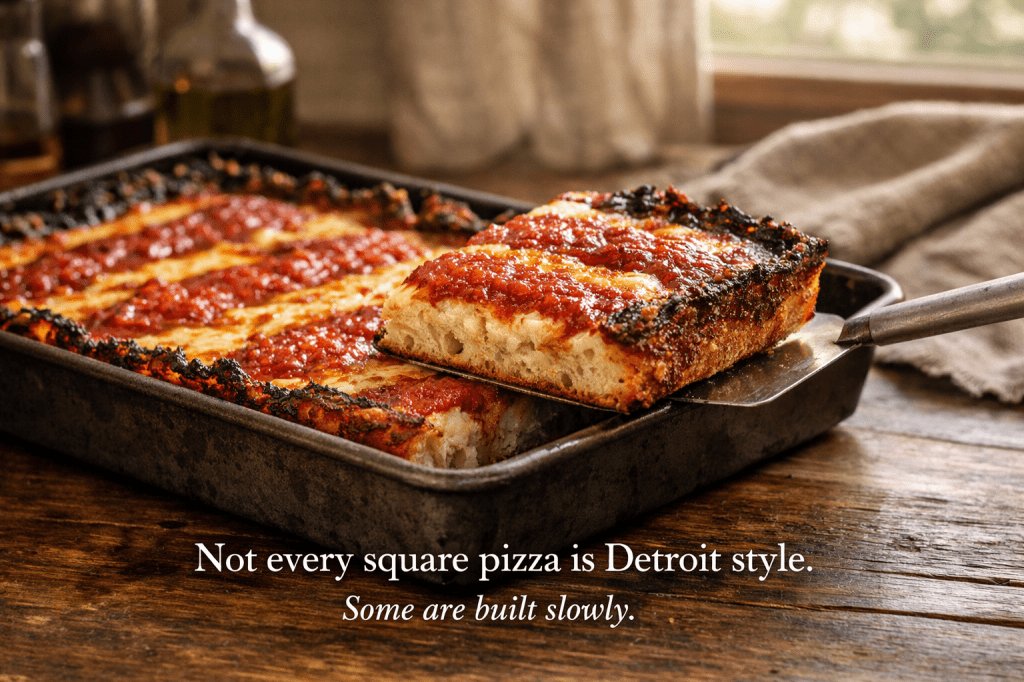
It seems lately that everywhere I turn, I see the words “Detroit-style pizza.”
On menus. In passing conversations. In videos where the crust is held up like proof of something—something important, something worth noticing. For a while, I thought I understood it. I thought the difference was simple. That Detroit-style pizza was just pizza that had been squared off. A shape. A presentation. Something visual.
I was wrong.
That’s the danger of distance. From far enough away, everything starts to look the same. Dough becomes Dough. Pizza becomes pizza. Regions blur into each other until all that’s left is the outline of something that used to mean more.
But I’m from the Midwest, and the Midwest doesn’t really believe in sameness, no matter how often it’s flattened into that idea.
Chicago is not Detroit.
Casey’s is not Chicago.
And Detroit is not trying to be either one.
Each of them carries something specific. Built from the people who made it. The work they did. The pace at which they lived. The kind of hunger they came home with. Food like this isn’t accidental. It doesn’t happen because someone wanted to be different. It happens because the difference was already there.
And maybe that’s why I kept seeing it.
Because something in me recognized that I had mistaken shape for substance.
So here I am, in Albuquerque, New Mexico, standing in a kitchen far from where this pizza began, trying to understand it the only way that ever really works—by making it.
Not quickly. Not forcefully. But with time.
Because Detroit-style pizza, the kind people talk about like it matters, doesn’t come together in a rush. The Dough sits overnight. It rests. It changes. It becomes something else while you’re doing something else. And by the time you come back to it, it’s no longer just ingredients. It’s something with structure. With intention.
And that feels familiar.
Because many things in life don’t reveal themselves immediately, a lot of things ask you to wait. Ask you to trust that something is happening even when you can’t see it yet.
This is my attempt at that kind of patience.
My attempt at making something I once misunderstood.
Detroit-Style Pizza
9 x 13 Pan — Overnight Dough
Why This Pizza Is Different
Detroit-style pizza isn’t just square.
It’s built in layers that challenge expectations.
Cheese goes to the edges.
Sauce comes last.
Oil becomes part of the crust, not just something used to keep it from sticking.
And the Dough—maybe the most important part—takes its time.
Dough Ingredients (Overnight Fermentation)
- 2 ½ cups (300g) bread flour
- 1 teaspoon salt
- 1 teaspoon sugar
- ½ teaspoon instant yeast
- 1 cup (240g) warm water
- 1 tablespoon olive oil
For the Pan
- 2 to 3 tablespoons olive oil
Cheese and Toppings
- 12 to 16 ounces low-moisture mozzarella, shredded or cubed
- Optional: brick cheese, if available
- Pepperoni, if desired
Sauce
- 1 cup crushed tomatoes
- 1 tablespoon olive oil
- 1 clove garlic, grated
- Salt to taste
- Pinch of sugar (optional)
- Dried oregano or basil
Method
Night Before — Let It Begin
In a bowl, combine the flour, salt, sugar, yeast, warm water, and olive oil. Stir until a sticky, shaggy dough forms.
It won’t look finished. That’s fine.
Let it rest for about 10 to 15 minutes. Then, if you want, do one gentle stretch and fold in the bowl. Just once. Enough to give it some direction without forcing it into something it isn’t ready to be.
Cover the bowl and refrigerate overnight.
12 to 18 hours.
This is where the real work happens. Quietly. Without you.
Next Day — Bring It Back
Take the Dough out of the refrigerator about 2 hours before you plan to bake. Let it come to room temperature slowly.
Oil your 9 x 13 pan with 2 to 3 tablespoons of olive oil. Spread it generously.
Transfer the Dough into the pan and gently stretch it toward the corners.
If it resists, don’t force it. Let it rest. Come back in 10 to 15 minutes. Dough responds better to patience than pressure.
Second Rise — In the Pan
Let the Dough rise in the pan for 1 to 2 hours.
It should look soft. Puffy. Alive in a quiet way.
Make the Sauce
In a small saucepan, combine the crushed tomatoes, olive oil, garlic, salt, and herbs. Add a pinch of sugar if needed.
Simmer for 10 to 15 minutes until slightly thickened.
Set aside.
Build the Pizza
Preheat your oven to 500°F, or as high as it will go.
Add the cheese across the entire surface of the Dough, pushing it to the edges. This matters more than it seems. The cheese that touches the pan becomes something else entirely—dark, crisp, almost laced into the crust itself.
Add pepperoni if you like.
Bake
Place the pizza in the oven and bake for 12 to 15 minutes, until the cheese is bubbling and the edges are deeply golden.
Remove it briefly and spoon the sauce across the top in stripes.
Return it to the oven for another 3 to 5 minutes.
Finish
Let the pizza rest in the pan for about 5 minutes.
Then carefully loosen it and lift it out.
If everything came together the way it should, the bottom will be crisp, the inside soft and airy, and the edges will carry that deep, caramelized texture that makes this style unmistakable.
Notes From My Kitchen
Overnight Dough changes things.
Not dramatically. Not in a way that demands attention. But in a way, you notice once you’ve had it.
The flavor is deeper. Slightly more complex. The texture feels more settled. More certain of itself.
That could be the part that stays with me.
Because we live in a time that pushes for speed. For immediacy. For results that appear as quickly as the desire for them.
But some things don’t respond well to that kind of urgency.
Some things need to sit.
Need to rest.
Need to become.
This pizza reminded me of that.
Reminded me that what looks simple from the outside often carries more intention than we realize. That shape isn’t the story. That time is part of the recipe, whether we acknowledge it or not.
And that sometimes, if you’re willing to wait—
What you end up with isn’t just better.
It’s understood.
Kyle J. Hayes
If this found you at the right time,
Feel free to like, comment, or share it with someone who might need it too.
Resources for Hard Times
If you’re looking for practical help, food support, or community resources, you can visit the Salt, Ink & Soul Resources Page.
 Salt,Ink, & Soul
Leave a comment